Written by: Doug Camplejohn, CEO & Co-Founder, Coffee | Last updated: July 5, 2026
Key Takeaways
- Vendors like HubSpot, Zoho CRM, Freshsales, Bitrix24, and Salesforce offer permanently free CRM tiers for basic contact storage, pipelines, and email integration.
- Free plans add strict limits on users, contacts, storage, and automation, so manual data entry grows quickly as your team scales.
- US data-privacy laws such as CCPA still apply to your business, yet free tiers rarely include the tools needed to manage state-by-state compliance.
- Most teams outgrow free CRMs within 6–12 months when they hit user caps, contact limits, or need AI-driven workflows and reporting.
- For teams ready to eliminate manual data entry entirely, see how Coffee’s autonomous agent handles the work your free CRM cannot.
Why free CRMs dominate search but stall growing teams
Free CRM plans rank well because they solve an obvious problem: replacing a spreadsheet without spending money. For a solo founder or a two-person team, that trade-off feels reasonable. Problems start once the team reaches three, five, or ten people, or when the pipeline becomes complex enough to need automation, reporting, or integrations.
Free CRMs commonly impose limits on users (typically 2–10), contacts, data storage, and email sends while lacking automation, advanced reporting, integrations, and live support. None of those limits appear in the headline. They sit in the fine print and then show up on your team calendar as hours spent on manual data entry instead of selling.
Sales reps often spend several hours per week on manual data entry and CRM updates. On a free plan with no automation, every one of those hours is irreplaceable human time.
Evaluation criteria for 2026 free CRM plans
The four criteria below determine whether a free CRM can grow with your team or forces a fast, expensive upgrade. Use them to look past marketing headlines and focus on the real limits your reps will feel day to day.
| Criterion | What to look for | Why it matters in 2026 | Typical free-plan reality |
|---|---|---|---|
| User & contact limits | Seats and record caps | Determines when you must pay | 2–3 users, 250–5,000 contacts |
| US data-residency & compliance | CCPA, HIPAA, CLOUD Act exposure | 20 US states now have privacy laws | Rarely addressed on free tiers |
| Automation & AI depth | Workflow rules, AI scoring, sequences | Determines manual-entry burden | AI and advanced automation locked to paid plans |
| Google Workspace / Outlook integration | Two-way sync, activity logging | Prevents duplicate data entry | Basic sync available, deep logging requires paid tier |
HubSpot CRM Free (2026)
Limits: New accounts created after September 2024 are capped at 1,000 contacts, 2 users, 1 deal pipeline, and 10 custom properties across objects. Older guides still cite the legacy 1-million-contact limit, which no longer applies to new sign-ups.
Compliance: HubSpot offers configurable data retention policies and one-click right-to-erasure workflows, but these features are not prominently surfaced on the free tier. CCPA obligations, including the right to know, delete, and opt-out, still apply to your business regardless of which HubSpot plan you use.
Automation depth: The free plan provides 1 simple workflow per form with up to 10 actions, including basic form automation and follow-up emails. Deeper automation and AI require the paid Smart CRM plan starting at $45/user/month.
Integrations: Gmail and Outlook are supported for email integration, with up to 200 email tracking notifications per month.
Upgrade trigger: The 2-user and 1,000-contact caps act as the main forcing functions. Most teams hit both within 6–12 months of active prospecting.
Manual-entry burden: Without automation sequences or AI logging, reps manually update deal stages, log calls, and write follow-up notes. For a 10-person team, that equals 4,420 hours of skilled labor redirected from selling to typing each year.
Zoho CRM Free (2026)
Limits: Zoho CRM Free caps users at 3 with no AI features on the free tier. Storage is 1 GB, and workflow rules are described as basic, with official pricing listing 2,500 workflow rules for the free edition. Teams usually hit the user cap first, then feel storage pressure as files and call recordings accumulate.
Compliance: Advanced features like predictive AI and multi-user portals require paid professional or enterprise tiers. Compliance tooling on the free tier remains minimal.
Automation depth: Five workflow rules total. That coverage supports basic lead assignment or stage changes but not sequenced outreach or AI-driven scoring.
Integrations: Multichannel communication across email, social, and phone is included, but storage can drop to 10 MB on some configurations and custom fields are restricted.
Upgrade trigger: The 3-user cap usually breaks first. A fourth hire forces a paid plan immediately.
Manual-entry burden: With only 5 workflow rules in practice and no AI, reps handle most data entry themselves. Activity logging defaults to manual updates.
Freshsales Free (2026)
Limits: The free plan (Sprout) supports up to 3–10 users and up to 10,000 records including contacts. Some sources cite a 3-user cap, so teams should confirm the limit at sign-up because Freshsales has adjusted this across plan iterations.
Compliance: The free tier includes no dedicated compliance tooling. US state privacy obligations still apply at the business level regardless of CRM plan.
Automation depth: The free plan includes built-in phone, live chat, email templates, and the Freddy AI assistant for lead scoring and deal insights. No workflow rules are available on the free plan. Reps receive AI hints but still perform the follow-up work manually.
Integrations: Built-in calling and live chat stand out at the free tier. Google Workspace and Outlook sync are available for basic email and calendar connections.
Upgrade trigger: The effective contact cap becomes the main constraint for teams running active outbound prospecting.
Manual-entry burden: Freddy AI provides scoring signals, yet without workflow automation, reps still log activities and update pipeline stages by hand.
Bitrix24 Free (2026)
Limits: Bitrix24 offers unlimited users and contacts on its free plan, restricted to 5 GB of cloud storage.
Compliance: The US CLOUD Act allows US law enforcement to compel any US-headquartered cloud vendor to produce data stored anywhere in the world. Bitrix24’s free plan includes no dedicated compliance or data-residency controls, so legal exposure remains your responsibility.
Automation depth: Sales automation requires a paid tier starting at $49/month for up to five users. The free plan includes basic task management and chat, which support coordination but not structured sales workflows.
Integrations: Calendar, video calls, and basic CRM live in one interface. The complexity of that interface creates a steep learning curve that slows onboarding for small teams.
Upgrade trigger: Storage fills faster than expected once call recordings and documents live in the CRM. Teams that need any sales automation move to paid tiers immediately.
Manual-entry burden: Manual work remains high. Every deal update, call log, and contact enrichment stays a human task.
Google / Microsoft ecosystem and Salesforce Free Suite (2026)
Limits: Neither Google nor Microsoft offers a standalone free CRM product. Salesforce’s Free Suite supports two users, tracks accounts, contacts, leads, and opportunities, includes Gmail and Google Calendar integration plus basic reporting, and allows up to 100 email sends per month. It runs on the same infrastructure as paid Salesforce tiers, so data carries forward without migration.
Compliance: Salesforce Hyperforce supports data residency requirements with region-specific deployment options. These controls do not extend to the free tier.
Automation depth: The free tier includes no automation. Automation, custom objects, and forecasting sit behind paid Salesforce plans.
Integrations: Gmail and Google Calendar integration is native. Microsoft 365 users can connect through standard OAuth for basic access.
Upgrade trigger: The 2-user cap and 100-email-per-month limit keep this plan viable mainly for solo founders testing the Salesforce ecosystem before a paid commitment.
Manual-entry burden: Manual work reaches the maximum level. No automation, AI, or workflow rules exist, so every data point requires a person to type it.
Let Coffee’s agent handle your data entry — no more manual logging, no more typing.

When free CRM plans start to break
Red flags that a team has outgrown a free CRM include hitting storage or contact limits, maxing out automation or user seats, needing deeper reporting, spending time on manual workarounds, and struggling to customize fields.
In practice, the breaking points cluster around three thresholds.
- User cap: As noted in the HubSpot and Salesforce sections, the 2-user cap is the first constraint many teams hit. Zoho and Freshsales often cap at 3 users. A fourth hire forces an immediate paid upgrade.
- Contact cap: HubSpot’s post-September 2024 accounts are capped at 1,000 contacts. Active outbound teams can exhaust that limit in a few weeks.
- Automation wall: AI workflows for lead follow-up, reminders, and automation require paid plans. Without automation, every follow-up becomes a manual calendar reminder.
Those operational breaking points have a legal counterpart: free CRMs also fail to provide the compliance tooling that US businesses now need to navigate state-by-state privacy laws.
US data-privacy and residency requirements
Free CRM plans rarely surface compliance tooling, yet your legal obligations remain the same on every tier. The table below maps common US data-privacy rules to what free plans actually provide, which is almost nothing.
| Rule / Law | Who it covers | Free-plan reality | Key obligation |
|---|---|---|---|
| CCPA / CPRA (California) | Businesses serving CA residents above size thresholds | Your obligation regardless of CRM plan | Right to know, delete, opt-out, with up to $7,500 per intentional violation |
| HIPAA (Health) | Health data handlers | Not addressed on free tiers | Requires BAA with CRM vendor, which free plans rarely offer |
| US CLOUD Act | All US-headquartered CRM vendors | Applies to every plan, free or paid | US law enforcement can compel data access regardless of server location |
| State patchwork (20 states) | Businesses operating across state lines | No free-tier tooling to manage multi-state compliance | State-by-state consent, deletion, and disclosure workflows required |
Organizations now invest heavily in privacy compliance because they must manage state-by-state legal analysis and jurisdiction-specific data subject request workflows. Free CRM plans provide none of the field-level encryption, automated consent management, or audit trails that compliance teams expect.
Honest limitations: the manual data-entry grind
Sales professionals spend significant time each week on admin tasks and manual CRM data entry instead of active selling. That time grows as the pipeline expands and more records need updates.
Many workers report spending a substantial portion of their work week on data entry and repetitive tasks. On a free CRM with no automation, that ratio only worsens as the pipeline grows.
That time burden is not a staffing problem or a training gap, it reflects an architectural flaw. Free CRMs are passive containers. They store what humans type. They cannot read your emails, transcribe your calls, or enrich a contact record automatically. That gap is not just a free-plan limitation, it is a design pattern shared by every legacy CRM, free or paid.

See Coffee’s pricing — the autonomous agent that eliminates the manual-entry grind entirely.
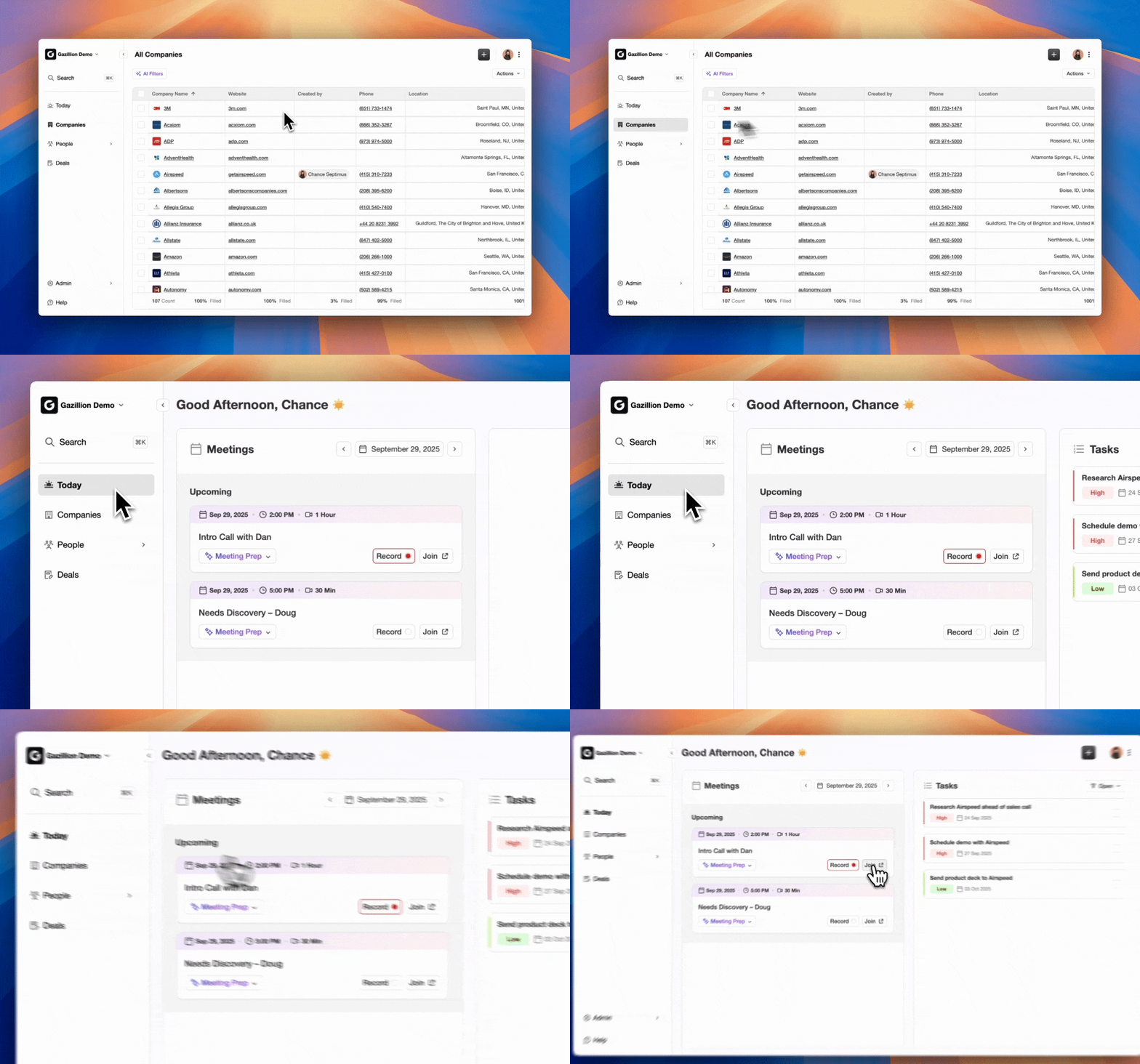
Decision matrix: choosing a free CRM or your next step
This decision matrix helps you match team size and current stack to a realistic next move. Use it to decide whether to stay on a free tier, upgrade, or add an agent layer.
| Team size | No existing CRM stack | On HubSpot or Salesforce | Recommended next step |
|---|---|---|---|
| 1–5 people | HubSpot Free or Zoho Free covers basics, with expected manual entry | Free tier likely sufficient for record storage | Start free, then add Coffee Standalone when data entry exceeds 3 hours per week |
| 6–10 people | Most free plans cap at 2–3 users, so a paid upgrade becomes unavoidable | Paid HubSpot or Salesforce seats required, while data quality degrades without automation | Coffee Standalone CRM or Coffee Companion App on the existing stack |
| 11–20 people | Free plans are not viable at this size | Salesforce or HubSpot investment is sunk, and switching cost is high | Coffee Companion App as an agent layer on top of the existing CRM, with no migration required |
If a small business has more than five active relationships to manage and is tracking them in a spreadsheet, a CRM will immediately pay for itself in time saved and follow-ups not dropped. Past that threshold, the decision shifts from whether to pay to what you pay for: seats in a passive database or an agent that does the work.
Upgrade-path cost comparison
Upgrade costs from free CRM plans rise quickly once teams need automation and reporting. HubSpot’s paid Sales Hub starts at $45/user/month. Salesforce moves beyond its 2-user free tier into paid Starter and Pro suites for automation, reports, quoting, and forecasting. After adding a call recording tool, a data enrichment tool, and a forecasting add-on, a 10-person team can spend $800–$1,500 per month while reps still log activities manually.
Automated data entry can reduce manual entry hours by up to 80%. Teams then redeploy that time toward revenue-generating activities instead of clerical work.

Coffee’s seat-based pricing bundles the agent’s labor, including contact creation, activity logging, call transcription, pipeline tracking, meeting briefings, and follow-up drafting, into a single line item. For teams already on Salesforce or HubSpot, the Coffee Companion App adds the agent layer without replacing the existing system of record. For teams starting fresh, the Coffee Standalone CRM replaces the passive database entirely. Both paths remove the point-tool sprawl that inflates the real cost of a “free” CRM stack.

Compare Coffee’s pricing to your current stack — see what it costs to replace manual entry entirely.
Frequently Asked Questions
Is there a truly 100% free CRM with no hidden costs?
Several CRMs, including HubSpot, Zoho, Freshsales, and Bitrix24, offer permanently free plans with no credit card required. These plans work for very small teams. The hidden cost is labor: every free plan requires humans to manually enter, update, and maintain data. For a two-person team managing 50 contacts, that cost stays small. For a six-person team running active outbound, the manual-entry burden can consume 9 or more hours per rep per week, a cost that never appears on a pricing page.
What happens when my team outgrows a free CRM plan?
The most common forcing functions are user caps and contact limits. HubSpot’s free plan caps new accounts at 2 users and 1,000 contacts. Zoho caps at 3 users. Freshsales caps contacts at lower tiers before paid upgrades. When any of these limits are hit, the vendor presents a paid upgrade, typically $15–$45 per user per month at entry level, scaling higher as automation and reporting features are added. Teams that need AI-driven automation, advanced reporting, or compliance tooling still face significant manual data entry on legacy CRMs because the underlying architecture remains a passive database, not an active agent.
Do free CRM plans comply with US data privacy laws like CCPA?
Your compliance obligations under CCPA, HIPAA, or state privacy laws apply to your business regardless of which CRM plan you use. The CRM vendor’s free tier rarely provides the tooling, such as field-level encryption, automated consent management, audit trails, and right-to-deletion workflows, that makes compliance manageable at scale. As of 2026, 20 US states have enacted comprehensive data privacy laws, creating a patchwork of obligations. Free plans are not designed to address this complexity. If your business handles health data, financial data, or serves California residents above CCPA size thresholds, you must verify your CRM vendor’s Data Processing Addendum and confirm whether the US CLOUD Act applies to your data.
Can I use Coffee alongside my existing HubSpot or Salesforce account?
Yes. Coffee offers a Companion App model designed for teams already invested in HubSpot or Salesforce. The Coffee Agent connects to your existing instance through a simple authentication, then handles the data-in process. It auto-creates contacts from emails and calendars, enriches records with job titles and LinkedIn profiles, logs activities, transcribes calls, and writes summaries back to your CRM. Your Salesforce or HubSpot instance remains the system of record. Coffee removes the manual-entry burden without requiring a migration or replacing your existing stack, which is especially valuable for teams with established Salesforce configurations that newer CRM tools cannot easily replicate.
How much time does Coffee actually save compared to a free CRM?
The Coffee Agent saves reps 8–12 hours per week by automating contact creation, activity logging, meeting summaries, follow-up drafting, and pipeline tracking. On a free CRM with no automation, those tasks fall entirely on the rep. The manual-entry burden quantified earlier, 9+ hours per week, is what Coffee eliminates. Coffee ingests emails, calendar events, and call transcripts automatically so the CRM stays accurate without anyone acting as a data entry clerk. For a 10-person team, that redeployment of time toward selling forms the economic case for moving beyond a free plan.