Written by: Doug Camplejohn, CEO & Co-Founder, Coffee
Key Takeaways for Automated Sales Reporting in 2026
- Sales reps lose 10–11 hours weekly to manual CRM entry. Agent-driven automation reclaims 8–12 hours by capturing activity automatically.
- Passive CRMs like Salesforce and HubSpot rely on reps to update records, which often results in incomplete data and shaky forecasts.
- Point solutions such as Gong and Apollo work in silos and still require manual CRM updates, so pipeline visibility remains patchy.
- Coffee’s agent-driven approach unifies emails, calls, and calendar data, writes back to existing CRMs, and delivers real-time pipeline visibility with minimal setup.
- Teams ready to eliminate manual reporting can evaluate Coffee’s pricing and deployment options to boost rep productivity in 2026.
How This Guide Evaluates Automated Sales Reporting Tools
This guide compares tools using seven consistent criteria so you can make a clear decision.
- Data quality at input, meaning the accuracy and completeness of records entering the system.
- Hours saved on reporting and admin, measured as weekly time reclaimed per rep.
- Integration depth, including native connections to email, calendar, dialers, and enrichment sources.
- Real-time pipeline visibility, or how fresh and reliable deal-stage data is for managers.
- Rep adoption, or how likely reps are to use the tool consistently without heavy enforcement.
- Implementation effort, including time and technical resources required to go live.
- Long-term scalability, covering performance and cost as headcount and data volume grow.
Salesforce, HubSpot, Gong, Apollo, and Coffee: Side-by-Side Comparison
The table below scores each platform across all seven criteria. 37% of sales staff admit to fabricating CRM data because manual entry conflicts with too many required fields. That behavior directly undermines data quality at input for passive systems. Coffee’s agent-driven Good Data In, Good Data Out framework tackles this at the source by capturing data from emails, calendars, and call transcripts automatically, which saves reps an estimated 8–12 hours per week.

| Criterion | Salesforce / HubSpot (passive CRM) | Gong / Apollo (point solutions) | Coffee (agent-driven) |
|---|---|---|---|
| Data quality at input | Human-dependent, incomplete records make forecasting unreliable | Captures call or contact data in a silo, gaps remain in CRM | Agent auto-captures emails, calls, calendar, structured and unstructured data unified |
| Hours saved (weekly per rep) | ~2–3.5 hrs with automation add-ons | Partial savings on call logging only | 8–12 hrs via full activity capture and auto-enrichment |
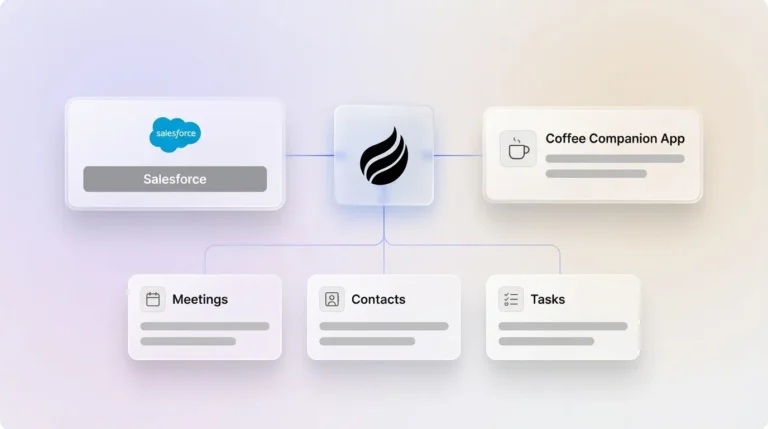
| Integration depth | Broad ecosystem, manual configuration and paid connectors required | Deep in one lane (calls or prospecting), limited CRM write-back | Native Google Workspace / M365 sync, writes back to Salesforce or HubSpot as Companion App |
| Real-time pipeline visibility | Dashboards mirror what reps manually enter, stale stages are common | Gong surfaces call insights, pipeline view still depends on CRM sync | Pipeline Compare tracks week-over-week changes automatically, no CSV exports needed |
| Rep adoption | Low, reps view entry as a chore, shadow CRMs emerge | Moderate, Gong is a passive listener and Apollo is prospecting-focused | High, the agent handles busywork so reps interact with outputs, not inputs |
| Implementation effort | Weeks to months, admin-heavy configuration | Days for point solution, CRM integration adds complexity | Hours via OAuth to Google/M365, Companion App authenticates to existing CRM |
| Long-term scalability | Scales with significant admin overhead and licensing cost | Scales within its lane, stack complexity grows | Seat-based pricing, agent labor scales without extra per-process fees |
See how Coffee’s agent captures pipeline data automatically.
Operational Steps to Automate Weekly Sales Reports
Teams eliminate manual data entry by addressing six operational categories in sequence.
- Setup and onboarding: Agent-driven tools connect via OAuth to existing email and calendar infrastructure. Passive CRMs demand field mapping, workflow rules, and admin training before records populate correctly.
- Data capture and maintenance: AI embedded in CRM software automatically captures, updates, and enriches customer data from multiple sources, which removes the human bottleneck. Passive systems depend on rep discipline that studies consistently show breaks down under quota pressure.
- Usability for frontline reps: Sales representatives save more than two hours per day using AI tools, primarily through automation of routine tasks. Reps using agent tools work with summaries and next-step drafts instead of blank fields.
- Manager visibility: Revenue teams often reconstruct deal history from emails when CRM data is incomplete. Automated pipeline snapshots replace that reconstruction with structured, timestamped records.
- Integration complexity: Point solutions like Gong require a separate CRM sync layer. Agent platforms that write directly to Salesforce or HubSpot consolidate that complexity into a single connection.
- Ongoing administrative burden: Passive CRMs accumulate technical debt, including duplicate records, stale contacts, and unmapped fields. An agent that continuously enriches and deduplicates records breaks that maintenance cycle.
Salesforce Reporting Productivity Compared to Agent-Driven Options
Salesforce remains the market’s most feature-complete CRM, with mature reporting, forecasting modules, and a large AppExchange ecosystem. Its core limitation is architectural. Market data shared by Coffee shows reps spend only about one-third of their time selling, and CRM data entry forms the single largest category of non-selling work. Salesforce reporting reflects whatever reps log, and when pipeline records are incomplete, forecasting becomes guesswork rather than a data-driven process.
Agent-driven alternatives address this upstream. Instead of adding another reporting layer on top of stale data, an agent captures activity at the moment it occurs. The agent logs the call, updates the stage, and drafts the follow-up so the Salesforce record reflects reality without rep intervention. CRM automation is associated with forecast accuracy gains around 25% and productivity lifts of 14.5–29% according to industry reports.

Gong and HubSpot Reporting Gaps for Manual Data Entry
Gong excels at conversation intelligence and surfaces deal risk signals from call transcripts along with coaching moments. Its reporting gap comes from operating downstream of the CRM. Deal stages, close dates, and contact roles still require manual updates in the system of record. Gong highlights what was said on a call but does not write structured pipeline data back automatically. Contact role gaps make every deal appear identical on paper regardless of documented executive sponsorship, which Gong’s call intelligence alone cannot fix.
HubSpot’s Breeze Customer Agent resolves approximately 65% of support conversations and cuts resolution time by 39%, which shows real automation strength. However, HubSpot started as a marketing platform with a CRM added later, so its data model does not center unified sales intelligence. Reps still toggle between HubSpot records, enrichment tools, and outreach platforms. That behavior recreates the fragmented stack problem that agent-driven solutions aim to collapse.
Best-Fit Use Cases for Early-Stage Teams and Growing Sales Orgs
Tool selection should match organizational maturity and current systems.
Early-stage teams (1–20 reps): A standalone AI-first CRM removes the overhead of configuring Salesforce or HubSpot before a sales process is defined. The agent handles contact creation, activity logging, and pipeline snapshots from day one.
Growing sales orgs committed to Salesforce or HubSpot: A Companion App model deploys the agent as an enrichment and capture layer on top of the existing system of record. This approach preserves workflow investments while improving data quality at input.
2026 ROI Reference Table for Automated Sales Reporting
| Metric | Baseline (no automation) | With agent-driven automation | Source |
|---|---|---|---|
| Weekly admin hours per rep | ~24–29 hrs | Reduced by 8–12 hrs (Coffee) | Salesforce / Gartner / Coffee |
| Forecast accuracy improvement | Baseline | +25% | CRM automation research, 2026 |
| Sales productivity increase | Baseline | 14.5-29% | CRM automation research, 2026 |
| AI labor productivity gain (firm-level) | Baseline | Positive gains expected in 2026 | Atlanta Fed working paper, 2026 |
| Win rate improvement | Baseline | +30% | McKinsey / Utmost Agency data, 2026 |
Calculate your team’s time savings with Coffee.
Risks and Limitations of Popular Automated Reporting Approaches
- Salesforce / HubSpot: Hidden maintenance work accumulates as data ages. The data quality spiral described earlier, where declining trust leads to less consistent updates, creates a compounding maintenance burden that reporting add-ons cannot resolve. Reporting modules such as Einstein and Breeze add cost without fixing the root input problem.
- Gong: Conversation intelligence is valuable but siloed. Pipeline accuracy still depends on rep-driven CRM updates. Integration gaps between Gong and the system of record create reconciliation work for RevOps.
- Apollo: Apollo performs well for prospecting and sequencing but offers limited pipeline reporting depth. Apollo’s AI Research Agent helps teams book 46% more meetings, yet post-meeting data capture still falls back to manual CRM entry.
- Coffee: Deeper integrations beyond Google Workspace, M365, Salesforce, and HubSpot currently route through Zapier, with native connectors on the roadmap. Large enterprises with highly complex custom workflows sit outside the current ideal customer profile.
Decision Framework for Choosing an Automated Reporting Stack
This checklist walks you from current pain to a clear deployment path.
- Reps spend more than 7 hours weekly on CRM updates: Passive CRM alone cannot solve the problem, so agent-driven capture becomes necessary to reclaim that time.
- Forecast accuracy sits below 70%: Bad CRM data produces unreliable pipeline reports. Fix data quality at input before layering on new reporting tools.
- Team is committed to Salesforce or HubSpot: A Companion App model preserves your system of record while the agent resolves data quality and activity capture.
- Team is evaluating a net-new CRM: A standalone AI-first CRM removes legacy architecture constraints from day one and centers automation in the core product.
- Leaders need week-over-week pipeline change visibility without spreadsheets: Coffee’s Pipeline Compare feature visualizes progressed, stalled, and new deals automatically, which turns pipeline reviews from interrogation sessions into strategic discussions.
- Stack consolidation is a priority: Teams using AI-driven automation make 23% more calls per day and close deals 20% faster compared to teams without automation. Consolidating capture, enrichment, and reporting into one agent amplifies those gains.
Business context is fragmented across CRM, ERP, productivity tools, and spreadsheets, and too often it does not travel with the data. The decisive factor in 2026 is not which passive database offers the most attractive dashboard. The crucial factor is which agent keeps the data feeding that dashboard accurate from the start.
Frequently Asked Questions
How long does it take to implement an automated sales reporting tool?
Implementation time varies significantly by approach. Passive CRMs like Salesforce typically require weeks to months of configuration, field mapping, and admin training before reporting becomes reliable. Agent-driven tools that connect via OAuth to Google Workspace or Microsoft 365 can be operational within hours, and the agent begins capturing contacts, activities, and pipeline data immediately. For teams deploying Coffee as a Companion App on top of an existing Salesforce or HubSpot instance, a simple authentication step allows the agent to start syncing and enriching data the same day.

Will migrating to an agent-driven CRM disrupt existing Salesforce or HubSpot data?
A Companion App model avoids migration. The agent writes enriched data back to the existing system of record, so historical records, custom fields, and workflow rules remain intact. For teams adopting a standalone AI-first CRM, migration scope depends on the volume of historical deal data. Coffee’s agent handles contact and company creation automatically from connected email and calendar history, which reduces the manual effort usually associated with CRM migrations.
How does agent-driven data capture affect data security and compliance?
Coffee is SOC 2 Type 2 and GDPR compliant. Data processed by the agent is not used to train public models. The agent accesses email and calendar data through standard OAuth protocols, so credentials are never stored directly. Teams in regulated industries should confirm that any automated data capture tool meets the specific compliance requirements of their sector before deployment.
Does automated data capture actually improve forecast accuracy, or does it just save time?
Automated capture improves both forecast accuracy and rep time. Forecast accuracy degrades when deal stages, close dates, and contact roles are missing or stale, and those problems start at data entry. When an agent captures activity automatically and keeps records current without rep intervention, the pipeline data feeding forecasts reflects actual deal state rather than what reps remembered to log. Forecast accuracy and time savings rise together, which reflects the core principle behind the Good Data In, Good Data Out framework.
Conclusion: Why Agent-Driven Reporting Wins in 2026
The 2026 comparison shows a clear pattern. Passive CRM databases and siloed point solutions push the data entry burden onto reps, which drags down productivity and forecast reliability. Agent-driven automation fixes the problem at the source by capturing structured and unstructured data automatically, writing accurate records to the system of record, and surfacing pipeline intelligence without manual exports. For RevOps and sales leaders evaluating automated sales reporting tools, the key criterion is not dashboard design. The key criterion is whether the platform guarantees good data in before promising good data out.