Written by: Doug Camplejohn, CEO & Co-Founder, Coffee
Key Takeaways
- Small business sales teams lose over an hour every day to manual CRM data entry, and 79% of opportunity data never gets captured, which cripples pipelines and forecasts.
- True automated CRMs use AI agents that proactively capture emails, meetings, and data without human input, unlike passive traditional systems.
- Coffee ranks #1 among seven leading automated CRMs for small teams with 1 to 20 reps, offering full agent-led automation, data enrichment, and historical warehousing.
- Essential features include auto-data entry, meeting intelligence, pipeline tracking, and lead enrichment, and Coffee covers all of them with zero manual work.
- Switch to Coffee today to save 8 to 12 hours per week and run a hands-free CRM so your team can focus on selling.
Essential CRM Automation Features for Small Teams in 2026
| Feature | Why It Matters | Top Tools | Coffee Edge |
|---|---|---|---|
| Auto-Data Entry | Eliminates more than an hour of daily manual work | Coffee, Dynamics 365 | Agent scans all communications |
| Meeting Intelligence | Captures unstructured conversation data | Coffee, Salesforce Einstein | AI briefings and automated summaries |
| Pipeline Tracking | Prevents 27% revenue loss from bad data | Coffee, HubSpot | Historical data warehouse |
| Lead Enrichment | Reduces need for separate enrichment tools | Coffee, Klaviyo | Built-in enrichment via licensed data |
Reddit Feedback on Manual CRMs and How Coffee Fixes It
Small business sales teams consistently report three critical pain points with traditional CRMs. 66% of sellers would rather do unpleasant tasks than update their CRM software, and 53% of sales leaders say their CRM causes friction for their sales team.
Common complaints include “HubSpot data entry kills my day,” “Pipeline reviews are guesswork without accurate data,” and “We are back to spreadsheets because the CRM is too much work.” Coffee solves these issues with an agent-first architecture that captures data automatically from Google Workspace or Microsoft 365, removes manual entry, and protects pipeline accuracy through its built-in data warehouse.

Best Automated CRM Choices for Small Sales Teams
1. Coffee – True agent-led automation with zero data entry 2. HubSpot – Semi-automated with strong marketing integration 3. Microsoft Dynamics 365 – Native Office 365 automation 4. Salesforce with Einstein – AI-enhanced traditional CRM 5. Klaviyo – Automation focused on ecommerce and B2C teams 6. Pipedrive – Basic automation with workflow triggers 7. Zoho CRM – Budget-friendly with limited automation
Top 7 Automated CRMs Ranked for Small Teams
1. Coffee: Fully Agent-Led CRM Automation
Coffee stands alone as the only CRM powered by a true AI agent that handles all data entry, meeting management, and pipeline intelligence automatically. After you connect Google Workspace or Microsoft 365, Coffee’s agent immediately starts creating contacts and companies, enriching records with job titles and funding data, and logging every interaction without human intervention.

Strengths: Saves 8 to 12 hours weekly through complete automation, handles both structured and unstructured data, includes a built-in data warehouse that preserves historical context, works as a standalone CRM or as a companion to existing systems, and supports natural language list building.

Best For: Small businesses with 1 to 20 reps that are outgrowing spreadsheets and want to avoid manual CRM maintenance, and teams that need accurate pipeline data without data entry overhead.
Pricing: Simple seat-based model with unlimited agent labor included.
2. HubSpot CRM for Semi-Automated Workflows
HubSpot provides semi-automated features such as email tracking, deal progression triggers, and automated opportunity creation through workflows. Many teams still need manual oversight for full pipeline management and accurate reporting.
Strengths: Free tier available, strong marketing automation integration, user-friendly interface, and an extensive third-party app ecosystem.
Limitations: Limited support for unstructured data and no historical data preservation when fields update.
Best For: Marketing-heavy small businesses that accept some manual CRM work.
3. Microsoft Dynamics 365 for Microsoft-First Teams
Dynamics 365 delivers consistent workplace experience with native Microsoft 365 integration and AI through Copilot for note-taking and meeting summaries. It scores highly on implementation speed and workplace integration.
Strengths: Seamless Office 365 integration, AI-powered meeting summaries, and strong forecasting capabilities.
Limitations: Complex pricing structure and an enterprise-focused feature set.
Best For: Microsoft-centric organizations with technical resources for setup.
4. Salesforce with Einstein AI for Custom Enterprise Setups
Salesforce Einstein adds AI-enhanced analytics, automated opportunity scoring, and activity capture, while the core platform still involves several manual processes. It leads in cloud maturity and AI capabilities, but it often requires significant customization.
Strengths: Extensive customization options, powerful analytics, and a large app marketplace.
Limitations: High total cost of ownership and complex setup.
Best For: Established teams with dedicated Salesforce administrators.
5. Klaviyo for Ecommerce and B2C Automation
Klaviyo shines in ecommerce automation with real-time customer profile sync and behavior-based personalization through its Klaviyo Data Platform, or KDP.
Strengths: Strong ecommerce integration, automated customer segmentation, and real-time data sync.
Limitations: Limited B2B pipeline management and a primary focus on marketing automation.
Best For: Ecommerce and B2C businesses that prioritize customer lifecycle automation.
6. Pipedrive for Simple, Visual Pipelines
Pipedrive delivers basic automation through workflow triggers and email integration, while teams still need to create opportunities and maintain data manually.
Strengths: Visual pipeline interface, affordable pricing, and straightforward setup.
Limitations: Limited automation depth, no unstructured data handling, and ongoing manual data entry.
Best For: Simple sales processes with predictable deal stages.
7. Zoho CRM for Budget-Conscious Teams
Zoho offers a budget-friendly CRM with advanced automation features such as email integration, workflows, and Zia AI capabilities.
Strengths: Competitive pricing, integrated business suite, customizable workflows, and Zia AI for predictive insights.
Limitations: Basic reporting features in lower tiers.
Best For: Price-conscious small businesses with straightforward sales processes.
Automated CRM Comparison for Small Sales Teams
| CRM | Automation Depth | Data Handling | Best For |
|---|---|---|---|
| Coffee | Full agent automation | Structured and unstructured | Teams with 1 to 20 reps wanting zero data entry |
| HubSpot | Semi-automated | Primarily structured | Marketing-heavy small businesses |
| Dynamics 365 | AI-assisted | Structured with AI summaries | Microsoft-centric organizations |
| Salesforce | AI-enhanced | Structured with Einstein AI | Established teams with admins |
Coffee leads in agent proactivity and comprehensive data handling, while traditional CRMs focus on familiarity and large ecosystems. The main difference is Coffee’s ability to remove manual data entry entirely and still preserve historical context through its data warehouse architecture.
How to Choose and Roll Out the Right CRM
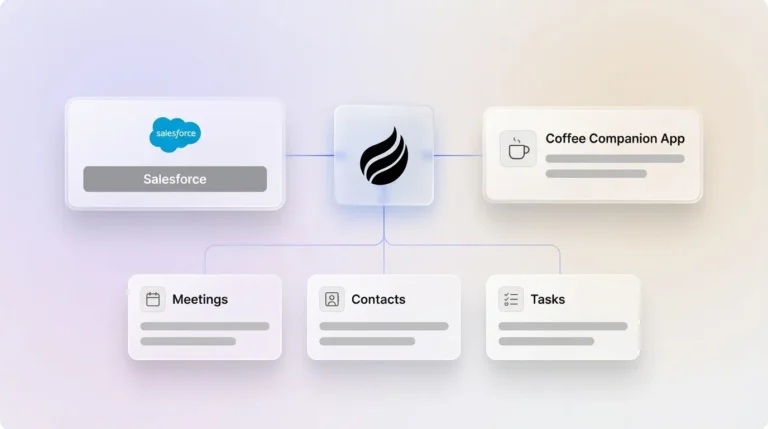
For startups and growing teams, Coffee provides the fastest path to CRM success as a standalone solution. Teams already invested in HubSpot or Salesforce can add Coffee as a companion agent that removes manual data entry while keeping existing workflows intact.
Setup uses simple Google Workspace or Microsoft 365 authentication, and Coffee’s agent starts capturing data right away. Agent-based systems reduce lead-to-meeting conversion from three to five touches to a single conversation through automatic qualification and intelligent routing.

You can estimate your savings easily. If your team spends eight hours weekly on CRM maintenance, Coffee’s automation returns 416 hours annually per rep, which shifts directly into revenue-generating work. Get started with Coffee and track your team’s productivity gains.
FAQ
What is the best no data entry CRM for small sales teams?
Coffee is the only CRM that removes data entry entirely through its AI agent. The agent automatically captures contacts, companies, and activities from your email and calendar, enriches records with relevant data, and maintains accurate pipeline information without human intervention. Unlike traditional CRMs that depend on manual input, Coffee’s agent manages every data task autonomously.
How does Coffee compare to HubSpot for small teams?
HubSpot offers a free tier and strong marketing features, while it still requires significant manual data entry for pipeline management. Coffee’s agent removes this work completely by creating opportunities, logging activities, and maintaining data quality automatically. Coffee also preserves historical context through its data warehouse, while HubSpot loses historical data when fields update. For teams that prioritize sales efficiency over marketing automation, Coffee delivers greater time savings.
Are there free automated CRM options for small businesses?
HubSpot provides a free tier with basic automation features, and true automation usually requires paid plans. Zoho offers affordable options with limited automation capabilities. Most free and low-cost CRMs still require manual data entry and do not include AI agents for full automation. Coffee’s seat-based pricing includes unlimited agent labor and often delivers better value once you factor in time savings.
What makes AI agent CRMs different in 2026?
AI agent CRMs like Coffee shift CRMs from passive databases to active assistants. Traditional CRMs mainly store data, while agent-based systems capture, process, and analyze information proactively. They handle unstructured data from emails and calls, surface intelligent insights, and automate complex workflows. This agent architecture ensures strong data input, which supports accurate forecasting and pipeline intelligence.
What do Reddit users say about automated CRMs for small sales teams?
Reddit users frequently express frustration with manual data entry in traditional CRMs. Many describe abandoning HubSpot and Salesforce because maintenance takes too much time. The most praised tools reduce manual work while keeping data accurate. Coffee addresses these pain points with its agent-first approach, which removes the data entry burden that often pushes teams back to spreadsheets.
Conclusion: Why Coffee Leads the Agent CRM Shift
The CRM market has entered an agent-driven era where passive databases give way to proactive AI assistants. For small sales teams, the decision is simple, either keep struggling with manual data entry or move to agent-led automation that handles the busywork automatically.
Coffee leads this shift as the only true agent-based CRM, saving 8 to 12 hours every week while protecting pipeline accuracy through complete data capture and historical preservation. Get started with Coffee and experience autonomous CRM management that lets your team focus on selling instead of data entry.