Written by: Doug Camplejohn, CEO & Co-Founder, Coffee | Last updated: June 19, 2026
Key Takeaways
- Sales forecasting accuracy depends on clean, complete CRM data, not on how advanced the AI model appears.
- Most forecasting tools fail because reps skip manual updates, so models rely on incomplete or outdated records.
- Automated, agent-led data capture fills the data gap and strengthens pipeline visibility and forecast confidence.
- Enterprise tools like Clari and Salesforce Einstein need consistent data inputs, while companion agents log activities automatically.
- Strengthen your forecasts and pipeline visibility with Coffee by reviewing Coffee’s plans and features.
Why Forecasts Fail Even With AI
Most sales teams that invest in AI forecasting tools still miss their numbers, and the reason is rarely the algorithm. Inaccurate CRM data, inconsistent sales process execution, and rapid shifts in customer behavior are the primary factors that produce poor pipeline visibility and missed targets. AI models can only analyze what has been logged. When reps skip updates, close dates drift without explanation, and deal stages go unchanged for weeks, the model works from fiction instead of reality.
Without agentic AI embedded across go-to-market systems, organizations rely on fragmented insights and rising manual effort, leaving pipeline health vulnerable to blind spots and lagging intervention. Dashboards from Clari, Gong, and Salesforce Einstein are only as trustworthy as the records feeding them, which ties every forecasting decision back to data capture quality.
How Data Quality Drives Forecast Accuracy
Teams often see forecast variance shrink after several months of model tuning on clean data. That improvement reflects a data discipline problem rather than a product limitation. In Pigment’s 2025 Office of the CFO report, data quality issues ranked among the top three challenges to AI, alongside security concerns and integration difficulties.
Pipeline stage progression, win rates, rep activity levels, deal velocity, and conversion metrics are foundational inputs that improve forecast confidence only when captured consistently. Consistent capture requires automation, not reminders, which connects directly to the tool choices that follow.
Because automation underpins reliable forecasting, the next decision centers on which tools actually deliver that automation for your stack. Enterprise, Salesforce-native, and mid-market teams each face different options, and the right fit depends on whether a tool closes the data-capture gap or assumes it is already solved.
Enterprise Forecasting Platforms and Their Data Limits
Clari, Salesforce Einstein, and Microsoft Dynamics 365 Sales dominate the enterprise segment. Salesforce expanded its partnerships with OpenAI and Anthropic in October 2025, integrating GPT-5 and Claude into its Agentforce 360 platform to enhance enterprise workflows and AI-powered automation. These platforms carry deep forecasting logic, territory hierarchies, and multi-currency support.
Their limitation is architectural. Missing or unlogged activities reduce model accuracy, and enterprise reps are no more likely to complete manual data entry than anyone else. Automated data capture through AI meeting bots, email parsing, and activity logging needs to sit underneath the forecasting layer before any model can produce reliable output.
Salesforce Stacks: Native AI and Companion Agents
Teams already committed to Salesforce often start with Einstein Forecasting and Clari because they offer native or near-native integration. Generative AI tools in Salesforce Einstein GPT automatically produce meeting notes and summaries from Zoom, Teams, and phone recordings, capturing key discussion points, objections, commitments, and next steps, then syncing them directly to CRM records.
This support still depends on reps initiating the recording or logging the activity. A companion agent that autonomously captures emails, calendar events, and call transcripts and then writes structured data back to Salesforce fields without rep intervention closes that gap before the forecast model runs.
HubSpot and Lighter Stacks: Where Agents Add the Most Value
HubSpot’s AI forecasting, Pipedrive AI, and tools like Chorus or Wingman serve mid-market and growth-stage teams on lighter stacks. Automated data entry via AI summarization saves 30–60 minutes daily per rep, and aggregated insights across calls can reveal sales trends and coaching opportunities for managers. However, HubSpot’s CRM was originally built as a marketing tool with a CRM bolted on, which means its data model handles unstructured inputs less natively than purpose-built intelligence systems.
Because of this architectural limitation, teams on HubSpot benefit most from a companion agent that ingests unstructured data such as email threads, transcripts, and LinkedIn signals and then structures it into HubSpot records automatically before it hits HubSpot’s less flexible data model.
The Missing Layer: Agent-Led Data Capture
Every tool reviewed above assumes data already lives in the CRM. Before introducing AI agents, organizations must ensure complete data accuracy and unification at all times so each go-to-market unit can take advantage of all AI sales agents have to offer. That prerequisite forms the missing layer most teams skip.

Coffee is an agent-led CRM platform built specifically to solve the data-in problem. It deploys in two models. As a Standalone CRM, the Coffee Agent powers the entire system of record for teams of 1–20 that have outgrown spreadsheets. As a Companion App, the Coffee Agent sits on top of existing Salesforce or HubSpot instances, autonomously capturing emails, calendar events, and call transcripts, then writing structured data back to the primary CRM without rep involvement. Both models run on seat-based pricing, and the agent’s labor is included with no metering on processes or LLM usage.

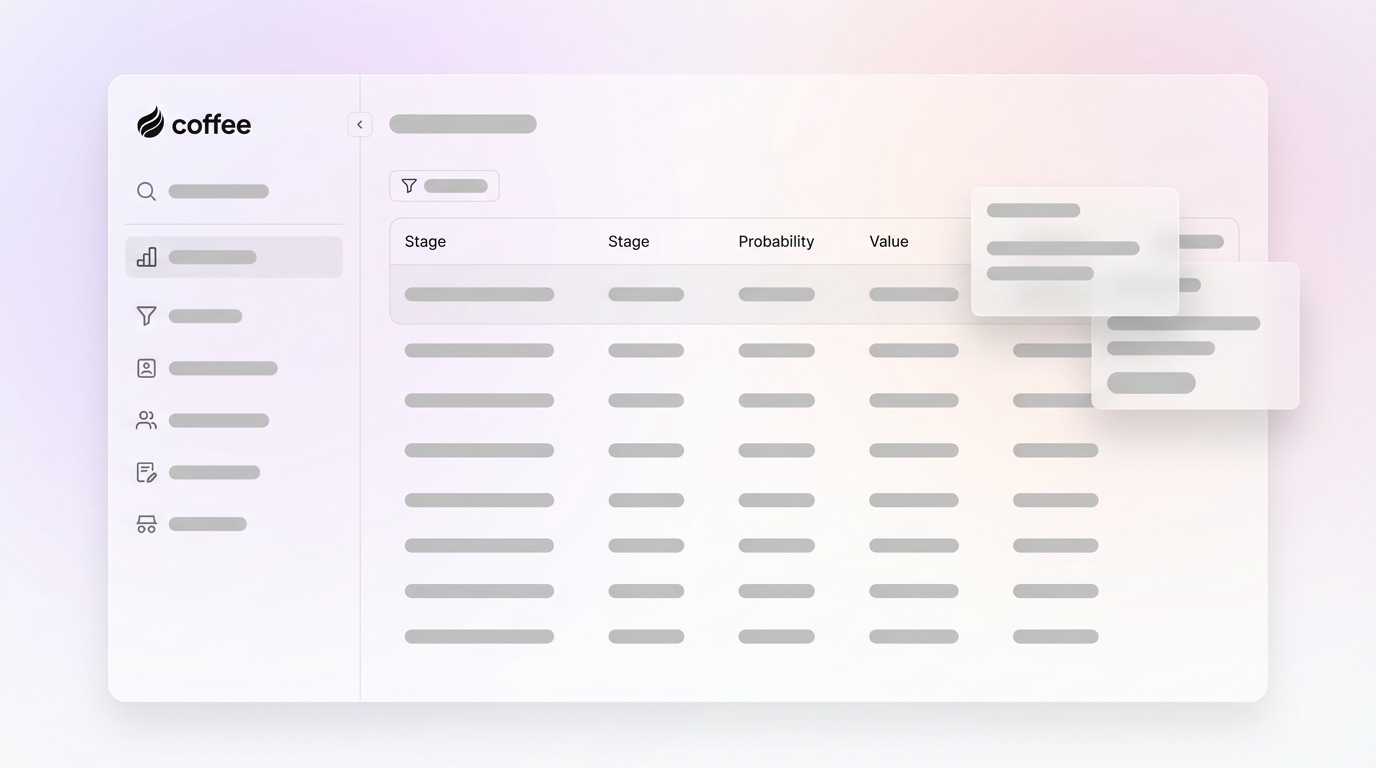
The Coffee Agent handles contact creation, activity logging, meeting briefings, post-call summaries, and pipeline change tracking. Its Pipeline Compare feature visualizes week-over-week deal movement, including progressed, stalled, and new deals, without manual CSV exports. Because the agent captures history in a built-in data warehouse, the historical context remains intact instead of being overwritten when a field updates.

See how Coffee captures pipeline data automatically before your next board review.
Choosing a Tool by Team Size and CRM
The table below compares how major forecasting tools handle automated capture, unstructured data, and pipeline visibility. Use it to match your current CRM stack and team size to the level of data-capture support you need, and to decide whether you require a companion agent or a full replacement.
| Tool | Automated Data Capture | Unstructured Data Support | Pipeline-Change Visibility | Salesforce / HubSpot Companion | Suitable for 10–100 Person Teams |
|---|---|---|---|---|---|
| Salesforce Einstein | Partial (rep-initiated) | Moderate (Einstein GPT) | Native dashboards | Native (Salesforce only) | Moderate (complex setup) |
| Clari | Partial (sync-dependent) | Limited | Strong | Both | Moderate (enterprise-oriented) |
| Gong | Call/email capture | Strong (calls, emails) | Moderate | Both | Yes |
| HubSpot AI | Partial (rep-initiated) | Moderate | Basic | Native (HubSpot only) | Yes |
| Coffee | Autonomous (agent-led) | Strong (emails, transcripts, calendars) | Strong (Pipeline Compare) | Both (Standalone or Companion) | Yes (purpose-built) |
Ratings reflect qualitative capability descriptors based on product documentation and company context. No third-party benchmark figures are cited for this table.
Implementation Checklist for Cleaner Forecast Data
- Audit current CRM for missing activity logs, blank close dates, and stale deal stages before enabling any AI forecasting layer. This baseline assessment reveals how much of your pipeline remains invisible to any forecasting model.
- Connect email and calendar (Google Workspace or Microsoft 365) to an agent that auto-creates contacts and logs interactions. This step closes the gaps identified in your audit by capturing activities that reps currently skip.
- Deploy an AI meeting bot to record, transcribe, and write structured summaries back to CRM records after every call. Call data becomes a rich source of deal health signals once it is captured in structured fields instead of staying in reps’ memories.
- Establish a weekly pipeline review cadence. Revenue operations teams that review forecasts weekly rather than monthly identify shifts in buyer behavior and deal health before they affect targets, which allows earlier intervention.
- Validate data completeness for 30 days before trusting AI-generated forecast outputs. This buffer period gives the agent time to populate consistent activity coverage.
- Choose a forecasting tool matched to your CRM stack and team size using the table above. This final step aligns your technology with the data-quality foundation you just created.
Using AI to Work Your Sales Pipeline
AI works a pipeline by analyzing deal stage progression, engagement signals, and historical conversion patterns to surface which opportunities need attention and which are at risk. The prerequisite is that those signals exist in the CRM in the first place. If reps are not logging calls, updating stages, or recording next steps, the AI has no signal to analyze. The most effective starting point involves deploying an agent that captures activity automatically from emails, calendars, and call recordings so the pipeline reflects reality before any analysis runs.
Selecting AI for Sales Forecasting
The right AI for sales forecasting depends on your CRM stack and team size, and no forecasting tool outperforms the quality of its input data. Salesforce Einstein suits large teams already on Salesforce. Clari suits revenue operations teams that need roll-up forecasting across many reps. Gong suits teams that want conversation intelligence alongside pipeline data.
For mid-market teams on Salesforce or HubSpot, a companion agent that automates data capture usually delivers more value than a new forecasting layer. For teams without a CRM or looking to replace one, an agent-first standalone system removes the data-entry problem at the foundation.
Factors That Improve Forecast Accuracy
Accurate forecasting depends on combining historical performance, current opportunities, seller input, deal-stage criteria, and market signals rather than relying on a single predictive model. Organizations at higher AI maturity stages often report greater confidence in their company’s direction, and the consistent variable separating those groups is data quality. Automated capture, consistent process execution, and weekly review cadences improve accuracy more reliably than switching forecasting vendors.
Conclusion: Close the Data Gap Before Adding More AI
The most effective AI tools for sales forecasting and pipeline insights share one dependency, which is clean, complete CRM data. Legacy and fragmented CRM architecture create a major barrier to agentic AI adoption. Dashboards, scoring models, and predictive layers stay only as reliable as the records underneath them.
Before evaluating another forecasting tool, assess whether your current data capture process operates autonomously or depends on rep discipline. If it depends on reps, the forecast will remain unreliable regardless of which AI sits on top. Evaluate your options against your current CRM, team size, and data capture maturity, then close the gap at the source.
Connect Coffee to your CRM and close the data-quality gap your forecasting tools depend on.
Frequently Asked Questions
What is the difference between a sales forecasting tool and a CRM agent?
A sales forecasting tool analyzes existing CRM data to project future revenue. It reads what is already logged and applies statistical or machine learning models to produce estimates. A CRM agent, by contrast, is responsible for getting accurate data into the CRM in the first place. It captures emails, calendar events, call transcripts, and contact details autonomously, then writes structured records back to the system of record without requiring rep input.
The two functions are complementary but sequential. The agent handles data-in, and the forecasting tool handles analysis-out. Skipping the agent layer and going straight to forecasting produces projections built on incomplete records.
Can Coffee work alongside Salesforce or HubSpot, or does it replace them?
Coffee operates in two distinct models. As a Companion App, the Coffee Agent deploys on top of an existing Salesforce or HubSpot instance. It authenticates with the existing system, captures activity from email and calendar connections, joins calls to record and transcribe, and writes enriched, structured data back to the primary CRM. The existing system of record stays in place, and Coffee handles the data-in layer that reps previously managed manually.
As a Standalone CRM, Coffee replaces legacy systems entirely for teams that have outgrown spreadsheets but find Salesforce or HubSpot too maintenance-heavy. Both models use the same agent and the same seat-based pricing structure.
How long does it take to see improvement in forecast accuracy after deploying an automated data capture agent?
Improvement timelines depend on the volume of historical clean data available and the consistency of the sales process. Teams that connect email and calendar immediately begin populating contact records and activity logs from day one. Pipeline change visibility improves within the first review cycle because the agent tracks deal movement automatically.
Forecast model accuracy, particularly for AI-driven tools that learn from historical patterns, typically stabilizes after two to three months of clean data accumulation. The critical variable is not the forecasting model’s learning curve but the speed at which the CRM transitions from partial to complete activity coverage.
What types of unstructured data does Coffee capture and structure?
The Coffee Agent ingests emails, calendar invitations, call recordings, and transcripts. It extracts contact details, company information, discussion topics, objections raised, next steps agreed, and sentiment signals from these sources and maps them to structured CRM fields. It can organize notes according to sales methodologies including BANT, MEDDIC, and SPICED, which keeps qualification data in a consistent format.
This structure matters for forecasting because AI models that score deal health or predict close probability require consistent field population across deals. Unstructured capture alone cannot guarantee that consistency without a structuring layer on top.
Is Coffee suitable for teams that are not yet using a formal CRM?
Yes. The Standalone CRM model serves small to mid-sized teams that manage sales in spreadsheets, Notion, or Airtable and have recognized that manual tracking will not scale. The Coffee Agent begins capturing contacts and activities from Google Workspace or Microsoft 365 immediately upon connection, building a clean system of record from the first day without requiring manual data migration or field configuration by the team.
Teams in this position avoid the adoption problems that plague traditional CRM deployments because the agent handles the data entry that typically causes reps to abandon the system within weeks of launch.