Written by: Doug Camplejohn, CEO & Co-Founder, Coffee | Last updated: July 23, 2026
Key Takeaways for Using BANT in 2026
- BANT remains the most widely used early-stage qualification framework for SDR and SMB sales motions in 2026, especially for deals under $25K ACV.
- Conversational delivery of BANT questions outperforms rigid checklists and helps surface Budget, Authority, Need, and Timeline without putting prospects on the defensive.
- Objection-handling scripts for budget and authority pushback keep deals moving by validating constraints and preparing champions with internal talking points.
- AI Agents remove the manual data-entry bottleneck by transcribing calls, extracting BANT signals, and writing structured fields directly into Salesforce or HubSpot records.
- Automate your BANT data capture and turn every conversation into clean, structured pipeline data without manual entry.
Budget BANT Questions That Reveal Real Funding
The question “What’s your budget?” on a discovery call usually produces a lowball number or a polite refusal. Most buyers have no approved figure yet and do not want to share financial details early. The questions below surface budget reality without cornering the prospect.
- “Have you allocated funding for this initiative, or are you still in the case-building stage?”
- “What tier of solution did you have in mind, a pilot, a department rollout, or company-wide?”
- “How does your organization typically fund new technology investments in this area?”
- “Has this initiative been budgeted, or are we building the business case together?”
- “Who controls the release of budget for something like this?”
- “What is the cost of doing nothing for another six months?”
- “If budget were not a factor, is this something you would move forward on?”
- “When does your next budget cycle open, and is this on the roadmap for that period?”
Objection script, “We don’t have budget right now”: Start by validating the constraint. Say, “That makes sense, a lot of teams are in the same position.” Then ask, “When you say no budget, is that a timing issue for this quarter, or is it that you have not seen enough value yet to build the case internally?” If timing is the issue, set a specific follow-up date for the next cycle. If value is the issue, return to cost-of-inaction discovery. A prospect who confirms they would move forward if budget were not a factor is signaling a fit issue, not a budget issue. That answer calls for a different conversation entirely.
The Coffee Agent joins your calls, detects budget signals in real time, and writes a structured Budget field directly to your Salesforce or HubSpot record, so reps avoid manual note-taking.

Authority BANT Questions That Map the Buying Committee
The question “Are you the decision-maker?” puts prospects on the defensive and yields incomplete answers. Most B2B deals now involve a buying committee of six to ten stakeholders per Gartner research. These questions map the full committee with neutral, collaborative language.
- “Walk me through how a decision like this typically gets made at your company.”
- “Beyond yourself, who else would need to weigh in before moving forward?”
- “Who else needs to be part of this decision?”
- “How did you buy something of similar scope last time, and who had to sign off?”
- “Is there a technical team, legal, or procurement group that would review this?”
- “What role do you play in evaluating tools like this?”
- “When does that conversation with your manager happen, and what do you think will be their biggest question?”
Objection script, “I need to run this by my boss”: Respond with, “Of course, when does that conversation happen?” Then offer to prepare a one-page business case or talking points the champion can use internally. Offering to prepare talking points and the business case for the champion keeps the deal moving without pressuring a contact who may lack final authority.
Need BANT Questions That Quantify Pain
Leading with Need rather than Budget raises reply rates to the first qualification question, based on analysis of hundreds of thousands of AI-driven sales conversations. These questions open discovery naturally and help you quantify the problem.
- “What problem are you trying to solve, and what have you already tried?”
- “What are some of the biggest challenges your team is facing with this right now?”
- “How is this problem showing up in your numbers, such as revenue, churn, or cycle time?”
- “What does the cost of this problem look like on a monthly basis?”
- “What would success look like six months after solving this?”
- “Is this a priority you are actively working on, or something on the back burner?”
- “What triggered you to look at solutions now instead of six months ago?”
- “Who inside your organization feels this pain most acutely?”
Objection script, “We are just exploring options”: Acknowledge the stance with, “That is a great place to start.” Then ask, “What would need to be true for this to move from exploration to an active project?” This approach surfaces latent urgency without pushing. Research from more than 2.5 million sales conversations found that 40% to 60% of qualified and interested buyers end in no decision, often because need was never quantified clearly enough for the buyer to act.
Timeline BANT Questions That Confirm Real Urgency
Timeline questions confirm whether urgency is real or manufactured. Effective timeline questions ask whether a prospect is actively evaluating solutions or treating this as a long-term project. This approach works better than requesting a close date upfront.
- “Are you actively evaluating solutions for this, or is it more of a long-term project for later in the year?”
- “Is there a specific event, such as a board meeting, product launch, or contract renewal, driving your timeline?”
- “What happens if this is not solved by Q3?”
- “When are you hoping to have a solution in place?”
- “What does your internal approval process look like, and how long does it typically take?”
- “Are there any hard deadlines on your end we should plan around?”
- “If everything checked out today, how quickly could your team move?”
Objection script, “We are not ready to move yet”: Ask, “What would need to happen internally before you would be ready?” This question identifies blockers such as budget cycles, headcount decisions, or competing projects. It also gives you a concrete follow-up trigger instead of an open-ended “check back later.”
Where BANT Fits in 2026 Sales Cycles
BANT is not outdated, but its application has narrowed. BANT remains the most-used B2B sales qualification framework in the US and Europe in 2026, particularly for SDR teams handling high call volumes. Its survival is justified. Fifty-two percent of salespeople still consider BANT reliable for qualification and 41% value its flexibility over rigid frameworks, per a Gartner Digital Markets survey.
The framework’s limits are equally clear. A Gartner survey of 632 B2B buyers found that 74% of buying teams experience unhealthy conflict during the decision-making process. That conflict undermines BANT’s single-decision-maker assumption. Forrester’s 2024 State of Business Buying Report states that an average B2B purchase now comprises 13 stakeholders and 89% of purchase decisions span multiple departments. For those deals, MEDDIC is the stronger tool.
The table below shows when each framework delivers the strongest results based on deal size, cycle length, and data-capture effort.
The practical answer for most SMB and mid-market teams is a hybrid approach. Use BANT at the SDR stage to triage inbound leads, then layer MEDDIC onto deals that clear the bar and grow in complexity. High-performing sales teams commonly run BANT at the top of funnel to qualify leads and book meetings, then switch to MEDDIC at the AE stage to qualify the deal and drive forecast accuracy.
Logging BANT Data Automatically Inside an AI CRM
The real bottleneck in BANT qualification is not the framework. The bottleneck is the manual data entry that breaks it. High-performing sales organizations deploy a Capture-Process-Distribute framework that uses AI to understand the nuance of a BANT framework and map extracted information directly to specific CRM properties such as Budget or Competitors. Without automation, qualification data lives in a rep’s notes or nowhere at all.
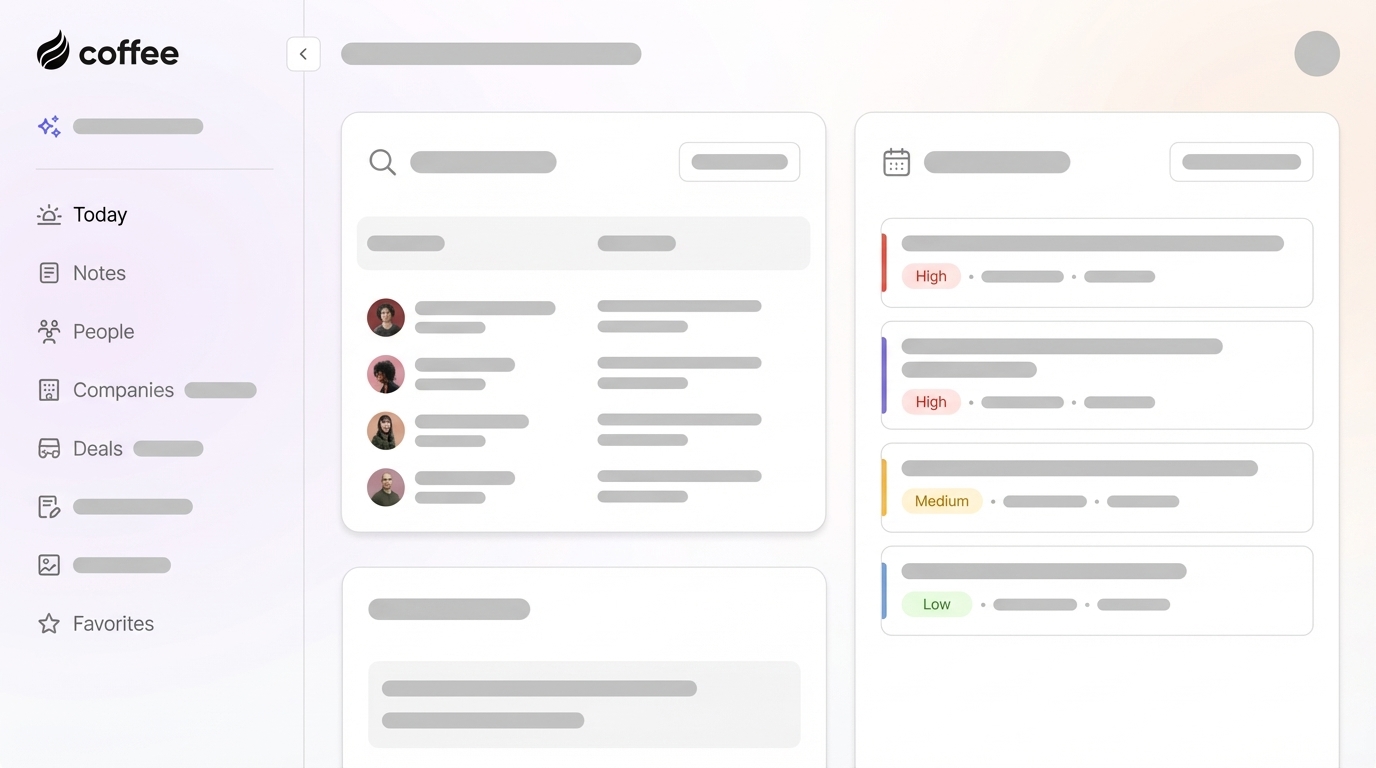
Coffee’s AI Agent solves this at the source by eliminating the manual transcription step entirely. Instead of forcing reps to take notes while listening, the Agent joins every call via Zoom, Teams, or Google Meet and transcribes the conversation in real time. As BANT signals surface during the call, the Agent parses them immediately and writes structured fields such as Budget status, Authority map, Need summary, and Timeline directly into the corresponding Salesforce or HubSpot record before the rep closes their laptop. The same process applies to emails. The Agent reads inbound and outbound threads, extracts qualification context, and enriches the deal record automatically.

The result is what SalesCloser AI describes as a “Morning Briefing” scenario. An AE opens the CRM to find new meetings already tagged with complete BANT status, a transcript summary, and a lead score. Coffee structures its meeting notes according to BANT, MEDDIC, or SPICED depending on the deal, so consistent qualification data enters the system regardless of call volume or rep discipline.
AI setters achieve higher BANT compliance than typical human SDR teams because the Agent never skips a qualification step and maintains consistency across every conversation, 24 hours a day.
Frequently Asked Questions
How many BANT questions should you ask per call?
Most teams see strong results with three to five targeted questions spread naturally across a 20–30 minute discovery call. This range works well for both SDR and AE motions. The goal is to surface all four BANT dimensions, Budget, Authority, Need, and Timeline, without the call feeling like an interrogation. Leading with two or three Need questions first establishes rapport and context. That foundation makes Budget and Authority questions land more naturally later.
Avoid clustering all four dimensions into the first five minutes. If a call is short or inbound-driven, prioritize Need and Timeline first, since those signals surface fastest and are least likely to trigger defensiveness. Budget and Authority can be confirmed in a follow-up email or second call if time runs short.
Can an AI Agent replace manual note-taking for BANT qualification?
An AI Agent can replace manual note-taking for BANT qualification, and for most sales teams it should. Manual note-taking during a live call forces reps to split attention between listening and writing. That split attention degrades both the quality of the conversation and the accuracy of the notes. An AI Agent like Coffee joins the call as a silent participant, transcribes the full conversation, identifies BANT signals in context, and writes structured qualification fields directly to the CRM record after the call ends.
This setup means the rep can focus entirely on the prospect while the Agent handles the data layer. The output is more reliable than manual notes. The Agent captures exact language, flags incomplete BANT fields, and maintains consistent qualification data across every rep and every call, something human teams struggle to achieve at scale. Coffee supports BANT, MEDDIC, and SPICED note structures, so the qualification framework matches the deal type automatically.
Conclusion
BANT remains a fast, practical qualification filter in 2026 when two conditions are met. The questions need to be delivered conversationally rather than as a checklist, and the answers need to be captured as structured CRM data rather than scattered notes. The 30 questions above give SDRs and AEs a ready-to-use library for every BANT dimension, with objection scripts for the moments prospects push back on budget or authority. The comparison with MEDDIC shows where each framework fits and how they can work together in sequence.
The operational gap that undermines BANT for most teams is not the framework itself. The real gap is the manual data entry that follows every call. Coffee’s AI Agent closes that gap by listening to every conversation, parsing every BANT signal, and writing clean, structured qualification data directly into Salesforce or HubSpot automatically.