Written by: Doug Camplejohn, CEO & Co-Founder, Coffee | Last updated: July 20, 2026
Key Takeaways for RevOps and Sales Leaders
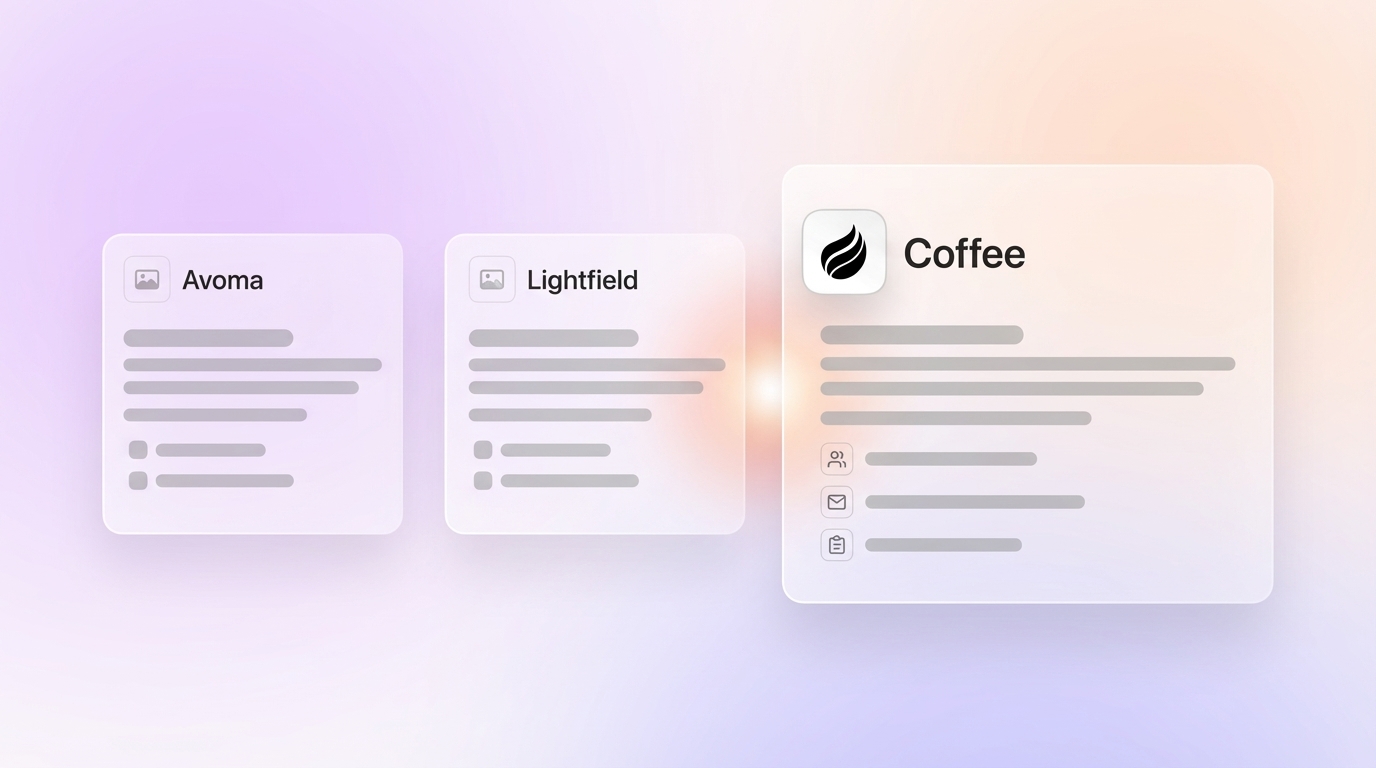
- Three distinct meeting intelligence approaches compete in 2026: Avoma focuses on coaching and analytics on top of existing CRMs, Lightfield positions itself as a CRM replacement with relationship memory, and Coffee acts as an agent layer that orchestrates both meeting intelligence and CRM data without replacing your system of record.
- Key evaluation criteria for mid-market teams include transcription quality, coaching depth, CRM integration versus replacement, pricing transparency, time saved on data entry, pre- and post-meeting automation, and long-term stack flexibility.
- Avoma offers strong coaching tools and bidirectional CRM sync but reaches $77 per user per month when fully loaded, while Lightfield lacks published pricing and introduces migration risks as a CRM alternative.
- Coffee provides seat-based pricing with agent labor included, targets 8–12 hours of weekly time savings, and works as a Companion App on Salesforce or HubSpot without forcing a CRM migration.
- See Coffee’s agent pricing to deploy an agent that handles meeting intelligence and CRM orchestration on your existing stack.
Seven Criteria to Compare Meeting Intelligence Tools in 2026
A consistent framework keeps this comparison practical for mid-market RevOps and sales leaders. The seven dimensions that matter most in 2026 are:
- Transcription and notes quality
- Coaching and analytics depth
- CRM integration versus replacement
- Pricing and total cost of ownership
- Time saved on data entry per rep per week
- Automation of pre- and post-meeting workflows
- Long-term flexibility for growing teams
These criteria reflect the reality that the Salesforce State of Sales 2026 survey of 4,050 professionals found the average seller spends only 40% of their time selling, with the remainder consumed by administrative tasks including manual CRM entry. Choosing the wrong tool compounds that problem rather than solving it.
Calculate your team’s agent cost and see how Coffee handles the seven criteria above on your existing Salesforce or HubSpot stack.
Side-by-Side Comparison of Avoma, Lightfield, and Coffee
The table below highlights three different architectures: Avoma as a coaching layer on existing CRMs, Lightfield as a CRM replacement with relationship memory, and Coffee as an agent orchestration layer that runs on top of your current stack. Pay close attention to the “CRM integration vs. replacement” and “Long-term stack flexibility” rows, because these determine whether you are adding a tool or changing your system of record.

| Criteria | Avoma | Lightfield | Coffee |
|---|---|---|---|
| Transcription quality | Claimed 85–95% accuracy, practical results vary by audio conditions | Schema-less capture, accuracy varies by data source | AI meeting bot joins Zoom, Teams, and Meet, accuracy on par with category leaders |
| Coaching and analytics depth | Strong all-in-one AI sales coaching platform in 2026: call scoring, MEDDIC/SPICED tracking, deal-risk alerts | Relationship memory with limited structured coaching scorecards | BANT, MEDDIC, and SPICED methodology notes, pipeline compare, and deal-state tracking |
| CRM integration vs. replacement | Bidirectional sync with Salesforce, HubSpot, and Pipedrive, integrates rather than replaces | Positions as CRM alternative, partial integrations with existing systems | Companion App sits on top of existing Salesforce or HubSpot, no replacement required |
| Published base pricing (2026) | $19/user/mo base (Meeting Assistant), $29 Conversation Intelligence and $29 Revenue Intelligence add-ons for a fully loaded $77/user/mo | Custom pricing, not publicly listed | Seat-based pricing with agent labor included, see coffee.ai/pricing |
| Weekly time saved per rep | AI meeting intelligence contributes to 6 hours/week recovered on CRM logging and notes | Relationship capture reduces some manual logging, full savings unquantified publicly | Agent handles data entry, enrichment, and activity logging, CRM auto-logging saves 4–6 hours/week, Coffee targets 8–12 hours/week total |
| Pre- and post-meeting automation | Automates full meeting lifecycle: pre-call prep, post-call coaching, CRM data entry, and revenue workflow updates | Post-meeting memory capture with limited pre-meeting briefing automation | Agent generates pre-meeting briefings, post-call summaries, action items, and follow-up email drafts automatically |
| Long-term stack flexibility | Add-on to existing CRM, modular tiers allow incremental adoption | Risk of CRM dependency on a proprietary schema, migration complexity increases over time | Works as Companion App on Salesforce or HubSpot or as standalone CRM, avoids lock-in to a single architecture |
Avoma vs Lightfield Pricing in 2026
Pricing transparency separates these three options sharply. Avoma publishes a modular structure: a $19/user/month base AI Meeting Assistant plan, a $29/user/month Conversation Intelligence add-on, and a $29/user/month Revenue Intelligence add-on. A fully loaded Avoma stack reaches $77/user/month annually, which approaches enterprise territory without mandatory platform fees.
Lightfield does not publish pricing publicly. Custom quotes create negotiation overhead and make budget forecasting harder for RevOps teams managing tight headcount plans. Organizations typically underestimate total cost of ownership for intelligence platforms by 60–70%, with hidden costs in implementation, data quality management, and ongoing maintenance accounting for most actual spend. For Lightfield, those hidden costs include the engineering effort required to maintain partial integrations with Salesforce or HubSpot when the tool was designed to replace them.
Coffee uses straightforward seat-based pricing. The agent’s labor for data entry, enrichment, meeting orchestration, and pipeline tracking is included. There are no per-process fees or LLM usage meters. For teams already paying Salesforce or HubSpot license costs, Coffee’s Companion App adds an agent layer without duplicating the system-of-record cost.
Choosing Meeting Intelligence for Salesforce and HubSpot Users
Your current bottleneck should guide which tool fits best. Three clear use cases emerge from the 2026 landscape.
- Coaching-first teams (Avoma): Sales organizations where manager-to-rep coaching cadence is the primary lever for performance improvement and where Salesforce or HubSpot already contains clean data. Avoma’s AI-generated call scorecards automatically evaluate each rep against configured criteria such as budget, timeline, discovery questions, and talk ratio. This makes Avoma a strong fit when coaching infrastructure is the gap rather than data quality.
- CRM-replacement seekers (Lightfield): Very early-stage teams with no existing CRM investment that want relationship memory without building a structured database. The risk grows as teams pass 20 people, because the absence of Salesforce or HubSpot compatibility creates migration debt and limits access to the broader GTM tool ecosystem.
- Data-quality and automation teams (Coffee): Mid-market teams committed to Salesforce or HubSpot that face low CRM adoption and poor data quality from manual entry. 94% of sales leaders with AI agents consider them critical for meeting business demands, and Coffee’s Companion App deploys the agent directly on top of the existing system of record, with no replacement and no migration.
Companies that use integrated CRM workflows can see higher revenue than those managing disparate silos. For Salesforce and HubSpot users, integration depth functions as a revenue variable, not a simple feature preference.
Lightfield as CRM Replacement vs Avoma as CRM Integration
Choosing a CRM replacement instead of a CRM integration carries significant operational implications that buyers often underestimate.
Avoma’s integration approach preserves existing Salesforce or HubSpot data structures, custom fields, and reporting hierarchies. Avoma offers bidirectional CRM sync with Salesforce and HubSpot, automatically pushing AI-generated notes, topics, action items, and coaching scores while reading deal stage data to contextualize meeting intelligence. Change management focuses on training reps on a new meeting workflow rather than a new system of record.
Lightfield’s customer-memory model introduces a different set of risks. When a tool positions itself as a CRM alternative, the organization accumulates proprietary data in a schema it does not control. As team size grows, the absence of Salesforce-native features such as quota management, required fields, forecasting hierarchies, and custom objects creates gaps that require either expensive middleware or a forced migration. Implementation costs for intelligence platforms with complex custom CRM integrations can exceed $75,000 in Year 1 for mid-market teams, and that figure does not include the ongoing maintenance burden.
Coffee’s Companion App avoids this risk entirely. A simple authentication connects the Coffee Agent to an existing Salesforce or HubSpot instance. The agent then handles data ingestion, enrichment, and write-back without touching the underlying CRM architecture. Historical data, custom fields, and reporting structures remain intact.

Decision Framework for RevOps Leaders
Use the following criteria to match the right approach to your organization’s current state.
- Choose Avoma if your CRM data quality is already acceptable, your primary gap is coaching depth and conversation analytics, and your team has 10–200 reps with an active manager-led coaching program. Avoma is a practical pick for mid-market sales, customer success, and RevOps teams seeking AI meeting notes, call coaching, CRM sync, and revenue intelligence without an enterprise contract.
- Choose Lightfield if your team is under 10 people, has no existing CRM investment, and prioritizes relationship memory over structured pipeline analytics. Plan for a migration once you scale past 20 people.
- Choose Coffee if your team is committed to Salesforce or HubSpot, CRM adoption is low, data quality is poor, and you need an agent that handles the full data-in problem. That scope includes contacts, enrichment, activity logging, meeting briefings, post-call summaries, and pipeline tracking, all without replacing your system of record. Coffee is the only option in this comparison that works with both structured and unstructured data simultaneously on top of the CRM you already own.
View pricing for your team size and see how the agent handles contacts, enrichment, activity logging, and pipeline tracking without replacing your CRM.
Frequently Asked Questions
How long does implementation typically take for teams already using Salesforce or HubSpot?
Implementation timelines vary significantly by tool category. Avoma offers same-day setup with no implementation fee for its core meeting assistant tier, with more complex Revenue Intelligence configurations taking a few days to configure scorecards and CRM field mappings. Coffee’s Companion App connects to Salesforce or HubSpot through a simple authentication flow, and the agent begins capturing contacts, logging activities, and generating meeting briefings immediately after connection to Google Workspace or Microsoft 365.

Lightfield’s implementation timeline depends on how much of the CRM workflow it is intended to replace. Partial integrations with existing Salesforce or HubSpot instances require custom configuration that can extend timelines and introduce ongoing maintenance overhead. For teams that want to avoid a multi-month deployment, Coffee and Avoma both offer faster paths to value than tools that require CRM schema changes or data migration.
What migration effort is required when moving from Avoma or Lightfield to an agent layer?
Moving from Avoma to Coffee requires minimal migration effort because Avoma operates as an integration layer on top of Salesforce or HubSpot, so the system of record remains intact. The transition involves connecting the Coffee Agent to the existing CRM, configuring methodology preferences such as BANT or MEDDIC, and retiring the Avoma bot. Historical call recordings and coaching data in Avoma do not transfer automatically, so teams should export any coaching scorecard baselines they want to preserve before switching.
Moving from Lightfield is more complex if the team has been using it as a primary CRM replacement, because relationship data stored in Lightfield’s proprietary schema must be exported and mapped to Salesforce or HubSpot fields before Coffee can begin enriching and managing those records. Teams in that position should plan a structured data export and field-mapping exercise before activating the Coffee Agent.
How transparent is pricing across the three options in 2026?
Avoma publishes its full pricing structure, with the fully loaded stack reaching $77 per user per month as detailed in the pricing section above. Coffee uses seat-based pricing with the agent’s labor included at no additional metered cost; full pricing details are available at coffee.ai/pricing. Lightfield does not publish pricing publicly, which requires a sales conversation to obtain a quote.
For RevOps leaders building a business case or comparing total cost of ownership across a three-year horizon, the absence of published pricing from Lightfield introduces friction and makes budget forecasting harder. Hidden costs such as implementation, data quality maintenance, and integration engineering are a documented risk across all three categories and should be factored into any evaluation beyond headline per-seat rates.
Which solution meets SOC 2 Type 2 and GDPR requirements while handling both structured and unstructured data?
Coffee is SOC 2 Type 2 and GDPR compliant. Customer data is not used to train public models, and the agent handles both structured CRM data such as contacts, deal stages, and custom fields and unstructured data such as email text, call transcripts, and calendar context within that compliance framework. Avoma also maintains enterprise-grade security certifications appropriate for mid-market sales environments and supports data processing agreements for call recording.
Lightfield’s compliance posture should be verified directly with the vendor, particularly for teams with prospects or customers in GDPR-regulated jurisdictions, because the tool’s customer-memory model involves storing relationship context that may include personal data across extended time horizons. For any team handling regulated data, SOC 2 Type 2 certification and explicit GDPR data processing agreements are non-negotiable evaluation criteria before granting a tool access to call recordings or CRM records.
Conclusion: Matching Meeting Intelligence to Your Revenue Stack
Manual data entry and fragmented point solutions cost mid-market revenue teams hours each week, the same administrative burden that keeps sellers at 40% selling time, and degrade the CRM data that every downstream AI feature depends on. A Gartner study of 210 chief sales officers found that AI tools save sellers an average of 4.8 hours per week, consistent with the 6-hour recovery potential from meeting intelligence alone, and organizations that reinvest that time into high-impact activities are 2.2 times more likely to exceed customer growth goals. The tool that creates those hours matters.
Avoma fits when coaching depth is the primary gap and CRM data quality is already sound. Lightfield suits very early-stage teams with no existing CRM investment that accept the replacement risk that comes with a proprietary schema. Coffee is the only option in this comparison that works with both structured and unstructured data, meets users where they are on Salesforce or HubSpot, and works on top of the existing stack while delivering pre- and post-meeting automation, pipeline intelligence, and data enrichment through a single agent.
See what Coffee costs for your team and let the agent handle the busywork so your team can focus on selling.