Written by: Doug Camplejohn, CEO & Co-Founder, Coffee | Last updated: July 6, 2026
Key Takeaways
- Coffee’s agent automates sales meeting notes with a four-step workflow: Capture, Extract, Sync, and Output for reliable CRM insights.
- Automated notes remove manual CRM entry, reclaim 8–12 hours of selling time per rep each week, and strengthen forecast accuracy.
- Before rollout, define core CRM fields, assign a RevOps owner, and confirm recording consent compliance across every region.
- The workflow extracts BANT, MEDDIC, or SPICED signals from transcripts and syncs structured data into Salesforce or HubSpot through native connectors.
- Start using Coffee today to turn every call into accurate pipeline intelligence, and see Coffee’s pricing and plans.
Why Sales Teams Are Automating Meeting Notes in 2026
Salesforce’s 2026 State of Sales report shows that reps spend 60% of their time on non-selling tasks, including manual CRM updates. The Forrester Activity Study reports that the average rep loses nearly two full days each week to administrative work. For a 10-person team, that adds up to roughly 100 lost selling hours per week, which equals 2.5 full-time sellers focused only on data entry.
The downstream damage appears in forecast accuracy. Only 21% of sales organizations hit forecast accuracy within ±10% of actual results (SiriusDecisions), and consistently poor CRM data quality sits at the center of that gap. When reps face too many required fields, 37% admit to fabricating CRM data just to move deals forward. This behavior degrades data quality, which then undermines AI initiatives. Gartner predicts that over 40% of agentic AI projects will be canceled by the end of 2027 because costs rise and business value stays unclear, not because the AI models fail. The fix is not a new dashboard. The fix is removing manual entry at the source so every call produces trustworthy data.
Readiness Checklist Before You Automate Notes
Three conditions need to be in place before you activate any automated note-to-CRM workflow. First, Salesforce or HubSpot must include defined fields for next steps, dates, stakeholders, budget, and timeline, because without destination fields, extracted signals have nowhere to land. These fields also need clear ownership, which makes the second requirement critical. A RevOps or sales operations owner must govern field mapping and review early outputs to keep the system aligned with your process. Finally, even with fields and ownership in place, you cannot capture data until recording consent posture is confirmed for every region. Silent auto-join recording is under federal litigation, and the 12 US all-party consent states, GDPR, and POPIA each require explicit configuration before capture starts.
Coffee is SOC 2 Type 2 and GDPR compliant, and customer data never trains public models. This security posture clears the initial compliance gate for most U.S. mid-market teams before the first call is recorded.
Step 1: Capture Across Email, Calendar, and Calls
Coffee’s agent connects to Google Workspace or Microsoft 365 and immediately scans emails and calendars to populate contact and company records. For live meetings, the agent deploys an AI meeting bot that joins Zoom, Teams, and Google Meet calls to record and transcribe conversations. Coffee has expanded call recording options with tools like Fathom, Gong, and Fireflies, so every interaction source can be captured regardless of your current stack.
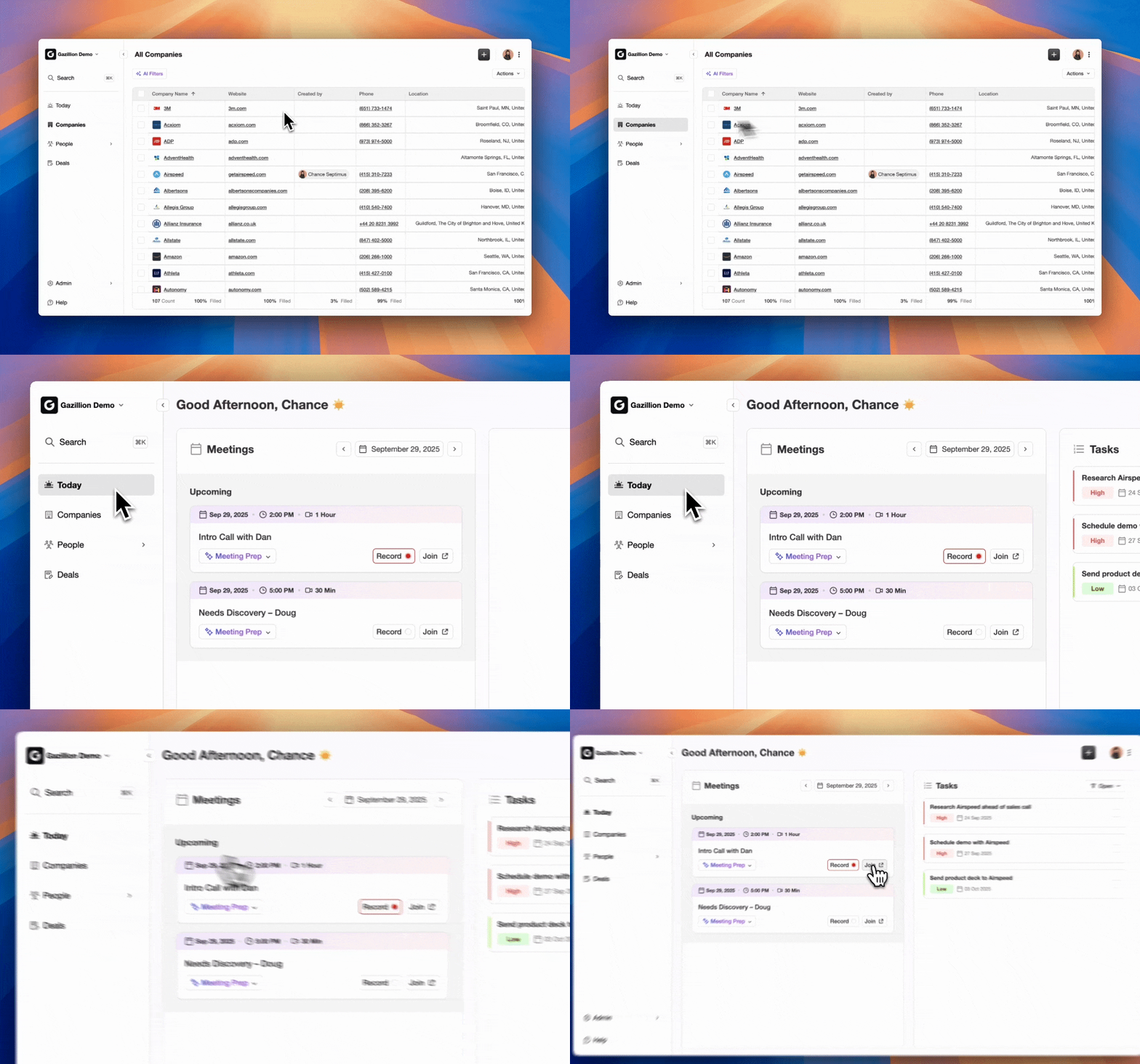
Each note and interaction links automatically to the correct contact and company record. Activity logging, including last activity, next activity, and deal state, updates on its own. The CRM reflects reality after every call, and reps do not need to touch the keyboard.
Step 2: Extract BANT, MEDDIC, and SPICED Signals from Transcripts
Once a transcript exists, Coffee’s agent structures its notes using BANT, MEDDIC, or SPICED, based on the configured deal profile. BANT fits SMB deals and short sales cycles. MEDDIC fits mid-market deals with ACVs above $30k and cycles longer than 60 days. MEDDPICC fits enterprise deals with multi-stakeholder buying committees. These frameworks keep qualification consistent across every rep and call.
Objective signals such as dates, stakeholder names, and next steps can flow directly into structured CRM fields, while higher-judgment signals like risk level should first trigger alerts and human review. To make these extractions accurate instead of generic, Coffee lets teams define and store deep context on business model, ICP, and competitors. The agent then evaluates BANT or MEDDIC signals against your specific sales motion instead of applying one-size-fits-all logic.
High-value fields such as deal value, close date, and contact identity should stay human-owned at first. Coffee surfaces these as agent suggestions for one-click confirmation instead of silent overwrites. This approach preserves data integrity while the team builds trust in the workflow.
Step 3: Sync with a Structured CRM Field Mapping
Coffee’s summary templates are customizable to match existing workflows and can write back to HubSpot or Salesforce through native connectors. The table below gives RevOps teams a ready-to-use field mapping reference when they configure the sync layer.
| Salesforce Field | HubSpot Property | Coffee Agent Output | Example Value |
|---|---|---|---|
| Next_Step__c | hs_next_step | Extracted next-step commitment from transcript | “Send security review doc by Friday” |
| Budget_Confirmed__c | ql_budget_confirmed | BANT Budget signal | “$48,000 annual, approved by CFO” |
| Economic_Buyer__c | ql_economic_buyer | MEDDIC Economic Buyer signal | “Sarah Chen, VP Revenue Operations” |
| Decision_Timeline__c | ql_decision_timeline | BANT/MEDDIC Timing signal | “Q3 2026, before fiscal year close” |
| Identified_Pain__c | ql_identified_pain | MEDDIC/SPICED Pain signal | “Reps spend 10+ hrs/week on manual CRM entry” |
| Competitor_Mention__c | ql_competitor_mention | Competitor flag from transcript | “Evaluating Gong; concerned about cost” |
| Call_Summary__c | hs_call_summary | Automated post-call summary | “Discovery call: confirmed budget, identified champion, next step agreed” |
Validation rules must enforce data types so date fields reject text and dropdowns reject free-form input. These constraints remove normalization work that usually lands on RevOps. Coffee’s native connectors respect these rules at the moment of write-back.
Step 4: Output Pipeline Insights and Follow-ups
Clean, structured data flowing into the CRM after every call powers Coffee’s Pipeline Compare feature. This view highlights week-over-week changes automatically, including progressed deals, stalled opportunities, and new additions. Pipeline reviews shift from interrogation sessions to strategic conversations, and managers no longer need CSV exports.
After each call, the agent drafts follow-up emails in Gmail for the rep to review and send. It also creates next-step tasks with due dates mapped to the decision timeline extracted in Step 2. Custom Meeting Briefings and Summaries, launched in February 2026, let teams define exact formats such as high-level executive summaries or granular technical breakdowns. Every output then matches the audience that receives it.

How to Validate Quality Before Scaling
Three quality dimensions should be verified before you roll the workflow out to the full team. Extraction quality checks whether the agent correctly identifies the customer signal. Mapping quality confirms that each signal lands in the right CRM field. Action quality measures whether the output enables the next piece of work. A pilot review across these three dimensions should come before any expansion of automated field write-back.
For a 10-rep team after 30 days, strong benchmarks include a CRM field completion rate above 85% compared with a typical 30–40% baseline where records lack complete information. Manual CRM entry time should drop by at least 50%. Pipeline Compare accuracy should match closed-won outcomes from the prior quarter. AI reaches 99%+ accuracy in data extraction tasks, compared to 96–99% for manual entry, which sets a clear quality ceiling to aim for.
Deployment Models and Governance as You Scale
Coffee operates in two deployment models that fit different stages of growth. As a Standalone CRM, it serves companies of 1–20 employees that have outgrown spreadsheets but view legacy CRMs as expensive maintenance burdens. As a Companion App, it runs as an intelligent layer on top of existing Salesforce or HubSpot instances and handles the “data in” process without forcing a CRM migration.
Governance requirements increase with team size, even though licensing remains predictable. For 1–15 reps, a shared rule log and one owner per rule are usually enough. For 15–50 reps, quarterly audits and sandbox testing before deployment become necessary. For 50+ reps, RACI matrices, change control tickets, and rollback procedures are required. Coffee’s seat-based pricing model includes the agent’s labor without extra metering, so governance overhead, not usage cost, becomes the main scaling variable. Sales teams using automation often report higher close rates and pipeline conversion, which makes the governance investment worthwhile at every stage.
Frequently Asked Questions
How long does initial setup take?
For the Companion App model on Salesforce or HubSpot, setup starts with a simple authentication that lets Coffee’s agent connect to the existing CRM instance. Most teams begin capturing, extracting, and syncing meeting data within the same business day. The field mapping template above speeds configuration by giving RevOps pre-built signal-to-field assignments they can adapt instead of creating from scratch. Custom methodology templates such as BANT, MEDDIC, or SPICED are selected during onboarding and can be adjusted per deal stage without engineering support.
Is Coffee SOC 2 Type 2 and GDPR compliant?
Yes. Coffee is SOC 2 Type 2 certified and GDPR compliant, and customer data does not train public AI models. For U.S. teams that operate across multiple states, Coffee’s recording configuration supports the consent requirements of all-party consent jurisdictions. Teams in regulated industries should confirm their specific compliance posture with Coffee’s team before activating call recording, because requirements vary by sector and geography.
Can the agent write directly into Salesforce or HubSpot custom fields?
Yes. Coffee’s native connectors support write-back to both standard and custom fields in Salesforce and HubSpot. The November 2025 summary template update enabled customizable outputs that write back to either platform. For high-judgment fields such as deal value, close date, and economic buyer identity, Coffee surfaces extracted values as agent suggestions for one-click rep confirmation before committing them to the CRM record. This safeguard keeps humans in control of the fields that most affect forecast accuracy.
How does the workflow change as the team grows from 5 to 50 reps?
At 5 reps, the workflow runs with light governance, a single RevOps owner, a shared field mapping template, and weekly extraction quality reviews. At 15–25 reps, stage-aware extraction logic becomes useful, with different methodology templates assigned to discovery calls and late-stage calls so qualification signals stay in context. At 50 reps, Coffee’s Pipeline Compare output feeds directly into structured pipeline review cadences and replaces manual manager prep with agent-generated deal movement summaries. Across this growth curve, Coffee’s seat-based pricing keeps the agent’s labor scalable without per-process or per-LLM-call fees creating unpredictable costs.
Conclusion: Turn Every Call into Reliable CRM Data
The four-step workflow of Capture, Extract, Sync, and Output closes the gap between what happens on a sales call and what appears in the CRM. As noted earlier, poor data quality drives failed AI projects, and the 40% cancellation rate Gartner predicts stems from unreliable inputs, not flawed algorithms. Teams that solve data quality first compound the impact of every downstream AI investment. Coffee’s agent addresses this by capturing every interaction, structuring each signal, and populating fields without turning reps into data entry clerks.
Coffee works as a standalone CRM for a 10-person team or as a companion layer on an existing Salesforce or HubSpot instance. In both models, it focuses on getting good data in so leaders can trust the insights that come out, week over week and call after call.
Explore Coffee’s plans and start making every meeting count toward pipeline accuracy.