Written by: Doug Camplejohn, CEO & Co-Founder, Coffee | Last updated: July 11, 2026
Key Takeaways for AI Sales Leaders
- Artisan Ava delivers fully autonomous outbound SDR workflows but depends on external databases that lose accuracy over time, which limits pipeline quality.
- Monaco CRM provides a hybrid workspace with human oversight but still relies on manual data entry, creating bottlenecks and forecast inaccuracies.
- Coffee solves the root data-quality problem by automatically capturing and enriching records from emails, calendars, and call transcripts without human input.
- Teams using Coffee see forecast variance shrink from ±20% to ±5–8% within 3–6 months while recovering 8–12 hours of rep time per week.
- See Coffee’s pricing and deployment options to eliminate manual CRM maintenance and unlock accurate, agent-driven pipeline intelligence.
Evaluation Criteria for Comparing Ava, Monaco, and Coffee
A clear comparison of Artisan Ava, Monaco CRM, and Coffee rests on six core criteria that match the decisions Series A+ teams face.
- Automation depth and human-in-the-loop requirements, meaning how much human oversight the tool demands at each workflow stage.
- CRM dependency, meaning whether the tool requires, replaces, or augments an existing CRM.
- Data capture quality, meaning how the tool ingests, structures, and maintains contact and activity data.
- Pipeline accuracy, meaning the forecast reliability the tool enables downstream.
- Setup burden, meaning implementation timeline and RevOps hours required.
- Pricing and TCO, meaning seat or usage costs plus hidden admin overhead.
Scalability across stages from seed to mid-market appears in the decision framework section below.
Side-by-Side Comparison Table (2026 Estimates)
The table below maps each tool’s strengths and constraints across the six criteria. The key pattern is simple. Artisan Ava and Monaco CRM both inherit the data quality problem from external databases or human entry. Coffee captures ground-truth data directly, so pipeline intelligence improves as the agent works.
| Criteria | Artisan Ava | Monaco CRM | Coffee (Standalone / Companion) |
|---|---|---|---|
| Automation depth | Fully autonomous outbound SDR, handles research, outreach, follow-up, and meeting booking without per-step human input | Hybrid revenue workspace, human approval required for key decisions | Autonomous data capture, enrichment, meeting management, and pipeline intelligence, agent handles all CRM data entry |
| Human-in-the-loop requirement | Call steps queued to human dialer, no autonomous phone capability | Human review required before high-value outbound actions | Human reviews and sends AI-drafted follow-ups, agent handles all logging and enrichment autonomously |
| CRM dependency | Syncs to Salesforce or HubSpot, does not replace CRM | Functions as the CRM replacement, standalone revenue workspace | Operates as standalone CRM or as companion agent on Salesforce / HubSpot |
| Data capture quality | 300M+ record database with technographic, firmographic, and intent enrichment | Relies on human-confirmed data entry for record accuracy | Agent auto-creates contacts, logs activities, and enriches records from email, calendar, and call transcripts without human input |
| Pipeline accuracy | Dependent on CRM data quality, stale records produce outreach to contacts who have left roles | Dependent on human data entry discipline for forecast reliability | Agent-maintained records enable the forecast accuracy improvement described above |
| Setup burden | 2–3 weeks initial setup, ongoing content tuning and governance required | CRM migration adds 4–8 weeks, data mapping and field configuration required | Authentication to Google Workspace or Microsoft 365, agent begins populating records immediately |
| Pricing / TCO (2026 estimates) | Custom pricing for moderate volume | Seat-based, CRM replacement adds migration and retraining costs | Seat-based pricing, agent labor included, no per-process metering |
| Scalability | Best for teams comfortable removing most human oversight from SDR workflows | Scales with team size but inherits manual data entry burden at scale | Serves 1–20 person teams on standalone and scales to mid-market as Salesforce / HubSpot companion |
Setup and Onboarding Effort Across the Three Tools
Implementation timelines differ sharply and create real RevOps cost that vendors rarely disclose upfront. AI sales tool purchases carry an integration tax consisting of CRM synchronization, field mapping, workflow configuration, user training, and ongoing governance that typically requires 2–6 weeks of RevOps time and often exceeds the first-year subscription cost.
Artisan Ava usually requires 2–3 weeks of initial setup for data integration and content configuration. Mid-market teams evaluating AI SDR tools typically run a 60–90 day pilot that includes 2–3 weeks of initial setup and data integration. AI SDR deployments require 20–40 hours of initial setup and configuration plus 5–15 hours per month of ongoing optimization and monitoring.
Monaco CRM’s implementation burden is even higher because it functions as a workspace replacement rather than an add-on. Teams that skip data preparation when implementing AI sales tools add 3–4 weeks to every deployment timeline. For teams migrating from Salesforce or HubSpot, field mapping and historical data transfer extend this further.
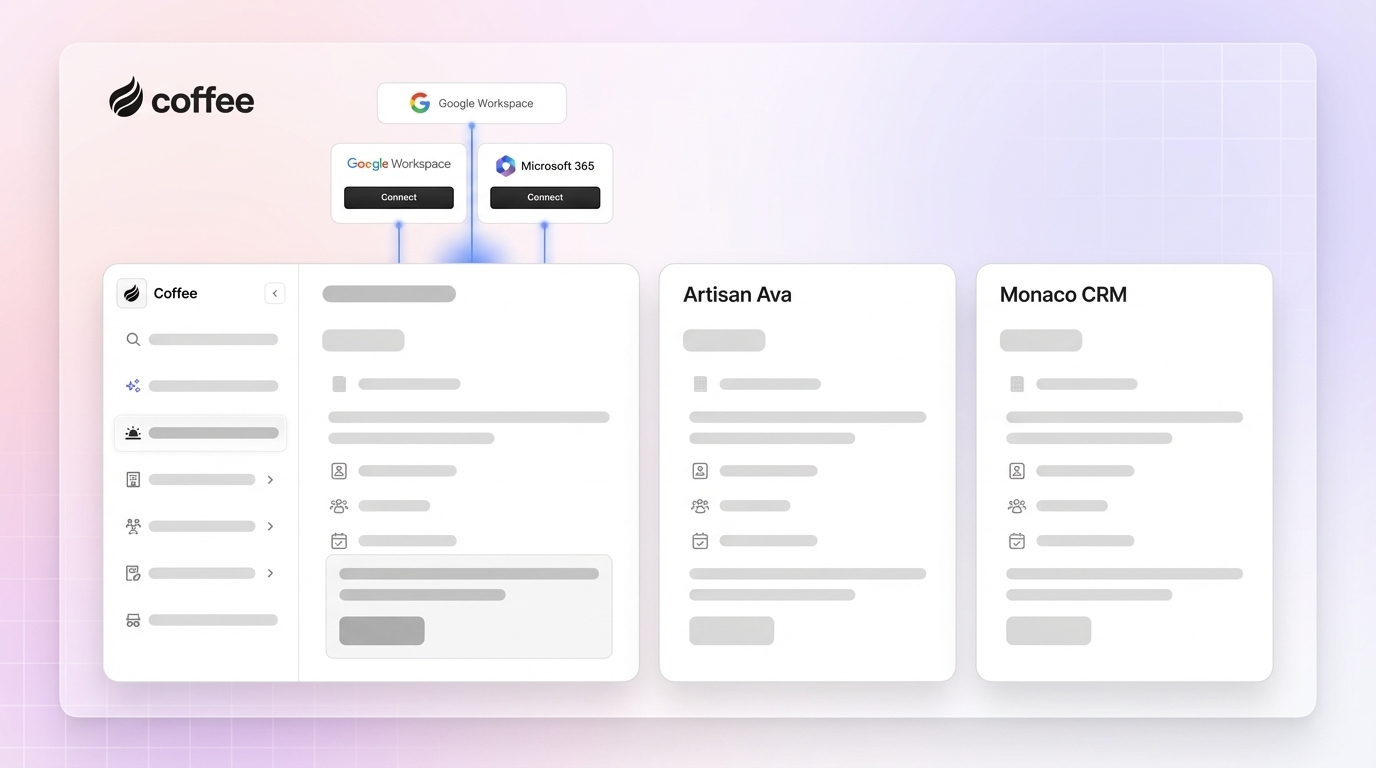
Coffee’s onboarding starts with a single authentication to Google Workspace or Microsoft 365. The agent immediately scans emails and calendars to auto-create contacts and companies, log activities, and begin enriching records. No manual field mapping or data migration is required for the Companion App deployment.

Autonomous vs Human-in-the-Loop Outreach Performance
Salesforce’s 2026 State of Sales report, based on a survey of over 4,000 global sales professionals, finds that 54% of organizations are deploying AI agents. This rapid adoption makes the performance gap between AI and human SDRs a critical planning input.
AI SDRs convert meetings to qualified opportunities at 15% versus 25% for human SDRs, a 40% performance gap driven primarily by deficits in relationship building, objection handling, and contextual judgment. Artisan Ava’s fully autonomous model maximizes volume. AI sales agents can handle 500–2,000 touches per day versus 50–100 for human SDRs, yet this volume advantage erodes when the underlying contact data is stale.
Monaco’s human-in-the-loop model preserves judgment at high-value decision points but reintroduces the manual bottleneck that autonomous tools aim to remove. High-volume teams often value the speed of autopilot agents, while enterprise sales usually requires a person to stay involved.
Companies that use AI to augment rather than replace human SDRs often see more pipeline than those attempting full replacement. Coffee’s model embodies this augmentation approach. The agent handles all data capture and enrichment autonomously, while human reps review AI-drafted follow-ups before sending, which concentrates human judgment where it produces the highest return.

Data Quality and Pipeline Intelligence Outcomes
Poor data quality blocks many AI sales projects from reaching ROI targets. The term “agentic AI” simply refers to AI agents that take actions on behalf of users, which magnifies any underlying data issues.
Both Artisan Ava and Monaco CRM face this risk. Artisan Ava’s outreach quality degrades when its 300M+ contact database surfaces contacts who have changed roles. UK B2B contact databases lose roughly 25–30% accuracy within a year on average across all channels. Monaco CRM’s pipeline intelligence depends on human data entry discipline that many organizations cite as their primary AI adoption barrier.
Coffee addresses this at the source. The agent captures ground-truth data from emails, calendars, and call transcripts automatically, so the records feeding pipeline intelligence stay current. Teams typically see forecast variance shrink from ±20% to ±5–8% after 3–6 months of model tuning, provided sales stages are clearly defined and activities are logged. The Coffee Agent handles the logging requirement without human effort.

Integration Choices for Salesforce and HubSpot Teams
For teams already standardized on Salesforce or HubSpot, the key integration question focuses on how deeply and reliably a tool writes data back to the system of record.
Artisan Ava syncs booked meetings and contact records to Salesforce or HubSpot but does not resolve the underlying data quality problem inside those systems. Outreach activity logged by Ava is only as useful as the CRM fields it writes to, and when CRM data is stale, duplicated, or unconstrained, AI agents optimize against noise, producing outreach to contacts who left or scoring against outdated firmographics.
Monaco CRM, as a replacement workspace, requires teams to migrate away from Salesforce or HubSpot entirely. That decision carries significant switching costs for organizations with established quotas, forecasting workflows, required fields, and custom objects built over years.
Coffee’s Companion App is purpose-built for teams committed to Salesforce or HubSpot. A single authentication allows the Coffee Agent to sync data, enrich it, and write valuable insights back to the primary CRM. The agent handles the data-in process so the existing system of record becomes accurate without human effort, which preserves all existing CRM infrastructure while removing the manual maintenance burden.
Explore Coffee’s Companion App pricing for Salesforce and HubSpot teams to see how this works with no migration required.
Measurable Time Savings for Reps
The gap between AI-enabled and lagging B2B sales teams often shows up as several hours per day returned to reps. Coffee’s agent delivers the time savings outlined above by automating contact creation, activity logging, meeting briefings, and post-call summaries, tasks that typically consume 8–12 hours per rep per week when done manually.

Analytic Partners significantly reduced account research time using AI account intelligence tools, while growing qualified pipeline 40% year-over-year. Sales teams can save hours per week per rep after adopting AI-driven GTM tooling.
Businesses using AI SDR agents report a 317% annual ROI on average; teams with clean data see returns in 3–4 months while poor data hygiene extends timelines to 6–9 months or results in churn. Coffee’s agent-maintained data quality places teams at the faster end of this payback range.
Stage-Based Tool Selection: Seed Through Series B
Stage-based fit matters as much as feature depth. The right tool depends on team size, existing CRM investment, and whether outbound volume or data quality is the primary constraint.
Choose Artisan Ava if:
- Your team has no existing SDR function and needs immediate outbound volume.
- You feel comfortable with fully autonomous outreach and have clean ICP data to seed the agent.
- Your deal cycle is short enough that meeting-to-opportunity conversion gaps are acceptable.
Choose Monaco CRM if:
- You are replacing a legacy CRM and want a hybrid workspace with human oversight built in.
- Your team does not have an existing Salesforce or HubSpot investment worth preserving.
- You prioritize workflow consolidation over autonomous outbound execution.
Choose Coffee if your primary constraint is data quality rather than outbound volume. Coffee serves two main profiles. First, 1–20 person teams that have outgrown spreadsheets but find HubSpot or Pipedrive to be expensive manual chores, where Coffee’s Standalone CRM provides an agent-powered system of record from day one. Second, 20–80 person Series A+ teams already on Salesforce or HubSpot with low CRM adoption and dirty pipeline data, where Coffee’s Companion App fixes the data-in problem without a CRM migration. In both cases, Coffee fits when you need pipeline intelligence accurate enough to replace manual CSV exports and weekly interrogation sessions, or when you want to consolidate enrichment, recording, and forecasting tools into a single agent instead of managing a fragmented stack.
Apollo.io fits seed through Series B teams for prospecting and basic sequencing, while deal management and forecasting tools should not be purchased until the pipeline contains enough deals to justify dedicated forecasting infrastructure. Coffee bridges this gap by delivering pipeline intelligence as a native output of agent-maintained data, without requiring a separate forecasting platform.
Pricing and Total Cost of Ownership (2026 Estimates)
Artisan Ava uses custom pricing. Mid-market outbound teams at Series A–B companies spend on AI SDR tools for sophisticated targeting, higher send volumes, multi-channel outreach, and deeper CRM integration, usually requiring a dedicated RevOps owner.
Monaco CRM’s seat-based pricing must be evaluated against the full cost of migrating from an existing CRM, including data mapping, retraining, and the loss of established Salesforce or HubSpot workflows. Legacy platforms like Marketo can exceed $80,000–$100,000+ in Year 1 TCO due to licensing, onboarding, and admin resource costs, which shows how quickly CRM replacement projects escalate beyond initial seat pricing.
Coffee uses seat-based pricing where the agent’s unlimited labor is included. There is no per-process metering on LLM usage, no separate enrichment tool subscription, and no add-on required for pipeline intelligence. For teams currently paying separately for ZoomInfo, Gong, and a forecasting layer, Coffee’s consolidation model reduces both cost and operational complexity.
Risks, Limitations, and Common Misconceptions
Three recurring misconceptions often push teams toward the wrong tool choice.
Misconception 1: Autonomous agents are “set it and forget it.” AI SDR platforms are not set-it-and-forget-it solutions; all tools reviewed require hands-on setup, ongoing content tuning, and thoughtful governance to avoid off-brand messaging or mishandled objections. Artisan Ava needs continuous prompt and sequence optimization to maintain outreach quality.
Misconception 2: A new CRM workspace solves the data quality problem. Monaco CRM’s hybrid model improves human oversight but does not eliminate the dependency on human data entry. The RevOps Co-op Q1 2026 survey of 412 stalled or canceled AI SDR deployments identified dirty CRM data producing bad outreach at scale as the top failure mode. Switching CRM platforms without fixing the data-entry process recreates the same problem in a new interface.
Misconception 3: High meeting volume equals pipeline quality. Weak meeting-to-opportunity conversion, approximately 15% for AI SDRs versus approximately 25% for human SDRs, is among the top failure modes identified in stalled AI SDR deployments. Volume without conversion quality inflates pipeline and distorts forecasts. UserGems 2026 research reports 50–70% annual churn on AI SDR tools. This pattern reinforces the earlier point about data decay rates of roughly 25–30% per year.
Practical Decision Framework by Company Profile
The framework below links tool selection to company constraints across three dimensions: company size, CRM dependency, and autonomy preference.
- 1–20 employees, no existing CRM, want full automation: Coffee Standalone CRM, where the agent manages the system of record from day one with no manual setup.
- 20–80 employees, committed to Salesforce or HubSpot, low CRM adoption: Coffee Companion App, where the agent fixes data quality inside the existing system without migration.
- 20–80 employees, no CRM investment, need immediate outbound volume: Artisan Ava, suitable for teams comfortable with fully autonomous SDR workflows and clean seed data.
- 20–80 employees, replacing a legacy CRM, want human oversight on key decisions: Monaco CRM, a hybrid workspace with human-in-the-loop controls that still requires data migration.
- Any stage, primary constraint is pipeline data quality and forecast accuracy: Coffee, the only option that resolves the data-in problem as a prerequisite to accurate data-out.
Frequently Asked Questions
How long does it take to implement Coffee compared to Artisan Ava or Monaco CRM?
Coffee’s Companion App deploys via a single authentication to Google Workspace or Microsoft 365. The agent begins auto-creating contacts, logging activities, and enriching records immediately after connection, with no field mapping, data migration, or RevOps configuration required. Artisan Ava typically requires 2–3 weeks of initial setup for data integration and sequence configuration, plus ongoing monthly optimization. Monaco CRM, as a CRM replacement, adds data migration complexity that can extend onboarding to 4–8 weeks depending on the size of the existing database and the number of custom fields being mapped. Coffee’s Standalone CRM follows a similar fast-start model for teams without an existing CRM investment.
Does Coffee work if my team is already on Salesforce or HubSpot, or does it require a migration?
Coffee is specifically designed for teams committed to Salesforce or HubSpot. The Companion App deploys as an intelligent layer on top of the existing instance. The Coffee Agent handles the data-in process, auto-creating contacts, logging call transcripts, enriching records, and writing pipeline intelligence back to the CRM, without requiring any migration. All existing Salesforce or HubSpot infrastructure, including quotas, forecasting workflows, required fields, and custom objects, remains intact. This reflects a deliberate design decision, based on deep knowledge of Salesforce and HubSpot integration complexity that newer CRM alternatives lack.
How does Coffee address the data quality problem that undermines both Artisan Ava and Monaco CRM?
Both Artisan Ava and Monaco CRM depend on data that humans either enter manually or that ages out of accuracy over time. Coffee resolves this at the source by deploying an agent that captures ground-truth data directly from emails, calendars, and call transcripts, structured and unstructured data alike, without requiring human input. Every contact, activity, and interaction is logged automatically. Because the agent maintains a built-in data warehouse with historical context, the pipeline intelligence Coffee produces reflects what is actually happening in deals rather than what reps remembered to log. Coffee prevents bad data from entering the system instead of trying to improve on top of it.
Is Coffee secure, and does it use my data to train AI models?
Coffee is SOC 2 Type 2 and GDPR compliant. Customer data is not used to train public AI models. For teams in regulated industries or those with data residency requirements, Coffee’s compliance posture supports standard enterprise security reviews. The agent connects to Google Workspace or Microsoft 365 via standard OAuth authentication, and data access is scoped to the permissions granted during setup.
What happens to the tools I am already paying for, such as ZoomInfo, Gong, and a forecasting add-on?
Coffee is designed to consolidate the fragmented point-solution stack that most Series A+ sales teams have accumulated. The Coffee Agent performs the functions of a data enrichment tool by augmenting records with job titles, funding data, and LinkedIn profiles via licensed data partners. It replaces a standalone call recording and transcription tool by joining Zoom, Teams, and Google Meet calls to record, transcribe, and generate structured summaries. It replaces manual pipeline review exports with the Pipeline Compare feature, which visualizes week-over-week deal changes automatically. Teams that consolidate onto Coffee typically eliminate separate subscriptions for enrichment, recording, and forecasting, which reduces both cost and the operational overhead of managing multiple vendor integrations.
Conclusion: Match the Right Agent to Your Constraints
Artisan Ava and Monaco CRM address real problems in the AI sales stack, yet both leave the data quality root cause unresolved. Artisan Ava maximizes outbound volume while remaining dependent on contact data that loses around 30% accuracy annually, as noted earlier. Monaco CRM improves human oversight while preserving the manual data entry dependency that causes many AI CRM initiatives to miss ROI expectations. Coffee is the only agent-based solution that fixes the data-in problem as a prerequisite, whether deployed as a standalone CRM for early-stage teams or as a companion layer for organizations already invested in Salesforce or HubSpot.
Compare Coffee’s Standalone and Companion App pricing to find the right fit for your team size and CRM investment.