Written by: Doug Camplejohn, CEO & Co-Founder, Coffee
Key Takeaways for Startup Sales Leaders
- Lean startups in 2026 win when revenue intelligence, buyer engagement, content, and CRM all share unified, clean data. That foundation drives accurate forecasts and more selling time.
- Agent-first systems like Coffee automate data entry from emails, calendars, and transcripts, cutting the non-selling time reps currently lose to manual CRM work.
- Traditional revenue intelligence and point solutions depend on accurate CRM inputs. Coffee fixes the upstream data-quality problem so those tools deliver reliable insights.
- Consolidating to a 5-tool stack anchored by Coffee reduces tool sprawl, saves about 54 minutes per rep daily, and improves quota attainment by feeding clean data to every downstream platform.
- Start scaling revenue without scaling headcount—see Coffee’s pricing and start your free trial today.
To understand where Coffee fits in the 2026 sales enablement landscape, compare how agent-first automation, traditional revenue intelligence platforms, and point solutions differ across five critical capabilities.
Three-Way Comparison: Agent-First Automation vs. Traditional Revenue Intelligence vs. Point Solutions
| Capability | Coffee (Agent-First) | Traditional Revenue Intelligence (Gong, Clari) | Point Solutions (Apollo, Highspot, Spekit) |
|---|---|---|---|
| Data entry | Fully automated via agent ingesting email, calendar, and call transcripts | Requires manual CRM hygiene upstream, analyzes data it receives | Each tool requires its own data input or separate integration |
| Forecast accuracy | High, because the agent ensures clean inputs for more reliable forecasting | Dependent on CRM data quality fed from other tools | Not a core function, requires separate forecasting layer |
| Tool count | One agent replaces CRM, enrichment, recording, and forecasting | Adds to existing stack, does not reduce tool count | Three to five separate tools required for prospecting, engagement, content, recording, and analytics |
| CRM compatibility | Standalone CRM or Companion App on Salesforce or HubSpot | Integrates with existing CRM, does not replace it | Varies by tool, integration depth inconsistent |
| Rep adoption driver | Agent handles busywork, reps interact with outputs, not inputs | Reps must still log data for intelligence to function | Adoption varies, content tools require rep-initiated use |
Consolidate your stack with Coffee and replace fragmented tools with a single agent layer.
Why Manual Data Entry Kills Enablement ROI
Sales reps often spend more than one hour per day on manual CRM data entry. Salesforce’s 2026 State of Sales report shows reps spend only about 28% of their time actively selling. The remaining 72% goes to logging notes, hunting for decks, and chasing approvals.
The downstream damage is severe. 76% of CRM users report that less than half of their organization’s CRM data is accurate and complete. This data quality problem carries a direct financial cost: poor CRM data quality costs the average B2B company $12.9 to $15 million per year in lost productivity, missed opportunities, and wasted marketing spend. Many data and analytics leaders agree that AI outputs are only as good as their data inputs, so every AI tool layered onto a dirty CRM amplifies the inaccuracy rather than correcting it.
Coffee’s agent eliminates this failure mode at the source. After connecting Google Workspace or Microsoft 365, the agent auto-creates contacts and companies, logs every activity, and enriches records with job titles, funding data, and LinkedIn profiles, without a rep touching a field. AI-driven CRM automation saves sales professionals an average of about 54 minutes per day on data entry, equivalent to about 4.5 hours per week per rep.
That clean, automatically captured data becomes the foundation for every downstream tool in the sales stack, starting with revenue intelligence platforms.
How Coffee Feeds Revenue-Intelligence Tools Clean Data
Revenue intelligence platforms depend on behavior and pipeline signals, requiring reliable data flows from engagement and content systems into the analytics layer to deliver unified visibility across the buyer journey. Tools like Gong and Clari are powerful analyzers, but they only analyze whatever the CRM contains. When that data is incomplete, their outputs become unreliable.
Coffee solves the upstream problem. Its Pipeline Compare feature visualizes week-over-week deal changes automatically, highlighting progressed deals, stalled opportunities, and new additions without manual CSV exports. Coffee’s AI search on deals, released in January 2026, answers natural-language questions such as “Which deals are stuck in negotiation?” or “What is closing this month?”. This delivers revenue intelligence natively, without a separate platform.
For teams already running Gong or Clari, Coffee’s Companion App feeds those tools the clean, structured data they need to function accurately. It acts as the data-quality layer those platforms assume exists but cannot create themselves.
Buyer-Engagement Platforms That Depend on Accurate CRM Records
Buyer-engagement tools such as email sequencers, digital sales rooms, and intent-signal platforms personalize outreach based on CRM records. When those records are stale or incomplete, personalization fails and sequences fire at the wrong contacts with the wrong context.
Coffee’s Visitor Identification feature closes this gap at the top of the funnel. A single tracking pixel identifies anonymous website visitors by name, title, email, and LinkedIn profile, then surfaces real-time Slack notifications for high-fit visitors. Unlike standalone tools such as RB2B or Warmly that surface company-level data or undifferentiated people lists, Coffee’s Suggested Leads feature uses the buyer persona to recommend the two or three specific individuals inside a visiting company most worth contacting, with enrichment pre-filled and ready for outbound.

The List Builder extends this further. A natural-language command such as “Find me VPs of Sales in North America at companies with $10M+ funding using Salesforce” executes a targeted prospect list without manual research and feeds accurate records directly into the engagement workflow.

In-Flow Content, Training Tools, and the Agent Advantage
Only 28% of B2B content marketers report having the technology they need, and in-flow content tools like Highspot and Spekit address this by surfacing relevant content and training during live deals. Their effectiveness depends on deal-stage data being current and accurate in the CRM.
Coffee’s Custom Meeting Briefings and Summaries, launched in February 2026, allow users to define exact formats, from high-level executive summaries to granular technical breakdowns, generated automatically post-call. The Intelligence layer, introduced in February 2026, stores deep context on business model, ICP, product specifics, and competitors to generate tailored AI suggestions and insights. Reps receive contextually relevant content recommendations without a separate in-flow tool, and any existing content platform receives accurate deal-stage signals to trigger the right assets at the right moment.

The agent also structures meeting notes according to BANT, MEDDIC, or SPICED frameworks. This ensures qualification data enters the system consistently, which is a prerequisite for any coaching or training tool to function on reliable inputs.

CRM Choices for Startups: HubSpot or Salesforce vs. Agent-Native Systems
55% of CRM implementations fail to meet planned objectives, according to the Johnny Grow 2025 CRM Failure Report. Salesforce carries 25 years of legacy architecture, and HubSpot was built as a marketing tool with a CRM bolted on. Neither was designed to ingest unstructured data such as email text and call transcripts or maintain historical context when fields are updated.
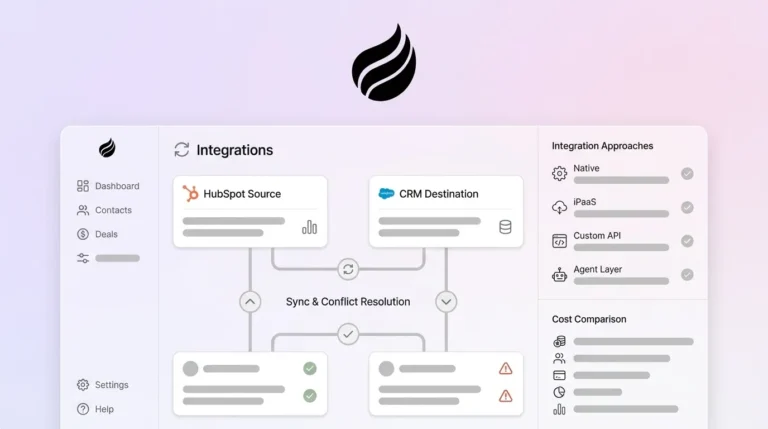
Coffee offers two paths. Teams committed to Salesforce or HubSpot deploy the Companion App, where Coffee’s agent authenticates, syncs data, enriches records, and writes insights back to the primary CRM while preserving existing workflows and eliminating manual entry. Teams ready to replace legacy systems use Coffee’s Standalone CRM, where the agent manages the entire system of record from day one. Both paths deliver the same outcome: clean data in and accurate forecasts out.
Choose your Coffee deployment model and see pricing for both Companion App and Standalone CRM options.
Building a Lean 5-Tool Starter Stack with Coffee as the Agent Layer
The average B2B sales team operates with 10 to 15 tools, but reps actively use only about 3 of them daily, a pattern that correlates with lower selling time and higher administrative burden. Nearly 70% of sales reps say they are overwhelmed by the number of tools. Stack consolidation provides the corrective.
A lean 5-tool starter stack anchored by Coffee includes:
- Coffee – agent layer handling CRM, enrichment, meeting intelligence, pipeline tracking, and visitor identification
- Gmail / Google Workspace or Microsoft 365 – email and calendar, natively integrated with Coffee’s agent
- Zoom or Microsoft Teams – Coffee’s AI meeting bot joins calls to record, transcribe, and generate summaries
- Zapier – connects Coffee to downstream tools such as Slack notifications and drip campaigns without custom engineering
- Stripe or QuickBooks – Coffee’s Stripe integration automatically imports customers, enriches them, and marks paid invoices as Closed Won, and the QuickBooks integration syncs invoices and payment statuses in real time
This stack eliminates the need for separate enrichment tools like ZoomInfo, call recording tools like Fathom, and pipeline reporting tools. It reduces both cost and the cognitive overhead of toggling between platforms.
The following metrics quantify the time and performance gains a lean startup can expect when replacing a legacy manual CRM stack with Coffee’s agent-first approach.
ROI Metrics and Time-Savings Examples from 2026 Startup Scenarios
| Metric | Legacy Stack (Manual CRM) | Coffee Agent Stack | Source |
|---|---|---|---|
| Daily non-selling time | About 72% of a rep’s day | Reduced by agent automation of logging, enrichment, and follow-ups | Salesforce |
| Time saved per rep per day | Baseline with no automation | Reflects the 54 minutes per day saved through automated CRM data capture noted earlier | Optifai |
| Forecast accuracy | Judgment-based | AI behavioral signal analysis | Sales forecasting research |
| Quota attainment lift | Baseline | 27% higher quota attainment with formalized sales enablement | Careertrainer.ai |
A concrete scenario illustrates the impact. A 10-person startup with 5 AEs running Coffee’s Companion App on HubSpot recovers roughly 4.5 hours of selling time per rep per week, based on the 54 minutes per day saved referenced above. At a $150K OTE, that recovered time represents meaningful pipeline capacity without adding headcount.
Risks, Limitations, and Common Misconceptions
AI outputs require clean inputs. This principle, established earlier, underpins every AI workflow. Coffee’s agent is designed to create those clean inputs, but teams migrating from severely degraded CRM data should expect an initial enrichment and deduplication period.
Agentic AI is not fully autonomous for high-stakes actions. AI governance requires teams to define what agents can and cannot do, with human-in-the-loop checkpoints for high-stakes actions. Coffee generates follow-up email drafts for rep review rather than sending autonomously, which is a deliberate design choice.
Coffee is not suited for large enterprises or heavily regulated industries. Complex custom Salesforce workflows at enterprise scale, or multi-year security reviews required in healthcare and finance, fall outside Coffee’s current ICP. Coffee is SOC 2 Type 2 and GDPR compliant, and data is not used to train public models, but enterprise procurement cycles are not the target use case.
Enrichment data quality. Coffee’s built-in enrichment via licensed data partners is on par with ZoomInfo for most startup use cases, removing the need for a separate enrichment subscription in the majority of scenarios.
Decision-Framework Checklist for Agent-First Adoption
Use this checklist to determine whether an agent-first approach fits your organization:
- ☐ Your team has 5–25 people and has outgrown spreadsheets or Notion
- ☐ Reps spend more than 30 minutes per day on CRM data entry
- ☐ Your pipeline reviews rely on manual CSV exports or rep self-reporting
- ☐ You run 3 or more separate tools for enrichment, recording, and forecasting
- ☐ CRM adoption is below 80% of the sales team
- ☐ You are committed to Salesforce or HubSpot but need cleaner data without adding headcount
- ☐ You want forecast accuracy above 70% without a dedicated RevOps analyst
- ☐ You need SOC 2 Type 2 compliance and Google Workspace, Microsoft 365, Zoom, Teams, or Zapier integrations
If four or more boxes apply, an agent-first layer is the correct architectural decision for your stack.
Frequently Asked Questions
What is the difference between an agent-first CRM and a traditional CRM?
A traditional CRM is a passive database. It stores data that humans enter manually and returns reports based on whatever was logged. An agent-first CRM deploys an autonomous AI agent that captures data automatically from emails, calendars, and call transcripts, enriches records without human input, and generates insights from clean, complete data. Reps using a traditional CRM spend significant time serving the software, while reps using an agent-first system like Coffee receive briefings, summaries, and pipeline updates without touching a data-entry field.
Can Coffee work alongside Salesforce or HubSpot, or does it require replacing them?
Coffee operates in two modes. The Companion App deploys Coffee’s agent as an intelligent layer on top of an existing Salesforce or HubSpot instance. The agent authenticates via a simple OAuth flow, syncs existing records, enriches them, logs all activity, and writes insights back to the primary CRM. No migration is required. Teams that want to move off legacy CRMs entirely can use Coffee’s Standalone CRM, where the agent manages the full system of record. Both models are available under seat-based pricing with no complex metering on AI usage.
How does Coffee handle data security and compliance?
Coffee is SOC 2 Type 2 certified and GDPR compliant. Customer data is not used to train public AI models. The agent connects to Google Workspace or Microsoft 365 via standard OAuth authentication, and all data processed by the agent remains within Coffee’s secure, audited infrastructure. For teams evaluating Coffee as a Companion App on Salesforce or HubSpot, the integration uses standard API authentication without requiring elevated system permissions beyond what is necessary for data sync and enrichment writes.
What tools does Coffee replace in a typical startup sales stack?
Coffee consolidates the functions of a CRM such as Salesforce, HubSpot, or Pipedrive, a data enrichment tool such as ZoomInfo or Apollo, a call recording and transcription tool such as Fathom or Gong, a pipeline reporting layer, and a website visitor identification tool such as RB2B or Warmly into a single agent. For teams using Zapier, Coffee connects to downstream engagement and notification tools without custom engineering. The Stripe and QuickBooks integrations additionally eliminate manual revenue reconciliation by automatically marking paid invoices as Closed Won and syncing payment statuses in real time.
How quickly can a 10-person startup get value from Coffee?
Coffee is designed for fast time-to-value. Connecting Google Workspace or Microsoft 365 triggers the agent to begin scanning emails and calendars, auto-creating contacts and companies, and logging historical activity. Most teams see a populated, enriched CRM within the first session. The Pipeline Compare feature becomes available as soon as deals exist in the system and provides week-over-week visibility without configuration. Meeting briefings and automated summaries activate as soon as the AI meeting bot joins the first call. Teams starting fresh on the Standalone CRM avoid lengthy implementation, professional services, and complex field-mapping exercises.
Get Started with Coffee
Legacy passive CRMs convert sales reps into data-entry clerks and produce forecasts built on incomplete records. An agent-first layer removes that failure mode, because the agent handles data in so accurate insights come out. For lean startups that need to scale revenue without scaling headcount or tool sprawl, Coffee acts as the unifying agent that makes every other tool in the stack work better or replaces the ones that do not.
Deploy your AI sales agent and eliminate manual CRM work today.