Written by: Doug Camplejohn, CEO & Co-Founder, Coffee | Last updated: June 17, 2026
Key Takeaways for Sales and RevOps Leaders
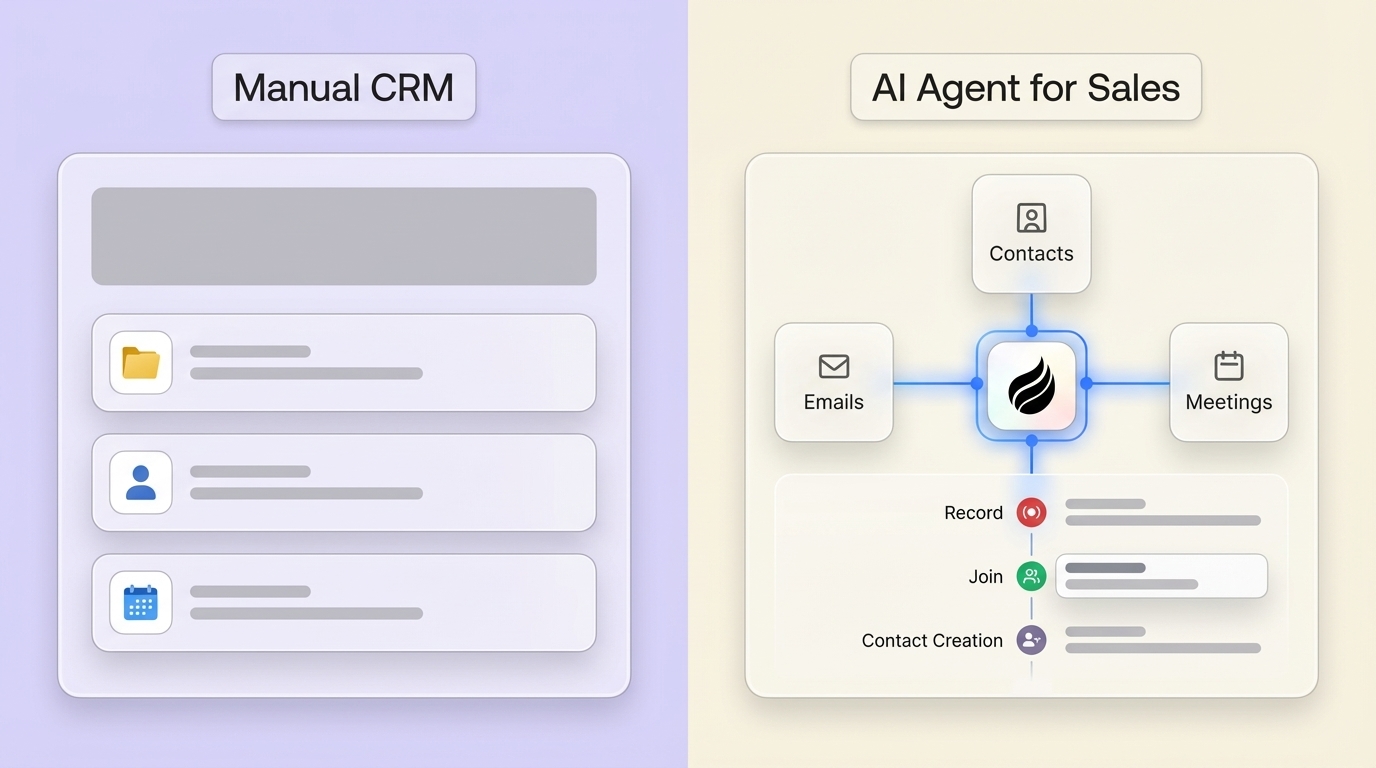
- Traditional CRMs rely on reps to type everything in, while AI-powered CRMs use agents that automatically capture emails, calendar events, and transcripts.
- AI sales agents cut data entry time from an average of 11.5 hours per week to near zero, improve accuracy, and reduce forecast variance from ±25–35% to ±8–15%.
- Automated data entry improves adoption, removes the need for shadow CRMs, and lets reps spend more time selling instead of doing admin work.
- AI agents plug into email, calendar, and transcript tools, which reduces integration complexity and supports stack consolidation with lower total cost of ownership.
- See Coffee’s pricing and estimate how much selling time your team can reclaim with an AI sales agent.
Evaluation Criteria for Comparing Manual Entry and AI Agents
This comparison evaluates both approaches across six criteria that directly affect revenue operations for 10–40 rep teams:
- Data entry time and accuracy
- Pipeline visibility and forecasting reliability
- User adoption and shadow CRM avoidance
- Integration complexity with email, calendar, and transcripts
- Total cost of ownership and scalability
- Suitability by team size and regulatory environment
For each criterion, you see the current state of manual processes, the AI agent alternative, and the practical impact for teams adopting AI in 2026.
Side-by-Side Comparison of Manual Entry vs AI Agent
| Criteria | Manual CRM Data Entry | AI Sales Agent | 2026 Impact |
|---|---|---|---|
| Data entry time | 11.5 hours/week on average | Near zero rep effort, agent logs automatically | 11.5 hrs/week reclaimed per rep for selling |
| Data accuracy | Salesforce estimates that 70% of CRM data decays annually and 91% of records are incomplete, while D&B research indicates a 30% annual decay rate | Agent ingests ground-truth data from emails and transcripts continuously | Forecast variance shrinks from ±25–35% to ±8–15% with high-quality data |
| Pipeline visibility | Stale, dependent on rep discipline | Continuous, agent tracks every deal change automatically | Eliminates manual CSV exports and pipeline review prep |
| User adoption | Low, reps treat entry as a chore | High, reps interact with outputs, not inputs | Reduces shadow CRM proliferation |
| Integration complexity | Manual toggling across CRM, enrichment, and recording tools | Single agent ingests structured and unstructured data | Stack consolidation reduces per-seat tool spend |
| Cost at scale | Grows linearly with headcount, ~$25,000/rep/year in misallocated compensation | Seat-based pricing, agent labor is unlimited and included | Favorable unit economics as team grows from 10 to 40 reps |
Review Coffee pricing and calculate time and cost savings for your team.
Data Entry Time and Accuracy in Daily Sales Workflows
The average B2B salesperson spends 11.5 hours per week on manual CRM data entry, with full automation still uncommon even in 2026.
Time pressure directly harms accuracy. Reps rush through fields to get back to selling, skip details, or log interactions days later from memory. The result is partial records and missing context that weaken every downstream report.
Salesforce estimates that 70% of CRM data decays annually and 91% of records are incomplete, while D&B research instead indicates a 30% annual decay rate. This decay accelerates in legacy relational databases, which overwrite historical context whenever a field is updated, so teams lose both current accuracy and the audit trail of how a deal evolved. An AI sales agent avoids both problems by ingesting emails, calendar events, and call transcripts into a data warehouse that preserves full interaction history without requiring a rep to type anything.
Pipeline Visibility and Forecasting Reliability from Better Inputs
Stale CRM data produces unreliable forecasts. Teams using AI-powered CRM forecasting typically see forecast variance shrink from ±25–35% to ±8–15%, but only when CRM data quality is high.
Weak inputs limit every advanced model. AI lead scoring underperforms when lead records lack predictive variables such as industry classification or deal source. The data quality problem comes before the forecasting problem and quietly caps performance.
An AI sales agent maintains a complete, timestamped deal history because it captures every interaction at the source. Pipeline reviews shift from interrogating reps about deal status to analyzing agent-generated week-over-week comparisons of progressed, stalled, and new opportunities. This richer view only exists because the agent keeps the underlying data fresh.
User Adoption and Shadow CRM Avoidance in the Real World
Low adoption is the defining failure mode of manual CRM processes. Salesforce’s State of Sales report found that reps dedicate only 35% of their workweek to actual selling, according to market data shared by Coffee. Reps who resent the system stop updating it, and managers lose visibility.
Shadow CRMs then appear as spreadsheets and Notion docs that become the real workspace while the official CRM accumulates stale records. Leaders think they have a single source of truth, but the real data lives elsewhere.
An AI agent removes the compliance burden entirely. Reps interact with briefings, summaries, and follow-up drafts the agent produces. Because they are not required to enter data, adoption shifts from a change management challenge to a product design outcome.

Integration Complexity with Email, Calendar, and Transcripts
Manual CRM workflows force reps to toggle between a CRM for records, a data enrichment tool for firmographics, a sales engagement platform for outreach, and a call recording tool for transcripts. Each handoff creates a failure point where data is lost or never transferred. The cumulative time spent on manual data entry and context switching is substantial.
An AI sales agent connects once to Google Workspace or Microsoft 365 and immediately begins ingesting structured data such as contacts and calendar events, along with unstructured data such as email threads and call transcripts. The agent handles the stitching that reps currently perform manually and writes enriched records back to the system of record, whether that is a standalone AI CRM or an existing Salesforce or HubSpot instance.

Total Cost of Ownership and Scalability for 10–40 Rep Teams
Manual CRM data entry costs organizations approximately $25,000 per rep per year in misallocated compensation, based on a rep earning $100,000 annually who spends 25% of their time on administrative tasks. For a 20-rep team, that equals $500,000 in annual compensation directed at data entry rather than selling.
AI sales agent pricing is typically seat-based, with the agent’s labor included at no additional metered cost. As headcount grows from 10 to 40 reps, the agent scales without adding administrative overhead. Stack consolidation, which replaces separate enrichment, recording, and forecasting tools with a single agent, further reduces per-seat spend.
Where AI Agents Can Replace Manual Data Entry in Sales
AI agents excel at repetitive, data-intensive tasks such as research, scheduling, data entry, and document analysis, while human workers retain advantages in creativity, emotional intelligence, and strategic judgment. For CRM data entry tasks such as logging calls, updating contact records, and tracking deal stages, AI agents act as a direct and superior replacement in most commercial sales environments.
Exceptions exist. Heavily regulated industries such as healthcare and financial services may require human review of every logged interaction before it enters a system of record. Very small teams of fewer than five reps with low call volume may find that the setup investment exceeds the time savings in the short term. Outside these cases, the productivity math favors automation decisively.
Best Fit by Team Size and Existing Tech Stack
Teams of 1–20 reps that have outgrown spreadsheets but find Salesforce or HubSpot too maintenance-heavy are the natural fit for a standalone AI-first CRM. The agent manages the system of record from day one, and there is no legacy architecture to work around.
Teams of 10–40 reps already committed to Salesforce or HubSpot are the fit for an AI companion layer. The agent authenticates once, enriches records, logs activities, and writes insights back to the existing CRM without displacing the system of record or requiring a migration. RevOps retains the forecasting infrastructure already in place, and the agent eliminates the data quality problem that undermines it.

Operational Steps When Moving from Manual to AI
A common deployment mistake is automating processes that should first be redesigned, which scales inefficiency faster instead of improving it. RevOps teams benefit from auditing which CRM fields are actually used in forecasting, which are populated inconsistently, and which can be deprecated. The agent then captures only what is operationally necessary and reduces noise in the system of record.
Cross-functional ownership matters because Sales, RevOps, and IT each have a stake in CRM data quality. Without a clear owner, configuration decisions get delayed or handled inconsistently across teams. Assigning a single owner for agent configuration, including field mapping, enrichment rules, and meeting bot permissions, ensures the agent matches how the team actually works and prevents the adoption failures that appear when tools do not fit the workflow.
Realistic Risks and Common Misconceptions
Deploying an AI agent on top of a broken process accelerates the broken process. If deal stages are defined inconsistently or required fields are ignored, the agent will log interactions against a flawed schema. Data quality parity with dedicated enrichment tools like ZoomInfo is a common concern, yet for most mid-market use cases an agent with integrated enrichment via licensed data partners covers the majority of firmographic needs without a separate tool purchase.
Integration depth deserves close attention. Zapier-based connections cover many workflows but introduce latency and failure points that native integrations avoid. Teams evaluating AI sales agents should confirm which integrations are native and which are middleware-dependent before committing.
Decision Framework for Switching to an AI Sales Agent in 2026
Use the following criteria to map your situation to the right approach:
- Team size 1–20, no existing CRM commitment: Standalone AI-first CRM. The agent manages the full system of record.
- Team size 10–40, committed to Salesforce or HubSpot: AI companion layer. The agent enriches and logs, while the existing CRM remains the system of record.
- Reps spending 5+ hours/week on data entry: Automation ROI appears immediately.
- Forecast variance exceeding ±15%: Data quality is the likely root cause. An AI agent addresses the input problem that forecasting tools cannot fix on their own.
- Heavily regulated industry or fewer than 5 reps with low call volume: Evaluate whether the setup investment matches the time savings before committing.
- Shadow CRMs present (spreadsheets, Notion): A signal that adoption has already failed. An agent-first approach removes the compliance burden that caused the failure.
Connect Coffee to your stack and see your first automated CRM entries within 24 hours.
Frequently Asked Questions
How long does Coffee implementation typically take?
Coffee connects to Google Workspace or Microsoft 365 through a single authentication step. For the standalone CRM, the agent begins populating contacts and logging activities immediately after connection, and most teams are operational within a day. For the companion app on Salesforce or HubSpot, setup involves mapping Coffee’s agent outputs to existing CRM fields, which RevOps teams typically complete within one to two weeks depending on the complexity of required fields and custom objects.
Is Coffee SOC 2 Type 2 compliant?
Yes. Coffee is SOC 2 Type 2 and GDPR compliant. Customer data is not used to train public AI models. For teams in regulated industries evaluating Coffee, the compliance documentation is available upon request during the sales process.
How does Coffee’s data quality compare with dedicated enrichment tools?
Coffee integrates enrichment via licensed data partners and augments contact and company records with job titles, funding data, and LinkedIn profiles automatically. For the majority of mid-market use cases, this built-in enrichment covers the firmographic data that teams currently purchase separately through tools like Apollo or ZoomInfo. Teams with highly specialized enrichment requirements, such as specific technographic signals or niche industry classifications, may find value in supplementing Coffee’s enrichment with a dedicated tool, though most teams find the built-in coverage sufficient to eliminate the separate purchase.
Is an AI sales agent suitable for teams smaller than 10 reps?
Yes. Coffee’s standalone CRM is designed for teams of 1–20 people, including founders and early sales hires who have outgrown spreadsheets. The agent handles data entry, meeting briefings, and follow-up drafts without requiring a dedicated RevOps function to configure or maintain it. The seat-based pricing model means small teams pay only for the humans on the team, while the agent’s labor is included regardless of volume.
Conclusion: Choosing Between Manual CRM Data Entry and an AI Sales Agent
Manual CRM data entry in 2026 is a documented productivity drain, a data quality liability, and a forecasting risk. The 11.5 hours per week that reps spend on manual entry represent time pulled away from selling. With data decay rates between 30% and 70% annually and the majority of records incomplete, manual entry creates a baseline condition that undermines every downstream process.
AI sales agents solve the input problem that legacy CRMs cannot. By capturing interactions at the source and writing enriched, structured records to the system of record automatically, they deliver the accurate data that forecasting, pipeline management, and revenue intelligence require. Coffee provides this capability as a standalone CRM for teams building from scratch and as a companion layer for teams already committed to Salesforce or HubSpot, so you get good data in and accurate insights out regardless of where the system of record lives.
Start a Coffee trial and eliminate manual CRM data entry for your team today.