Written by: Doug Camplejohn, CEO & Co-Founder, Coffee
Key Takeaways For AI-Driven Data Quality
- Traditional deterministic tests alone miss unknown anomalies that silently corrupt data pipelines and erode trust.
- A two-layer architecture pairs deterministic tests for known invariants with AI observability for novel anomalies to improve pipeline data quality.
- AI-driven anomaly detection catches schema drift, null-rate spikes, distribution shifts, freshness violations, duplicates, and outliers that static rules miss.
- Self-healing capabilities such as quarantining bad records and generating root-cause explanations cut mean time to resolution from hours to minutes.
- Extending the same AI data quality layer to CRM pipelines prevents bad data from becoming bad revenue. Apply These Principles To Your Revenue Pipeline.
How AI Improves Pipeline Data Quality
AI improves pipeline data quality by learning normal data behavior and flagging deviations instead of relying only on static rules. Traditional monitoring relies on known failure modes or preset thresholds and therefore misses novel or subtle problems, while AI observability platforms use machine learning to build baselines and surface unexpected changes.
According To The CNCF Annual Survey 2024, 68% Of Organizations Cite Data Quality And Observability Gaps As The Top Blocker To Scaling Analytics And ML Workloads In Production. AI observability platforms address this by detecting deviations from historical baselines. A connector that ingests 10,000 rows daily for six months and then drops to 2,000 rows still signals a problem even when the sync technically succeeds.
Key anomaly detection categories that AI observability platforms cover include:
- Schema Drift: Detecting added, removed, or type-changed columns.
- Null-Rate Anomalies: Flagging unexpected spikes in missing values.
- Distribution Shifts: Identifying changes in the statistical shape of data.
- Freshness Violations: Alerting when data is late or stale.
- Duplicates: Catching primary key collisions or duplicate records.
- Outliers: Spotting values that fall outside expected ranges.
The Two-Layer Model: Deterministic Tests And AI Observability
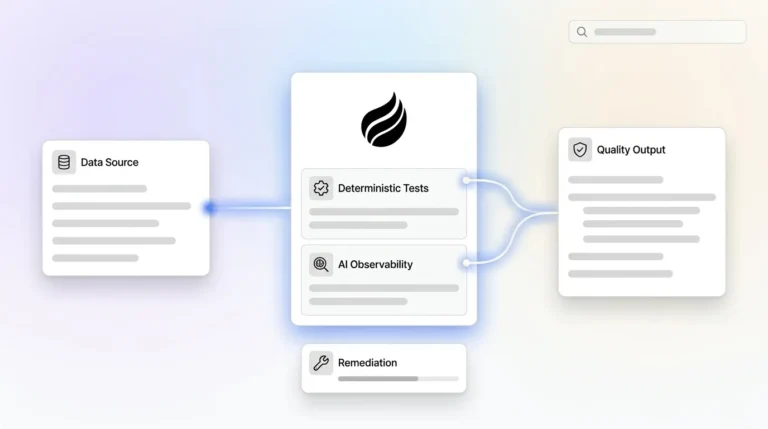
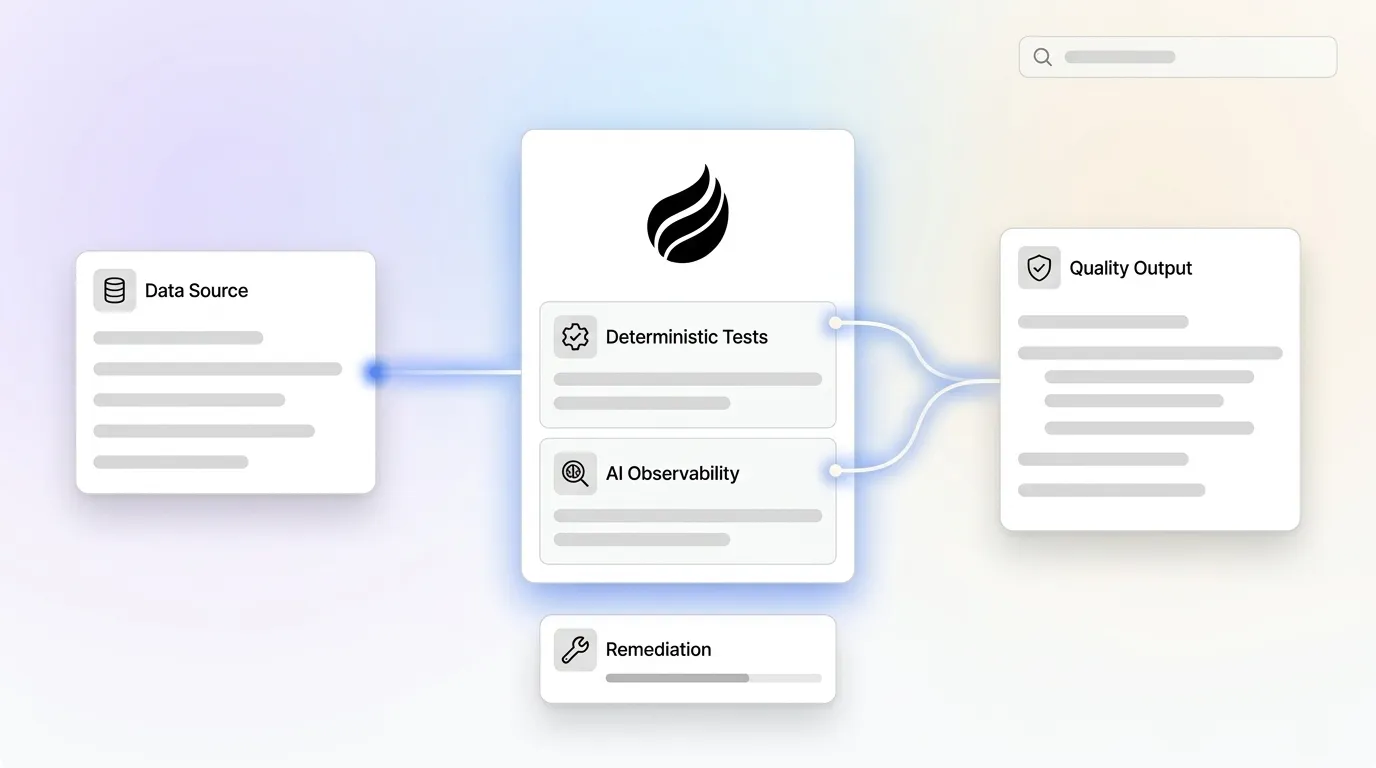
Deterministic tests such as dbt tests, Great Expectations, and data contracts catch known invariants but leave gaps for unknown issues. Teams that treat deterministic tests and observability as the same layer either drown in flaky tests or miss silent failures. The AI observability layer uses ML models to learn normal behavior and surface unknown unknowns.
The decision rule stays simple. The deterministic layer owns schema, null, uniqueness, referential integrity, and business-rule invariants. The AI layer owns distribution shifts, volume anomalies, freshness drift, and novel failure modes.
A robust AI data quality pipeline architecture follows this flow:
source → ingestion → AI quality layer → transformation → quality gate → warehouse → BI/MLThe AI quality layer handles several core responsibilities:
- Learning baselines for freshness, volume, schema, and distribution.
- Detecting anomalies against these learned baselines.
- Providing lineage-aware impact analysis.
- Routing alerts with context to the right owner.
A configuration example shows how deterministic rules and AI monitoring coexist:
# Deterministic rules - freshness: column: updated_at warn_after: {count: 2, period: hour} - not_null: column: customer_id - unique: column: order_id # AI monitoring declarations - anomaly_detection: metric: row_count baseline: 30d - distribution_detection: column: order_total method: kl_divergenceAnomaly Detection Categories And What Traditional Tests Miss
The AI layer described above earns its place by catching failure modes that deterministic tests overlook. AI-powered anomaly detection tools use statistical methods to detect patterns that static rules cannot express. Static threshold alerts fail as businesses grow: once normal row count reaches 1,200,000, a 25% drop to 900,000 goes undetected, and the same threshold generates false positives during known low-volume periods like holidays.
- Schema Drift: A column type changes from INT to STRING. AI detects this by diffing
INFORMATION_SCHEMAsnapshots daily. - Null-Rate Anomalies: A required field goes from 2% to 40% nulls. AI detects this by monitoring null rate against a historical distribution and alerting on deviations greater than 3-sigma.
- Distribution Shifts: Average order value doubles overnight. AI detects this using KL divergence exceeding a learned threshold, a signal that static threshold monitoring does not track.
- Freshness Violations: A table that updates every 15 minutes has not updated in 12 hours. AI detects this by alerting when latency exceeds the p99 of historical arrival times.
- Duplicates: A primary key collision after a faulty join. AI detects this by monitoring uniqueness violations.
- Outliers: Negative revenue values appear in a fact table. AI detects this using isolation forests or autoencoders.
A single dataset with 150 columns can generate between 900 and 1,200 automated monitoring rules, which across hundreds of datasets can produce thousands of alerts per week for a data engineering team. Intelligent alert clustering and threshold tuning become essential at that scale.
Self-Healing And Remediation For Data Pipelines
A self-healing data pipeline AI moves beyond alerting into automated remediation. Self-healing data pipelines use AI agents operating on continuous observe-reason-act-remember loops to reduce Mean Time to Resolve (MTTR) from hours to minutes, and Gartner predicts that 40% of enterprise applications will feature AI agents by the end of 2026, up from less than 5% in 2025.
Common remediation patterns include:
- Quarantining bad records to a dead-letter table to prevent downstream contamination.
- Rerouting pipelines to avoid propagating corrupt data.
- Triggering alerts with LLM-generated root-cause explanations.
A quarantine pattern in SQL:
INSERT INTO quarantine_table SELECT *, anomaly_score FROM source_table WHERE anomaly_score > 0.95;The critical governance caveat remains clear. Write actions such as schema migrations, job restarts, backfills, and table updates require human approval, while read-only diagnostics run autonomously, so the agent proposes and a person confirms. The LLM explains what is anomalous, and a human decides what to do. Human-in-the-loop control protects high-impact decisions.
Choosing Tools For The Two-Layer Data Quality Model
Tool selection should reflect the two-layer model and your existing stack. The tools below fall into code-defined validators, ML-first observability platforms, or hybrids that bridge both approaches.
| Tool | Approach | Best For | Key Tradeoff |
|---|---|---|---|
| Soda | Hybrid: SodaCL checks plus ML anomaly detection | Teams wanting one platform for deterministic and AI checks | Advanced ML features require Soda Cloud and are unavailable in Soda Core or Soda Library alone. |
| Monte Carlo | ML-first, lineage-based observability | Large enterprises needing broad coverage with minimal configuration | Typical six-figure contracts and ML baselines that some teams report require more tuning than expected. |
| Great Expectations | Code-defined validation in Python | Teams needing flexible, open-source validation at any pipeline stage | No built-in alerting or lineage, so orchestration integration is required for production. |
| Dbt | Deterministic tests in SQL on warehouse models | Teams already using dbt for transformations | Limited to dbt-managed models and does not monitor raw source tables. |
| Anomalo | ML-first with deep detection and no-code rules | Teams wanting rich ML detection with a user-friendly interface | Narrower coverage matrix than Monte Carlo and longer time-to-first-detection while baselines train. |
| Bigeye | Automated monitoring with strong dbt integration | Dbt-heavy teams wanting transparent, per-metric pricing | Lineage graph is less comprehensive than Monte Carlo. |
Code-defined tools such as dbt and Great Expectations anchor the deterministic layer. ML-first platforms such as Monte Carlo, Anomalo, and Bigeye power the AI layer. Soda bridges both, which suits teams that want a single control plane.
Implementation Reality: False Positives, Threshold Tuning, And Alert Fatigue
AI layers generate false positives, so threshold tuning and alert design matter. A retail data engineering team managing 500+ data assets on Snowflake was receiving over 3,000 alerts per week; after deploying context-aware alert clustering, those alerts collapsed into fewer than 30 prioritized clusters, cutting mean-time-to-resolution by more than 60%.
Practical threshold management follows this sequence:
- Start with a baseline period of 7–14 days before trusting model-based alerts so the model can learn normal behavior.
- Set alert thresholds conservatively, starting at roughly 3x your typical refresh interval for freshness SLOs, then tighten thresholds as pipeline reliability improves.
- Route low-severity alerts to a digest channel and reserve PagerDuty for critical anomalies on tier-1 tables.
- Review alert precision weekly and adjust. A precision below 0.5 signals alert fatigue, while above 0.8 is excellent.
- Assign clear ownership to every alert so nothing becomes background noise.
Using AI For ETL Testing
AI supports ETL testing by generating candidate tests and detecting anomalies, while deterministic tests still guard known invariants. Deterministic tests and data contracts should cover known, articulable failure modes, while observability handles runtime-only issues such as drift, freshness SLA breaches, and schema changes on upstream sources not owned by the warehouse model layer. AI accelerates rule creation and catches unknown anomalies, and explicit assertions still protect critical data contracts.
How AI Changes ETL Work
AI augments ETL by adding observability and remediation rather than replacing core transformation logic. Self-healing shifts what senior data engineers work on and frees them from repetitive firefighting. ETL code, business logic, and data model design remain human-led, while AI assists with writing, testing, and repairing pipelines.
Extending The AI Data Quality Layer To The CRM Pipeline
The same AI data quality layer that protects analytics pipelines should extend to the CRM pipeline, where bad data directly impacts revenue. A Forrester Research study found that enterprises with 2,000 or more employees lose an average of $12.9 million per year directly attributable to poor CRM data quality, including $5.4 million in missed revenue opportunities, $4.1 million in wasted marketing and outreach spend, and $3.4 million in productivity loss from sales reps manually correcting data.
CRM data exhibits familiar failure modes, and each statistic illustrates a specific risk:
- Manual Entry Errors: Sales reps spend 70% of their time on non-selling tasks, with 9% of the week spent manually entering customer and sales information, which increases the chance of typos and incomplete records.
- Missing Fields: Seventy-six percent of CRM users say less than half of their organization’s CRM data is accurate and complete, which weakens segmentation and forecasting.
- Duplicate Records: Salesforce research shows the average company has 20–30% duplicate accounts, and after mergers, acquisitions, or large imports the duplicate rate can spike to 40% or higher, which fragments account history and confuses ownership.
- Stale Activity: B2B contact data decays at roughly 2.1% per month, or over 22% annually, which quickly turns once-accurate data into unreliable inputs for pipeline reviews.
Coffee applies AI-driven data quality improvement directly to the CRM pipeline. It automatically creates and enriches contacts and companies, logs activities, and unifies structured and unstructured data, including emails and call transcripts, into one coherent view. Coffee works with both structured and unstructured data, runs on a data warehouse, and meets users where they are as a standalone CRM or as a companion app for Salesforce and HubSpot.

Key features include automatic data entry and enrichment, meeting briefings and summaries, Pipeline Compare for week-over-week changes, visitor identification, Lead Finder, and Campaigns. These features keep CRM data accurate and current across the entire revenue engine.

Eliminate Bad CRM Data From Your Revenue Pipeline.

Conclusion: Bringing AI Data Quality To Revenue Pipelines
The two-layer model of deterministic tests plus AI observability now defines modern pipeline data quality. Deterministic tests enforce the invariants you can state up front. AI observability catches runtime failure modes that emerge only in production.
Together, these layers reduce mean time to detection, cut silent failures, and rebuild trust in data across dashboards, ML models, and business decisions. Extending this architecture to CRM pipelines keeps revenue teams aligned on accurate, timely information instead of fighting bad data.
Coffee acts as the agent that maintains CRM data quality by capturing interactions automatically, enriching records, and delivering reliable pipeline intelligence without turning humans into data entry clerks.
Bring AI-Driven Data Quality To Your Revenue Pipeline.