Written by: Doug Camplejohn, CEO & Co-Founder, Coffee
Key Takeaways
- Real-time enrichment appends verified data the instant an event occurs, so workflows run in seconds instead of waiting on batch jobs.
- Leads contacted within the first five minutes are 21x more likely to qualify than those reached after 30 minutes, so latency directly affects revenue.
- Coffee’s agent compresses ingestion, enrichment, CRM write-back, and autonomous follow-up into a single automated loop without manual steps.
- Unlike list-based tools, Coffee continuously re-enriches records on every interaction signal and immediately routes, logs, and drafts outreach.
- Eliminate data latency and manual gaps, and explore Coffee’s pricing and deployment options today.
How Real-Time and Batch Enrichment Actually Differ
The architectural difference between real-time and batch enrichment changes how fast sales teams can act. Batch pipelines accumulate records and process them on a schedule, such as hourly, nightly, or weekly. Real-time pipelines achieve millisecond-to-second latency compared with minutes-to-hours latency in batch pipelines. This latency gap determines whether a lead is routed before or after a competitor calls first. Leads contacted within the first hour of expressing interest are 7x more likely to qualify, and contacting a lead within the first five minutes makes qualifying it 21x more likely than after 30 minutes. The following table shows how these speed differences show up in latency, data freshness, CRM workload, and revenue impact.
| Dimension | Batch Enrichment | Real-Time Enrichment | Coffee Agent |
|---|---|---|---|
| Latency | Minutes to hours | Milliseconds to seconds | Sub-second enrichment plus immediate autonomous action |
| Data Freshness | Stale at next batch window, typically refreshed quarterly for active outreach | Current at event time | Continuous re-enrichment on every interaction signal |
| CRM Impact | Manual gaps between runs; reps waste 8–12 hours per week on data entry | CRM automation typically reduces admin time by 35-55% per rep | Zero manual entry; agent writes enriched records directly to CRM |
| Revenue Outcome | Missed trigger windows; first seller to contact after a trigger event is 5x more likely to win | Signal-qualified leads show improved conversion rates | Instant routing plus autonomous follow-up drafts close the loop |
Event-Driven Architecture Behind Real-Time Enrichment
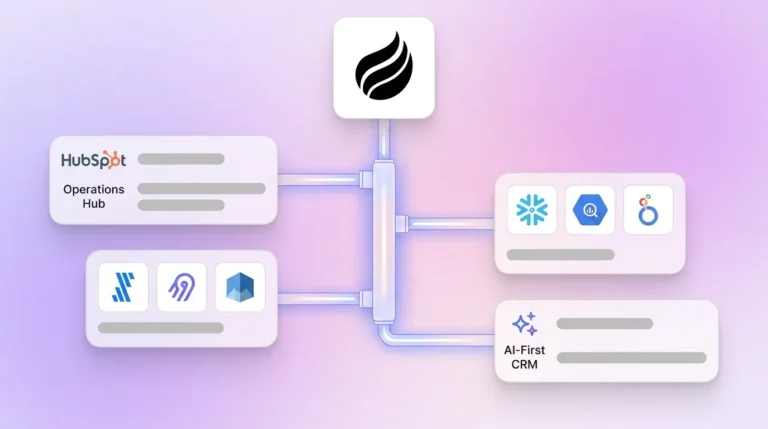
A real-time data pipeline typically consists of four core layers: ingestion, transformation or processing, storage, and serving. For CRM enrichment, those stages map directly to sales workflow steps.
- Event capture. A trigger fires, such as a form fill, a website visit, or an inbound email. Ingestion tools capture these events in real time.
- Stream processing. Frameworks such as Apache Flink and Kafka Streams transform and enrich data on the fly so downstream systems can act immediately.
- Reference-data lookup. Enrichment in a streaming pipeline requires fast reference-data lookups performed inside the processing engine, because slow enrichment services break sub-second end-to-end latency.
- CRM write-back. Enriched attributes such as job title, funding stage, and tech stack are written to the contact or company record without human intervention.
- Autonomous action. The agent triggers routing rules, drafts follow-up emails, and logs activity. Lead routing rules in modern CRMs assign a new contact to the appropriate rep based on territory, deal size, or round-robin logic within seconds of creation.
Coffee's agent compresses all five stages into a single automated loop. A visitor hits your site, the pixel fires, the agent identifies the individual, enriches the record, and surfaces a Slack notification. This entire sequence completes before a traditional batch job would even start.
Sales and CRM Use Cases for Real-Time Enrichment
Lead routing. Speed is the primary variable. The first seller to contact a decision-maker after a trigger event is 5x more likely to win the deal. Coffee's visitor identification pixel identifies named individuals, enriches their profile, and routes them to the right rep in real time, without a human touching the record.
Personalization. Signal-personalized outreach achieves 15–25% reply rates versus the 3–5% industry average for cold email. Coffee's agent uses enriched firmographic and behavioral signals to draft context-aware follow-ups immediately after a call or site visit.

Pipeline accuracy. Businesses using AI-assisted CRM forecasting see a 15-25% improvement in forecast accuracy. Because Coffee's agent continuously logs activity and enriches records, pipeline reviews reflect current deal state rather than whatever a rep last typed. See how Coffee's real-time enrichment powers these use cases in your CRM, and explore pricing and deployment options.
Real-Time Data Enrichment Tools in 2026
- Apollo. Apollo maintains a database of 230M+ contacts. It automates enrichment workflows, but enrichment is primarily list-based and export-driven rather than event-triggered. No autonomous CRM action layer exists.
- ZoomInfo. ZoomInfo offers deep firmographic coverage with native CRM connectors. Enrichment runs on scheduled syncs rather than sub-second event triggers. Seat and credit pricing adds cost complexity for SMB teams.
- Clearbit (HubSpot). HubSpot Breeze Intelligence appends firmographic data the moment a new contact is created. Enrichment reacts to record creation, not to broader behavioral signals. The product remains locked to the HubSpot ecosystem.
- Crustdata. Crustdata provides API-first enrichment with real-time endpoints suited for engineering-led teams. It requires custom integration work to connect enrichment output to CRM action. No agent layer is included.
- Coffee. Coffee is the only platform that pairs real-time enrichment with autonomous action. The agent ingests emails, calendars, call transcripts, and website visitor signals, enriches records via licensed data partners, and immediately creates contacts, logs activities, and drafts follow-ups inside a standalone CRM or as a companion layer on Salesforce or HubSpot. Coffee is SOC 2 Type 2 compliant and uses seat-based pricing with no credit metering.
Implementation Considerations for Agent-Based Enrichment
Governance and compliance. Enterprise real-time pipelines must enforce access controls, lineage tracking, and compliance policies for regulated data under GDPR, CCPA, and HIPAA. These controls protect sensitive customer information and reduce regulatory risk for RevOps leaders. Coffee meets enterprise compliance requirements (SOC 2 Type 2, GDPR), and customer data is never used to train public models, which keeps proprietary information contained.
Data freshness cadence. B2B contact data decays at roughly 25-30% per year due to job changes, funding rounds, and tool changes, making a 90-day refresh cycle the sensible standard rather than only at lead creation. This decay rate means a contact enriched once at lead creation will be significantly inaccurate within a year, so reps waste time on bounced emails and outdated titles. A 90-day refresh cycle reduces this risk for active outreach lists. Coffee's agent eliminates the refresh-cycle problem by re-enriching on every interaction signal, so each reply, meeting, or visit triggers a fresh lookup when the rep needs it.
Pricing model. Credit-based enrichment tools penalize high-volume teams, because every lookup consumes budget. This structure forces RevOps to ration enrichment and accept patchy data. Coffee uses seat-based pricing, so teams pay for the humans and the agent's enrichment labor is included without metering.
Integration effort. Sales automation integrates with CRMs through native apps, APIs, and middleware to sync data in real time. Complex integrations slow down adoption and stretch engineering resources. Coffee connects to Salesforce or HubSpot through a simple authentication flow. The agent begins enriching and writing back to the existing system of record immediately, with no data migration required.
After authentication, the agent syncs existing records, begins enriching new contacts as they are created, and writes summaries, activity logs, and enrichment attributes back to the primary CRM. Ready to implement real-time enrichment in your stack? Review Coffee's deployment options and pricing.
Why an Autonomous CRM Agent Fills the Missing Layer
Most enrichment tools stop at data delivery. They append a job title or a funding round to a record and wait for a human to act. That gap between enriched data and executed workflow is where pipeline velocity dies.
71% of B2B marketers used third-party intent data in 2024, so most teams already rely on intent or signal data tools. Coffee closes that gap with an agent that both enriches and acts.
Coffee's dual deployment model removes the adoption barrier. Teams already committed to Salesforce or HubSpot deploy Coffee as a Companion App, so the agent enriches records and writes insights back to the existing system without replacing it. Teams ready for a modern alternative deploy Coffee as a standalone CRM where the agent is the system of record from day one. Companies using enriched, signal-augmented CRM data can generate more sales-qualified leads than those relying on base contact data alone.
Decision Framework: When Real-Time and Coffee Make Sense
| Criteria | Batch Is Sufficient | Real-Time Required | Coffee Is the Right Fit |
|---|---|---|---|
| Lead volume and speed | Low volume, long sales cycles with no time-sensitive triggers | High-velocity inbound where 5-minute response windows determine win rates | Any team where a rep should act within minutes of a signal |
| CRM data quality | Static records refreshed quarterly are acceptable | Static records refreshed quarterly lose 25-30% accuracy per year | Teams losing deals to stale routing or outdated contact data |
| Autonomous action needed | Humans review and act on every enriched record manually | 83% of sales teams with AI saw revenue growth this year vs. 66% without AI | RevOps teams who want enrichment to trigger routing, logging, and follow-ups without human input |
| Stack flexibility | Single CRM, no companion tooling needed | Multi-tool stack requiring real-time sync across Salesforce, HubSpot, and enrichment providers | Teams on Salesforce or HubSpot who need an agent layer, or teams replacing a legacy CRM entirely |
Frequently Asked Questions
How long does Coffee implementation take?
Companion App deployment on Salesforce or HubSpot starts with a simple authentication flow. Once connected, the Coffee agent immediately starts scanning emails and calendars, enriching records, and writing activity data back to the existing CRM. Most teams are operational within a single session. The Standalone CRM requires no data migration from a legacy system, because the agent builds the record base from connected communication channels automatically.
Does Coffee's data quality match ZoomInfo?
Coffee's enrichment data is roughly on par with ZoomInfo for the firmographic and contact attributes that matter most to small-to-mid-market sales teams, such as job titles, company size, funding stage, and LinkedIn profiles. The key difference is that Coffee's enrichment is bundled into seat-based pricing with no credit metering, and the agent acts on that data immediately rather than depositing it into a static record for a human to review later.
What integration effort is required with Salesforce or HubSpot?
The Coffee Companion App connects to Salesforce or HubSpot through standard OAuth authentication. No custom development, middleware configuration, or data migration is required. After authentication, the agent syncs existing records, begins enriching new contacts as they are created, and writes summaries, activity logs, and enrichment attributes back to the primary CRM. Broader integrations with other tools in the stack are currently available via Zapier, with deeper native integrations on the product roadmap.
Can the agent operate without replacing my existing CRM?
Yes. The Companion App model is designed for teams that are committed to Salesforce or HubSpot and do not want to migrate. Coffee operates as an intelligent layer on top of the existing system of record. The agent handles data enrichment, activity logging, meeting summaries, and follow-up drafts, then writes all of that output back into Salesforce or HubSpot. The existing CRM remains the system of record, and Coffee keeps it accurate and current without human effort.
Conclusion
Batch enrichment worked when sales cycles moved slowly and CRM data served mainly as a reporting tool rather than a routing engine. In 2026, it has become a structural liability. Signal-qualified leads convert at higher rates, teams using AI-driven automation close deals 36% faster, and the 5x win-rate advantage for first contact after a trigger event favors teams that act in minutes. None of these outcomes are realistic when enrichment runs on a nightly schedule.
Coffee is the only platform that pairs sub-second real-time enrichment with autonomous CRM action, with no manual review step, no credit metering, and no separate enrichment vendor to stitch together. Whether your team runs on Salesforce, HubSpot, or needs a modern CRM from scratch, the agent meets you where you are and removes the latency that costs deals. Start your free trial today.