Written by: Doug Camplejohn, CEO & Co-Founder, Coffee | Last updated: August 6, 2026
Key Takeaways
- Contact management software stores basic contact info. Full CRMs add pipelines, forecasting, and automation, but both suffer from dirty data caused by manual entry.
- 71% of sales reps waste 8–13 hours weekly on manual CRM work, and poor data quality can affect roughly a quarter of company revenue.
- Coffee’s agent automatically ingests emails, calendars, and transcripts to create clean records without human intervention, which reduces data decay and admin work.
- Teams of 1–25 people can deploy Coffee as a Standalone CRM or as a Companion App layered on existing Salesforce or HubSpot instances without migration.
- Unlock accurate forecasts and reclaim hours every week. Get started with Coffee.
Contact Management vs CRM for Clean Data
Most sales teams spend far too much time on manual CRM work. 71% of sales reps report spending too much time on data entry, and teams lose 8 to 13 hours per rep per week to manual CRM work. Coffee’s agent removes that grind entirely. Poor data quality impacts 26% of company revenue on average, according to a 2022 Monte Carlo survey of data professionals, and only 9% of CRM records remain accurate after one year without regular updates.
The right tool depends on where your team sits today.
- Solo founders: A lightweight contact manager handles relationship tracking without pipeline overhead. The risk is data decay, since B2B contact data decays at about 22.5% per year.
- Small teams (2–10 people): Once a second rep touches the same contact, shared pipeline visibility becomes necessary. Many businesses outgrow a pure contact organizer as their teams grow beyond just a few people.
- Growing organizations (10–25 people): Manual entry at this scale is unsustainable. A 20-person team loses $200,000 annually in direct salary costs from manual CRM data entry alone. An agent-powered CRM becomes the only practical path.
Top Contact Management and CRM Tools in 2026
| Tool | Auto Data Capture | Pipeline & Forecasting | Starting Price |
|---|---|---|---|
| Coffee | Agent ingests emails, calendars, and call transcripts automatically | Full pipeline with agent-driven week-over-week compare | Seat-based; agent labor included |
| HubSpot CRM | Form capture and email logging, manual activity entry required | Full pipeline, forecasting at higher tiers | HubSpot CRM is free (with paid plans starting at $20/seat/mo) |
| Zoho CRM | Email parsing and web forms, enrichment via add-ons | Full pipeline, AI forecasting at Enterprise tier | Zoho CRM starts at $14/user/month |
| Less Annoying CRM | Manual entry only | Basic pipeline view, no forecasting | Less Annoying CRM costs $15 per user per month with a single flat rate that includes everything |
Coffee’s Agent is the only tool in this group that ingests unstructured data such as emails, calendar events, and call transcripts, then writes clean, structured records back to the system of record without human effort. Recent studies show the average seller spends 28–37% of their time actually selling. Coffee’s agent helps teams reclaim much of the remaining time.
Contact Management Software for Small Teams
Small businesses often start with a lightweight contact manager to avoid complexity, then watch data quality erode as the team grows. Coffee prevents that slide with a dual deployment model.
- Standalone CRM: Ideal for teams of 1–20 that have outgrown spreadsheets and Notion but refuse to become data-entry clerks for HubSpot or Pipedrive. The agent auto-creates contacts from Google Workspace or Microsoft 365 on day one.
- Companion App: Designed for small-to-mid-market teams already on Salesforce or HubSpot. The agent layers on top, handles all data capture, and writes clean records back, so no rip-and-replace is required.
Businesses often purchase full CRMs and later underuse advanced features, turning them into overpriced address books. Coffee’s agent keeps the system accurate regardless of which deployment path a team chooses.
When a Contact Manager Is No Longer Enough
The 2026 inflection point centers on a shift from passive database to active agent. Legacy contact managers and traditional CRMs share the same flaw: they wait for humans to enter data. 75% of respondents say staff fabricates CRM data to tell the story they want decision makers to hear, and 76% of organizations report that less than half of their CRM data is accurate and complete.
Several signals show that a team has crossed this agent inflection point.
- Leads slip through the cracks because no one logged the last interaction.
- Pipeline reviews require a spreadsheet to fill gaps the CRM cannot answer.
- More than one rep touches the same deal and records conflict.
- Revenue forecasting is required monthly or more frequently.
- The team maintains a separate spreadsheet to track follow-ups.
At that stage, a passive database, whether a contact manager or a legacy CRM, cannot solve the problem. An active agent that captures data automatically becomes the only reliable way to break the cycle.
HubSpot Contact Management Compared to Coffee
| Capability | Coffee | HubSpot |
|---|---|---|
| Data capture | Agent auto-ingests emails, calendars, and transcripts | Manual logging, form capture and email sync available |
| Data accuracy | Agent-maintained, near-zero decay | HubSpot reports that B2B contact databases decay at about 22.5% per year |
| Meeting intelligence | Agent joins calls, generates summaries, drafts follow-ups | Requires third-party integration (for example, Gong or Fathom) |
| Deployment model | Standalone CRM or Companion App on top of HubSpot | Standalone only |
HubSpot began as a marketing tool with a CRM added later. Without a strong underlying data model, lightweight CRMs quickly accumulate duplicate records, inconsistent fields, and disconnected information. Coffee’s Companion App deploys directly on top of an existing HubSpot instance, so teams keep their workflows while the agent handles all data entry.

Zoho CRM Contact Management Compared to Coffee
| Capability | Coffee | Zoho CRM |
|---|---|---|
| Data capture | Agent auto-ingests emails, calendars, and transcripts | Email parsing and web forms, enrichment via paid add-ons |
| Admin overhead | Near-zero, agent handles all logging and enrichment | High, Blueprint workflows require dedicated admin configuration |
| AI capability | Native agent across all tiers | Zia AI available at Enterprise tier only |
| Setup time | Connect Google Workspace or Microsoft 365, agent starts immediately | Days to months with consultant often required |
Free Contact Management Tools and Their Hidden Costs
Free tiers from HubSpot, Zoho, and similar tools remove the subscription line item but keep the most expensive cost: human labor. Sales reps spend a large share of their time verifying contact information, which erodes productivity. A free tool that requires manual entry every week functions as a hidden payroll tax on your sales team.
Several additional hidden costs come with free contact management software.
- The revenue impact mentioned earlier, 26% on average, compounds when teams rely on free tools that still require manual work.
- Companies lose sales opportunities when they act on unreliable data.
- Duplicate records can waste up to 25% of campaign budget on sending to the same person multiple times.
- The 1-10-100 rule states it costs $1 to ensure data quality from the start, $10 to correct mistakes, and $100 for unresolved issues.
Clean Data as the 2026 Standard
Data and analytics leaders agree that AI outputs only match the quality of the inputs. Coffee’s architecture follows that principle closely. The agent ingests ground-truth data from emails, calendars, and call transcripts, then turns those unstructured sources into clean records automatically.
Because the agent guarantees clean input, Coffee’s pipeline intelligence stays accurate by design. The Pipeline Compare feature visualizes week-over-week deal movement without spreadsheets. Meeting briefings draw from real interaction history, not manually entered notes. Businesses that maintain clean CRM data see higher campaign response rates, better conversion rates, and stronger close rates.

Coffee’s Companion App for Salesforce and HubSpot
Many sales leaders cannot justify a full platform migration. Salesforce and HubSpot instances often hold years of configuration, custom objects, quota structures, and required fields that newer AI-native tools such as Day.ai and Clarify cannot yet support. Coffee’s Companion App exists for this exact situation.
A simple authentication connects the Coffee Agent to an existing Salesforce or HubSpot instance. From that point, the agent manages the complete data lifecycle.
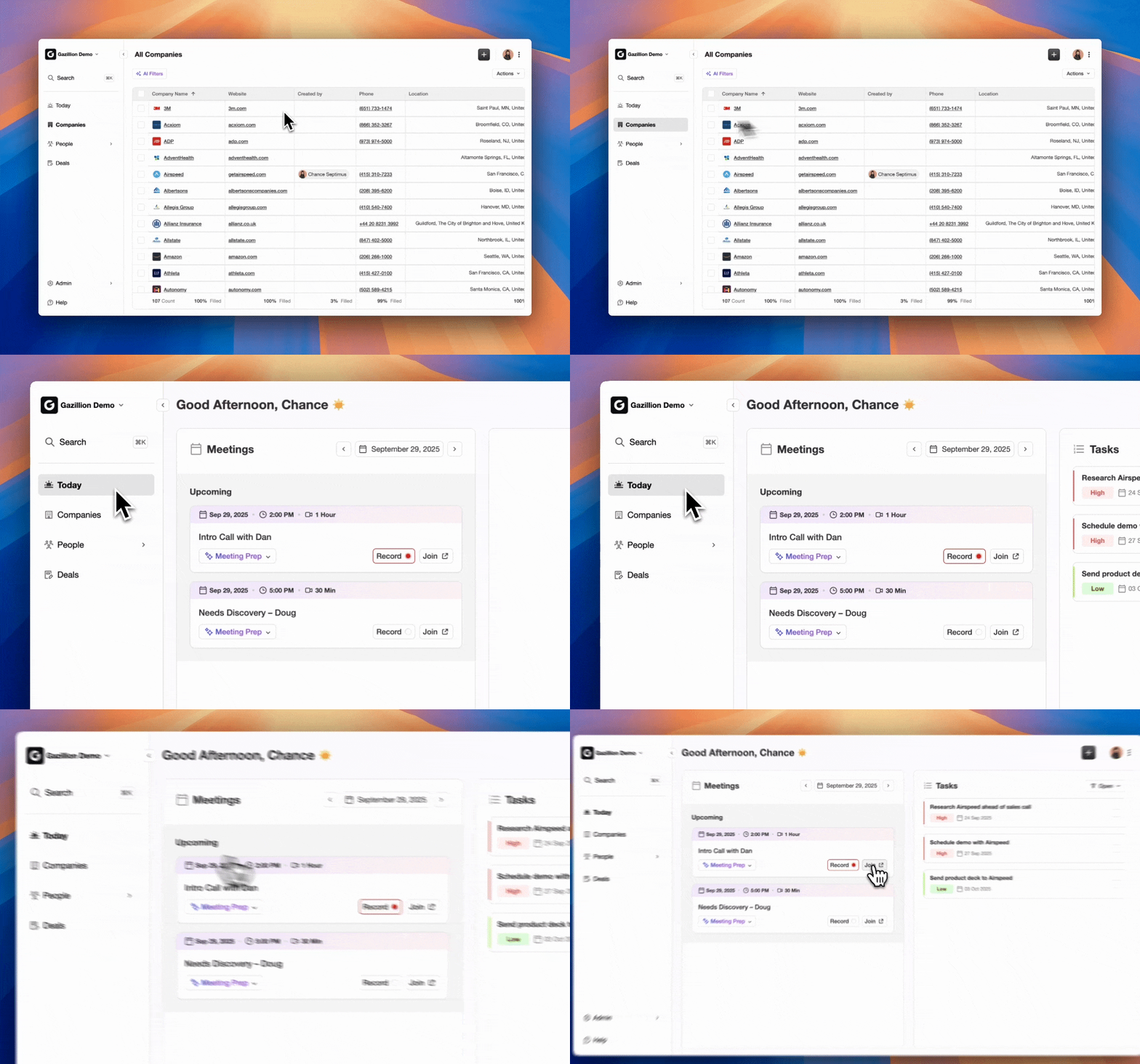
- It auto-creates and enriches contacts and companies from email and calendar activity, so every interaction starts from accurate baseline data.
- It joins calls via AI meeting bot and writes structured summaries back to the CRM record, capturing context that would otherwise be lost.
- It logs all activity autonomously, which keeps deal state current without rep intervention.
- It surfaces pipeline intelligence and week-over-week changes inside the existing system, turning clean data into clear insights.
The result is a Salesforce or HubSpot instance that finally reflects reality, without replacing the investment already made in it.

Choosing Between Contact Management and CRM Agents
| Company Profile | Current Stack | Recommended Path |
|---|---|---|
| 1–10 people, no formal CRM yet | Spreadsheets or Notion | Coffee Standalone CRM |
| 10–25 people, outgrown lightweight tools | Pipedrive, Less Annoying CRM, or similar | Coffee Standalone CRM |
| 10–25 people, committed to HubSpot | HubSpot with low adoption and dirty data | Coffee Companion App |
| 10–25 people, committed to Salesforce | Salesforce with manual entry and stale records | Coffee Companion App |
| Solo founder, simple follow-up needs | None or basic contact manager | Coffee Standalone CRM, with the agent handling admin from day one |
The CRM versus contact manager decision depends more on sales process maturity than on company size. In 2026, the more useful distinction is whether the tool behaves as a passive database or an active agent. Only an active agent produces consistently accurate forecasts.
Frequently Asked Questions
How long does Coffee take to implement?
Coffee connects to Google Workspace or Microsoft 365 through a simple authentication flow. The agent begins auto-creating contacts, logging activity, and enriching records immediately after connection. No multi-week implementation or consultant is required, and most teams are fully operational the same day they sign up.
Is Coffee SOC 2 Type 2 compliant?
Yes. Coffee is SOC 2 Type 2 and GDPR compliant. Customer data is not used to train public models. Teams in regulated industries, or those with strict security review requirements, can request full details on Coffee’s compliance posture.
Does Coffee integrate with other tools via Zapier?
Yes. Coffee supports integrations via Zapier, which connects the platform to the broader tools in a sales team’s stack. Deeper native integrations are on the product roadmap. For teams already on Salesforce or HubSpot, the Companion App provides a direct, authenticated sync that writes enriched data back to the primary system of record.
How is Coffee priced?
Coffee uses seat-based pricing. Each human seat covers unlimited agent labor, with no metering on AI usage, processes run, or data enrichment calls. Teams pay for the people, and the agent’s work is included, which keeps costs predictable as the team scales.
What is the difference between Coffee’s Standalone CRM and the Companion App?
The Standalone CRM is a complete system of record powered by the Coffee Agent, built for teams that want a modern alternative to HubSpot or Pipedrive without manual entry. The Companion App deploys the same agent as an intelligent layer on top of an existing Salesforce or HubSpot instance, handling all data capture and writing clean records back without a platform migration. Both models deliver the same core guarantee: good data in, accurate insights out.
Conclusion
The contact management software comparison in 2026 centers on data quality rather than feature lists. Passive databases, whether lightweight contact managers or legacy CRMs, all depend on humans entering data reliably. As noted earlier, the vast majority of reps spend too much time on data entry, and many businesses lose meaningful revenue to data decay. The agent inflection point has arrived. Coffee is the only solution in this comparison that guarantees clean data in and accurate insights out, deployed either as a Standalone CRM or as a Companion App on top of Salesforce or HubSpot.