Written by: Doug Camplejohn, CEO & Co-Founder, Coffee
Key Takeaways
- Website visitor identification turns anonymous HubSpot traffic into named, enriched contact and company records without manual entry.
- Native HubSpot tools like Breeze Intelligence only provide company-level data, so individual details such as names, titles, and LinkedIn profiles stay missing.
- This six-step workflow covers pixel installation, real-time enrichment, direct HubSpot sync, and Suggested Leads that surface persona-matched buyers.
- Remote work, VPNs, and international traffic reduce the accuracy of traditional IP-based identification, so deterministic, person-level tools now matter more.
- Unlock the full power of your anonymous traffic — start a Coffee trial and turn HubSpot visitors into pipeline-ready leads.
Why HubSpot Users Need Visitor Identification Today
97% of B2B website visitors leave without converting, meaning that with 10,000 monthly visitors, roughly 9,800 never fill out a form. That non-converting traffic creates a dark funnel of hidden demand that standard HubSpot analytics cannot surface.
HubSpot’s native approach to this problem, reverse-IP lookup, has structural limits that prevent it from solving the full identification challenge. Many knowledge workers browse from home networks, so IP-to-company matching often resolves to consumer ISPs like Comcast instead of employer-owned ranges. Remote work and VPN use have materially degraded reverse-IP accuracy, and IP-based tools perform strongly on US B2B traffic but drop off sharply for international visitors.
Set three basics before you start: an active HubSpot portal with tracking code already deployed, a defined ICP or buyer persona with firmographic criteria such as industry, company size, and title, and a designated owner for lead routing.
How HubSpot, IP Tools, and Coffee Compare for Visitor Identification
| Capability | Native HubSpot (Breeze Intelligence) | Third-Party IP Tools (e.g., Leadfeeder, Leadinfo) | Agent-Integrated (Coffee) |
|---|---|---|---|
| Match Rate | Company-level, IP accuracy 70–80% under ideal conditions, drops with remote workers | 15–40% of B2B traffic depending on tool and method | Person-level deterministic matching, deterministic tools achieve 95%+ accuracy on matched records |
| Person-Level Identification | No, company and firmographic data only | Contact enrichment layered separately, person-level tools achieve 5–20% real-world accuracy | Yes, name, title, email, and LinkedIn profile inferred per visitor |
| Suggested Leads (Persona-Matched) | No | No, raw people lists or company-only output | Yes, surfaces the two or three individuals inside each visiting company who match your defined buyer persona |
| Direct HubSpot Sync (No Manual Entry) | Native, company-level only | Native integrations available, Zapier recommended for unsupported CRMs | Yes, contacts, companies, and activities created or updated automatically |
Turn anonymous HubSpot traffic into named, enriched leads — start your free trial today.
Step 1: Audit Gaps in Your Current HubSpot Visitor Data
Start by opening HubSpot’s traffic analytics and prospects tool to establish your baseline. Document which fields stay empty on inbound contact records, such as individual name, job title, LinkedIn URL, and direct email, because these gaps show where native tracking falls short. Next, note the pages generating the most traffic, since pricing, product, and case study pages signal high intent and will guide your alert setup later. When a visitor views a pricing page, the first vendor to respond wins 78% of deals, so those pages deserve priority in your configuration. Finally, record your current form-conversion rate as a baseline, which gives you a clear before-and-after comparison once the workflow runs.
Step 2: Install a Tracking Pixel on High-Intent Pages
To capture the visitor data your audit revealed as missing, install a tracking pixel that monitors site activity in real time. Paste the Coffee-generated pixel script into the <head> tag of every target page, or deploy it site-wide through Google Tag Manager. Coffee verifies installation automatically and starts capturing page views, time on site, pages per session, and return visit status right away. Confirm the pixel fires on your highest-intent pages first so sales can act on the most valuable visits.
Privacy callout: A cookie banner, plain-English privacy notice explaining data usage, and opt-out mechanisms are practical requirements for compliant visitor identification workflows under GDPR and CCPA/CPRA. Several U.S. states require businesses to honor Global Privacy Control opt-out signals automatically. Configure your consent banner so it allows the pixel for visitors who have not opted out and suppresses tracking for those who have.
Step 3: Configure Real-Time Alerts and Visitor Enrichment
Next, set up Slack or email alerts that trigger when a visitor matches your ICP criteria, such as a company with 50–500 employees in your target industry that visits the pricing page. Coffee enriches each identified visitor with name, title, company, LinkedIn profile, and email, along with behavioral data like pages visited, time on site, and first versus returning visit status. This combination gives reps both context and contact details in a single view.
Reaching prospects within five minutes of a high-intent website visit can make them significantly more likely to convert. To hit that five-minute window consistently, configure alerts to fire in real time instead of daily digest batches. Then define which pages trigger an alert, with pricing, demo request, and competitor comparison pages as standard starting points because they signal active buying intent. Finally, document the handoff process by specifying who receives each alert and what action they should take within the five-minute window so no lead sits unassigned.
Step 4: Sync Identified Visitors into HubSpot Records
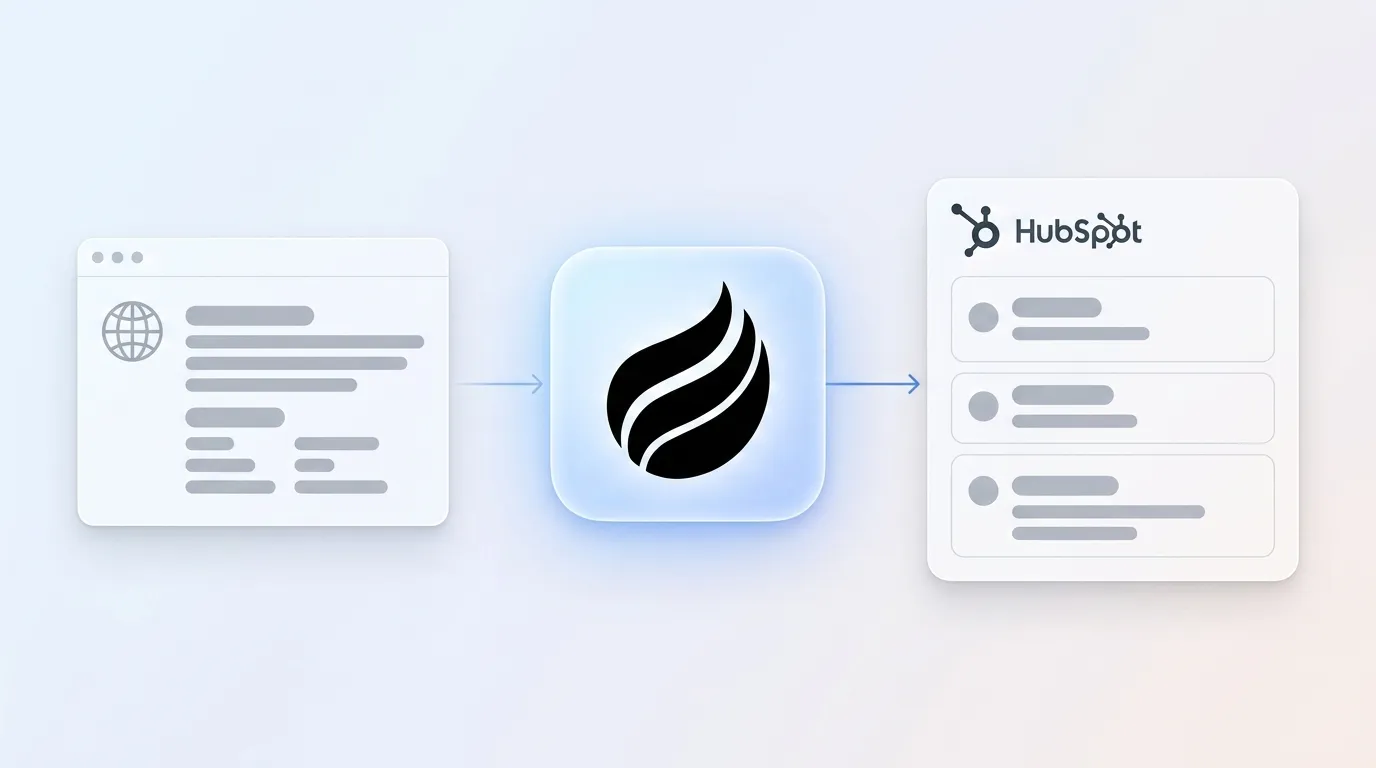
Configure the Coffee-to-HubSpot sync so each identified visitor either creates a new contact and company record or updates an existing one, with activity timestamps that match the actual site visit. Map at least these fields: first name, last name, job title, company name, company domain, LinkedIn URL, pages visited, and visit timestamp. This mapping keeps your CRM both enriched and chronologically accurate.
If field mapping is configured incorrectly, you create data quality problems that undermine the entire workflow. Common pitfalls: mismatched company domains, such as a subsidiary domain that does not match the parent HubSpot company record, cause duplicate company creation. Set domain as the primary deduplication key. For contacts, use email address as the deduplication key and configure the sync to update instead of overwrite existing records. Leadinfo’s synchronization model matches against existing CRM records using domain or company name before creating new records, and you should apply the same logic in your Coffee sync configuration.
Step 5: Use Suggested Leads to Target the Right People
With visitor data now flowing into HubSpot, the next challenge is knowing which person at each company to contact first. Coffee’s Suggested Leads feature solves this by using your defined buyer persona to recommend the two or three individuals inside that company most likely to be the right contact, and it surfaces their LinkedIn profiles for immediate outreach. This capability differentiates Coffee from tools like RB2B and Warmly, which surface either company-only data or undifferentiated people lists without persona matching.
Route Suggested Leads to the correct rep based on territory, account size, or existing ownership rules in HubSpot so follow-up stays organized. Teams using sequences can enroll the suggested contact directly from the Coffee interface, which shortens the time from visit to outreach. For single-rep setups, the Slack alert plus one-click LinkedIn connection usually provides enough structure. Define routing rules before go-live to prevent leads from sitting unassigned.
Step 6: Confirm Data Quality and Measure Pipeline Lift
Within 48 hours of go-live, confirm that every high-intent visitor appears as a HubSpot contact within minutes of their visit. Check that activity timestamps in HubSpot match the actual visit time recorded in Coffee, that Suggested Leads align with your ICP criteria, and that no duplicate contacts or companies were created. After 30 days, measure outreach volume from identified visitors versus the prior period and track the conversion rate from identified visitor to booked meeting.
Scaling the Workflow for Solo Reps and Larger Teams
For single-rep outbound setups, the workflow above runs as described: one Slack channel, one alert recipient, and one sequence. For multi-rep teams, add HubSpot-based routing rules that assign identified visitors to reps by territory or named account list before the contact record is created, which prevents ownership conflicts. If the company later migrates from Coffee as a HubSpot Companion App to Coffee’s Standalone CRM, the pixel, enrichment logic, and Suggested Leads configuration transfer without reinstallation, and only the sync destination changes.
Visitor Identification Validation Checklist
- Pixel fires on all target pages and the Coffee dashboard shows incoming visitor data
- ICP-matching visitors trigger Slack or email alerts within seconds of the visit
- HubSpot contact and company records are created or updated within five minutes of identification
- Activity timestamps in HubSpot match visit timestamps in Coffee
- No duplicate contacts or companies created in the first 48 hours
- Suggested Leads match defined buyer persona criteria such as title, seniority, and function
- Consent banner does not suppress the pixel for visitors who have not opted out
- Thirty-day outreach volume and meeting-booked rate measured against the pre-implementation baseline
Frequently Asked Questions
How long does initial setup typically take?
Most HubSpot users complete the full workflow, including pixel installation, enrichment configuration, HubSpot sync mapping, and Suggested Leads setup, in one to three hours. Pixel installation through Google Tag Manager usually takes under fifteen minutes. The longest step typically involves mapping enriched fields to existing HubSpot contact and company properties, especially when you need to create custom properties first. Teams with a defined ICP already documented in HubSpot often finish the full setup in a single working session. Routing rules for multi-rep teams add time that scales with the complexity of territory or account ownership logic already in place.
Is website visitor identification for HubSpot compliant with SOC 2 and GDPR?
Coffee is SOC 2 Type 2 and GDPR compliant, and data is not used to train public models. For GDPR specifically, company-level identification usually falls under Article 6(1)(f) legitimate interest, while person-level identification requires a stronger compliance posture that includes a cookie banner, privacy notice, and opt-out mechanism. Several U.S. states require businesses to honor Global Privacy Control opt-out signals automatically, and online tracking litigation has increased significantly. Best practice is to implement a consent banner that suppresses tracking for opted-out visitors, use first-party scripts, and limit data retention to defined periods such as 90 days. Coffee’s compliance architecture supports these configurations.
What is the difference between Zapier sync and native integration?
A native integration writes identified visitor data directly to HubSpot contact, company, and activity records in real time without an intermediary. Zapier sync routes data through a third-party automation layer, which introduces latency, adds a dependency on Zapier’s uptime, and requires extra field mapping maintenance when either Coffee or HubSpot updates its data schema. For high-intent use cases where the five-minute response window matters, native integration works better. Zapier fits as a fallback for edge-case workflows or for connecting Coffee to tools outside its native integration set. Coffee’s current HubSpot integration is native, and Zapier is available for additional workflow automation beyond the core CRM sync.
How does the workflow handle traffic volume spikes?
Coffee’s pixel and enrichment pipeline process visitor data in real time regardless of traffic volume. During spikes from product launches, paid campaign bursts, or viral content events, the volume of Slack alerts increases proportionally. To prevent alert fatigue, configure ICP filters so only visitors matching your firmographic criteria trigger notifications. HubSpot’s contact creation rate limits are generous for mid-market traffic volumes, but if a spike generates thousands of new records in a short window, review HubSpot’s API rate limit documentation and confirm your sync configuration uses batch-safe write operations. Suggested Leads continue to apply persona matching during spikes, so your prioritization logic stays consistent even when raw visitor volume jumps.
Conclusion: Turn Anonymous Traffic into Named HubSpot Leads
By implementing this workflow, you convert the 97–98% of B2B visitors who never fill out a form into named, enriched HubSpot contacts without manual data entry. Native HubSpot tracking identifies companies, while this approach identifies people, routes them to the right rep, and surfaces the specific individuals most likely to buy. The result is measurable pipeline lift from traffic already arriving on your site.
Close the gap from anonymous visitor to named HubSpot lead — see pricing and start your trial.