Written by: Doug Camplejohn, CEO & Co-Founder, Coffee | Last updated: August 12, 2026
Key Takeaways for B2B Sales Leaders
- Legacy stacks built from Apollo, Clay, Outreach, and HubSpot create hidden costs, manual data entry, and incomplete automation that costs reps 8–12 hours per week.
- Agent-native platforms like Coffee score 9/10 on automation depth versus 5/10 for fragmented legacy stacks, delivering 10–12 hours saved per rep per week.
- Coffee consolidates four to five separate subscriptions into a single seat-based subscription, cutting total cost of ownership from $300+ per rep per month.
- Implementation timelines drop from 6–14 weeks for legacy stacks to 14–35 days with Coffee, eliminating data-migration and integration testing phases.
- See Coffee’s pricing to replace your fragmented stack with one agent-native CRM that handles the busywork so reps can focus on revenue.
How We Evaluate Automated Lead Generation in 2026
The following eight criteria define what a mature automated lead generation stack must deliver in 2026. Each criterion receives a 1–10 score in the comparison table below so you can see how each platform performs in practice.
- Automation depth: The range of tasks the platform handles autonomously, from initial data capture through enrichment, scoring, sequencing, and CRM logging, without requiring human intervention at each handoff.
- Time saved per rep per week: Measured against 2026 benchmarks. Sales teams using full automation save an average of 12 hours per rep per week, while single-tool pilots realistically land at 3–5 hours.
- Native visitor-to-outreach loop: Whether the platform closes the full cycle from anonymous website visitor identification through named-lead enrichment to automated outreach inside a single system without middleware.
- Stack consolidation math: The number of point-solution subscriptions the platform replaces and the resulting reduction in per-rep total cost of ownership.
- Data quality: Enrichment accuracy, contact decay management, and the platform’s ability to ingest unstructured data such as call transcripts and email threads alongside structured firmographic records.
- Implementation timeline: Time from contract signature to first qualified meeting, including data migration, integration, and warmup requirements.
- Compliance posture: SOC 2 Type 2, GDPR, CCPA, CAN-SPAM, and EU AI Act readiness, given that CAN-SPAM violations for sequences without unsubscribe links carry fines of $53,088 per email in 2026.
- Long-term flexibility: API access, integration depth with existing Salesforce or HubSpot instances, and the platform’s ability to scale as headcount grows beyond 50 reps.
Side-by-Side Comparison: Legacy Stack vs Coffee
The table below scores each platform on the eight criteria using a 1–10 automation score, where 10 represents full agent-driven execution with no manual handoffs required. Every figure is drawn from 2026 benchmarks cited inline. The largest gaps appear in automation depth, the native visitor-to-outreach loop, and implementation timelines, which directly affect rep time saved and how quickly teams see ROI.
| Criterion | Apollo / Clay / Outreach / HubSpot (Legacy Stack) | Coffee (Agent-Native) |
|---|---|---|
| Automation depth score (1–10) | 5, each tool automates one stage, and cross-tool handoffs require Zapier or manual CSV exports, placing this stack at Stage 2–3 of the agentic maturity model | 9, a single agent handles capture, enrichment, scoring, sequencing, CRM logging, and visitor identification natively |
| Time saved per rep per week | 3–6 hours, single-tool pilots land at 3–5 hours, and mid-stack teams reach higher savings only with full AI coverage across all tools | 10–12 hours, consistent with the full-stack automation benchmark cited earlier for agent-driven workflows |
| Native visitor-to-outreach loop score (1–10) | 3, visitor ID (for example, RB2B), enrichment (Apollo or Clay), and sequencing (Outreach) are separate subscriptions with no shared data layer | 9, pixel identification, named-lead enrichment, suggested persona matching, and campaign enrollment execute inside one agent |
| Stack consolidation | 4–5 separate subscriptions, and the average B2B sales team runs 7–10 tools per rep with true TCO of $180–$420 per rep per month | 1 seat-based subscription replacing prospecting database, visitor ID, sequencing, meeting intelligence, and CRM |
| Data quality score (1–10) | 6, enrichment accuracy varies by provider and company size, and Validity’s 2025 State of CRM Data Management report did not report any annual contact decay rate | 8, the agent ingests structured and unstructured data (emails, transcripts, calendar) continuously, reducing decay lag, with enrichment accuracy on par with Apollo for most SMB use cases |
| Implementation timeline | 6–14 weeks for a multi-tool stack, and each additional connected system adds testing time beyond the initial build, per Layer3 Labs July 2026 data | Days to first data capture after Google Workspace or Microsoft 365 authentication, with first qualified meetings in 21–35 days and expert setup compressing to 14 days |
| Compliance posture score (1–10) | 5, compliance responsibility is distributed across vendors, and B2B SaaS teams must conduct vendor compliance audits of platforms such as Apollo and Clay for GDPR, CCPA, and DPA compliance | 9, SOC 2 Type 2 and GDPR compliant, data is not used to train public models, and stop-on-reply sequencing plus send throttling reduce CAN-SPAM exposure |
| Long-term flexibility score (1–10) | 7, deep Salesforce and HubSpot ecosystems with high switching cost once embedded | 8, operates as a standalone CRM or as a companion agent on top of existing Salesforce or HubSpot, with API access available |
Calculate your savings, and replace your fragmented stack with one agent-native seat.
Setup and Onboarding Effort Across Platforms
Implementation timelines vary significantly across these platforms and represent a material operational cost that rarely appears in license comparisons.
Apollo and Clay each deploy quickly as standalone tools. Apollo’s prospecting database is usable within hours, and Clay workflows can be configured in days by a technically proficient RevOps operator. The compounding problem appears when teams connect them. A multi-workflow platform connecting CRM, phone, email, and scheduling typically takes 6–14 weeks because integration and testing time compounds with each connected system. Messy or scattered data across multiple systems is the single biggest timeline risk, often adding 3–4 extra weeks to the data-connection phase alone.
Outreach requires dedicated administrator configuration for sequence libraries, governance rules, and CRM sync. HubSpot’s onboarding is well-documented but assumes a clean CRM baseline. A dirty CRM with duplicates or missing company data adds two to four extra weeks before reliable flows can go live, and 42% of enterprises report that more than half of their AI projects have experienced delays, underperformance, or failure due to data readiness issues.
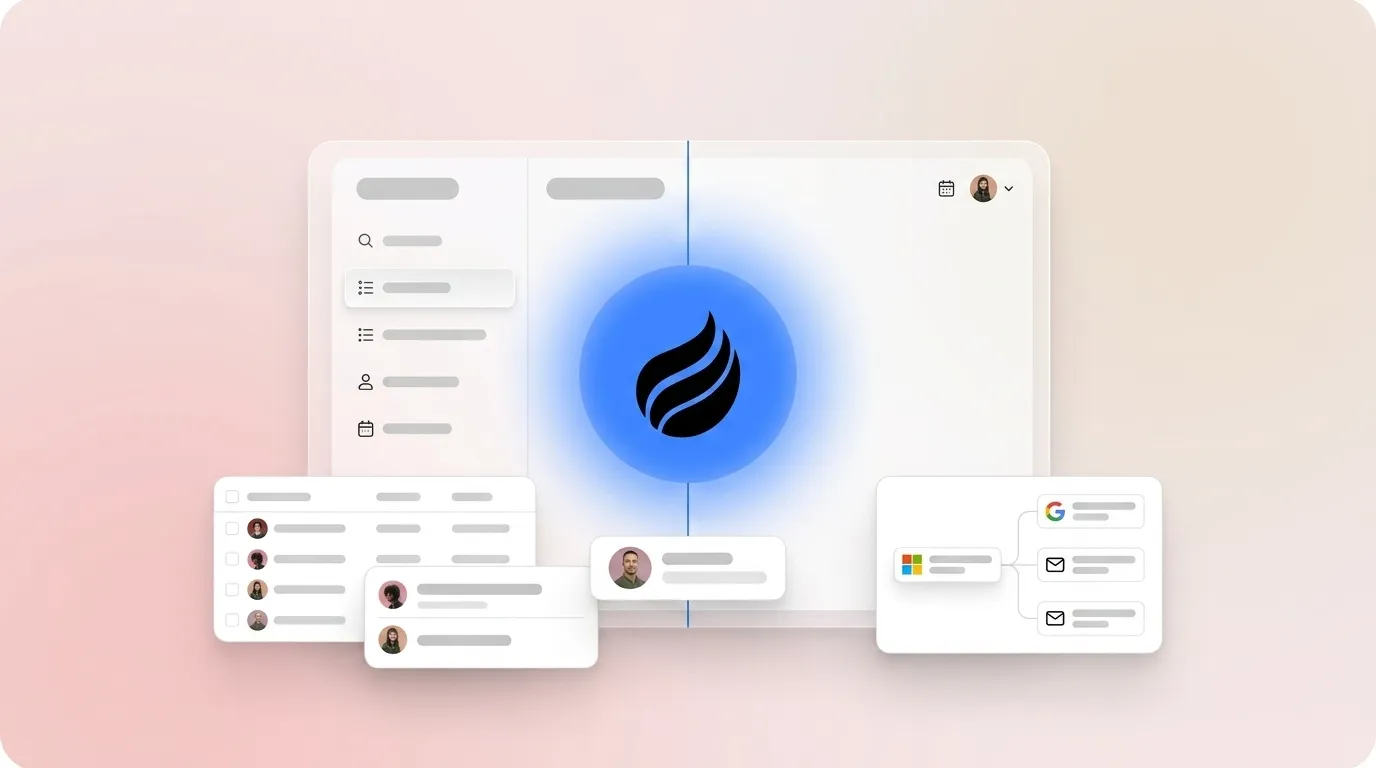
Coffee’s onboarding starts with a single authentication to Google Workspace or Microsoft 365. The agent immediately scans emails and calendars to auto-create contacts and companies, which removes the data-migration phase that slows legacy deployments. A properly built AI lead generation system produces first qualified responses in 2–3 weeks and reaches steady-state performance by month 3, with expert setup compressing the timeline to 14 days, consistent with the comparison table.
Data Capture and Ongoing Maintenance
The core difference between legacy point solutions and an agent-native platform is who performs ongoing data maintenance.
The Salesforce State of Sales 2026, based on responses from over 4,000 sales professionals globally, found that AI agents are expected to slash research time by 34% and content creation by 36%. Teams without agent-driven capture absorb those hours as manual overhead. Automating CRM data entry alone saves 17% of admin time for sales reps, while automated workflows reduce reporting time by 27%. The 12-hour weekly savings cited earlier comes directly from this reduction in manual work.
Apollo provides a prospecting database with enrichment at the point of list-building, but records remain static after export. Clay adds enrichment workflows via API waterfalls but requires a technically skilled operator to build and maintain those waterfalls. Neither platform ingests unstructured data such as call transcripts, email threads, or meeting notes into the CRM record automatically.
HubSpot logs email activity through its Gmail and Outlook extensions, but it relies on reps to manually update deal stages, add meeting notes, and maintain contact accuracy. Validity’s 2025 State of CRM Data Management report did not report any annual contact decay rate. That missing figure hides the impact of decay when no agent continuously refreshes records against live signals.
Coffee’s agent ingests both structured data, such as firmographics, funding, and LinkedIn profiles via licensed partners, and unstructured data, such as email text, call transcripts, and calendar context, on a continuous basis. Every note and interaction is associated with the correct record automatically, and the agent logs last activity and next activity without rep input. Automated data capture solves the technical problem of CRM hygiene, but teams still need a system that reps actually want to use.

Frontline Usability and Manager Visibility
Rep adoption is the primary failure mode for legacy CRM deployments. When reps are required to serve the software rather than the software serving them, adoption collapses and shadow CRMs such as spreadsheets or Notion documents become the real system of record.
The Salesforce State of Sales 2026 report does not report a 47% productivity gain; it states that top performers are 1.7x more likely to use AI agents and that AI agents can reduce research and content time by roughly one-third. That productivity gap comes from whether tools remove friction or add it. Apollo and Outreach require reps to context-switch between prospecting, sequencing, and CRM logging interfaces. Clay is a power-user tool that most frontline reps do not operate directly.
HubSpot’s interface is the most rep-friendly of the legacy options, but pipeline review still requires managers to export data or build custom reports to understand week-over-week deal movement. Coffee’s Pipeline Compare feature visualizes week-over-week changes automatically, highlighting progressed deals, stalled opportunities, and new additions. This converts pipeline reviews from interrogation sessions into strategic discussions without manual preparation.

Coffee’s meeting intelligence layer adds a pre-meeting briefing page and post-call automated summaries, action items, and follow-up drafts. Reps review and send, and the agent handles the rest. This directly supports the finding that AI can reduce account research and meeting preparation time, often cutting the typical 30–60 minutes required per account by roughly half.

Integration Complexity and Total Cost of Ownership
A realistic fully-loaded cost of sales tech stack ownership in 2026 is $180–$420 per rep per month for a mid-market stack, with an intent or ABM layer pushing costs above $600 per rep per month. The sticker price of licenses is rarely more than a third of the true total cost of ownership, and the remainder breaks down across four layers.
- License fees: 35–45% of TCO
- Usage and overages: 15–25%
- Implementation and admin: 20–30%
- Integration debt: 10–20%
These hidden layers, including usage overages, implementation labor, and integration debt, explain why visible license costs for a multi-tool stack often understate the all-in total once admin hours and middleware are included. For a 10–50 rep SaaS team running Apollo, Clay, Outreach, and HubSpot simultaneously, that math produces a fully-loaded cost consistent with the $300+ baseline cited earlier, even before RevOps labor is counted.
Coffee’s seat-based pricing includes the agent’s labor for data entry, enrichment, sequencing, meeting intelligence, visitor identification, and pipeline tracking. There is no separate metering for LLM usage or workflow executions. For teams replacing four to five point solutions, the consolidation savings are material in both dollars and operational complexity. A 90-day utilization audit typically reveals 20–35% of seats attached to logins with near-zero activity, and that waste disappears when the stack collapses to a single platform.
View consolidated pricing for your team size.
Scenario-Based Guidance by Company Size
Stack consolidation economics shift depending on team size and existing infrastructure commitments.
For a 10-rep SaaS team with no existing Salesforce or HubSpot contract, running Apollo, Clay, Outreach, and HubSpot simultaneously creates four separate renewal cycles, four vendor compliance obligations, and four integration surfaces to maintain. Under approximately 12 reps, best-of-breed point solutions almost always win on cost versus all-in-one suites; above that size, suites can pay for themselves in reduced admin overhead if adoption is enforced across modules. Coffee’s agent-native model is an exception at the small end because it removes the RevOps labor required to maintain integrations, which moves the break-even point earlier.

For a 25–50 rep team already committed to Salesforce or HubSpot, Coffee’s Companion App model deploys the agent as an intelligent layer on top of the existing system of record. The agent handles data capture, enrichment, and meeting intelligence while writing structured data back to Salesforce or HubSpot. This preserves existing forecasting workflows, quota configurations, and required fields without a platform migration.
For teams above 50 reps with complex, custom Salesforce workflows, multi-region compliance requirements, or heavily regulated industry constraints, legacy enterprise platforms retain advantages in configurability and vendor support depth that an agent-native platform at this stage may not fully match.
Operational Ownership and Long-Term Fit
Deploying any automated lead generation platform requires cross-functional ownership decisions that outlast the initial implementation.
Legacy stacks distribute ownership across multiple vendors and internal administrators. A RevOps manager owns HubSpot configuration, a sales ops analyst maintains Apollo lists, and an IT resource manages Outreach governance. DevCommX’s work with over 75 B2B clients shows that progression from Stage 2 to Stage 3 agentic maturity requires adding failure monitoring, assigning ownership to a named RevOps person, and connecting agent output to the CRM of record. Fragmented stacks make this ownership assignment structurally difficult.
Data hygiene is a continuous process, not a one-time project. B2B contact data decays at roughly 30% per year on the classic benchmark and reaches 30–40% in high-turnover industries such as tech startups. An agent that continuously refreshes records from live email and calendar signals reduces decay lag compared to static database exports that age from the moment of download.
Scalability considerations include whether the platform’s data model supports the buying committee complexity that appears as deal sizes grow, and whether the agent’s automation depth extends to forecasting and revenue orchestration as the organization matures beyond early-stage outbound.
Risks and Limitations by Platform
Each platform in this comparison carries specific risks that decision-makers should weigh before committing. These limitations matter because the decision framework that follows matches platforms to team scenarios, and a platform’s risks often determine whether it fits a given use case, regardless of feature advantages.
Apollo: Enrichment accuracy varies and can be lower for smaller organizations. Apollo faces similar constraints across segments, and data exported to a separate CRM becomes static immediately.
Clay: Clay requires a technically proficient operator to build and maintain enrichment waterfalls. It is not a frontline rep tool and adds integration surface area rather than reducing it.
Outreach: Governance and sequence management require dedicated administrator time. Compliance exposure is distributed, and vendor failures expose the SaaS company to direct regulatory penalties under GDPR and CCPA.
HubSpot: CRM data quality depends on rep adoption. Without an agent enforcing data entry, the system accumulates stale records, and pipeline reporting requires manual configuration or expensive add-ons.
Coffee: Integration with third-party tools beyond Google Workspace and Microsoft 365 currently routes through Zapier, with deeper native integrations on the product roadmap. Teams with complex, custom Salesforce configurations should validate compatibility before migrating. Coffee is not designed for large enterprises with multi-region, heavily regulated workflows.
Decision Framework for Choosing a Stack
The matrix below matches platform options to team constraints without prescribing a single answer. Use the scenario that most closely matches your current state.
- 10–50 person SaaS team, no existing Salesforce or HubSpot contract, running 3+ point solutions: Coffee Standalone CRM replaces Apollo, Clay, Outreach, and a separate visitor ID tool with one seat-based subscription and removes the RevOps labor required to maintain integrations.
- 10–50 person SaaS team, committed to Salesforce or HubSpot, low CRM adoption and poor data quality: Coffee Companion App deploys the agent on top of the existing system of record, improving data quality without a platform migration.
- Team prioritizing maximum prospecting database depth over stack consolidation: Apollo or ZoomInfo as a standalone database, paired with a sequencing tool, remains viable but requires accepting the integration and compliance overhead of a fragmented stack.
- Team above 50 reps with complex custom Salesforce workflows: Evaluate whether Coffee’s Companion App covers the required configuration depth before committing, because legacy enterprise platforms retain configurability advantages at this scale.
- Team in a heavily regulated industry such as healthcare or finance requiring multi-year security reviews: Coffee is not the right fit at this stage.
Get started with Coffee and find the right model for your team’s current stack.
Frequently Asked Questions
How long does it take to implement Coffee compared to a legacy stack like Apollo plus HubSpot?
Coffee’s onboarding begins with a single authentication to Google Workspace or Microsoft 365. The agent starts auto-creating contacts and logging activity immediately, with no data migration phase required. Most teams see their first qualified meetings within 21–35 days, and expert-assisted setup can compress that to 14 days, which aligns with the earlier implementation benchmarks. By contrast, assembling and integrating a multi-tool stack such as Apollo for prospecting, HubSpot for CRM, Outreach for sequencing, and a visitor ID tool typically takes 6–14 weeks, and data quality issues add further delays. The implementation gap is most pronounced for teams without a dedicated RevOps engineer, where the hidden labor cost of maintaining integrations compounds over time.
What internal expertise does a 10–50 person SaaS team need to run Coffee versus a fragmented stack?
Coffee is designed so that a Head of Sales or RevOps lead can configure and manage the platform without engineering support. The agent handles data entry, enrichment, sequencing, and meeting intelligence autonomously. A fragmented stack that includes Apollo, Clay, Outreach, and HubSpot distributes administrative responsibility across multiple tools, each with its own configuration requirements. Clay in particular requires a technically proficient operator to build and maintain enrichment waterfalls. For teams without a dedicated sales operations function, the fragmented stack model creates a hidden staffing dependency that Coffee’s agent-native design removes.
How does Coffee handle data quality and contact decay compared to standalone prospecting databases?
Legacy prospecting databases export static lists that begin decaying from the moment of download. B2B contact data decays at roughly 30% per year on the classic benchmark and reaches 30–40% in high-turnover industries such as tech startups. Coffee’s agent continuously refreshes records by ingesting live signals from emails, calendar events, and call transcripts, which reduces the lag between a contact’s real-world change and the CRM record update. For enrichment of firmographic data such as job titles, funding, and LinkedIn profiles, Coffee uses licensed data partners and delivers accuracy on par with Apollo for most SMB use cases. Teams targeting companies with fewer than 50 employees should validate enrichment coverage for their specific ICP, because accuracy rates decline across all enrichment providers at that company size.
What compliance obligations should B2B SaaS teams verify before deploying any automated lead generation tool?
The compliance surface for automated B2B lead generation expanded significantly in 2025–2026. The EU AI Act’s transparency obligations took effect August 2, 2026, and require disclosure when prospects interact with AI-generated content. GDPR Article 14 requires disclosing the data source in prospecting emails, and omissions can factor into enforcement decisions issued by data protection authorities. CAN-SPAM violations for sequences without unsubscribe links or physical addresses carry fines of $53,088 per email in 2026. The CCPA’s B2B exemption expired January 1, 2023, which means California-based professional contacts now have full consumer privacy rights. Coffee is SOC 2 Type 2 and GDPR compliant, with stop-on-reply sequencing and send throttling built in. Teams using fragmented stacks must audit each vendor independently for GDPR, CCPA, and Data Processing Agreement compliance, because vendor failures expose the SaaS company to direct regulatory penalties.
Can Coffee work alongside an existing Salesforce or HubSpot instance, or does it require a full migration?
Coffee operates in two distinct models. The Standalone CRM is a full replacement for teams without an existing Salesforce or HubSpot commitment. The Companion App deploys the Coffee agent as an intelligent layer on top of an existing Salesforce or HubSpot installation and handles data capture, enrichment, meeting intelligence, and CRM writes without requiring a platform migration. A simple authentication allows the agent to sync data, enrich it, and write structured insights back to the primary CRM, preserving existing forecasting workflows, quota configurations, and required fields. This model is designed for teams that have invested in Salesforce or HubSpot but are experiencing low adoption and poor data quality because of manual entry requirements.
Conclusion: Why Agent-Native CRM Wins for 10–50 Rep Teams
Fragmented lead generation stacks force sales reps to act as data-entry clerks, consuming 8–12 hours per week that should be directed at selling. The four-tool combination of Apollo, Clay, Outreach, and HubSpot solves individual problems in isolation while creating integration debt, distributed compliance risk, and a total cost of ownership that routinely exceeds $300 per rep per month once admin labor and middleware are included.
Coffee is an agent-native platform that closes the full visitor-to-outreach loop inside a single seat-based subscription. It replaces the prospecting database, visitor identification tool, sequencing platform, meeting intelligence layer, and CRM at the same time. For 10–50 person SaaS teams, the consolidation math is straightforward. Fewer subscriptions, fewer integration surfaces, and an agent that handles the busywork allow reps to focus on revenue.
See Coffee’s pricing and replace your fragmented stack with one agent that works.