Written by: Doug Camplejohn, CEO & Co-Founder, Coffee
Key Takeaways for Automating Contact Creation
- Automated CRM contact creation in 2026 spans three categories: native CRM features, middleware tools, and AI agents. Each category differs in data quality, coverage, and maintenance needs.
- Native CRM automation is low cost for structured inputs but struggles with unstructured data and lacks autonomous deduplication.
- Middleware solutions like Zapier expand coverage across tools but introduce ongoing workflow maintenance and per-task costs.
- AI agents deliver the highest precision in deduplication, handle both structured and unstructured sources continuously, and require minimal maintenance.
- Teams ready to eliminate manual contact creation should explore Coffee’s pricing to see how an autonomous agent can recover hours each week.
How Native CRM Automation Handles Contact Creation
Data quality and deduplication: Native tools in Salesforce and HubSpot offer rule-based duplicate detection using exact-match logic on fields like email or company domain. Fuzzy matching for near-identical names such as “John Smith” and “Jon Smith” requires additional configuration or third-party add-ons. Out of the box, completeness and uniqueness scores are inconsistent, which becomes more painful as contact volume grows.
Volume and coverage: Native automation handles structured web form submissions and manual imports reliably. The same exact-match logic that limits deduplication also restricts which sources native automation can manage. Coverage drops when contacts originate from emails, calls, or external enrichment sources that depend on separate connectors.
Implementation effort: Setup stays low for basic workflows with a few fields and sources. Effort increases sharply when teams introduce custom objects, complex field mappings, or multi-source ingestion. Most teams eventually need a dedicated admin or RevOps resource to keep these workflows aligned with changing processes.
Ongoing maintenance: Data quality degrades after initial enrichment, and native tools provide no autonomous remediation. Schema changes, new data sources, or shifts in rep behavior all require manual workflow updates. This maintenance work connects directly back to the earlier implementation effort, since every new rule or object adds another surface area to maintain.
Cost: Native features are included in existing CRM licenses, so there is no separate software line item. The hidden cost appears in rep time spent on manual entry and cleanup. The average sales rep wastes 5.5 hours per week on CRM data entry and hygiene, which compounds quickly across a full team.
Unstructured data handling: Legacy CRM architectures rely on relational databases and structured field inputs. Email body text, call transcripts, and meeting notes remain unparsed unless a human copies details into fields. As a result, valuable context from conversations rarely reaches the CRM in a structured way.
The Coffee Agent addresses all six of these criteria automatically and ingests structured and unstructured data from email and calendar without manual configuration.
Where Middleware and Zapier-Style Tools Fit
Data quality and deduplication: Middleware tools pass data between systems using predefined field maps. Deduplication depends entirely on the logic built into each Zap or workflow. Inadequate data integration and lack of synchronization between sources commonly cause duplicate and inconsistent records when middleware serves as the primary automation layer.
Volume and coverage: Middleware scales horizontally by adding more workflows for each new source or trigger. Every additional integration requires its own build and testing cycle. Coverage remains only as broad as the integrations a team has configured and kept current.
Implementation effort: Initial setup usually moves faster than custom CRM development. Simple Zaps that connect a web form to a CRM can go live quickly. Complex multi-step workflows with conditional logic, error handling, and field normalization demand meaningful RevOps time to design, test, and document.
Ongoing maintenance: Middleware workflows break when upstream APIs change, field names shift, or new data sources appear. Middleware tools like Zapier can reduce time spent on manual data entry, yet that gain is often offset by the engineering overhead of keeping workflows operational.
This maintenance burden has a direct cost implication. Cost: Middleware pricing scales with task volume, so high contact creation frequency drives up both per-task charges and internal labor for workflow maintenance.
Unstructured data handling: Middleware tools move structured payloads between APIs and do not interpret content on their own. They do not parse email body text, extract contact details from signatures, or interpret call transcript content without a separate AI processing step added into the flow.
The Coffee Agent replaces this middleware layer by autonomously connecting data sources, normalizing records, and writing enriched contacts directly to the CRM.
Why AI Agent Solutions Change the Equation
Data quality and deduplication: AI-assisted matching achieves 97.0% precision and 95.5% recall when merging duplicate CRM records while preserving interaction history. This performance compares to manual data entry which typically achieves 96–99% accuracy, with error rates of 1–4% under normal conditions. AI agents maintain this level of quality consistently, even as volume grows.
Volume and coverage: AI agents process contacts from every source simultaneously, including email signatures, calendar invites, call transcripts, web forms, and enrichment APIs. Coverage remains continuous rather than trigger-dependent, so new contacts appear in the CRM without manual intervention or Zap tuning.

Implementation effort: Modern AI agent platforms connect via OAuth to Google Workspace or Microsoft 365 and begin populating records immediately. There is no workflow builder, field mapper, or Zap to configure, which keeps the initial rollout simple compared with native or middleware approaches.
Ongoing maintenance: Unlike rule-based automation, AI CRM automation interprets context from unstructured inputs, adapts to new behavior patterns, and improves decision accuracy over time. Maintenance burden stays minimal because the agent adjusts to new patterns instead of relying on brittle rules.
Cost: AI agent platforms typically use seat-based pricing. The agent’s labor, including contact creation, enrichment, and deduplication, is included in the seat cost rather than metered per task or record. This structure simplifies forecasting for high-volume teams.
Unstructured data handling: Natural language understanding in AI CRM systems extracts structured contact details from email signatures and action items from meeting notes or call transcripts. This capability turns previously unused text into reliable CRM data.

Coffee’s Agent is purpose-built for this category and autonomously creates and enriches contacts from every structured and unstructured source without human intervention.
Side-by-Side Comparison of Native, Middleware, and AI Agents
| Criterion | Native CRM Automation | Middleware (Zapier-style) | AI Agent (Coffee) |
|---|---|---|---|
| Volume handled | Structured inputs only, performance drops with multi-source scale | Scales by adding workflows, each source requires a separate build | Continuous, multi-source ingestion with no practical volume ceiling |
| Cost model | Included in CRM license, hidden cost is the rep time documented earlier | Per-task pricing, scales with contact creation frequency | Seat-based, unlimited agent labor included per seat |
| Maintenance burden | Admin-dependent, breaks on schema or source changes | High, API changes and new sources require manual workflow rebuilds | Minimal, agent adapts to new patterns autonomously |
| 2026 limitations | No unstructured data parsing, no autonomous deduplication | No native NLP, requires bolt-on AI for transcript or signature parsing | Requires OAuth connection to email or calendar to begin, not suited for heavily regulated enterprise environments |
Deduplication Best Practices for Automated CRM Contact Creation
Data quality testing for CRM contact data should validate at three stages: source validation before ingestion, transformation validation during standardization, and post-load validation after records land in the CRM. Skipping any stage allows duplicates to propagate downstream and erode trust in reports.
Duplicate detection uses exact-match logic on fields such as email or customer ID, combined with fuzzy matching algorithms for near-identical names. Both methods must run together, since exact match alone misses phonetic or typographic variants that appear frequently in real data.
Uniqueness is a distinct data quality dimension most often associated with customer profiles, where a single accurate record determines the difference between winning a sale and losing to a competitor. Teams should assign a uniqueness score per data source and set automated alerts when it drops below a defined threshold.
Continuous monitoring of data throughout its lifecycle is required because quality degrades after initial enrichment or automated contact creation. A quarterly deduplication audit is the minimum cadence for teams with more than 5,000 contacts.
Handling Email Signatures and Call Transcripts at Scale
Native CRM tools do not parse email body content or transcript text, so a rep must manually copy name, title, phone, and company from a signature into a new contact record. Finding the actual decision-maker with budget authority takes 3–4 hours of research per qualified contact, which slows pipeline generation.
Middleware tools can route transcript files or email payloads to an AI processing API, but this requires a custom multi-step workflow. The structured output from that API must then be mapped to CRM fields in a separate step. Each handoff introduces another potential failure point and another workflow to maintain.
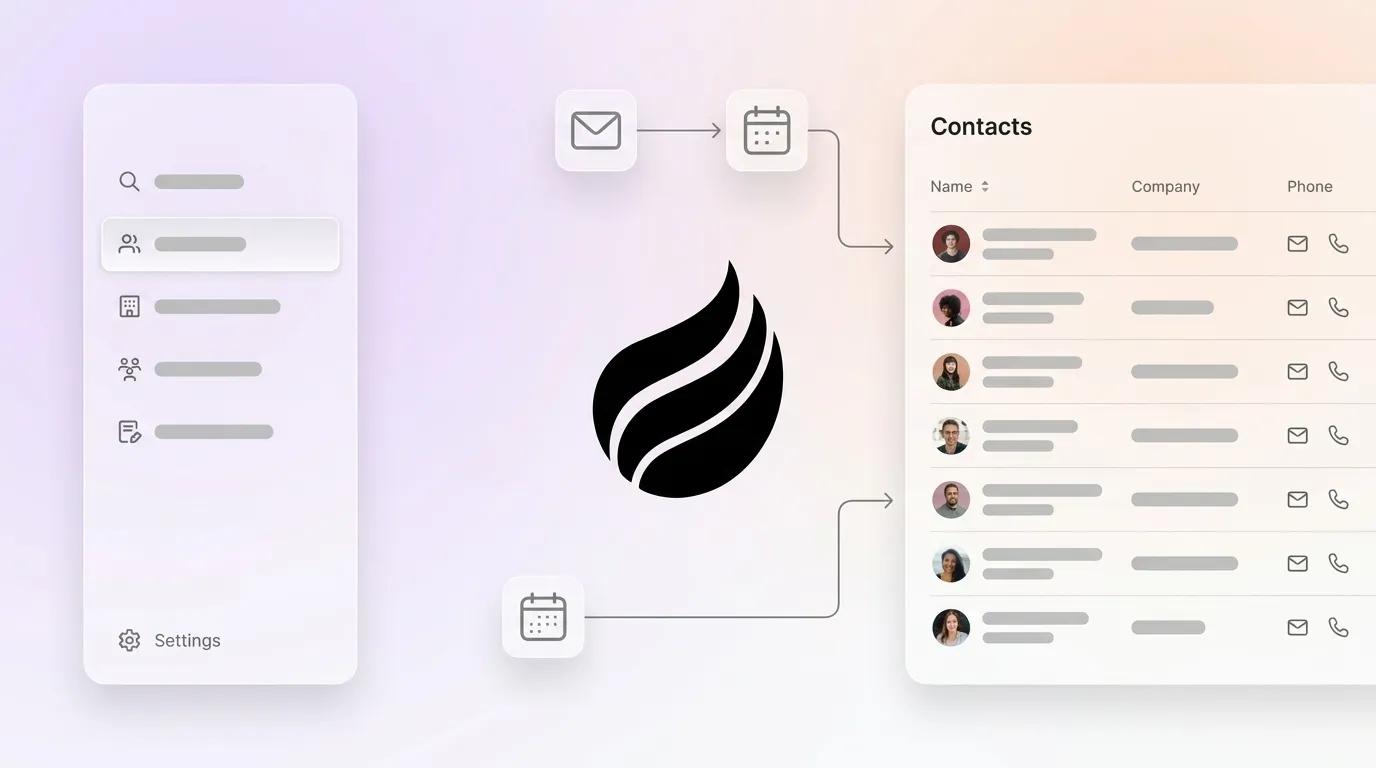
AI CRM systems automatically capture contact data from customer interactions by reading email signatures and extracting details from documents, eliminating manual clicking or typing to create records. Coffee’s Agent joins calls via its meeting bot, transcribes in real time, extracts contact and action-item data, and writes structured records back to the CRM without any human step in between.

Measuring ROI from Hours Saved
Administrative and non-selling tasks including CRM updates, data entry, logging, and meetings consume about 70% of a sales rep’s week, or roughly 28 hours in a 40-hour week. For a 10-person sales team, this represents a large pool of recoverable capacity.
Sales organizations using AI agents report productivity increases from time savings on repetitive tasks such as lead enrichment, intent scoring, and automatic CRM record updates. These gains compound when combined with shorter sales cycles and higher data accuracy.
Blueprint Automation implemented CRM automation to eliminate manual spreadsheet entry, resulting in up to a 75% reduction in time spent on day-to-day activities. CRM automation shortens sales cycles by 8–14% by centralizing contact data and enabling timely automated follow-ups.
Best-Fit Guidance by Company Stage
Early-stage teams (1–20 people): Native CRM automation often falls short at this stage because contact volume is low while data sources are diverse. Middleware adds maintenance overhead that a small team cannot absorb. Coffee’s Standalone AI-First CRM fits this profile well and replaces spreadsheets and manual CRMs with an agent that handles all contact creation from day one.
Teams committed to Salesforce or HubSpot (20–50 people): These teams have invested in a system of record and cannot migrate easily. The core issue is not the CRM itself but the quality of data flowing into it. Coffee’s Companion App deploys the agent as an intelligent layer on top of the existing instance and writes enriched, deduplicated contacts back to Salesforce or HubSpot without disrupting the current stack.
Decision Checklist: Matching Constraints to the Right Approach
- Budget is the primary constraint and you have an existing CRM license: Start with native automation for structured sources, since it is already included in your license cost. Native tools struggle with data quality at scale, so schedule a data quality audit within 90 days to catch emerging deduplication issues.
- You have RevOps capacity and multiple disconnected tools: If your team can absorb ongoing maintenance work, middleware can bridge gaps between systems that native automation cannot connect. Document every workflow and assign an owner for break-fix maintenance, because middleware workflows often break when APIs or schemas change.
- Your reps handle 10+ meetings per week and contacts originate from email and calls: When contact volume is high and sources are unstructured, neither native automation nor middleware can reliably parse email signatures or call transcripts without manual intervention. Reps handling multiple meetings per week often spend several hours on post-meeting administration, and an AI agent is the only category that removes this work entirely.
- You are on Salesforce or HubSpot and cannot migrate: Deploy Coffee as a Companion App to add autonomous contact creation while keeping your existing system of record in place.
- You are pre-CRM or on spreadsheets: Deploy Coffee’s Standalone CRM to avoid inheriting the manual data entry problem from the start.
- Data quality is a board-level concern: Gartner predicts that through 2026, organizations will abandon 60% of AI projects unsupported by AI-ready data. Only an AI agent with continuous enrichment and deduplication satisfies this requirement reliably.
Frequently Asked Questions
How long does implementation take for each approach?
Native CRM automation for basic structured inputs can be configured by a CRM admin, but multi-source workflows with deduplication rules typically require several weeks of RevOps time. Middleware implementations vary widely, since a single Zap connecting a web form to a CRM can be set up quickly, while a full multi-source stack with error handling and field normalization takes longer. AI agent CRM implementations typically take 2–4 weeks for targeted pilots and 3–6 months for full enterprise deployments, with no workflow builder or field mapper required.
What security and compliance considerations apply to automated CRM contact creation?
All three categories process personal data and fall under GDPR and CCPA requirements. Native CRM tools inherit the compliance posture of the CRM vendor, which for Salesforce and HubSpot includes enterprise-grade certifications. Middleware tools introduce a third-party data processor into the chain, so teams need a Data Processing Agreement with each vendor and an audit of where contact data is stored in transit. AI agent solutions must be evaluated on whether they use customer data to train shared models. Coffee is SOC 2 Type 2 and GDPR compliant, and customer data is not used to train public models. Role-based access control and audit logging remain standard requirements for any category handling contact-level personal data.
How difficult is it to migrate between methods?
Migrating from native CRM automation to middleware is straightforward because the CRM remains the system of record and only the ingestion layer changes. Migrating from middleware to an AI agent is similarly non-destructive, since the agent connects to the same CRM and begins writing records while existing Zaps can be deactivated incrementally. The most complex migration involves switching the underlying CRM itself, which requires a full data export, deduplication audit, and field remapping. Coffee’s Companion App model avoids this entirely by operating on top of an existing Salesforce or HubSpot instance, so teams gain AI agent capabilities without migration risk to their system of record.
Conclusion: Choosing the Best Way to Automate CRM Contact Creation
Native CRM automation covers structured inputs at low cost but fails on unstructured data and autonomous deduplication. Middleware extends coverage across tools but introduces maintenance overhead that scales with complexity. AI agents remove both constraints by processing every data source continuously, achieving deduplication precision that manual or rule-based methods cannot match, and requiring no ongoing workflow maintenance from your team.
For Heads of Sales and RevOps at 10–50 person tech companies, the calculus stays direct. Given the time allocation documented earlier, where reps spend only about 28% of their week actually selling, every hour recovered from manual contact creation returns an hour to revenue-generating activity. Coffee’s Agent is the only solution in this comparison that handles structured and unstructured data, operates as either a standalone CRM or a companion to Salesforce and HubSpot, and delivers continuous enrichment and deduplication without human intervention.