Written by: Doug Camplejohn, CEO & Co-Founder, Coffee
Key Takeaways
- 6sense pricing starts around $60,000 per year, with hidden fees and credit overages that overwhelm most mid-market RevOps teams.
- Coffee delivers an agent-led alternative that automates visitor identification, data entry, and CRM sync, saving teams 8–12 hours of manual work each week.
- Budget-friendly tools like Apollo.io ($49 per user per month) and Salesmotion ($85 per month) give SMBs clear pricing for prospecting and research.
- RollWorks focuses on mid-market ABM advertising, while enterprise platforms like Demandbase and ZoomInfo rely on custom pricing and complex implementations.
- Switch to Coffee’s simple per-seat pricing to get fast automation and stronger ROI without 6sense-level complexity.
How Much Does 6sense Cost in 2026?
6sense uses custom pricing with median annual costs of $60,211 according to Vendr data. Actual deployments range from $35,000 to more than $130,000, depending on modules and credit volumes. Contracts typically run 12 to 24 months and include implementation fees, with potential credit overages that can add $10,000 to $50,000 per year.
For most mid-market teams, this level of spend and commitment feels like overkill. First-year total costs often reach $120,000 to $150,000 when you factor in RevOps staffing, training, and integrations, and many teams reach that spend before they see meaningful adoption or ROI.
The following six alternatives offer clearer pricing and faster time-to-value. They range from agent-led automation with Coffee to budget prospecting tools and enterprise ABM platforms, so you can match your choice to your team’s complexity.
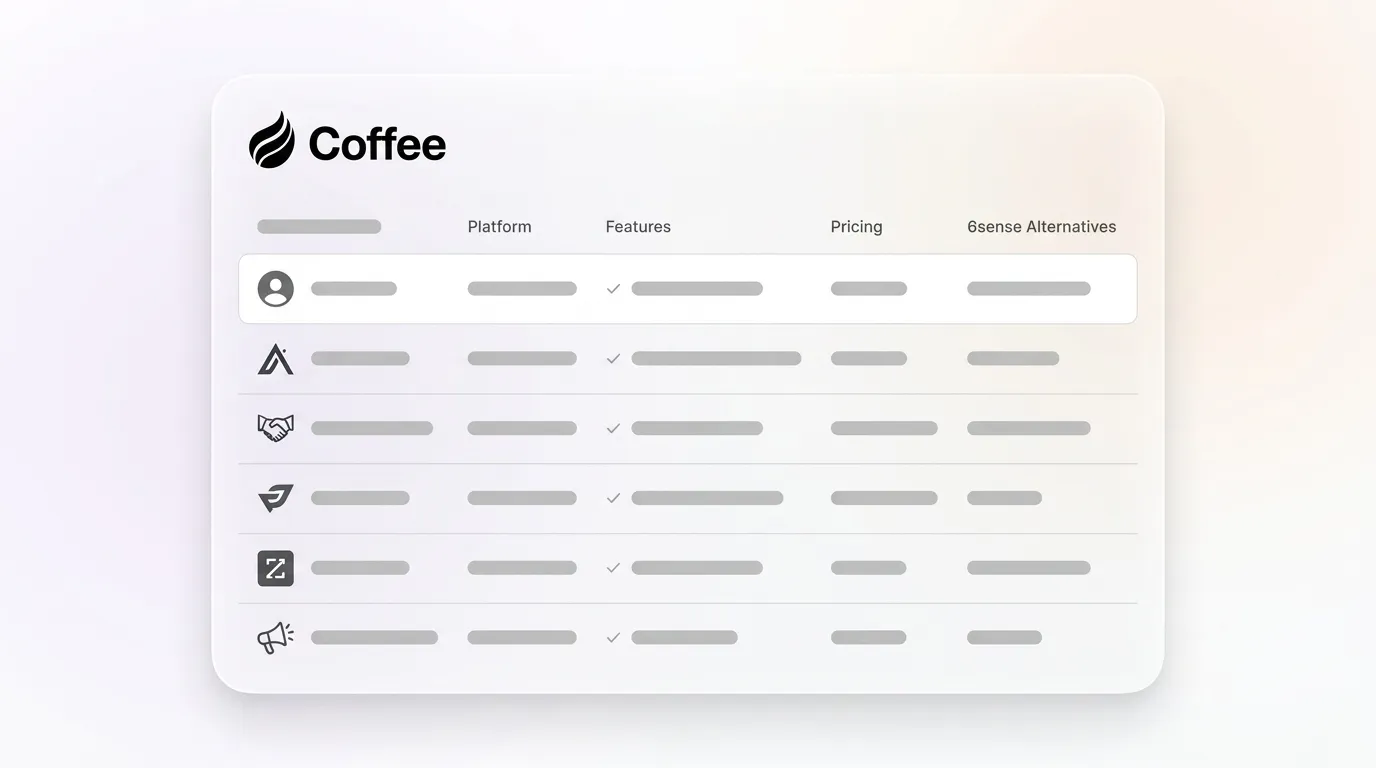
6sense Alternatives Pricing Comparison 2026
| Tool | Starting Price (2026) | Best For | Key vs 6sense |
|---|---|---|---|
| Coffee | Per-seat pricing with trial period | Agent-led automation | Automatic data entry and visitor ID |
| Apollo.io | $49/user/month (annual billing) | SMB prospecting | Clear per-user pricing |
| Salesmotion | $85/month | Account research | Unlimited users and monthly contracts |
| RollWorks | Custom annual pricing | Mid-market ABM ads | Lower-cost advertising programs |
| ZoomInfo | Custom tiered pricing | Contact database + intent | Tiered, published pricing ranges |
| Demandbase | Custom enterprise pricing | Enterprise ABM | Modular pricing by capability |
The tools below follow a clear progression by use case complexity. Coffee comes first as the agent-led option for teams that want automation. Apollo and Salesmotion serve basic prospecting and research. RollWorks focuses on advertising, while ZoomInfo and Demandbase fit enterprise data and ABM needs.
1. Coffee – Agent-Led Automation for Growing Teams
Coffee stands out as an agent-led alternative to 6sense that removes manual data entry and visitor identification work from your team. It replaces 6sense’s complex credit system with clear per-seat pricing and a trial period so teams can validate fit before committing.

The Coffee Agent uses a simple tracking pixel to identify visitors and automatically create enriched contact records in your CRM. It joins meetings, generates summaries, and maintains pipeline intelligence, which saves teams 8–12 hours of manual work every week. For HubSpot and Salesforce users, Coffee acts as a tireless companion that keeps data accurate without constant human effort.

Best for: Mid-market teams that want automation instead of complexity
Pricing: Per-seat model with a free trial period
Key advantage: The agent handles busywork so humans can focus on selling

2. Apollo.io – Budget Prospecting Platform for SMBs
Apollo offers clear pricing, with the Basic plan starting at $49 per user per month on annual billing, plus a free tier for simple prospecting. The platform combines a contact database with basic intent signals and email sequencing, which works well for SMBs and early-stage teams.
Best for: Small teams with fewer than 10 people
Pricing: $49 to $119 per user per month on annual contracts
Limitation: Basic intent data limited to six topics
3. Salesmotion – Focused Account Intelligence
Salesmotion specializes in account research automation and starts at $85 per month for individuals and $990 per month for unlimited team users. The platform cuts account preparation time by about 85 percent, moving from three hours to roughly 15 minutes per account.
Best for: Teams that care most about research efficiency
Pricing: $85 per month for individuals, $990 per month for teams
Key advantage: Monthly contracts with no long-term commitment
4. RollWorks – ABM Advertising for Mid-Market Teams
RollWorks offers accessible ABM advertising with custom pricing plus ad spend. The platform supports account identification, retargeting, and lead scoring, and it usually has a simpler setup than large enterprise ABM suites.
Best for: Teams experimenting with ABM advertising programs
Pricing: Custom platform fees plus media spend
Trade-off: More manual reporting and less automation than agent-led tools
5. ZoomInfo – Contact Data with Intent Signals
ZoomInfo sells access through custom tiered pricing. The platform combines a large contact database with intent data through Bombora partnerships, which helps teams identify and reach in-market accounts.
Best for: Teams that need contact data plus intent insights
Pricing: Custom tiered plans
Limitation: No built-in dialer or workflow automation
6. Demandbase – Enterprise ABM for Complex Orgs
Demandbase targets large enterprises and uses custom pricing that can reach six figures for full deployments. It suits organizations with complex buying committees and advanced ABM programs.
Best for: Large enterprises with layered workflows and many stakeholders
Pricing: Custom pricing that scales with scope and deployment
Consideration: Complex setup and long implementation timelines
Why Coffee Outperforms 6sense for Most Teams
Coffee’s agent-led model fixes a core problem with traditional ABM platforms, which often turn sales reps into data entry clerks. Coffee’s agent takes over the data work, from identifying visitors to updating your CRM, so reps can focus on conversations and pipeline.
Coffee also replaces 6sense’s credit-based system and potential overages with a straightforward per-seat model backed by SOC 2 compliance. This pricing clarity extends to functionality, because the agent covers enrichment, recording, and pipeline management in one platform. Teams can shrink their tech stack, reduce integration headaches, and rely on a single source of truth for sales data. Test Coffee’s agent-driven automation to see how this consolidated approach feels in your own workflow.

A $10M-plus ARR team recently replaced manual Salesforce processes with Coffee’s automation. They removed spreadsheet-based pipeline reviews and confirmed the weekly time savings that similar customers report, with more than eight hours of data entry work removed from their sales team’s schedule.
Best-Fit Use Cases and Buyer Guidance
Company size shapes both budget and process complexity, so it should guide your choice of platform. SMBs with fewer than 50 employees usually lack dedicated RevOps support, which makes Coffee’s standalone CRM or Apollo.io’s simple prospecting tools a strong fit for lean teams.
Mid-market teams with 50 to 500 employees often already run HubSpot or Salesforce but struggle with data quality and manual work. Coffee works well as a companion to these CRMs, while RollWorks fits teams that focus mainly on advertising-led ABM. Enterprise organizations with more than 500 employees can justify platforms like Demandbase or 6sense, yet they still need to confirm that their teams will actually use the advanced features.
Implementation time also matters when you compare alternatives. Coffee can go live quickly, while enterprise platforms often require several weeks or even months for full deployment. This timeline gap affects your total cost of ownership, because longer implementations demand more RevOps hours and extended training before you see any return.
Risks and Insights from Buyer Forums
6sense’s annual contracts and credit systems create vendor lock-in and unpredictable costs. Some alternatives, such as Apollo, have data warehouse limits, and lower-cost tools may not match 6sense’s advanced intent capabilities. Teams that want predictable outcomes should focus on transparent pricing and fast time-to-value instead of long feature checklists.
Decision Matrix Summary for 6sense Alternatives
Three criteria help narrow your decision. Budget constraints favor Coffee and Apollo, which both provide clear pricing. Existing tech stack matters as well, and Coffee pairs especially well with HubSpot and Salesforce. Automation needs complete the picture, because Coffee’s agent-led model removes manual work that traditional ABM platforms still expect humans to handle.
Most mid-market teams see stronger ROI from focused, affordable tools than from enterprise platforms they cannot fully adopt. A smaller, well-used stack usually beats a large, underutilized one.
Frequently Asked Questions
What is the difference between 6sense and Coffee pricing?
6sense relies on opaque custom pricing that often starts around $60,000 per year, with credit-based overages and 12 to 24 month contracts. Coffee uses transparent per-seat pricing with no hidden fees, and teams can try the full platform during a trial period. Coffee’s agent automation often delivers better ROI for mid-market teams by removing manual data entry work.
What is the cheapest 6sense alternative?
Apollo.io offers the lowest entry price at $49 per user per month, along with a free tier for basic prospecting. Salesmotion provides account intelligence starting at $85 per month. Coffee delivers the strongest value for automation-focused teams through its agent-led model and clear pricing.
Can Coffee replace ZoomInfo?
Coffee’s agent handles visitor identification, contact enrichment, and CRM integration, which covers many common ZoomInfo use cases. It also adds automation for meeting management and pipeline intelligence. Many teams consolidate several tools when they adopt Coffee’s comprehensive agent approach.
What are the best 6sense alternatives for Salesforce users?
Coffee works especially well as a Salesforce companion, because it automatically syncs enriched data and takes over manual entry tasks. RollWorks and Demandbase also integrate with Salesforce, although they require more manual oversight than Coffee’s agent-led experience.
How quickly can teams implement 6sense alternatives?
Coffee can be set up quickly through a simple Google Workspace or Microsoft 365 connection. Apollo and Salesmotion usually deploy within a few days. Enterprise platforms like Demandbase often take several weeks or months for full implementation, which mirrors 6sense’s more complex rollout process.
The ABM landscape in 2026 gives mid-market teams clear options beyond 6sense’s expensive and complex model. Teams that choose transparent, automation-focused platforms remove manual work instead of adding more tools to manage. See how Coffee’s agent-led automation reshapes your sales process and reduces manual effort without enterprise-level complexity or cost.