Written by: Doug Camplejohn, CEO & Co-Founder, Coffee | Last updated: July 26, 2026
How This Guide Helps Your ABM CRM Integration
- Fragmented ABM and CRM data causes lost deals because intent and buying signals never reach Salesforce or HubSpot in real time.
- Legacy connectors and manual syncs cannot keep up with real-time intent spikes or unstructured engagement signals in 2026.
- An agentic layer like Coffee’s Companion App syncs structured and unstructured data between ABM platforms and CRMs without human effort.
- Five core data categories, including account and contact fields, must flow both ways to keep CRM records accurate.
- Eliminate manual sync work from your ABM CRM integration with Coffee’s agentic integration platform.
ABM CRM Integration and Its Direct Impact on Revenue
ABM CRM integration is the bidirectional, real-time synchronization of account-level data between an account-based marketing platform and a CRM such as Salesforce or HubSpot. It keeps intent scores, engagement timelines, buying committee contacts, firmographic enrichment, and opportunity signals flowing between systems without human intervention.
Effective integration produces three clear operational outcomes. It creates a unified account view so every rep sees the same engagement history, intent score, and contact coverage that marketing used to prioritize the account. It enables intent-driven routing so accounts that cross a defined signal threshold trigger automatic assignment, task creation, and outreach sequences in the CRM. It closes the attribution loop so ABM-influenced pipeline is traceable inside the CRM without manual tagging or CSV reconciliation.
Demandbase Labs, analyzing data from 1,452 tenants, found that organizations connecting CRM, marketing automation, and predictive models achieve higher MQA-to-pipeline conversion rates compared to programs with limited integration. That performance gap reflects the direct cost of fragmented ABM CRM integration.
The 2026 Demand Gen Report ABM Benchmark Survey identified MarTech integration as a primary barrier to AI adoption in ABM programs, ahead of limited internal expertise and difficulty proving ROI. Integration quality now functions as a direct revenue variable, not a technical detail.
Why Manual Syncs and Point Connectors Break Modern ABM
Native connectors between ABM platforms and CRMs were built for simpler data models and lighter traffic. They handle structured fields reasonably well in one direction. They fail under 2026 ABM requirements such as real-time intent spikes, buying group changes, unstructured engagement from call transcripts, and multi-system field ownership conflicts.
B2B contact data decays at an estimated rate of 22.5% per year across all sectors, with Gartner research showing rates exceeding 70% in high-turnover industries as professionals change roles, companies merge, and sectors pivot. A connector that syncs data once daily on top of this decay produces records that are already wrong before the next cycle runs.
The hidden labor cost compounds the problem. Evidence indicates a five-person SDR team typically spends 1,430–2,860 hours per year on manual data tasks. Point connectors reduce some of this work but never remove it because they still require field mapping maintenance, deduplication governance, and manual exception handling when sync failures occur silently.
Approximately half of HubSpot integrations silently break, fall out of sync, or stop scaling within the first year. OAuth tokens expire, webhook gaps miss bulk imports, and rate limits throttle high-volume syncs without alerts. Limited internal resources prevent many organizations from implementing and maintaining complex ABM platform integrations. The maintenance tax becomes a recurring operational drag rather than a one-time setup task.
The Agentic Layer That Replaces Brittle Native Syncs
An autonomous agent between the ABM platform and the CRM resolves most ABM CRM integration failures. A passive connector waits for a scheduled job or a webhook to fire. An agent continuously monitors both systems, ingests structured and unstructured signals, applies field ownership rules, and writes enriched data back to the correct record without human instruction.
Coffee's Companion App for Salesforce and HubSpot operates as this agentic layer. It connects to existing CRM instances through simple authentication and then manages data-in flows autonomously. The agent captures intent signals, enriches contact and account records, logs activity from emails and call transcripts, and surfaces pipeline changes through automated compare views. This capability extends beyond traditional structured fields such as intent scores, firmographics, and opportunity stages to unstructured data like meeting summaries and email threads that relational CRM databases cannot process without manual extraction and reformatting.

In 2026, the average ABM program runs with an AI orchestration layer that would have required three people to manage manually two years earlier. The agent model replaces the manual process rather than augmenting it. Agentic AI in CRM systems monitors deal activity, detects overdue follow-ups, updates records from meeting transcripts, escalates risk cases, and runs multi-step workflows without manual input at each stage.
Five Data Categories Your ABM CRM Sync Must Support
A reliable ABM CRM integration depends on explicit field ownership and bidirectional sync across five data categories. When any category falls out of sync, routing, scoring, and attribution workflows inherit the gap.
The CRM acts as the source of truth for firmographic and opportunity data, while the ABM platform writes back intent scores, engagement scores, and most-engaged contact data without overwriting CRM-owned fields. The five categories that must flow bidirectionally are:
- Account fields: Primary domain as the universal lowercase match key, CRM account ID, account owner, ABM tier or segment, and firmographic data such as industry, headcount, revenue, and technology stack.
- Contact fields: Buying committee roles, including economic buyer, champion, technical evaluator, and procurement, plus job title mapped to a standard taxonomy, verified email, and LinkedIn profile.
- Intent scores: Composite scores normalized to a 0–100 scale, combining pricing page visits, comparison page visits, recent email clicks, high third-party intent, and funding or executive hire signals.
- Engagement timeline: Campaign touches, content consumed, meetings held, webinar attendance, and product trial activity, mapped to the account object so reps see full history without switching systems.
- Pipeline signals: Opportunity stage, close date, deal size, and won or lost reason, with real-time webhooks for stage changes and new deals plus daily batch updates for other account fields.
Missing intent scores force scoring models to work on partial information and misprioritize pipeline. Missing engagement timelines leave reps entering calls without context. Incomplete buying committee roles mean many enterprise accounts lack full buying committee coverage, so deals stall at the champion level without economic buyer engagement.
Salesforce ABM CRM Integration: 7-Step Agent Checklist
This checklist guides mid-market RevOps teams deploying Coffee's Companion App as the agent layer on top of an existing Salesforce instance. These steps operationalize the field and data requirements described above.
- Authentication: Connect Coffee to Salesforce via OAuth 2.0 and confirm the connected user has read and write access to Account, Contact, Opportunity, and custom ABM objects.
- Field mapping: Define explicit field ownership. Salesforce owns firmographic and opportunity fields. The ABM platform writes intent score, engagement score, and most-engaged contact while Coffee enforces these rules and prevents overwrite conflicts.
- Agent enrichment: Enable Coffee's automated enrichment to populate job titles, funding data, and LinkedIn profiles on new and existing Account and Contact records, removing reliance on separate enrichment tools.
- Real-time webhooks: Configure webhooks for opportunity stage changes and new deal creation, and set daily batch sync for account-level updates such as ABM tier changes and intent score refreshes.
- Deduplication rules: Establish a three-tier match confidence model where high-confidence matches auto-sync, medium-confidence matches route to a 48-hour RevOps review queue, and low-confidence matches require enrichment before inclusion.
- Pipeline-compare setup: Activate Coffee's Pipeline Compare feature to visualize week-over-week changes in Salesforce opportunities and replace manual CSV exports and spreadsheet reviews.
- Ongoing monitoring: Set alerts for sync failures, field drift, and CRM match rates below 90 percent, and review monthly metrics such as match rate, contact coverage, sync lag, and ABM-influenced pipeline.
HubSpot ABM CRM Integration: 7-Step Agent Checklist
This checklist mirrors the Salesforce track but aligns with HubSpot authentication, object models, and lifecycle stage logic. It applies the same data principles using HubSpot-specific controls.
- Authentication: Connect Coffee to HubSpot via Private App token, confirm scopes for contacts, companies, deals, and custom properties, and implement refresh logic to prevent OAuth token expiration that can silently stop sync approximately every 30 minutes without proper refresh handling.
- Lifecycle-stage mapping: Define how ABM tier maps to HubSpot lifecycle stages and ensure lifecycle transitions in HubSpot and the ABM platform update each other to avoid nurturing accounts already in active sales cycles.
- Field mapping: Create custom properties in HubSpot for intent score, ABM tier, engagement score, and last_content_engaged, and assign ownership so HubSpot controls deal and contact fields while the ABM platform writes intent and engagement properties.
- Agent-driven enrichment: Enable Coffee's agent to enrich HubSpot Company and Contact records automatically with job titles, funding rounds, and technographic data, removing manual research and extra enrichment tools.
- Webhook and batch configuration: Use HubSpot webhooks for deal stage changes and new contact creation, and supplement with daily batch polling for account-level property updates because some lifecycle transitions and bulk imports do not emit webhooks.
- Deduplication governance: Use company domain as the primary lowercase match key, run deduplication before enabling bidirectional sync, and prevent last-write-wins conflicts that corrupt valid updates.
- Monitoring and alerting: Configure Coffee to surface sync errors, rate-limit warnings, and field mapping failures in real time, addressing the silent failure mode described in step one where integrations stop without alerts.
How Coffee’s Agent Becomes Your Operational Source of Truth
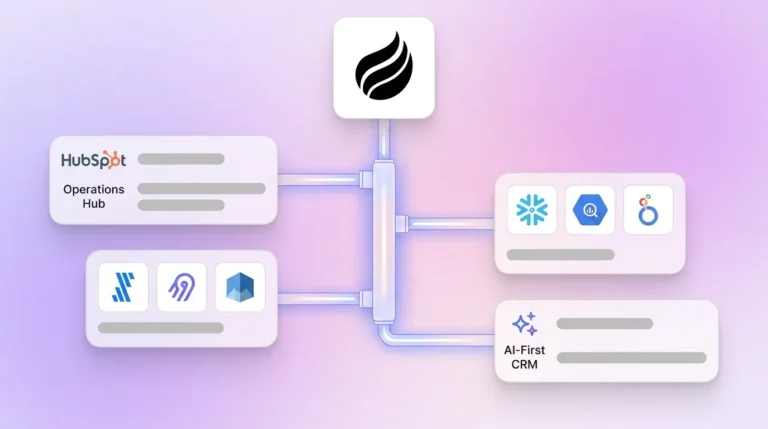
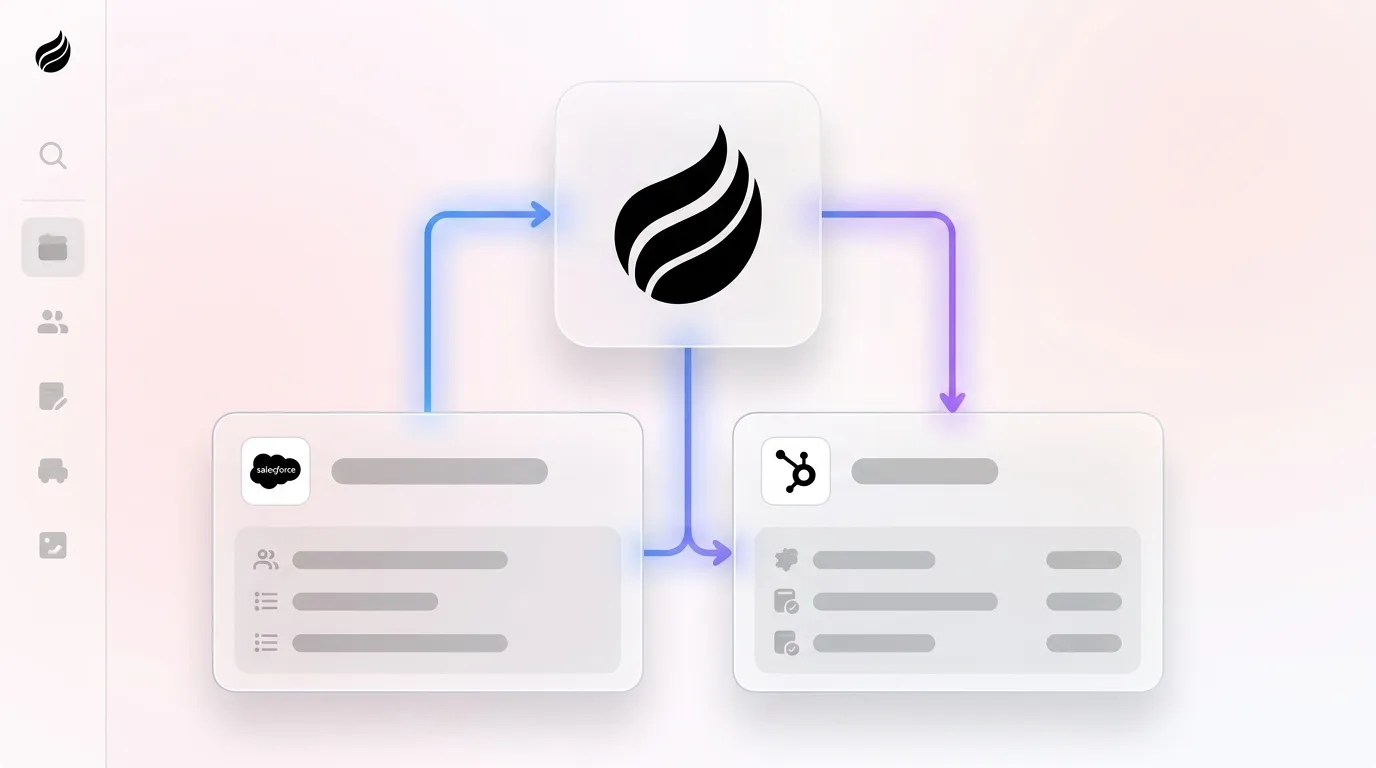
The Coffee Agent sits between the ABM platform and the CRM and functions as integration middleware that removes the maintenance tax of brittle native connectors. The ABM platform emits intent signals, engagement events, and account tier changes. The Coffee Agent ingests these signals, enriches them, enforces field ownership rules, deduplicates against existing records, and writes clean data back to Salesforce or HubSpot in real time.

In the reverse direction, when a rep updates an opportunity stage, closes a deal, or logs a meeting outcome in the CRM, the Coffee Agent sends that signal back to the ABM platform. The ABM platform then adjusts account scoring and suppresses converted accounts from active campaigns. This bidirectional flow removes the one-way sync failure mode where engagement signals never reach the CRM and CRM outcomes never reach the ABM platform.
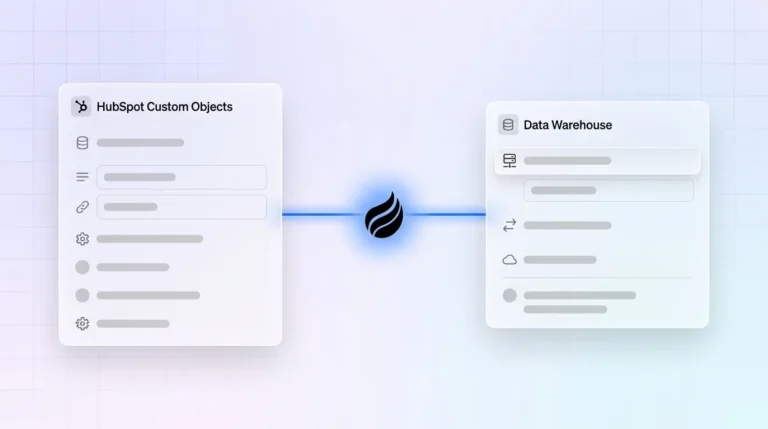
Coffee maintains a built-in data warehouse instead of relying on a relational database that overwrites historical context. Every field change is versioned so RevOps teams can audit the full history of an account record, including when intent scores changed, which enrichment source updated a job title, and how pipeline stage shifts correlated with engagement spikes, without building separate data infrastructure.
Deploy Coffee's agent layer for your CRM and keep your Salesforce or HubSpot instance accurate without manual maintenance.
Measuring ABM ROI Directly Inside the CRM
When ABM CRM integration works correctly, ROI measurement moves from quarterly CSV reconciliation to automated pipeline-compare views inside the CRM. Coffee's Pipeline Compare feature visualizes week-over-week opportunity changes, highlights progressed deals, flags stalled accounts, and surfaces new additions based on continuous agent data capture instead of manual exports.
The benchmark for connected systems is clear. Organizations connecting CRM, marketing automation, and predictive models achieve higher MQA-to-pipeline conversion rates versus programs with limited integration. Reaching the Demandbase benchmarks mentioned earlier requires the CRM to reflect accurate intent scores, engagement timelines, and buying committee coverage, which an agentic layer can maintain without ongoing human effort.
Track additional ROI indicators monthly, including CRM match rate above 90 percent, contact coverage rate by ABM tier, sync lag between intent signal and CRM update, ABM-influenced pipeline, and win rate by ABM tier. A 2026 benchmark of 94 B2B companies found that signal-based motions using synchronized first- and third-party signals in CRMs achieved a 32 percent win rate and 94-day average cycle time, versus 13 percent and 151 days for static list-based ABM.
Common Post-Integration Pitfalls and How Agents Prevent Them
Three failure modes recur after ABM CRM integrations go live: field drift, duplicate record accumulation, and adoption drop-off. Each one quietly degrades data quality until pipeline reviews expose the damage.
Field drift appears when field ownership rules are not enforced at the system level. A rep manually overwrites an intent score, then a marketing automation workflow updates a firmographic field that the CRM owns. These conflicting updates compound over weeks, and the canonical data model drifts away from reality. Coffee's agent enforces field ownership rules continuously, rejects writes that violate the defined source-of-truth hierarchy, and logs each conflict for RevOps review.
Duplicate records grow when new integrations sync records without a prior deduplication pass. CRMs without deduplication governance often accumulate duplicate records, which create territory conflicts, double outreach, and broken routing rules. The Coffee Agent applies the three-tier match confidence model at ingestion and blocks duplicates from entering the system instead of relying on periodic cleanup campaigns.
Adoption drop-off follows when reps view the CRM as a data-entry burden instead of a productivity tool. When the agent handles enrichment, activity logging, and meeting summaries automatically, reps work in a CRM that reflects reality without their manual input. The system serves them, which creates the conditions for sustained adoption.
Readiness Checklist for Agent-First ABM CRM Integration
RevOps teams should assess readiness across four dimensions before deploying an agentic ABM CRM integration. Any gap defines sequencing for remediation work but does not block deployment.
- Data maturity: Core CRM objects such as Account, Contact, and Opportunity should have more than 90 percent completion on critical fields like verified email, job title, company domain, and industry. RevOps teams often gate AI or advanced automation using a readiness checklist that requires this completion level before enabling AI scoring or recommendations. If completion falls below 80 percent, run an enrichment pass before enabling bidirectional sync.
- Field ownership documentation: Every field in the ABM CRM integration needs a defined source of truth. Undocumented ownership remains the most common cause of post-integration data corruption. A data dictionary that covers at minimum intent score, engagement score, ABM tier, and buying committee roles is required before go-live.
- Deduplication baseline: Target a duplication rate below 2 percent before enabling bidirectional sync. Run a deduplication audit using company domain as the primary match key and resolve conflicts before the agent begins writing enriched data.
- Change-management capacity: Agent-first integration changes how RevOps, marketing ops, and sales teams interact with the CRM. Assign a data owner to monitor sync health, review the RevOps queue for medium-confidence matches, and conduct monthly field-completion audits. Teams without a designated owner often see governance decay within 90 days of go-live.
Explore Coffee's seat-based pricing for unlimited agent labor with no metering on LLM usage.
Frequently Asked Questions
How does Coffee secure ABM CRM integration data?
Coffee is SOC 2 Type 2 certified and GDPR compliant. All data processed by the Coffee Agent, including intent signals, CRM records, call transcripts, and enrichment outputs, is handled under these frameworks. Customer data never trains public models. For mid-market RevOps teams in regulated environments or handling sensitive account data, Coffee's security posture meets the standard required for CRM and ABM integrations without a multi-year security review.
Can my team use Zapier until a native connector exists for our ABM platform?
Zapier remains available as a fallback integration path while Coffee builds deeper native connectors across the ABM ecosystem. RevOps teams can deploy the Coffee Agent as their agentic layer immediately, use Zapier to bridge ABM platforms not yet covered by native connectors, and later transition to native integrations without disrupting data flow.
What pricing model does the Coffee Agent use?
Coffee uses seat-based pricing. You pay for the human seats on your team, and the Coffee Agent's labor, including enrichment runs, activity logging, sync operations, meeting summaries, and pipeline compare updates, is included without metering on LLM usage or process volume. This structure keeps ABM CRM integration costs predictable and avoids per-API-call or per-record fees that make point solutions expensive to scale.
How often does Coffee refresh intent signals inside the CRM?
Coffee uses real-time webhooks for high-priority events such as opportunity stage changes and new deal creation. Account-level fields including intent scores, engagement scores, and ABM tier designations update through daily batch sync. This pattern delivers real-time propagation for signals that require immediate sales action and daily refresh for enrichment that does not need sub-hour latency. RevOps teams can configure drift thresholds that trigger alerts when ABM tier changes exceed defined percentages between batch cycles.