Written by: Doug Camplejohn, CEO & Co-Founder, Coffee | Last updated: July 26, 2026
Key Takeaways for ABM Data Automation
- ABM data automation replaces manual research and entry with agent-led workflows that continuously discover, enrich, and sync account data into Salesforce or HubSpot.
- Dirty CRM data costs organizations millions annually, and automation removes stale firmographics, duplicate records, and missed buying signals that derail campaigns.
- A seven-step workflow covering discovery, enrichment, intent monitoring, deduplication, scoring, Salesforce sync, and HubSpot sync keeps every stage of the ABM funnel running on clean, real-time data.
- Weekly metrics such as 90%+ field completion, under 1% duplicate rate, and strict intent-signal latency targets keep the automated system accurate and the pipeline reliable.
- Track these metrics automatically and eliminate manual data entry with Coffee’s agent-led ABM workflow.
Readiness Checklist Before You Start ABM Data Automation
Confirm these prerequisites before you launch any automated ABM workflow.
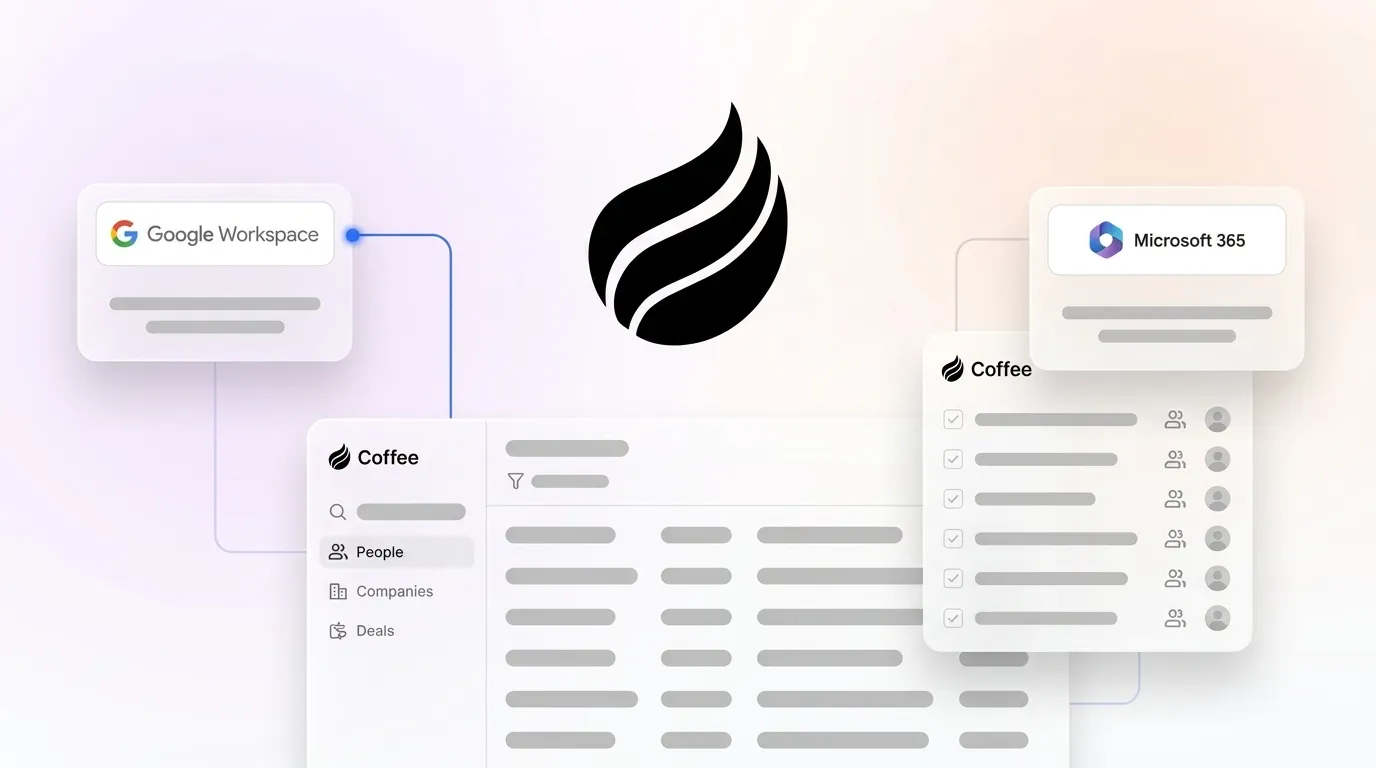
- Google Workspace or Microsoft 365 access — required for the Coffee Agent to scan emails and calendars, auto-create contacts, and log activity autonomously.
- Existing CRM instance — a live Salesforce or HubSpot environment, or a willingness to adopt Coffee as a standalone CRM. CRM contact data decays at roughly 2–3% per month, and studies show that 90% of contacts in the average database are incomplete, so the instance must be active and accessible.
- Buyer-persona definitions — documented ICP criteria including industry, headcount range, revenue band, and target titles. Before you deploy automation, run a data cleanup that deduplicates accounts and fills missing firmographic fields so your ICP filters and scoring models operate on accurate inputs from day one.
- Named data steward — one RevOps owner responsible for field-level governance. Without assigning named data stewards to each field category and setting quarterly SLA reviews, data quality degrades faster than any enrichment tool can fix it.
- Defined success metrics — baseline CRM completeness score, current MQL-to-SQL conversion rate, and weekly hours spent on manual data tasks.
With these prerequisites in place, you can deploy the following seven-step workflow to automate every stage of your ABM data pipeline, from account discovery through CRM sync.
7-Step Automated Workflow for ABM Data Automation
Step 1: Account Discovery Automation
Purpose: Identify net-new accounts that match your ICP without manual research.
Inputs: ICP criteria (industry, headcount, revenue, tech stack), existing CRM account list.
Systems: Coffee List Builder, Coffee Visitor Identification pixel.
Owner: RevOps lead.
Completion signal: New accounts appear in CRM with firmographic fields pre-populated and tagged as agent-discovered.
Failure-point call-out: Account lists often inflate to include aspirational logos or demonstrate scale, so enforce strict ICP scoring thresholds before any account enters the workflow.

Step 2: Enrichment Automation
Purpose: Augment discovered accounts and contacts with job titles, funding data, LinkedIn profiles, and technographics.
Inputs: Raw account and contact records from Step 1.
Systems: Coffee’s built-in enrichment via licensed data partners (removes the need for standalone ZoomInfo or Apollo licenses).
Owner: RevOps lead.
Completion signal: Required fields such as title, company size, industry, and LinkedIn URL reach 90% or higher completeness across the account list.
Failure-point call-out: Enrichment only delivers value when the data remains accurate over time, so monitor synchronization quality weekly to keep data quality high and conflict rates low across systems.

Step 3: Intent Signal Automation
Purpose: Monitor target accounts for buying signals such as pricing page visits, content downloads, and topic surges, then route alerts to the CRM in real time.
Inputs: Coffee Visitor Identification pixel data, first-party engagement events, third-party intent feeds.
Systems: Coffee Agent (intent scoring and Slack notification), CRM workflow triggers.
Owner: Marketing Ops or RevOps.
Completion signal: Every intent event updates the account score field in CRM and triggers a task or sequence enrollment within the defined SLA. A 24-hour intent SLA is recommended, with Tier 1 signals triggering rep notification via Slack within 1 hour and personalized outreach within 24 hours.
Failure-point call-out: Intent data must be refreshed daily at minimum, because stale intent signals quickly lose value and can mislead your campaigns.
Step 4: Deduplication and Hygiene
Purpose: Remove duplicate records, normalize field formats, and flag stale contacts before they corrupt scoring or routing.
Inputs: Full CRM account and contact database.
Systems: Coffee Agent (automated hygiene), with human approval required for merges and deletions.
Owner: RevOps data steward.
Completion signal: Duplicate rate falls below 1%, required-field completeness exceeds 90%, and every change is logged with old value, new value, source, and timestamp.
Failure-point call-out: Many duplicate records originate during the data entry stage due to human error, so agent-led deduplication must run continuously instead of as a one-time project.
Step 5: Scoring and Prioritization
Purpose: Rank accounts by ICP fit, intent intensity, engagement depth, and buying-committee coverage so reps focus on the highest-probability opportunities.
Inputs: Enriched firmographics, intent scores, CRM activity history, buying-committee contact count.
Systems: Coffee Agent scoring model, Coffee Pipeline Intelligence.
Owner: RevOps lead with sales leadership sign-off on tier thresholds.
Completion signal: Every account in the active list carries a numeric score and a tier designation (Tier 1, Tier 2, or Tier 3), and weekly prioritized lists reach SDR and AE queues automatically.
Failure-point call-out: Companies that closely track buying groups tend to achieve higher win rates than organizations taking a broader, less structured approach, and scoring models that ignore buying-committee depth systematically underperform.
Step 6: Syncing ABM Data to Salesforce
Purpose: Write enriched account records, contact data, intent scores, and activity logs from the Coffee Agent into Salesforce without manual field mapping by reps.
Inputs: Scored and enriched records from Steps 2 through 5.
Systems: Coffee Companion App for Salesforce (bidirectional sync); Coffee handles required fields, forecasting hierarchies, and quota-relevant objects that simpler integrations miss.
Owner: Salesforce Admin or RevOps.
Completion signal: Critical field updates occur within the same SLA used for intent and enrichment updates, and Salesforce account and contact records reflect the same completeness score as the Coffee Agent layer.
Failure-point call-out: As noted in the readiness checklist, most CRM databases suffer from severe incompleteness, so a sync that writes dirty data into Salesforce at speed makes the problem worse instead of better, which is why hygiene in Step 4 must precede sync.
Step 7: Syncing ABM Data to HubSpot
Purpose: Mirror the same enriched, scored, and deduplicated account data into HubSpot for marketing automation, sequence enrollment, and reporting.
Inputs: The same scored records used in Step 6.
Systems: Coffee Companion App for HubSpot; Coffee understands HubSpot’s lifecycle stage logic, deal pipeline structure, and required property rules.
Owner: Marketing Ops or RevOps.
Completion signal: HubSpot contact and company records match Coffee Agent data, intent-triggered workflow enrollments fire within the defined SLA, and no orphaned records exist without an associated account.
Failure-point call-out: Many B2B marketers cite integration of data across multiple platforms as a major challenge, and a companion agent with native HubSpot knowledge removes the field-mapping errors that often appear in generic Zapier connections.
Deploy this 7-step workflow in under a week, with no new headcount required.
2026 Tool-Stack Comparison for ABM Data Automation
This comparison table outlines how three automation approaches perform across discovery, integration depth, and ongoing hygiene for mid-market RevOps teams.
| Approach | Account Discovery & Enrichment | Salesforce / HubSpot Integration Depth | Ongoing Data Hygiene |
|---|---|---|---|
| No-code (manual + forms) | Manual list uploads, and error rates range from 1% to 5% depending on task complexity | Native CRM fields only, no automated write-back, and 91% of CRM data may become inaccurate within a year without regular updates | Quarterly manual cleanup, and duplicates accumulate faster than cleanup cycles can resolve them |
| Zapier-based automation | Trigger-based enrichment via Apollo or Clearbit, and single-provider coverage yields 50–70% valid email coverage versus 85–95% with waterfall enrichment | Zap-level field mapping that does not handle Salesforce required fields, forecasting hierarchies, or HubSpot lifecycle logic natively, and many B2B marketers cite cross-platform data integration as a major challenge | Rules-based deduplication only, no audit log, and human review required for all merges |
| Agent-based (Coffee) | Autonomous discovery via email and calendar scan, Visitor ID pixel, and List Builder, plus enrichment via licensed partners, and proper data sync automation typically recovers 8–12 hours per week per sales rep | Deep bidirectional sync for Salesforce and HubSpot including required fields, quota objects, forecasting hierarchies, and lifecycle stages, with implementations showing notable improvements in CRM data accuracy and forecast reliability | Continuous agent-led hygiene with full audit log, every change logged with old value, new value, source, and timestamp, and merges requiring explicit human approval per CRM hygiene agent governance standards |
Weekly Validation Metrics for ABM Data Automation
RevOps teams should review these data-quality and pipeline-accuracy metrics every week instead of waiting for quarterly reviews.
- Field completion rate: Percentage of required CRM fields such as title, industry, company size, and LinkedIn URL filled across all active accounts. Target: 90% or higher. As noted in Step 5, data completeness and buying-group tracking are both correlated with higher win rates.
- Duplicate rate: Percentage of duplicate records resolved per week. Target: under 1% net new duplicates. Measure duplicate rate, required-field completeness, stale-stage backlog, merge approval time, and AI action failure caused by bad data as a unified hygiene scorecard.
- Intent signal latency: Time from signal detection to CRM field update and task creation. Target: under 1 hour for Tier 1 signals and under 24 hours for all others. Intent signals lose value rapidly, so strict latency SLAs ensure reps can act while prospects remain engaged.
- MQL-to-SQL conversion rate: Baseline and weekly delta. Programs combining lead scoring with AI intent signals can improve MQL-to-SQL conversion in a measurable way.
- Enrichment hit rate: Percentage of new accounts enriched automatically without manual intervention. Target: 85% or higher.
- Forecast variance: Week-over-week pipeline change explained by agent-logged activity versus unexplained manual updates. Companies using integrated platforms with AI forecasting often reduce forecast variance significantly.
- Cost per qualified lead: Automated programs can lower the cost per qualified lead compared to manual programs, so track this weekly to confirm the workflow delivers ROI.
Frequently Asked Questions About Coffee’s ABM Automation
How long does it take to set up Coffee’s ABM data automation workflow?
Most mid-market teams complete the initial Coffee setup in under a day. Connecting Google Workspace or Microsoft 365 triggers the Coffee Agent to begin auto-creating contacts and logging activity immediately. The Companion App for Salesforce or HubSpot requires a simple authentication step, after which the agent begins enriching records and writing data back to the primary CRM. The full seven-step workflow, from account discovery through CRM sync, can be operational within the first week. Teams with existing dirty CRM data should run a 30-day data cleanup sprint in parallel to maximize the agent’s effectiveness from day one.
Is Coffee secure enough for mid-market sales data?
Coffee is SOC 2 Type 2 certified and GDPR compliant. Data processed by the Coffee Agent is not used to train public AI models. The agent shares only minimal record data such as name, email, and domain with external enrichment APIs and never exports full records. Every CRM change made by the agent is logged with an audit trail that includes the old value, new value, source, and timestamp. Merges and deletions of customer account records require explicit human approval, and the agent never performs bulk destructive operations without a preview and sign-off step.
How does Coffee’s pricing model work?
Coffee uses seat-based pricing. You pay for the human seats on your team, and the Coffee Agent’s labor across enrichment, data entry, meeting management, pipeline intelligence, hygiene, and CRM sync is included without additional metering on AI usage or automated processes. There are no separate charges for LLM calls, enrichment lookups, or workflow executions. This model keeps costs predictable as you scale and removes the per-record or per-API-call fees common in legacy enrichment tools.
How does Coffee scale from a small team to 50 seats?
Coffee’s agent architecture scales linearly with seat count. Adding a new rep means the agent automatically begins scanning their email and calendar, creating contacts, logging activity, and including their deals in pipeline intelligence with no extra configuration. The Companion App model keeps Salesforce or HubSpot as the system of record throughout the scale-up, and existing admin configurations, custom objects, and reporting structures remain intact. Teams scaling from 10 to 50 seats do not need to re-architect their CRM or rebuild enrichment workflows, because the agent layer expands to cover new users automatically.
What happens to intent signals that fire outside business hours?
The Coffee Agent operates continuously. Intent signals captured by the Visitor Identification pixel or connected intent feeds are processed and written to CRM records in real time, regardless of when they occur. High-fit visitor alerts surface in Slack so the relevant rep sees them at the start of their next working session. The agent pre-fills enrichment data such as name, title, email, LinkedIn profile, pages visited, and time on site so the rep can act immediately without manual lookup. Prospects can be added to outbound sequences or routed to LinkedIn outreach with a single click directly from the alert.
Conclusion: Turn ABM Data into a Reliable Growth Engine
The seven-step workflow for account discovery, enrichment, intent monitoring, deduplication, scoring, Salesforce sync, and HubSpot sync closes the gaps where manual entry and dirty data cause ABM programs to fail. Connecting CRM, MAP, and predictive models on a clean data foundation supports stronger MQA-to-pipeline conversion rates, and companies with mature RevOps functions often outperform peers on revenue growth, win rates, and forecast accuracy. Those outcomes depend less on adding more tools and more on using one agent that guarantees clean data in and accurate insights out at every step.
Coffee serves as that agent. Deployed as a standalone CRM or as a companion layer on your existing Salesforce or HubSpot instance, Coffee removes the manual entry grind, enforces continuous data hygiene, and delivers the pipeline intelligence your team needs to run ABM at scale without adding headcount.
Automate your ABM data pipeline and reclaim 8–12 hours per rep per week.