Written by: Doug Camplejohn, CEO & Co-Founder, Coffee | Last updated: August 14, 2026
Key Takeaways
- Pre-campaign contact data verification confirms every email, phone, identity record, and suppression status is accurate and legally contactable before any outbound message is sent.
- B2B data decays rapidly, with email addresses decaying at 3.6% monthly and job titles changing for 20% of contacts annually, so one-time list purchases become unreliable within 90 days.
- A five-step verification framework covers email checks, phone status, identity and employment matching, suppression and DNC screening, plus scheduled re-verification to maintain deliverability and compliance.
- Verified lists often achieve roughly double the reply rate of unverified lists, keep hard bounce rates below 0.5%, and protect sender reputation against Gmail, Yahoo, and Microsoft flags.
- Automate your verification stack with Coffee to keep every outbound campaign running on fresh, compliant data.
The Five-Step Verification Framework
Every contact should pass through a consistent verification framework before entering an outbound campaign. The framework covers four validation layers before enrollment and a fifth step that keeps data fresh between campaigns.
The four validation layers are email verification, phone verification, identity and employment matching, and suppression screening. Scheduled re-verification then maintains accuracy as data decays over time.
Step 1: Email Syntax, MX, and Mailbox Validation
Email verification sits first in the stack because email decay directly harms sender reputation and domain deliverability.
Inputs:
- Raw email address string from CRM or imported list
- Domain of the address for DNS lookup
Decision points:
- Syntax validation against RFC 5321/5322 rejects malformed inputs such as missing TLDs or invalid characters before any network calls occur.
- After syntax passes, MX record validation performs a DNS lookup to confirm the domain publishes mail exchanger records, and domains without MX records are rejected because they cannot receive email.
- For domains with valid MX records, an SMTP probe issues RCPT TO commands to verify whether a specific mailbox accepts mail without transmitting a message.
- Catch-all domains accept mail for any local part, so verification pipelines must flag these as a distinct “catch-all” or “unknown” status rather than confirmed-valid.
Outputs: Valid, Invalid, Catch-All (requires secondary classification), Role Account (info@, sales@), Disposable.
Common errors:
- Treating catch-all addresses as fully deliverable, even though B2B email databases often contain catch-all addresses with variable deliverability.
- Verifying once and never re-checking, which allows lists older than six months to accumulate a growing share of invalid addresses.
Step 2: Phone Status and Carrier-Type Checks
Phone verification confirms that a number is active, identifies whether it is a mobile or landline, and flags reassigned numbers that carry TCPA consent risk.
Inputs:
- Phone number string, either direct dial or switchboard
- Country and area code for regulatory routing
Decision points:
- Line status lookup confirms the number is active and not disconnected.
- Carrier-type classification distinguishes mobile, which is TCPA-regulated for automated calls and texts, from landline or VoIP.
- FCC Reassigned Numbers Database checks prevent contacting reassigned numbers where the new holder did not provide consent.
Outputs: Active or Inactive, Mobile, Landline, or VoIP, Reassigned flag, DNC pre-screen flag.
Common errors:
- Skipping reassignment checks, even though the FCC database is a separate lookup from line-status APIs and is required for TCPA compliance.
- Ignoring decay cadence, even though significant numbers of phone numbers change or become invalid each year.
Step 3: Identity and Employment Matching
Identity and employment matching confirms that the named contact still holds the stated role at the stated company. This layer prevents misrouted outreach and protects personalization accuracy.
Inputs:
- Full name, job title, company name, and LinkedIn profile URL from the CRM record
- Date the record was last verified or enriched
Decision points:
- Cross-reference name and title against a licensed data source or LinkedIn signal to confirm current employment.
- Flag records where title or company has changed since the last verification.
- Route departed contacts to a re-enrichment queue rather than suppression, because the individual may be reachable at a new company.
Outputs: Confirmed current, Title changed, Company changed, Departed with no new employer found, Enrichment needed.
Common errors:
- Relying on title data older than 90 days; as noted earlier, job titles change for around 20% of B2B contacts annually, so quarterly checks often miss moves.
- Suppressing departed contacts permanently, even though the same person may become a high-value prospect at a new employer.
- Skipping senior contacts, even though C-level contacts experience some of the highest job-change rates.
Step 4: Suppression-List and DNC Screening
Suppression screening acts as the compliance layer that protects against legal and reputational risk. It confirms that a contact has not opted out, is not on a federal or state DNC registry, and has not previously hard-bounced or complained.
Inputs:
- Email address checked against the internal suppression list and ESP suppression file
- Phone number checked against the National DNC Registry, applicable state DNC lists, and the internal do-not-call list
- Consent record with timestamp and channel scope for EU contacts under GDPR Article 21
Decision points:
- Scrub phone numbers against the National DNC Registry at least every 31 days for all area codes called.
- Check email against the suppression list maintained by the ESP, because once an address is on that list, the ESP refuses to send any campaign to it regardless of segment.
- For EU contacts, maintain a GDPR-compliant suppression list that stores the email address, the opt-out timestamp, and the channel, and check it against every new list import before any contact enters a sequence.
- Complete opt-out processing in under one hour to avoid TCPA exposure.
Outputs: Clear to contact, DNC suppressed at the federal level, DNC suppressed at the state level, Internal opt-out suppressed, GDPR objection suppressed, Prior hard bounce suppressed.
Common errors:
- Scrubbing only the federal DNC list, even though many states maintain their own DNC registries with additional requirements, including Florida.
- Deleting opted-out EU records entirely, even though deletion removes proof of the opt-out and increases the risk of re-contact if the email reappears in a future list import.
- Relying on list-provider assurances for TCPA consent, even though assurances from the list provider are not sufficient without verification that consent applies to the specific business.
With all four verification layers in place, the remaining challenge is keeping records accurate over time as data decays.
Step 5: Freshness and Re-Verification Cadence
Single pre-campaign verification passes do not keep data accurate for long. B2B data decays continuously, so every outbound program needs a scheduled re-verification cadence tied to field-level decay rates.
Inputs:
- Field-level “last verified” timestamp for each contact record
- Tier classification of the contact, such as cold outreach list, active pipeline, ABM target, or critical account
- Performance signals including bounce rate, reply rate, and connect rate from prior campaigns
Decision points and recommended cadences:
- Work email: re-verify every 30–60 days, because the 3.6% monthly decay rate mentioned earlier creates significant deliverability risk within 60 days.
- Job title and seniority: re-verify every 60–90 days.
- Direct phone: re-verify every 90 days.
- For SaaS and technology companies in Tier 1 volatile sectors, use continuous trigger-based enrichment combined with monthly bulk verification instead of quarterly refreshes.
- Use event-driven triggers for Tier 1 fields such as job title, email, and company name to fire immediate updates on events like job changes, bounces, or new record creation.
Outputs: Freshness score per record, batch enrichment queue for aging records, archive queue for stale records, exception queue for unmatched records.
Common errors:
- Applying a uniform cadence across all tiers, even though cold outreach lists can follow a 6–9 month cadence, while high-touch ABM targets require re-verification every 1–2 months.
- Relying on manual spot checks, even though automation is the only scalable answer to CRM data hygiene and manual cleanup acts as a short-term patch.
Verify contact data on a fully automated cadence with Coffee, without manual re-verification steps.
Validate Results with Deliverability, Replies, and Time Saved
The five-step workflow produces measurable outcomes that you can track against 2025–2026 benchmarks.
Bounce rate: The target threshold after full verification is a hard bounce rate below 0.5%. B2B Technology and SaaS industry lists show average bounce rates of 0.5–2.5% when verified and 5–20% when unverified in 2026 benchmarks. Cleaning a B2B database every 90 days supports these lower bounce rates.
Reply rate: Woodpecker’s 2026 analysis of over 20 million cold emails reports an average reply rate of 3.43%, with good performance defined as 5–10% and excellent performance above 10%. Verified lists combined with narrow targeting improve reply rates by reducing spam filter triggers and enabling deeper personalization.
Sender reputation: Google’s bulk sender spam complaint threshold of 0.3% serves as a compliance benchmark that outbound programs must stay below to avoid sender reputation damage.
Time saved: Sales reps lose 27.3% of their working time chasing leads based on outdated information. Automating the five-step workflow removes that loss without adding headcount.
Scaling Verification by Team Size and CRM Setup
The same five-step workflow scales differently depending on team size and existing CRM infrastructure.
10-person teams typically lack a dedicated RevOps function, so the priority is real-time validation at record creation and a monthly email re-verification batch. Coffee’s Standalone CRM executes both steps autonomously, auto-creating contacts from Google Workspace or Microsoft 365, enriching records with job titles and LinkedIn profiles via licensed data partners, and logging activity without human input. The agent handles the verification stack that a 10-person team cannot staff manually.
25-person teams usually run structured outbound sequences and need suppression-list management and DNC screening integrated into the campaign workflow. Coffee’s Campaigns feature sends from the rep’s own connected mailbox with stop-on-reply enabled by default, which prevents automated follow-up after a real conversation begins. The agent’s built-in Lead Finder discovers prospects matching the buyer persona and routes them directly into verified, enriched sequences without CSV exports between tools.
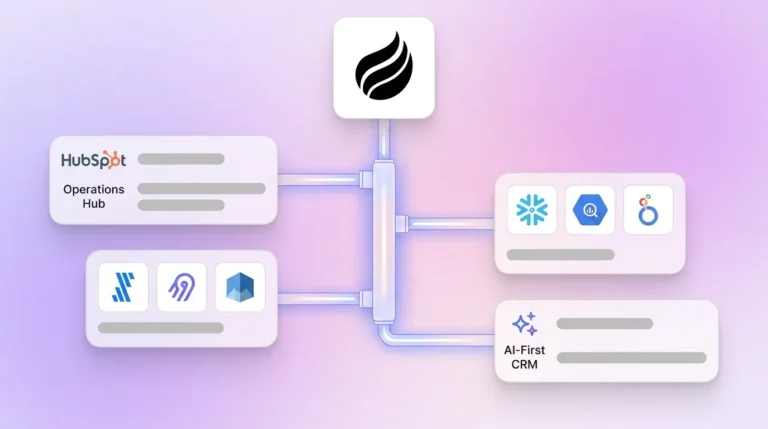
50-person teams committed to Salesforce or HubSpot need the verification workflow to operate inside the existing system of record without replacing it. Coffee’s Companion App deploys the agent as an intelligent layer on top of either platform. The agent handles data enrichment, activity logging, and freshness maintenance, writing verified data back to Salesforce or HubSpot so the system of record stays accurate without human effort. HubSpot users on Operations Hub Professional or Enterprise can use the Data Quality Command Center alongside Coffee’s agent to maintain a live dashboard of data health with a recurring weekly operational review.
Frequently Asked Questions
How long does it take to set up a contact data verification workflow?
Teams using Coffee’s Standalone CRM can begin verifying and enriching contacts immediately after connecting Google Workspace or Microsoft 365, usually within minutes of authentication. Teams using the Companion App on Salesforce or HubSpot complete a simple authentication that allows the Coffee Agent to sync, enrich, and write data back to the existing system. Configuration remains lightweight. The five-step workflow then runs autonomously once the agent is connected, with event-driven triggers handling Tier 1 fields in real time and scheduled batch jobs handling lower-priority fields on a weekly or monthly cadence.
Who owns the verification workflow in a small SaaS sales team?
In a 10-to-50-person SaaS team, ownership typically falls to the Head of Sales or a RevOps lead. Both roles face limited bandwidth for manual verification at scale. Coffee’s agent removes the execution burden from these roles by automating contact creation, enrichment, suppression checks, and re-verification cadences inside the CRM. The Head of Sales sets the targeting criteria and reviews pipeline intelligence, while the agent handles the data quality work that would otherwise consume 27% of a rep’s working time chasing outdated records.
How often should outbound contact lists be re-verified?
Re-verification frequency depends on field type and the sector of the contacts being targeted. Work email addresses should be re-verified every 30 to 60 days. Job titles and seniority should be re-verified every 60 to 90 days. Direct phone numbers should be re-verified every 90 days. For SaaS and technology companies, which experience 45 to 70% annual data decay, monthly bulk verification combined with event-driven triggers on job changes, bounces, and new record creation is the recommended approach. Cold outreach lists that are not in active sequences can follow a 6-to-9-month cadence, while high-touch ABM targets require re-verification every 1 to 2 months.
What is the difference between a suppression list and email verification?
Email verification removes technically invalid addresses, such as non-existent mailboxes, disposable addresses, and domains without MX records, before any send occurs. A suppression list prevents sending to addresses that have already proven problematic through prior hard bounces, explicit opt-outs, or spam complaints. Both layers are required. Verification catches addresses that will bounce, and suppression catches addresses that are legally or reputationally off-limits. Under CAN-SPAM, CASL, and GDPR, unsubscribed addresses must not receive further marketing, and the suppression list acts as the enforcement mechanism that prevents accidental re-import from a new list source.
Does verifying contact data protect against TCPA violations?
Phone verification reduces TCPA risk but does not eliminate it on its own. A complete compliance workflow requires checking phone numbers against the National DNC Registry at least every 31 days, checking applicable state DNC lists, maintaining an internal do-not-call list, confirming that documented prior express written consent exists for automated calls or texts to mobile numbers, and checking the FCC Reassigned Numbers Database to avoid contacting individuals who did not provide consent. TCPA penalties start at $500 per violation and reach $1,500 per call for willful violations. Coffee’s agent logs consent records, timestamps, and DNC status inside the CRM so reps can see the legal basis before any outbound contact is initiated.
Conclusion: Automate the Entire Verification Stack
Manual contact verification does not scale for a 10-to-50-person SaaS sales team. B2B data decays at 22.5% to 70% annually depending on field type and sector. Unverified outbound lists produce bounce rates that damage sender reputation, reply rates that underperform verified benchmarks by a factor of two, and compliance exposure that carries per-violation penalties in the hundreds to thousands of dollars.
The five-step workflow of email validation, phone status checks, identity and employment matching, suppression screening, and scheduled re-verification closes the gaps that point tools address in isolation. Most small SaaS teams understand these steps but lack the capacity to execute all five continuously without adding headcount or stitching together a fragmented tool stack.
Coffee’s autonomous CRM agent executes the entire verification stack inside the system of record. It auto-creates and enriches contacts, runs outbound sequences from verified lists, applies suppression logic before every send, and maintains freshness through event-driven and scheduled re-verification, without requiring a human to act as a data entry clerk. The agent handles the busywork so the team can focus on selling.