Written by: Doug Camplejohn, CEO & Co-Founder, Coffee | Last updated: July 2, 2026
Key Takeaways for 10–50 Person B2B Sales Teams
- Many 10–50 person B2B sales teams are replacing CRMs that turn reps into data-entry clerks and are adopting proactive agent platforms that capture data autonomously.
- Key evaluation criteria include depth of zero-touch data capture, handling of structured and unstructured data, pipeline intelligence quality, integration effort, time saved, pricing clarity, and whether the tool can run as a standalone CRM, a companion layer, or both.
- Coffee leads this comparison by delivering agent automation across email, calendar, calls, web activity, and financial sync, which removes most routine admin work from reps.
- Unlike passive databases such as Attio or rule-based systems like legacy HubSpot, Coffee processes structured fields and unstructured content to keep pipeline records complete and accurate without manual input.
- Teams ready to eliminate manual entry can review Coffee’s pricing and deployment options to roll out an AI-first CRM or companion agent layer.
Seven Criteria to Evaluate Proactive CRM Alternatives
Seven practical criteria shape every comparison in this guide and give sales operations leaders a consistent lens. Teams can then weigh each factor against their own constraints, such as budget, headcount, and existing stack.
- Depth of zero-touch data entry, meaning whether the system captures contacts, activities, and enrichment without human input.
- Unification of structured and unstructured data, meaning whether the platform ingests email text, call transcripts, and calendar signals alongside standard fields.
- Pipeline intelligence quality, meaning whether the system produces accurate forecasts and change tracking from its own captured data.
- Integration effort, meaning the setup burden and whether the tool requires a dedicated admin.
- Time saved per rep per week, meaning the measurable reduction in non-selling hours the platform delivers.
- Pricing transparency, meaning whether the cost model is predictable and seat-based or metered on usage.
- Standalone versus companion flexibility, meaning whether the tool can replace an existing CRM, augment one, or support both modes.
Side-by-Side Comparison of Leading CRM and Agent Options
| Option | Automation Depth | Standalone or Companion |
|---|---|---|
| Coffee | Full agent: email, calendar, calls, web, enrichment, financial sync | Both |
| Salesflare | Automated contact and activity logging from email and calendar | Standalone only |
| Attio | Passive database with modern UI, manual entry still required | Standalone only |
| HubSpot (legacy) | Rule-based logging, relies on human input for most fields | Standalone only |
Coffee publishes a benchmark that its agent saves reps 8–12 hours per week by eliminating manual contact creation, activity logging, and post-meeting note-taking. Comparable per-rep benchmarks for Salesflare, Attio, and HubSpot are not independently available at the time of publication, so their impact on time use is better described qualitatively in the sections below.
Data Capture Mechanics Across Coffee, Salesflare, Attio, and HubSpot
Coffee connects to Google Workspace or Microsoft 365 and immediately scans emails and calendars to auto-create contacts and companies, associate every interaction with the correct record, and enrich profiles with job titles, funding data, and LinkedIn profiles via licensed data partners. This approach removes the need for standalone enrichment tools such as Apollo or ZoomInfo. Coffee’s January 2026 Stripe integration automatically imports customers and companies, enriches them, and logs paid invoices as Closed Won deals, and its February 2026 QuickBooks integration syncs invoices and payment statuses in real time, which extends zero-touch capture into financial workflows that no other option in this comparison currently addresses.

By contrast, the other platforms in this comparison offer narrower automation. Salesflare automates contact and activity logging from email and calendar but does not process unstructured data such as call transcripts. Attio provides a modern interface over a conventional relational database, so data entry remains largely manual. HubSpot logging relies on rules and human behavior, a structural limitation that Coffee’s companion model is designed to fix by layering agent automation over the existing system.
Meeting Management and Follow-up Automation in Practice
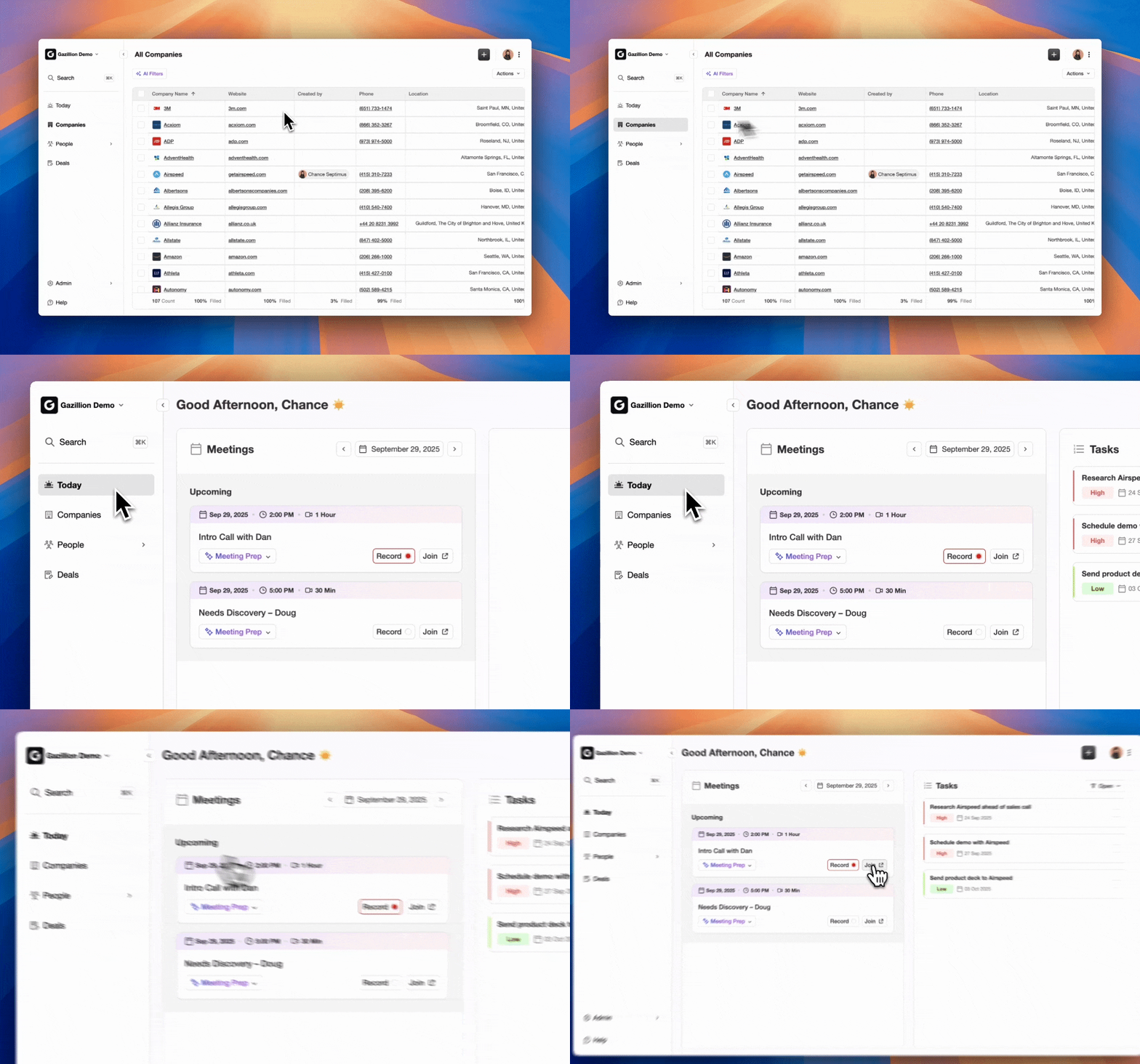
Coffee deploys an AI meeting bot that joins Zoom, Teams, and Google Meet calls to record and transcribe conversations. After each call, the agent generates structured summaries, identifies next steps, and drafts follow-up emails in Gmail for rep review. Summaries can follow BANT, MEDDIC, or SPICED qualification frameworks. Improved summary templates released in November 2025 are customizable to match individual workflows and can be written back to Coffee, HubSpot, or Salesforce, which makes Coffee a post-meeting intelligence layer on an existing CRM rather than a tool that always requires a full platform switch.
Salesflare does not offer native meeting recording or AI-generated summaries. Attio and HubSpot require third-party tools such as Fathom or Gong to achieve similar functionality, which adds both cost and integration complexity.
Pipeline Intelligence and Week-Over-Week Visibility
Coffee captures interaction history into a built-in data warehouse, so it can visualize week-over-week pipeline changes without manual CSV exports or expensive add-ons. The Pipeline Compare feature highlights progressed deals, stalled opportunities, and new additions automatically, which turns pipeline reviews from interrogation sessions into strategic discussions. HubSpot pipeline reporting depends on the accuracy of human-entered data, so forecast quality drops when reps skip logging. Attio and Salesflare provide pipeline views but do not include the agent-driven data warehouse that makes historical comparison reliable.
Agent Versus Passive Database: Before-and-After Workflow
Before (passive database): A rep finishes a discovery call. They open HubSpot, manually create a contact, type meeting notes, update the deal stage, set a follow-up task, and copy a summary into an email. This sequence consumes 15–25 minutes per meeting and is frequently skipped under time pressure, which leaves the CRM with incomplete records.
After (Coffee agent): The rep finishes the same call. Coffee’s bot has already transcribed it, generated a MEDDIC-structured summary, identified next steps, drafted a follow-up email, updated the contact record, and logged the activity before the rep closes their laptop. The rep reviews and sends the email. Total time stays under two minutes.

This workflow difference provides a practical definition of a proactive agent CRM compared with a passive database. Teams ready to remove the 15–25 minute post-call admin burden can deploy Coffee’s agent so transcription, summary generation, and follow-up drafting run automatically.
Best-Fit Recommendations by Company Size and Stack
Early-stage teams (1–20 people) seeking a full replacement: Coffee Standalone fits directly. Teams that have outgrown spreadsheets but find HubSpot’s manual upkeep prohibitive gain a complete system of record managed by the agent, with seat-based pricing and no complex setup.
Mid-market teams (20–50 people) already on HubSpot or Salesforce: Coffee Companion runs the agent as an intelligence layer on the existing CRM. A simple authentication allows Coffee to sync, enrich, and write structured data back to the primary system, which preserves current workflows, quotas, and required fields while removing the manual entry burden. Newer alternatives such as Day.ai and Clarify do not yet match the depth of HubSpot and Salesforce integration required to handle quotas, forecasting, and required fields reliably at this scale.
Operational Risks, Compliance, and Integrations
Coffee addresses the primary operational risk, data security, through SOC 2 Type 2 and GDPR compliance, with a guarantee that customer data is not used to train public models. This security posture is critical for any B2B team that handles prospect and customer communications. On the integration side, Coffee connects natively to Google Workspace, Microsoft 365, Stripe, and QuickBooks, with additional third-party service support available.
Teams migrating from HubSpot to Coffee Standalone should plan for a data migration phase and a brief change management effort. Coffee’s agent begins delivering value as soon as email and calendar connections are live, which shortens the payback period. The main risk with any incomplete automation tool, including Salesflare, is partial capture. If the system misses call transcripts or web signals, pipeline data stays incomplete and forecasts degrade. Coffee’s agent architecture targets all four capture channels at once to reduce that gap.
Decision Matrix and Quick-Scan Checklist
| Team Profile | Recommended Option | Key Reason |
|---|---|---|
| 1–20 people, no existing CRM commitment, high manual entry pain | Coffee Standalone | Full agent replaces manual CRM entirely |
| 20–50 people, committed to HubSpot or Salesforce, low adoption | Coffee Companion | Agent layer improves data quality without platform migration |
| Any size, needs email and calendar auto-logging only, no call intelligence | Salesflare | Narrower automation scope with lower complexity |
| Any size, wants modern UI and accepts manual entry | Attio | Better UX than HubSpot, no agent automation |
| Any size, tolerates manual entry, needs deep marketing automation | HubSpot | Broad feature set with high admin burden |
Frequently Asked Questions
How long does Coffee implementation typically take?
Implementation for teams adopting Coffee Standalone usually moves quickly. Connecting Google Workspace or Microsoft 365 triggers the agent to begin auto-creating contacts and logging activities immediately. Teams avoid lengthy admin configuration or field-mapping work before data capture starts. Teams using Coffee as a Companion on HubSpot or Salesforce authenticate the integration once, and the agent begins enriching and writing back to the existing CRM in the same session. Full team onboarding, including customizing summary templates and setting up meeting bots, can typically be completed in a short rollout window.
What migration effort is required when moving from HubSpot to Coffee Standalone?
Migration from HubSpot to Coffee Standalone involves exporting existing contact, company, and deal records from HubSpot and importing them into Coffee. Coffee’s agent then enriches and updates records autonomously after import, so teams do not need to clean or update historical data manually before the switch. The more significant effort involves change management. Reps accustomed to manual HubSpot workflows need to understand that Coffee’s agent handles logging automatically, so the main behavioral shift is learning to trust the agent rather than learning new data-entry procedures. Teams with complex HubSpot automation sequences, especially marketing workflows, should audit which sequences are sales-critical before migrating, because Coffee focuses on sales intelligence rather than marketing automation.
How does Coffee’s data quality compare with dedicated enrichment tools?
Coffee’s enrichment, delivered via licensed data partners, matches dedicated tools for most B2B use cases. It covers job titles, company funding, and LinkedIn profiles without a separate ZoomInfo or Apollo subscription. The practical advantage is consolidation, since enrichment runs automatically as part of contact creation instead of as a separate manual workflow. Teams with highly specialized enrichment needs, such as technographic data at enterprise scale or intent signals from niche providers, may still require a dedicated enrichment tool. For the 10–50 person B2B teams this guide targets, Coffee’s built-in enrichment usually removes the need for a standalone enrichment contract.
What ROI metrics should teams track after adopting an automated CRM agent?
Useful ROI metrics include hours recovered per rep per week, CRM data completeness rate, and pipeline forecast accuracy. Hours recovered measure the reduction in time spent on manual logging, note-taking, and post-meeting admin, where Coffee’s benchmark is 8–12 hours per rep per week. Data completeness rate tracks the percentage of contacts, activities, and deal stages populated without human input, and a well-functioning agent should push this above 90 percent. Pipeline forecast accuracy measures whether the deals the CRM predicts to close actually close, which improves as data quality rises. Secondary metrics include CRM adoption rate and the reduction in shadow CRM usage such as spreadsheets or Notion documents maintained outside the official system of record.
Conclusion: Choosing a Proactive CRM Architecture in 2026
The 2026 CRM decision for a 10–50 person B2B sales team centers on one architectural choice: platforms either capture data autonomously or wait for humans to enter it. Salesflare automates a subset of structured signals. Attio modernizes the interface but keeps a passive database model. HubSpot remains a capable marketing platform built on a CRM architecture that predates the agent era. Coffee is the only option in this comparison that processes structured and unstructured data together, operates as both a standalone system of record and a companion intelligence layer on HubSpot or Salesforce, and delivers measurable time savings across the full sales workflow, from first email to closed invoice. For sales leaders ready to stop managing a database and start deploying an agent, Coffee’s pricing page shows how the zero-touch CRM alternative supports how modern teams actually sell.