Written by: Doug Camplejohn, CEO & Co-Founder, Coffee | Last updated: August 12, 2026
Key Takeaways for 2026 SaaS LinkedIn Prospecting
- LinkedIn prospecting for SaaS in 2026 works best with a unified seven-step framework that removes the 8–12 weekly hours of data entry caused by juggling Sales Navigator, Apollo, Clay, and CRM tools.
- Precise ICP definition using firmographics, technographics, and intent signals can lift connection acceptance rates to 40% compared with 15% for poorly targeted outreach.
- Compliant daily limits (20–30 connection requests, 50–75 messages) and authority-led multichannel sequences protect account health while improving reply rates.
- Automatic enrichment, visitor identification, and native CRM logging remove manual CSV exports and shadow spreadsheets so pipeline attribution stays accurate in real time.
- Coffee unifies discovery, enrichment, outreach, and CRM logging into a single AI agent so 1–50 person SaaS teams can replace their fragmented stack; see Coffee’s pricing and plans today.
How SaaS Prospecting Works in 2026
SaaS prospecting in 2026 is the systematic process of identifying buyers who match a defined ICP, enriching their contact and firmographic data, engaging them across LinkedIn and email, and logging every touchpoint to a CRM so pipeline attribution stays accurate. The operational problem is not strategy, it is the manual labor of stitching four or more tools together. Sales reps spend only 35% of their time selling because 71% report spending too much time on data entry, typically 8–12 hours per week, and that burden compounds when LinkedIn activity, enrichment exports, and CRM updates all require separate human action.
Step 1: Define a Precise ICP and Buyer Persona
Precise ICP definition is the variable that separates a 40% connection acceptance rate from a 15% one. Effective filters combine three data layers:
- Firmographics: Company size, industry, geography, revenue band, and funding stage.
- Technographics: Current tools in the prospect’s stack that signal fit or displacement opportunity.
- Intent signals: Hiring velocity, recent funding rounds, leadership changes, and content engagement that indicate active buying motion.
Coffee’s Lead Finder removes the manual filter-building step entirely. A rep types a natural-language query such as “Find me VPs of Sales at B2B SaaS companies with 50–200 employees in the US” and the agent interprets the request, previews matching results for confirmation, and builds the list directly inside the platform. No CSV export and no Apollo subscription are required. The resulting list lives alongside every other record in Coffee, ready for enrichment and outreach enrollment.

Step 2: Set Safe, Compliant LinkedIn Daily Limits
LinkedIn’s enforcement posture hardened significantly in 2026, deploying more sophisticated detection systems that identify non-organic patterns such as unusual timing or repetitive content. This shift means the daily limits that worked in 2024 can now trigger account restrictions if teams do not adjust volumes and pacing.
The community-tested safe daily ranges for established Sales Navigator accounts in 2026, as documented by compliance practitioners, are:
- 20–30 connection requests per day
- 50–75 messages per day
- 80–150 profile views per day
- 30–50 search queries per day
LinkedIn enforces a soft weekly ceiling of roughly 100 invitations for free and Premium accounts and up to 150–200 for Sales Navigator accounts with strong account health, not a per-day hard cap, and pending unaccepted invitations count against that ceiling until withdrawn. New accounts are throttled to lower daily volumes and require a period of manual activity before automation, followed by a gradual ramp-up.
LinkedIn treats connection request acceptance rates below 20% as spammer behavior, so operators should target acceptance rates above 40% to maintain account health. Total daily LinkedIn actions (profile views, connection requests, and messages combined) should stay at or below roughly 150 to avoid triggering behavioral flags.
Step 3: Build Multichannel Sequences That Warm Prospects First
Authority-led sequencing, which uses profile views and content engagement before a connection request, can deliver higher positive reply rates than cold-first approaches. This structure works because prospects who have already engaged with your content are more receptive than cold contacts who see your name for the first time. Based on this principle, a compliant multichannel sequence for a 1–50 person SaaS team should follow this structure:
- Profile view (Day 1)
- Like or comment on a recent post (Day 2–3)
- Personalized connection request referencing the content (Day 4–5)
- Value-first LinkedIn message on acceptance
- Email follow-up using enriched work address (Day 7–10)
- Second email or LinkedIn touchpoint (Day 14)
Coffee Campaigns generate and run these sequences natively. A rep describes the campaign in plain English and the agent produces subject lines, body copy, and delays for every step. Sequences send from the rep’s own connected mailbox with their real signature. Stop-on-reply is on by default, so the moment a prospect responds, the agent pauses their sequence and no automated message follows a live conversation. Built-in send throttling protects sender reputation without manual calendar management.
Step 4: Turn Anonymous Traffic into LinkedIn-Ready Leads
Most SaaS teams have no visibility into who is browsing their website between outbound touches. Coffee’s Visitor Identification feature closes that gap with a single tracking pixel dropped into the site’s <head> tag.
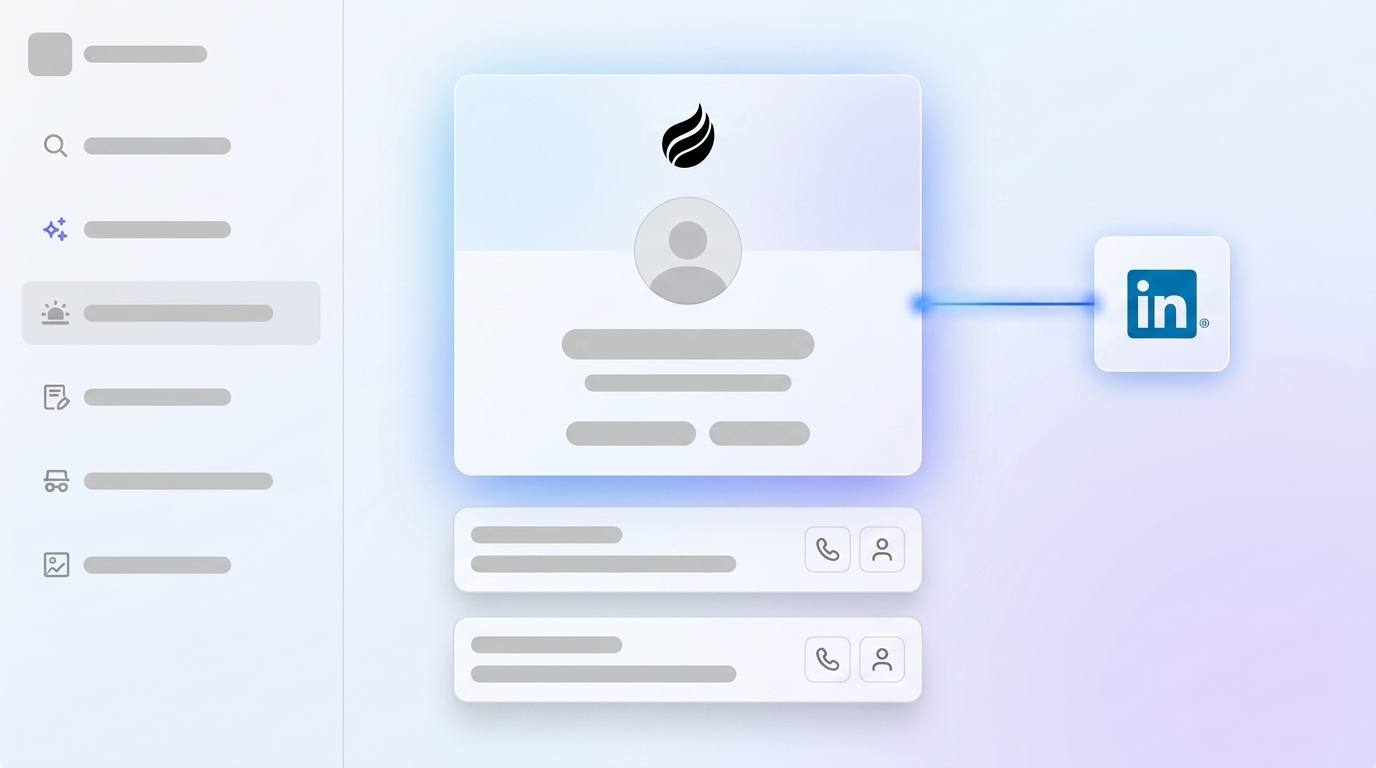
Once installed, the agent infers the visitor’s name, title, email, and LinkedIn profile alongside the company they belong to, pages visited, time on site, and whether it was a first or returning visit. Real-time Slack notifications surface high-fit visitors the moment they qualify. With one click, the prospect is added to Coffee with all enrichment pre-filled, ready for a LinkedIn connection request, an outbound email, or auto-enrollment into a Campaign.

The differentiator is Suggested Leads. Where competitors like RB2B and Warmly surface only the visiting company or undifferentiated people lists, Coffee uses the defined buyer persona to recommend specifically which two or three individuals inside that visiting company to contact and surfaces their LinkedIn profiles for instant outbound. This flow closes the loop from pixel hit to personalized LinkedIn outreach without leaving the agent.
Step 5: Enrich and Score Prospects Automatically
Waterfall enrichment, which queries multiple data sources in sequence until a verified record is returned, is the standard for 2026 B2B prospecting. Modern automated prospecting systems apply AI scoring against the ICP so that only prospects scoring above a defined threshold enter the sending queue. The operational problem for most SaaS teams is that enrichment lives in Apollo or Clay, scoring lives in a spreadsheet, and the output requires a CSV export before anything reaches the CRM.
Coffee’s agent handles enrichment and scoring natively. It augments records with job titles, funding data, and LinkedIn profiles via licensed data partners, then writes enriched records directly to Salesforce or HubSpot, with no export, no middleware, and no manual field mapping. Contact enrichment platforms that automatically push complete records into the CRM eliminate manual spreadsheet entry and the data decay that follows when records are touched by multiple tools.
Step 6: Log Every Touchpoint to Your CRM
Middleware between a LinkedIn prospecting tool and a CRM is the main failure point because it breaks silently on field renames and spawns duplicate contacts that corrupt attribution. A scraper that pastes LinkedIn activity into free-text notes produces data that cannot be queried or reported on. Manual CSV export carries the highest risk of stale data and lost attribution.
Coffee eliminates all three failure modes. The agent logs connection requests sent, accepts, messages, replies, and meetings booked directly to mapped fields in Salesforce or HubSpot on a stable identity key such as work email or LinkedIn profile URL, so event-level sync survives field renames. Shadow spreadsheets disappear because reps have no data entry to perform.
The Pipeline Compare feature visualizes week-over-week changes automatically. Progressed deals, stalled opportunities, and new additions surface without a manual export, so pipeline reviews shift from interrogation sessions into strategic discussions because the data is already current. With accurate, real-time CRM data in place, the next step is measuring which activities actually drive pipeline outcomes.
Step 7: Measure Pipeline Outcomes That Matter
Activity metrics are leading indicators only. The metrics that matter for a 1–50 person SaaS team are:
- Connection acceptance rate: Benchmark 28–40% for well-targeted B2B outreach from an aged account. A drop of more than 5 points in a rolling 7-day window signals account risk.
- Positive reply rate: Benchmark 8–15% for well-targeted, personalized sequences, and treat rates under 5% as a sign of broken ICP or messaging.
- Reply-to-meeting conversion: Benchmark 20–35% from positive replies for mid-market and scale-up companies.
- Cost per booked meeting: Benchmark $30–80 for optimized operations.
- LinkedIn-sourced pipeline percentage: Early-stage Series A/B companies should target LinkedIn outreach contributing 15–25% of total outbound pipeline.
The single most important metric for proving LinkedIn pipeline impact is the number of demos booked where the prospect explicitly mentioned LinkedIn in their own words. Because Coffee logs every touchpoint automatically, attribution is available without manual tagging or rep self-reporting.
Sales Navigator + Apollo + Clay + CRM Compared with Coffee
The following table shows how Coffee removes the operational friction of managing four separate tools by consolidating every capability into a single agent.
| Capability | Fragmented Stack (Sales Navigator + Apollo + Clay + CRM) | Coffee | Impact |
|---|---|---|---|
| Prospect Discovery | Sales Navigator filters, manual list building | Natural-language Lead Finder inside the agent | No separate subscription, and the list lives in the same system |
| Data Enrichment | Apollo or Clay export → CSV → CRM import | Waterfall enrichment written directly to CRM record | Removes CSV exports and manual field mapping |
| CRM Data Entry | Manual; reps spend 8–12 hours per week on data entry | Agent logs all touchpoints automatically | Reps reclaim selling time and the CRM stays current |
| Outreach Sequencing | Separate engagement tool (Outreach, Salesloft) with its own data silo | Campaigns run natively from the rep’s own mailbox with stop-on-reply | No additional subscription and no data silo |
| Visitor Identification | Separate tool (RB2B, Warmly) showing company-level data only | Named individual identification with Suggested Leads matched to buyer persona | Pixel hit to LinkedIn outreach without leaving the agent |
| Pipeline Visibility | Manual CSV exports for week-over-week review | Pipeline Compare feature updates automatically | Reviews require no spreadsheet preparation |
Common Mistakes That Trigger Bans or Stale Data
The following patterns account for the majority of LinkedIn account restrictions and CRM data failures in 2026, and they often appear together inside the same broken workflow.
- Burst activity: Sending 50 connection requests in five minutes or viewing 100 profiles in one hour are high-risk indicators that LinkedIn’s detection systems flag immediately. Consistent daily volume is safer than erratic spikes.
- Templated messages: Personalized, value-first LinkedIn outreach yields 25% reply rates compared with 1–2% for automated first-message pitches. Any message sendable to 500 people with only merge fields changed will be treated as spam.
- Exceeding weekly caps: A common myth is that the LinkedIn daily limit is 100, which reflected the pre-2021 policy. The 2026 ceiling is approximately 100–150 per week, and pending unaccepted invitations count against it.
- Multi-tool overlap: Using multiple LinkedIn automation tools simultaneously significantly increases detection risk by creating overlapping actions and excessive activity volumes.
- Shadow CRM spreadsheets: Middleware that breaks silently on field renames spawns duplicate contacts that corrupt attribution. Manual copy-paste notes produce data that cannot be queried or reported on.
- Ignoring acceptance rate signals: LinkedIn treats connection request acceptance rates below approximately 20% as a spam signal, so teams that ignore this metric often face sudden restrictions.
Frequently Asked Questions
Does Coffee integrate with Salesforce and HubSpot?
Yes. Coffee operates as a Companion App that deploys the Coffee Agent as an intelligent layer on top of an existing Salesforce or HubSpot installation. A simple authentication allows the agent to sync data, enrich records, and write touchpoints such as connection requests, accepts, messages, replies, and meetings back to mapped fields in the CRM in real time. Coffee has deep knowledge of Salesforce and HubSpot architecture, including quotas, forecasting, required fields, and custom objects, which distinguishes it from newer CRM alternatives that lack this integration depth.
Is Coffee SOC 2 Type 2 and GDPR compliant?
Yes. Coffee is SOC 2 Type 2 and GDPR compliant. Customer data is not used to train public models. For B2B SaaS teams operating in markets where GDPR applies to LinkedIn-derived contact data, this matters because GDPR enforcement for B2B sellers using LinkedIn-sourced data can result in significant penalties, which makes the compliance posture of every tool in the prospecting stack a material business consideration.
How does Coffee’s data quality compare with ZoomInfo?
Coffee’s enrichment data is roughly on par with ZoomInfo for most B2B SaaS use cases and is built directly into the agent rather than requiring a separate subscription. The agent augments records with job titles, funding data, and LinkedIn profiles via licensed data partners, then writes enriched records directly to Salesforce or HubSpot. For teams whose primary pain is the cost and complexity of maintaining a separate enrichment tool alongside a CRM, Coffee removes that line item entirely while keeping data quality at a level sufficient for ICP-fit prospecting and outreach sequencing.
What is Coffee’s pricing model?
Coffee uses seat-based pricing. You pay for human seats, and the agent’s labor, including enrichment, data entry, outreach sequencing, CRM logging, meeting summaries, and pipeline tracking, is included without complex metering on LLM usage or automated processes. This model suits 1–50 person SaaS teams that need the output of a full prospecting and RevOps stack without paying for five separate subscriptions or managing five separate data silos.
Conclusion: Run LinkedIn Prospecting Without a Heavy Stack
The seven-step framework in this guide, which covers ICP definition, compliant daily limits, multichannel sequencing, Visitor Identification, automatic enrichment, CRM logging, and pipeline measurement, reflects the same motion that high-performing SaaS teams already run. The difference in 2026 is whether a human or an agent handles the operational layer between each step.
Fragmented stacks produce fragmented data. When Sales Navigator, Apollo, Clay, and a CRM each hold a different version of the same prospect record, pipeline attribution breaks, forecasts mislead, and reps spend their selling hours on data entry instead. Coffee’s agent unifies every step, including discovery, enrichment, outreach, and CRM logging, in one workflow so the system of record stays accurate without extra work from the team.