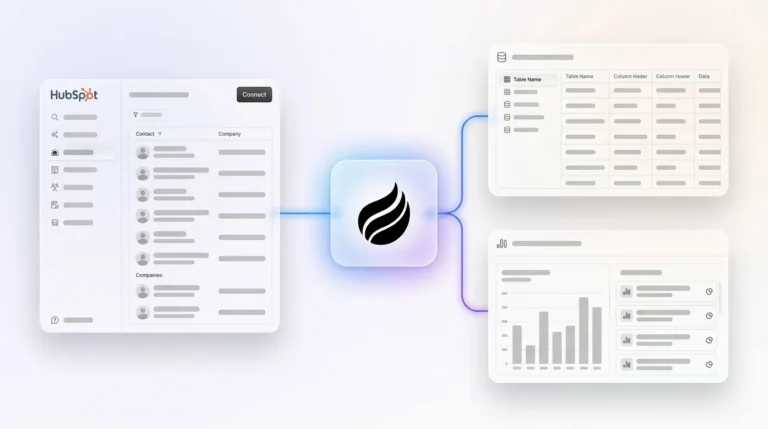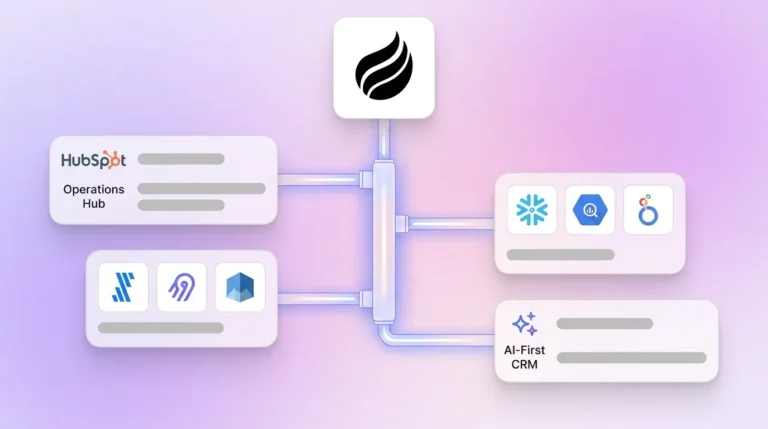
Written by: Doug Camplejohn, CEO & Co-Founder, Coffee | Last updated: August 26, 2026
Key Takeaways for Sales and RevOps Teams
- Autonomous AI agents remove manual CRM data entry by capturing emails, calls, and meetings, then writing structured data into the system of record without human input.
- The most useful AI sales workflow tools fall into three categories: specialized AI agents, data orchestration tools, and native CRM suites, each evaluated on setup effort, integration friction, and output quality.
- Coffee is the only autonomous agent that works as both a standalone CRM and a companion layer on Salesforce or HubSpot, delivering bidirectional write-back with a single authentication.
- Teams running fragmented stacks like Gong plus Zapier or Clay lose out on autonomous post-call logging, enrichment, and pipeline intelligence that Coffee provides natively without extra middleware.
- Ready to eliminate manual data entry and get accurate pipeline intelligence? See Coffee’s pricing and deployment options.
How AI Automates CRM Data Entry
AI automates CRM data entry by running an autonomous agent that perceives customer interactions, decides what to log, executes updates, and verifies results without a human trigger at each step. Unlike traditional workflow automation rules that fire identically every time based on fixed if-then triggers, autonomous AI agents in CRM reason over unstructured data like call transcripts, apply multi-step logic across CRM objects, and maintain memory so each decision reflects prior outcomes.

The three categories below are evaluated on five dimensions: setup effort, data capture mechanics, Salesforce and HubSpot integration friction, quantified time savings, and output quality.
Category 1: Specialized AI Data Capture Agents
Coffee connects to Google Workspace or Microsoft 365 and immediately starts auto-creating contacts, logging activities, and enriching records with job titles, funding data, and LinkedIn profiles. To capture full customer context, the agent also joins calls via Zoom, Teams, or Meet, transcribes them, and writes structured summaries back to Coffee, HubSpot, or Salesforce using customizable summary templates released in November 2025. Setup uses a single authentication, so teams avoid custom connectors and Zapier flows for core CRM write-back. AI-powered CRM data capture improves data completeness and forecast accuracy. Coffee targets 8 to 12 hours of weekly time savings per rep by removing the data entry loop entirely.

Gong captures call intelligence accurately but does not write enriched contact or company records back to the CRM autonomously. A Zapier flow or manual export must move data between systems. Traditional automation tools like Zapier operate on a deterministic if-X-then-Y model where all logic is defined at build time and the tool cannot handle ambiguity, maintain memory of prior runs, or reason across steps. A Gong-plus-Zapier stack therefore produces fragmented coverage. Call data is captured, while contact enrichment, activity logging, and pipeline updates stay partially manual.
Category 2: Data Orchestration Tools for Enrichment
Clay excels at building enriched prospect lists by pulling from dozens of data providers and running waterfall enrichment logic. It functions as an orchestration tool, not an autonomous agent. Clay executes a declared graph of steps instead of reasoning about what to do next based on live CRM context. For linear workflows with one to two tool calls and no branching or stateful retries, a standalone agent is faster and cheaper than a full orchestration platform. Clay does not join calls, does not log post-meeting summaries, and does not write pipeline changes back to Salesforce or HubSpot without additional middleware. Coffee performs enrichment natively and adds the autonomous agent layer that Clay lacks.

Category 3: Native CRM Suites with AI Agents
Salesforce Agentforce and HubSpot Breeze represent the native-suite category. Agentforce replaces fixed if-then automation with context-aware agents that read live customer context and complete multi-step CRM workflows without requiring human approval for each step. However, the biggest blockers to scalable Salesforce AI adoption are fragile workflow orchestration, permission complexity, inconsistent operational data, and undocumented integration dependencies. Teams carrying technical debt face significant friction before any agent delivers value. Coffee deploys as a companion layer on top of existing Salesforce or HubSpot instances, bypassing that internal remediation work entirely. This companion-layer model keeps AI value high even when the underlying CRM org needs cleanup.
What Is the Best AI Tool for CRM?
The best AI tool for CRM in 2026 writes data back to the system of record autonomously, not one that only reads or surfaces recommendations. Tools that only read CRM records but cannot write back to the system of record fail to deliver real data actions and should be excluded from consideration for CRM-integrated AI agents.
Coffee’s companion-layer model creates a structural advantage. A simple authentication allows the Coffee Agent to sync data bidirectionally, enrich records, and write meeting summaries, next steps, and pipeline changes back to the primary CRM. Coffee’s AI search on deals, released in January 2026, answers natural-language questions such as “Which deals are stuck in negotiation?” or “What is closing this month?” This capability turns the CRM from a passive database into an active intelligence layer. Newer alternatives such as Day.ai and Clarify lack the integration depth required to handle Salesforce quotas, forecasting hierarchies, and required fields reliably at this level.

Which AI Works Best for Sales Workflow Automation?
Mature enterprise automation stacks in 2026 run a three-layer architecture: rule-based automation for predictable high-volume triggers, context-based AI automation for workflows where content determines the action, and platform-native automation inside existing systems of record. Coffee operates at the context-based layer and connects directly to the platform-native layer, giving sales teams a single-vendor answer for most workflow automation needs.
Native CRM suites require teams to remediate their existing org before agents deliver value. MuleSoft’s 2026 Connectivity Benchmark Report found that integration is one of the biggest challenges when deploying AI, and without proper integration, AI agents can add more complexity than value. Coffee sidesteps this by acting as the agent layer above the existing CRM, not inside it, so reps see time savings without an internal remediation project.
How to Automate CRM Data Entry After Sales Calls
Post-call CRM automation works best with an agent that can ingest an unstructured transcript, reason about which fields to update, and execute write-back without human review of every record. The table below compares the three categories on the dimensions most relevant to post-call logging.
| Tool / Category | Data Entry Automation Depth | CRM Integration Type | Time Savings Benchmarks | Pipeline Intelligence Output |
|---|---|---|---|---|
| Coffee (Specialized AI Agent) | Autonomous: ingests transcripts, emails, and calendar data, auto-creates contacts, logs activities, enriches records, and writes structured summaries back to Coffee, HubSpot, or Salesforce with customizable templates supporting BANT, MEDDIC, and SPICED | Standalone CRM or companion layer on Salesforce or HubSpot, with bidirectional write-back via single authentication | Salesforce’s 2026 State of Sales report states that AI agents are expected to slash research time by 34% and content creation by 36%. AI data capture can provide additional selling hours per rep per week | Intelligence layer stores ICP, product, and competitor context for tailored AI insights (February 2026) |
| Gong + Zapier (Fragmented Stack) | Gong captures call data accurately, while Zapier executes fixed if-then triggers defined at build time with no memory, no reasoning across steps, and no handling of ambiguous inputs like transcript classification | Companion only, with Zapier pushing data one-directionally and no autonomous write-back of enriched contact or company records | Automated data entry can reduce CRM entry time by up to 91%, yet fragmented stacks capture only a subset of that potential because of coverage gaps between tools | Gong surfaces call-level insights, while pipeline-level intelligence requires manual export or additional tooling, with no autonomous pipeline comparison |
| Clay (Data Orchestration) | Waterfall enrichment from multiple data providers, but no call joining, no post-meeting summaries, and no autonomous deal-stage updates | Pushes enriched lists to HubSpot or Salesforce via integration, not a companion layer, and lacks real-time post-call write-back | AI automation updates CRM records more quickly with more complete data. Clay focuses on enrichment and leaves a post-call logging gap | Enrichment-focused output with no pipeline intelligence layer or deal-change tracking |
| Salesforce Agentforce / HubSpot Breeze (Native CRM Suite) | Agentforce logs outreach activities, updates lead scores, and flags records for rep review without manual entry, but requires org remediation before deployment | Native, operating inside the existing CRM instance with no standalone option | Organizations carrying technical debt feel operational friction almost immediately, and time-to-value is delayed by permission rationalization and integration remediation | Native forecasting and pipeline views, with depth limited by data quality already in the org, so the garbage-in problem persists without an external agent improving input quality |
Best AI Tool for HubSpot Data Logging
For teams committed to HubSpot, the core requirement is an agent that writes back to HubSpot records in real time without a human reviewing every field update. Coffee’s companion-layer model meets this requirement directly. After a single OAuth authentication, the Coffee Agent reads emails and calendar events from Google Workspace or Microsoft 365, joins calls, and writes structured summaries formatted to the team’s exact specification back to the corresponding HubSpot contact, company, and deal records.
Coffee’s Custom Meeting Briefings and Summaries, launched in February 2026, allow teams to define exact formats ranging from high-level executive summaries to granular technical breakdowns, and those summaries write directly to HubSpot. HubSpot’s native Breeze AI offers similar summarization inside the platform, but it operates only on data already in HubSpot. It cannot ingest a call transcript from an external meeting bot and structure it against a custom MEDDIC template without additional configuration. Coffee delivers that behavior autonomously from day one.
Coffee AI vs Clay for CRM Enrichment
Clay and Coffee address adjacent but distinct problems. Clay functions as an orchestration tool that pulls from dozens of enrichment providers in a waterfall sequence to build high-quality prospect lists. It works well for outbound list-building but does not behave as an autonomous agent, because it executes a declared workflow instead of reasoning about live CRM context, joining calls, or logging post-meeting data.
Coffee operates as an autonomous agent that treats enrichment as one function within a broader data-in workflow. Coffee’s Stripe integration, launched in January 2026, automatically imports customers and companies, enriches them, and adds paid invoices to deals as Closed Won. An orchestration tool would require custom workflow configuration to match this level of autonomous action. Coffee also operates as the system of record for teams without Salesforce or HubSpot, a role Clay does not fill.

Teams that need both deep list enrichment and autonomous post-call CRM logging can rely on Coffee for the logging and enrichment layer, which reduces the need for Clay as a separate subscription. Compound AI platforms that deliver prospecting, enrichment, AI research, and CRM sync as a single connected workflow reduce integration tax compared to stitching multiple point solutions, which create failure points through API connections, CSV handoffs, and contract overhead.
See how Coffee handles enrichment and post-call logging in one platform.
With the category landscape and head-to-head comparisons established, the next step is matching your team’s specific situation to the right deployment model.
Decision Framework for Choosing an AI CRM Agent
The right tool depends on company size, current CRM commitment, and the depth of automation required. The framework below maps those variables to a recommended approach.
- 1–20 reps, no existing CRM or on spreadsheets: Coffee Standalone CRM. The agent manages the system of record from day one with no migration required.
- 5–50 reps, committed to Salesforce or HubSpot: Coffee Companion App. Single authentication deploys the agent on top of the existing instance, without a rip-and-replace project.
- Teams using Gong + Zapier: Coffee replaces the Zapier layer and adds autonomous enrichment and pipeline intelligence that Gong alone does not provide.
- Teams evaluating Clay for enrichment: Coffee’s Lead Finder and built-in enrichment cover the majority of use cases. Clay remains an option for teams requiring extreme enrichment depth across 50 or more providers.
Common objections addressed:
- Integrations: Coffee connects to existing tools currently via Zapier, with deeper native integrations on the roadmap. Core Salesforce and HubSpot write-back is native and does not require Zapier.
- Security: Coffee is SOC 2 Type 2 and GDPR compliant. 69% of IT leaders cite data security as their top modernization concern in the age of AI (Rocket Software). Coffee’s certifications meet the minimum standard that many enterprise AI purchases require from IT security and legal teams. Data is not used to train public models.
- Data quality: Coffee’s enrichment is roughly on par with ZoomInfo for most mid-market use cases and is included in the seat price rather than billed as a separate subscription. B2B CRM contact data decays at a baseline annual rate of 22.5%, with higher rates in some sectors, so continuous automated enrichment delivers more value than a static database snapshot.
- Migration effort: Coffee’s companion-layer model requires no data migration for Salesforce or HubSpot customers. The agent writes to the existing instance, and historical records remain untouched.
Frequently Asked Questions
How long does it take to implement the Coffee agent?
For the Companion App on Salesforce or HubSpot, implementation requires a single OAuth authentication to connect Coffee to the existing CRM instance and a connection to Google Workspace or Microsoft 365. Most teams start capturing calls, logging activities, and writing summaries back to their CRM within the same day. The Standalone CRM requires no migration from an existing system. The agent begins populating contacts and companies from email and calendar data immediately after connection. Teams avoid multi-week configuration phases, custom connector builds, and internal IT projects for core functionality.
How much migration effort is required from an existing Salesforce or HubSpot instance?
For teams deploying Coffee as a Companion App, no migration is required. Coffee writes to the existing Salesforce or HubSpot instance as an agent layer above it, so the system of record, historical data, custom fields, forecasting hierarchies, and permission structures remain exactly as they are. Teams replacing a fragmented stack such as Gong plus Zapier plus a separate enrichment tool simply disconnect those tools and allow Coffee to handle the same functions natively. Teams moving from spreadsheets or a legacy CRM to Coffee’s Standalone CRM let the agent auto-populate the new system from connected email and calendar history, which reduces the manual import burden significantly.
What is Coffee’s pricing model?
Coffee uses seat-based pricing. Each human seat covers unlimited agent labor, with no metering on LLM usage, number of records processed, calls transcribed, or enrichment lookups performed. This model keeps cost predictable at any team size and avoids the per-action billing that makes some AI automation tools expensive at scale. Full pricing details are available at coffee.ai/pricing.
How does Coffee handle data security and compliance for mid-market teams?
Coffee is SOC 2 Type 2 certified, which verifies that security controls operate effectively over time rather than only being designed correctly. Coffee is also GDPR compliant. Customer data is not used to train public AI models, and all processing is scoped to the customer’s own workspace. For teams on Salesforce or HubSpot, Coffee respects the existing role-based access control model of the connected CRM, so the agent does not access records outside the authenticated user’s permission scope. These certifications and controls meet the security requirements that IT, legal, and compliance teams apply to AI platform evaluations in 2026.
Conclusion: Why an Autonomous CRM Agent Matters
Sales reps spend roughly 25% of their workweek, or 10 to 11 hours, on manual CRM data entry, leaving only 35% of their time for actual selling. Fragmented stacks of Gong, Zapier, and point enrichment tools reduce that burden partially but introduce new integration failure points. They also fail to solve the fundamental problem that no single agent owns the responsibility for getting good data into the CRM so that good intelligence comes out.
Coffee is the only autonomous agent that operates as both a standalone CRM for teams that have outgrown spreadsheets and as a companion layer for teams committed to Salesforce or HubSpot. The agent handles data entry, enrichment, meeting management, pipeline tracking, and outreach sequencing in one system. This unified approach removes stack fragmentation that forces reps into data-entry work and gives revenue leaders the accurate pipeline intelligence they need to forecast with confidence.