Written by: Doug Camplejohn, CEO & Co-Founder, Coffee | Last updated: August 18, 2026
Key Takeaways for B2B SaaS Sales Teams
- Sales reps at 10–50 person B2B SaaS companies lose 60% of their week to non-selling tasks, largely because legacy CRMs and fragmented tools create more admin work than they solve.
- Autonomous sales agents act on goals instead of static rules, perceive context across tools, and execute multi-step workflows without human triggers, which can reclaim 30–40% of the workweek.
- Manual admin tasks such as CRM logging, enrichment, meeting summaries, and follow-up sequencing consume 17–28 hours per rep each week, which compounds into thousands of lost selling hours annually for mid-sized teams.
- Agent-first architectures outperform rule-based automation by synthesizing emails, calls, LinkedIn signals, and intent data in real time, which prevents the data-quality degradation caused by manual entry.
- Teams ready to eliminate fragmented stacks and reclaim hours per rep per week can explore Coffee’s unified agent to deploy an autonomous solution that consolidates every admin workflow.
Autonomous Sales Agents in 2026: What They Are and Why They Matter
An autonomous sales agent is a goal-based AI system that perceives context across data sources, reasons over that data, and executes multi-step workflows without a human triggering each step. It captures tasks, unifies structured and unstructured data streams, and logs every interaction automatically. Gonzalez, Habel and Hunter (ScienceDirect, January 2026) define autonomous AI agents in sales as systems capable of independent perception, reasoning, and action across lead generation, lead qualification, customer interaction, and sales performance management. Teams that deploy this type of agent escape the 30–40% of the workweek currently consumed by admin.

Where Automation Saves Time: 7-Step Data Entry Workflow
Teams gain the most from automation when they target workflows that burn the most manual hours each week. The table below maps each automation category to its documented weekly time savings, based on industry analyses, and highlights that meeting intelligence and follow-up sequencing deliver some of the largest individual gains at 4–8 hours per week each. Coffee’s agent executes every step natively.
| Workflow Step | Manual Time Cost | Automated Time Saved / Week | Coffee Capability |
|---|---|---|---|
| Form capture → CRM lead hand-off | High manual routing | Several hours | Visitor ID + auto-contact creation |
| Contact & company enrichment | Manual ZoomInfo/Apollo lookups | 2–3 hrs | Built-in enrichment via licensed data partners |
| CRM activity logging | ~8 hrs pre-automation | Approximately 6 hrs | Auto-logs calls, emails, meetings |
| Meeting intelligence & summaries | 10–15 min per call manual notes | 4–6 hrs | AI meeting bot + BANT/MEDDIC/SPICED summaries |
| Pipeline stage updates | Manual CSV exports / rep input | 2–4 hrs | Pipeline Compare (week-over-week agent tracking) |
| Follow-up drafting & sequencing | Manual email writing per deal | 5–8 hrs | AI Campaigns with stop-on-reply logic |
| Lead scoring & prioritization | Manual review of lists | 2–3 hrs | Lead Finder with natural language ICP targeting |
See Coffee’s pricing and reclaim several hours per rep per week across every step above.
The Real Cost of Manual Admin Work
Salesmotion’s audit of the rep workweek allocates 17% (6.8 hours) to CRM data entry and 14% (5.6 hours) to email triage and admin. Forrester reports that the average sales rep spends only about 41% of their time on active selling. The downstream consequences compound over time. Companies with messy CRMs often see lower AI forecast accuracy compared to teams that enforce CRM hygiene. Low adoption creates shadow CRMs such as spreadsheets and Notion docs, which fragment the data further and create a cycle where bad data in guarantees bad data out.
Everstage data indicates that reps waste up to 60 minutes daily navigating between disconnected apps. The average B2B sales team runs eight to twelve tools purchased independently and integrated poorly, which results in mismatched CRM data, delayed onboarding, and contract terms that never flow to invoicing. For a 20-person sales team, that fragmentation translates to thousands of hours of lost selling capacity annually.
Agent-First vs. Passive-Database Architectures
Traditional sales automation executes predefined, rule-based workflows with if/then triggers for sequencing, lead routing, and CRM logging, while sales AI agents are goal-based systems that perceive context, reason, decide, and execute multi-step actions autonomously. Legacy CRMs such as Salesforce and HubSpot operate on the first model and act as passive containers that rely on humans to ensure data quality. When humans do not comply, and 71% of sales reps say they spend too much time on data entry, the system degrades.
AI sales agents automatically log calls, emails, and meetings to CRM records, generate follow-up summaries, update deal stages, and keep pipeline data accurate in real time, which eliminates inconsistencies caused by manual data entry. The architectural difference affects every workflow. Traditional sales automation such as HubSpot sequences and Salesforce flows operates on explicitly mapped, structured CRM fields only and follows fixed if/then rules that require human-defined triggers for each step. An agent instead synthesizes emails, call transcripts, LinkedIn signals, and intent data simultaneously.

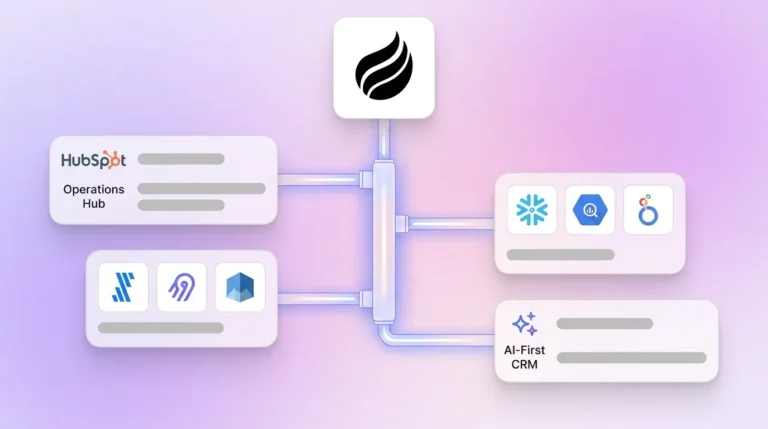
This architectural advantage becomes concrete when comparing Coffee’s unified agent approach against the fragmented stacks most teams currently run.
Coffee Companion App vs. Clay + Zapier + HubSpot/Salesforce
The table below compares Coffee’s Companion App against the most common fragmented stack used by 10–50 person B2B SaaS teams. All figures are cited and show the impact on time, cost, and complexity.
| Criterion | Coffee Companion App | Clay + Zapier + HubSpot/Salesforce | Source |
|---|---|---|---|
| Weekly time saved (CRM logging) | Up to 6 hrs/rep | 1–2 hrs/rep (CRM sync only) | SalesMotion 2026 |
| Enrichment coverage | Built-in (job titles, funding, LinkedIn), no extra subscription | Clay enrichment requires separate subscription ($800–2K/mo) | OneAway 2026 stack cost analysis |
| Meeting intelligence | Native AI bot for transcription, BANT/MEDDIC/SPICED summaries, and follow-up drafts | Requires separate tool such as Gong or Grain ($1K–2.5K/mo) | OneAway 2026 |
| Data architecture | Built-in data warehouse that retains full historical context | Relational DB only, historical context lost on field updates | Coffee company context |
| Stack complexity | Single agent with simple auth to existing CRM | 5+ tools integrated via Zapier | SalesMotion 2026 |
A complete 2026 AI sales stack including Clay, intent data, ZoomInfo/Apollo, a sequencing tool, and Gong totals $6K–15K per month. Coffee consolidates enrichment, meeting intelligence, sequencing, and pipeline tracking into a single seat-based subscription with no consumption overages and no middleware maintenance.
Choosing Between Coffee Standalone CRM and Companion App
Coffee offers two deployment paths, and the right choice depends on team size, existing infrastructure, and operational maturity.
Choose the Standalone CRM if:
- The team has 1–20 employees with a nascent sales function that includes founders and early hires.
- The current system relies on spreadsheets or Notion and the team has clearly outgrown them.
- No existing Salesforce or HubSpot instance exists that is worth preserving.
- Speed of setup and low administrative overhead are the primary constraints.
Choose the Companion App if:
- The team has 20–50 people with an established Salesforce or HubSpot instance, quotas, and required fields already configured.
- CRM adoption is low and data quality is poor despite the existing investment.
- The Head of Sales or RevOps needs the agent to write enriched data back to the primary system of record without replacing it.
- The team is consolidating point solutions such as ZoomInfo, Gong, and Salesloft to reduce cost and complexity.
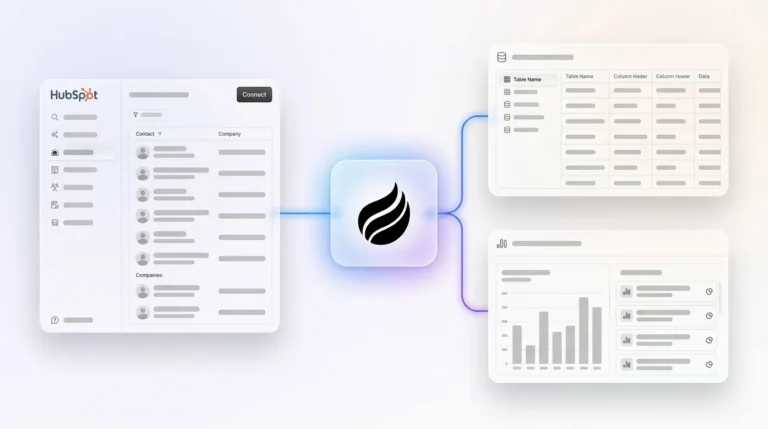
Thirty-nine percent of respondents say ability to integrate with existing systems is one of the most important aspects when evaluating a new CRM solution. Coffee’s Companion App addresses this directly. A simple authentication allows the Coffee Agent to sync data, enrich it, and write insights back to Salesforce or HubSpot, which preserves the existing system while removing the manual labor that degrades it.
Compare Coffee’s deployment options to find the model that fits your team’s current stack.
Good Data In, Better Outcomes Out: 2026 Results
Coffee’s February 2026 Intelligence layer allows users to define and store deep context on business model, product specifics, ICP, and competitors for tailored AI suggestions and insights. Custom Meeting Briefings and Summaries, also launched in February 2026, let users define exact formats, from high-level executive summaries to granular technical breakdowns. The agent then writes these back to Coffee, HubSpot, or Salesforce.
Pipeline Compare, Coffee’s week-over-week pipeline visualization, turns pipeline reviews from interrogation sessions into strategic discussions. The agent captures every interaction in a built-in data warehouse, so historical context never disappears when a field is updated. Legacy relational CRMs cannot retain that depth of history. Gartner’s May 2026 survey found that sales organizations reinvesting AI time savings into high-value activities are 2.2× more likely to exceed customer growth goals and 3.1× more likely to exceed lead-to-opportunity conversion goals.
Decision Checklist: Match Your Constraints to the Right Coffee Model
Use the checklist below to identify the correct deployment path before requesting a demo.
- Current system: Start by identifying what you are replacing. If you run spreadsheets or Notion, the Standalone CRM provides a complete system of record. If Salesforce or HubSpot is already deployed, the Companion App preserves that investment while fixing the data quality issues.
- Team size: Consider how headcount affects operational complexity. Teams of 1–20 reps usually lack the infrastructure to justify maintaining a legacy CRM, so the Standalone model offers a faster path. Teams of 20–50 reps with a RevOps function already have quotas, forecasting models, and required fields configured, so the Companion App layers intelligence on top without a migration.
- Data quality problem: Clarify whether you lack data or suffer from bad data. If you have no CRM data yet, the Standalone CRM lets you start clean. If your existing CRM struggles with low adoption and dirty data, the Companion App automates the logging and enrichment that humans skip.
- Stack consolidation goal: Decide how aggressively you want to simplify tools. If you plan to replace ZoomInfo, Gong, and Salesloft, either model works. If you want to keep Salesforce or HubSpot but eliminate enrichment and sequencing point solutions, the Companion App fits better.
- Budget model: Align pricing expectations with finance. Both models use seat-based pricing with no LLM consumption overages, and agent labor is included.
Frequently Asked Questions
How does Coffee automate data entry without requiring reps to change their behavior?
Coffee connects to Google Workspace or Microsoft 365 and immediately scans emails and calendars to auto-create contacts, companies, and activity logs. The agent joins calls through an AI meeting bot, transcribes the conversation, and writes structured summaries that include BANT, MEDDIC, or SPICED qualification fields directly to the CRM record. Reps review and send AI-drafted follow-up emails from their own mailbox. No manual logging step exists in the workflow because the agent handles it in the background.

What is the difference between Coffee’s Standalone CRM and the Companion App?
The Standalone CRM is a complete system of record powered by the Coffee Agent and designed for teams of 1–20 people that have outgrown spreadsheets and want a modern, automated alternative to HubSpot or Pipedrive. The Companion App deploys the Coffee Agent as an intelligent layer on top of an existing Salesforce or HubSpot instance. It handles data enrichment, activity logging, meeting intelligence, and pipeline updates, then writes the results back to the primary CRM. This approach preserves existing configurations such as quotas, required fields, and forecasting models while eliminating the manual work that degrades data quality.
How does Coffee compare to building a stack with Clay, Zapier, and Gong?
A Clay + Zapier + Gong stack requires separate subscriptions for enrichment, middleware automation, and conversation intelligence, along with ongoing maintenance when API connections break. Each tool operates in its own data silo, which forces manual reconciliation and increases the risk of data drift. Coffee consolidates enrichment, meeting intelligence, pipeline tracking, sequencing, and visitor identification into a single agent on a seat-based subscription. There are no consumption overages, no middleware tickets, and no data drift between tools because every capability reads from and writes to the same data warehouse.
Is Coffee secure, and does it use my data to train AI models?
Coffee is SOC 2 Type 2 and GDPR compliant. Data processed by the Coffee Agent is not used to train public AI models. For teams in regulated-adjacent industries that evaluate data governance closely, Coffee also provides audit-ready activity logging because every agent action is traceable to the interaction that triggered it.
Conclusion: Fix the Architecture, Not the Reps
The 2026 sales productivity gap stems from architecture, not motivation. Legacy passive CRMs and fragmented point stacks force reps to act as data-entry clerks, which consumes most of the workweek before a single selling conversation occurs. An autonomous CRM agent that unifies form capture, enrichment, CRM logging, meeting intelligence, pipeline updates, and follow-up sequencing into a single system addresses the root cause instead of adding another tool to the stack.
Coffee operates as that agent in two deployment models, a Standalone CRM for early-stage teams and a Companion App for established Salesforce and HubSpot users. Both models return 8–12 hours per rep per week and produce accurate pipeline data that makes forecasting, coaching, and revenue decisions reliable.
Get started with Coffee and put an autonomous agent to work on your admin backlog today.