Written by: Doug Camplejohn, CEO & Co-Founder, Coffee | Last updated: August 22, 2026
Key Takeaways for AI Forecasting Success
- AI sales pipeline forecasting improves accuracy only when it runs on clean, complete, and continuously updated CRM data.
- Dirty or incomplete CRM data causes forecast failures, and AI models amplify those errors instead of correcting them.
- Legacy CRMs depend on manual data entry that reps cannot sustain, which leaves 76% of organizations with inaccurate or incomplete records.
- Agent-led systems like Coffee capture structured data from emails, calls, and calendars automatically, removing the data-quality bottleneck that blocks AI forecasting gains.
- Teams ready to move off dirty data can review Coffee’s pricing and deployment options today.
Why AI Forecasts Still Fail Without Clean Data
Manual data entry sits at the center of dirty CRM data, and the scale of the problem is easy to underestimate. 76% of respondents in Validity’s 2025 State of CRM Data Management report said less than half of their organization’s CRM data is accurate and complete. Meanwhile, 71% of sales reps report spending too much time on data entry, which leaves only 35% of their time for actual selling. The people responsible for data quality are also the people with the least time to maintain it.
The downstream effects on AI forecasting are direct and severe:
- Companies with CRM data completeness above 85% report forecast accuracy 22% higher than those below 60% completeness, and this gap widens when incomplete records cause AI to forecast revenue from “ghosts,” deals that are actually dead or misclassified.
- These ghost deals are not rare. Organizations lose revenue as a direct consequence of poor data quality, and companies lose an average of 16 sales deals per quarter because of bad data, while CRM opportunity records often contain materially incorrect data points without active maintenance.
- The problem extends beyond structured fields. 70% of data and analytics leaders say the most valuable insights are trapped in unstructured data such as call notes, emails, and documents, which legacy CRMs cannot process.
Legacy CRM architectures make this problem worse at a structural level. Systems like Salesforce and HubSpot rely on relational databases that overwrite fields on update, so historical context disappears permanently. They also cannot handle unstructured data, including email text, call transcripts, and meeting notes. 80–90% of enterprise data is unstructured, yet most AI systems only work with the 10–20% that is structured, which leaves most behavioral signals unavailable for pipeline forecasting. Coffee’s agent solves this by autonomously capturing and structuring unstructured data from day one, and you can see pricing and deployment options here.

Agent-Led Systems vs. Legacy Passive CRMs for Forecasting
The distinction between a passive CRM and an agent-led system is not cosmetic. It determines whether clean data enters the system at all. The table below compares the two architectures across the dimensions that matter most for AI forecasting reliability, and shows how each structural difference turns into measurable gains or losses in forecast accuracy.
| Dimension | Legacy Passive CRM (Salesforce / HubSpot) | Coffee Agent (Companion App or Standalone) | Forecasting Impact |
|---|---|---|---|
| Data Entry Method | Manual rep entry, and workers spend time hunting for information in CRM systems | Autonomous agent captures contacts, activities, and interactions from email and calendar automatically | Automated CRM updates can reduce missing-field rates and improve forecast accuracy |
| Unstructured Data Handling | Not supported natively, so call transcripts and emails remain outside the data model | Agent ingests call transcripts, emails, and meeting notes, then structures them against BANT, MEDDIC, or SPICED frameworks and writes values to deal records | AI forecasting models combining CRM pipeline data with conversation signal inputs produce more reliable outputs than models using CRM data alone |
| Historical Context Preservation | Relational database overwrites fields on update, so prior state is lost permanently | Built-in data warehouse retains full history, and Pipeline Compare visualizes week-over-week changes automatically | Historical sales data, including closed-won and closed-lost deals with size, product mix, and close dates, is a key data element required for accurate AI-driven forecasting |
| Data Hygiene Maintenance | Depends entirely on rep discipline, and CRM databases naturally degrade by about 22.5% every year | Agent continuously enriches records with job titles, funding, and LinkedIn data via licensed partners, while activity logging remains autonomous | Data hygiene is not a one-time cleanup but an operating model requirement for reliable forecasting and AI use |
How AI Removes Sales Rep Bias from Forecasts
Sales rep bias creates a structural forecasting problem rather than a simple behavioral issue. Optimism bias leads reps to overestimate closing odds, quarter-end compression pushes deals into advanced stages artificially, and zombie deals inflate pipeline numbers and distort conversion rates.
AI removes bias by replacing subjective inputs with objective signals. AI forecasting tools generate independent close-probability scores from signals and historical patterns that often differ from rep estimates. Leaders can then treat the gap as a coaching opportunity instead of silently overruling the rep.
These mechanisms work together to correct rep-specific bias:
- AI forecasting models adjust for individual rep behaviors and biases by learning each rep’s historical accuracy and deal patterns.
- Forecast accuracy improves when inputs shift from rep-asserted confidence scores to evidence-based qualification signals drawn from real customer interactions.
- AI forecasting systems reduce mean absolute percentage error versus traditional spreadsheet methods by using pattern-based scoring that corrects for structural biases such as manager inflation and rep sandbagging.
For Coffee users, this bias correction depends on the agent capturing complete, objective interaction data from every email, calendar event, and call transcript. Without that clean input layer, the model attempts to correct bias using the same biased data it needs to fix.
Behavioral Signals That Reveal Deal Risk Early
Buyer hesitation, the most common deal risk, appears as gradual disengagement in conversation data weeks before it shows in CRM pipeline activity such as missed follow-ups or slipped close dates. Pipeline stages capture process milestones but reveal very little about actual deal health.
Removing rep bias improves forecast accuracy, and the impact grows when the model also detects deal risks that reps miss entirely. AI systems that process real-time behavioral signals close this gap. AI forecasting agents detect at-risk deals earlier than manual processes by analyzing behavioral patterns before reps or managers notice changes.
The signals that drive early risk detection include:
- Email reply rates, response lag times, meeting frequency, and sentiment drift across interactions, engineered into predictive features such as “days since last meaningful two-way interaction.”
- NLP detection of rising themes such as “security review,” “budget freeze,” or “implementation complexity” in call transcripts, correlated with stage delays to identify pipeline risk.
- Anti-signals, which are risk indicators that appear in live first-party conversation data while the CRM still shows the deal as healthy, including budget freezes, champion departures, and competitor mentions.
- AI tools that flag at-risk opportunities before the forecast close date, which reduces deal slippage by prompting earlier intervention.
Coffee’s agent captures this signal layer automatically by joining every call via its AI meeting bot, transcribing interactions, and writing structured qualification data back to the deal record, without any manual rep entry.

Continuous Rolling Forecasts vs. Static Models
Continuous rolling forecasts keep forecasts aligned with reality, while static weekly roll-ups rely on stale data. A static annual budget is stale by Q2 in most environments, and a rolling forecast maintains a constant forward view that always incorporates actuals from the last closed period.
Capturing real-time behavioral signals only creates value when the forecast updates continuously to reflect them. AI-powered sales forecasting agents produce continuous rolling forecasts that update in real time as new signals arrive, including email engagement, meeting cadence, and document activity, instead of static weekly or monthly snapshots.
The operational advantages are concrete:
- Rolling forecasts increase estimate accuracy, enable proactive decision-making, support business flexibility, and improve resource allocation by using actual results and current business data instead of outdated assumptions.
- AI agents provide probability distributions for forecasts instead of single-point estimates, for example, “$3.8M at 90% confidence, $4.4M at 50% confidence,” which gives leadership clear uncertainty ranges.
- Rolling forecasts support earlier identification of risks and opportunities because the model absorbs changes such as pipeline shifts or deal slips into the next forecast cycle instead of treating deviations as isolated exceptions.
Coffee’s Pipeline Compare feature turns this into a daily practice. The agent visualizes week-over-week pipeline changes automatically and highlights progressed deals, stalled opportunities, and new additions without CSV exports or manual review preparation.
Conversation Intelligence That Feeds Forecasting
A typical 6,000-word sales call produces only a 40–60 word CRM summary, so the CRM captures under 1% of the actual conversation content. Conversation intelligence closes this gap by turning call recordings into structured qualification data that feeds forecasting models.
Conversation intelligence converts buying signals from calls and email threads, including buying-committee engagement patterns, champion activity, sentiment shifts, and timeline language, into structured data that becomes the foundation for forecasts instead of subjective CRM stage fields. Sales teams using conversation intelligence close deals faster on average and improve win rates.
Coffee’s AI meeting bot joins calls on Zoom, Teams, and Google Meet, transcribes the conversation, generates summaries and next steps, and structures notes against BANT, MEDDIC, or SPICED, then writes every qualification signal back to the deal record automatically. This workflow turns conversation intelligence into a live forecasting input instead of a static archive. See how Coffee’s meeting bot integrates with your existing workflow.

Practical Implementation Roadmap for Coffee
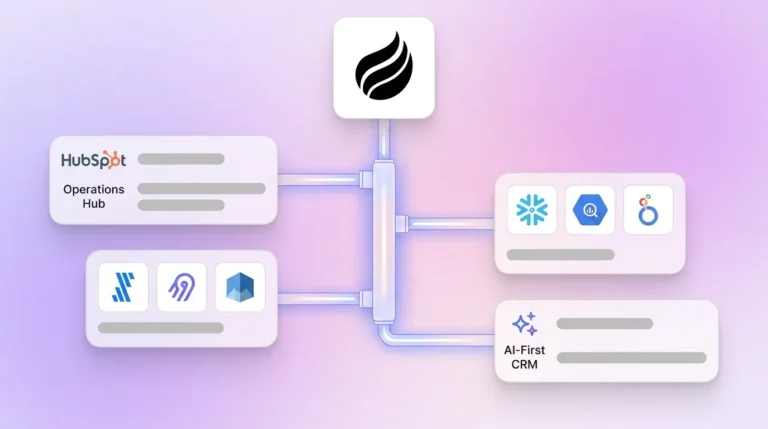
The right implementation path depends on whether your team adds Coffee as a Companion App on top of an existing Salesforce or HubSpot instance, or adopts the Standalone AI-First CRM.
For Salesforce and HubSpot Companion App users:
- Authenticate Coffee with your existing Salesforce or HubSpot instance through the Companion App setup flow.
- Connect Google Workspace or Microsoft 365 so the agent starts auto-creating contacts and logging activities from existing email and calendar data.
- Enable the AI meeting bot to join scheduled calls and begin capturing transcripts and structured qualification data.
- Review the Pipeline Compare dashboard after the first week to establish a baseline of deal health and identify stalled opportunities immediately.
- Allow 60–90 days of clean data accumulation before evaluating forecast accuracy improvement, consistent with research documenting this lag for automated CRM data capture systems.
For teams adopting the Standalone AI-First CRM:
- Connect Google Workspace or Microsoft 365 on day one so the Coffee agent immediately scans emails and calendars to populate the CRM with contacts, companies, and activity history.
- Configure your buyer persona and ideal customer profile so the Lead Finder and Visitor Identification features surface the right prospects from the start.
- Set deal stage definitions with explicit entry and exit criteria before the agent begins logging opportunities, which aligns with the requirement that inconsistent deal stage definitions are a silent killer of AI pilot success.
- Activate the AI meeting bot and select your preferred sales methodology, BANT, MEDDIC, or SPICED, for structured note output.
- Use Pipeline Compare weekly to replace manual roll-up preparation with agent-generated deal progression summaries.
Neutral Framework for Evaluating AI Forecasting Tools
Any AI forecasting solution should meet clear criteria before adoption.
- Integrations: Coffee connects to Salesforce and HubSpot natively through the Companion App and to broader tooling through Zapier, with deeper integrations on the roadmap. Teams with complex custom Salesforce configurations, including quotas, required fields, and custom objects, should verify compatibility before committing to newer alternatives like Day.ai or Clarify, which do not yet match this depth of CRM integration.
- Data Quality Mechanism: Evaluate whether the solution writes clean data to the CRM or only reads from it. 63% of organizations either do not have or are not sure they have the right data management practices for AI, so a solution that does not solve data entry autonomously will not solve forecasting.
- Security and Compliance: Coffee is SOC 2 Type 2 and GDPR compliant, and customer data does not train public models. Teams in heavily regulated industries should still conduct a full security review before deployment.
- Implementation Effort: Coffee is designed for 10–50 person SaaS teams that need fast time-to-value. Large enterprises with multi-year security review requirements or deeply customized CRM architectures fall outside the intended use case.
- Company-Size Fit: The Standalone CRM is optimized for teams of 1–20 that have outgrown spreadsheets. The Companion App targets small to mid-market teams committed to Salesforce or HubSpot that need the agent layer without a platform migration.
Frequently Asked Questions
What does “AI improves pipeline forecasting” mean in practice?
AI improves pipeline forecasting by replacing subjective rep-submitted deal stages and close probabilities with objective signals from real buyer behavior, including email engagement, meeting frequency, call sentiment, stakeholder coverage, and historical deal patterns. The model scores each opportunity against the outcomes of statistically similar past deals and updates those scores continuously as new signals arrive. The forecast then reflects what buyers are doing instead of what reps believe will happen.
Why does data hygiene matter more than the AI model itself?
AI models pattern-match on the data they receive. When that data is incomplete, inconsistent, or stale, the model learns those inaccuracies as signal and carries them into every prediction. A sophisticated model trained on dirty CRM data produces confident-looking outputs that remain structurally wrong. The model is not the bottleneck, because the data is. Improving CRM field completion from below 70% to above 90% on active opportunities can reduce forecast error from 22% to 8%, which no model upgrade alone can match.
How does Coffee differ from adding a read-only AI forecasting tool?
Most AI forecasting tools are read-only and consume whatever data exists in the CRM, then generate predictions from it. They do not fix the underlying data quality problem. Coffee’s agent acts as a write layer that autonomously creates contacts, logs activities, captures call transcripts, and enriches records from email and calendar data before any forecasting model runs. This “good data in” function makes the forecasting output trustworthy. Without it, adding an AI forecasting tool to a CRM where 43% of records contain at least one materially incorrect data point amplifies errors instead of improving forecasts.
Is Coffee compatible with Salesforce and HubSpot, or does it replace them?
Coffee supports both deployment models. The Companion App deploys the Coffee agent as an intelligent layer on top of an existing Salesforce or HubSpot instance. It authenticates with the existing system, syncs data, enriches records, and writes structured insights back to the primary CRM without a platform migration. Teams that prefer a full replacement can adopt the Standalone AI-First CRM, which is designed for companies of 1–20 people that have outgrown spreadsheets and want an agent-native system of record from day one.
How long before forecast accuracy improves after deploying Coffee?
Research consistently documents a 60–90 day lag between implementing automated CRM data capture and measurable improvement in forecast accuracy. This lag exists because AI forecasting models need enough clean, consistently structured historical data before their pattern-matching becomes statistically reliable. Coffee starts improving data quality immediately after connection by auto-creating contacts, logging activities, and capturing call data from day one, and the downstream forecast accuracy improvement becomes measurable after two to three months of clean data accumulation. Teams should establish a forecast accuracy baseline at deployment and measure against it at the 90-day mark. This 60–90 day window is shorter than the 9–14 month lag typical of traditional revenue intelligence tools that require manual configuration and longer training periods.
Conclusion: Clean Data First, Then AI Forecasting
AI delivers real and well-documented accuracy improvements in pipeline forecasting. AI forecasting tools that analyze deal activity signals achieve better accuracy than manager-adjusted forecasts, and teams using AI pipeline monitoring reduce deal slippage. Every one of these gains depends on the quality of the data the model consumes.
Reps who already spend most of their time on data entry instead of selling will not fix this problem manually. Legacy CRMs that rely on human data entry as their primary input mechanism cannot produce the clean, complete, continuously updated data that AI forecasting requires. Gartner predicts that through 2026, organizations will abandon 60% of AI projects unsupported by AI-ready data.
The prerequisite for trustworthy AI sales pipeline forecasting is an autonomous agent that handles data entry, captures unstructured signals from calls and emails, preserves historical context, and writes clean structured data to the CRM before any forecasting model runs. Coffee provides that agent layer. Forecasting accuracy follows from data quality, and data quality depends on the agent. Explore Coffee’s plans and build the clean-data foundation that makes AI forecasting work.