Written by: Doug Camplejohn, CEO & Co-Founder, Coffee
Key Takeaways from This 7-Step MEDDPICC Criteria Playbook
- 70% of enterprise deals fail pre-RFP due to unprobed decision criteria, and strategic discovery boosts closes by 30%.
- Group MEDDPICC criteria into technical, economic, and relationship types, then use weighted scorecards to align stakeholders.
- Uncover stated criteria with targeted questions like “Walk me through your eval process” and then probe unstated personal risks.
- Shape criteria with champions using the 10-3-1 rule so your strengths carry more weight and one criterion blocks competitors.
- Automate criteria extraction, CRM tracking, and AI-powered analysis with Coffee to reach 90% criteria visibility and a 30% win-rate lift.
- Validate criteria across the full buying committee so every stakeholder agrees on how vendors will be judged.
- Track criteria health in your CRM with clear thresholds that flag risk and highlight where you still need influence.
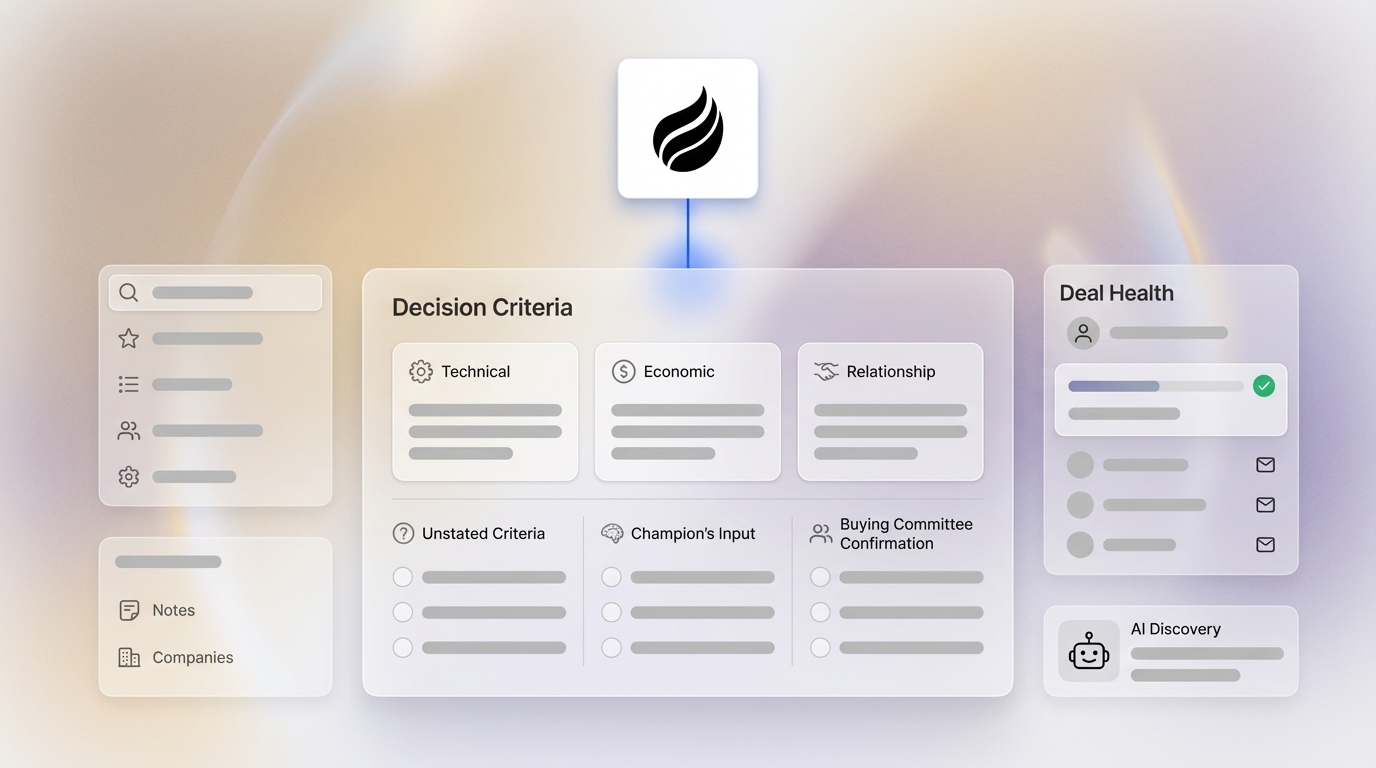
Step 1: Group Criteria into Technical, Economic, and Relationship Buckets
Strong MEDDPICC decision criteria fall into clear categories that mirror stakeholder priorities. Understanding these categories matters because each group evaluates your solution through a different lens. Technical criteria are owned by Architects, Engineering, and Security stakeholders who define what must work in the real environment at scale. Examples include compliance with industry standards and robust encryption for cybersecurity solutions.
Economic criteria focus on financial justification and ROI. Financial approvers such as CFOs assess cost exposure through financial models, focusing on quantifiable ROI, payback speed, and risk management. Relationship criteria cover champion alignment, internal advocacy, and political dynamics that decide whether a technically strong deal actually closes.
Create a weighted scorecard with 3 to 5 criteria in each category to organize your evaluation framework. For Fortune 500 security requirements, technical criteria might include SOC2 compliance and 99.99% uptime guarantees. Economic criteria can specify ROI thresholds under 18 months and total cost of ownership comparisons. Relationship criteria involve champion influence levels and internal political dynamics that affect final approvals.
Step 2: Surface Stated Criteria with Direct Discovery Questions
Stated criteria are the explicit evaluation requirements that prospects share openly. Use targeted discovery scripts so these benchmarks come out early and clearly. Ask “Walk me through your eval process, what must your team see?” to get in-depth insights into a prospect’s goals and reveal stated decision criteria.
Beyond that first process question, drill into specific priorities with “What are your top three vendor evaluation priorities?” and “What are the top three things your team is evaluating vendors on?” to identify and enable influence over decision criteria. These variations help you understand how different stakeholders frame success. Focus on multi-stakeholder perspectives, because IT requirements often differ significantly from CFO budget considerations.

Document responses in a structured format that captures both functional requirements and success metrics. For enterprise software evaluations, stated criteria often include integration capabilities, security certifications, implementation timelines, and vendor stability measures.
Step 3: Expose Unstated and Personal Criteria Driving Real Risk
Unstated criteria are hidden evaluation factors that heavily influence decisions but rarely appear in formal documents. These factors often sit behind stalled deals and surprise losses. Use questions like “What keeps the CFO up at night regarding vendor switches?” and “What would represent a personal win if this problem was solved?” to uncover real pain in committee buying.
Career risk frequently drives unstated criteria in enterprise deals. Ask “What concerns do you have about recommending a new vendor?” and “How have past technology implementations affected team dynamics?” These questions reveal personal motivations and political considerations that shape final decisions.
Ignoring unstated criteria creates significant risk and erodes forecast accuracy. Sales reps asking at least three questions about challenges during discovery achieve a 37% higher win rate. Focus on individual stakeholder concerns, departmental politics, and change management fears that quietly shape evaluation processes.
Step 4: Shape Criteria Collaboratively with a True Champion
Champions give you a path to influence criteria through internal advocacy and co-creation. A true MEDDPICC champion co-authors decision criteria, socializes them internally, and defends them when the seller is not present. Use the 10-3-1 rule: shape evaluations toward ten total criteria, ensure your top three strengths are weighted heavily, and establish one killer criterion that quietly removes competitors.
Use scripts like “If we hit these specific benchmarks, would you advocate for us internally?” to secure clear champion commitment. Co-author criteria documents with champions so they feel ownership and can defend the framework. This collaborative approach turns champions from passive supporters into active advocates who steer buying committee discussions.
Effective criteria shaping depends on understanding champion motivations and giving them strong internal selling tools. Equip champions with ROI calculators, competitive comparisons, and risk mitigation frameworks that support their advocacy efforts inside the organization.
Step 5: Confirm Criteria Across the Full Buying Committee
Committee-wide validation keeps criteria aligned across all stakeholders and decision-makers. Forrester research finds that the average B2B purchase involves 13 stakeholders, with 89% of buying decisions crossing multiple departments. Once your champion has helped shape the criteria, those benchmarks must gain acceptance across the entire buying committee, because a single advocate rarely carries an enterprise deal alone.
Use validation scripts like “Will all vendors be held to these same standards?” and “How will you weight technical requirements versus economic factors?” Map stakeholder-specific priorities so you see where friction might appear. IT stakeholders prioritize SOC 2 certifications and API documentation, while Finance stakeholders value custom payback calculators showing automation savings.

Document validated criteria in writing to prevent scope creep and political shifts. Establish scoring methods that weight criteria according to stakeholder influence levels. Without documentation, verbal agreements drift during long evaluation cycles and your deal control weakens.
Step 6: Document Criteria in Your CRM and Track Deal Health
Systematic documentation supports accurate pipeline management and reliable forecasts. To quantify deal health, calculate what percentage of the buyer’s stated criteria your solution meets. Establish clear criteria matching thresholds, where 80% alignment signals green status and gaps below 60% highlight red flags that need immediate attention. Build hypothesis-driven tracking that moves from initial assumptions to locked criteria and then to proof-of-value testing.
Avoid RFP traps by documenting criteria before formal procurement processes begin, because once an RFP is issued, criteria usually lock and your shaping window closes. Track criteria evolution through deal stages and note changes that signal shifting priorities or new stakeholder involvement. Use checklist-based validation to confirm criteria ownership, measurement methods, and timeline expectations so nothing slips through the cracks.
Automate your criteria tracking with Coffee to eliminate manual CRM entry burdens that reduce selling time.

Step 7: Automate Criteria Discovery with AI Agents like Coffee
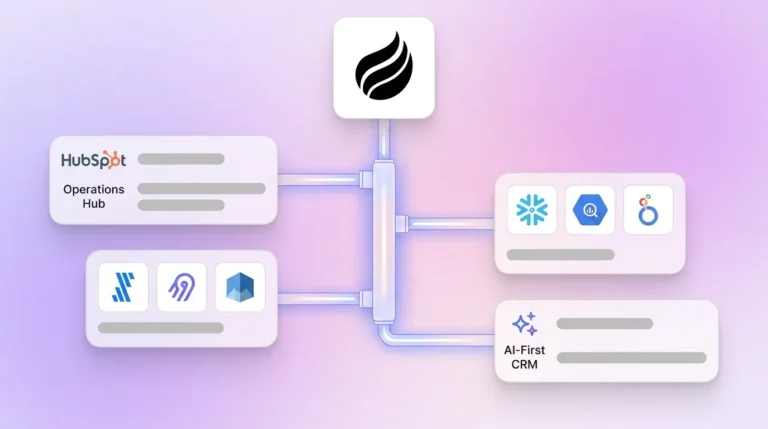
AI agents turn criteria discovery from a manual chore into an automated intelligence system. Coffee auto-extracts criteria from transcripts and emails, structures MEDDPICC data, and feeds Salesforce and HubSpot systems, saving 8 to 12 hours per week of manual data entry.
Unlike conversation intelligence tools like Gong that provide unstructured insights, Coffee ensures that clean data goes into your CRM so useful intelligence comes out. Agentic AI autonomously perceives context from calls and emails, investigates deal risks, updates CRM fields such as qualification fields, and generates summaries, improving the speed and accuracy of extracting and validating deal criteria.

Here is how this works in practice. A company generating tens of millions in revenue achieved automated agent briefings that surfaced criteria gaps and competitive positioning insights from call transcripts. The AI agent identified unstated security concerns from IT stakeholders that manual note-taking had missed, which enabled targeted responses that secured the deal.
Deploy Coffee’s AI-powered criteria extraction to transform sales conversations into structured MEDDPICC intelligence.
Measurable Success: Hit 90% Criteria Visibility and Lift Win Rates by 30%
Strong MEDDPICC criteria implementation produces measurable performance gains. Sales reps who conduct strategic discovery conversations close 30% more deals than those who do not, and sales conversations focused on business outcomes outperform product-focused conversations by 28% in close rates.
Define success metrics such as criteria visibility percentage, stakeholder validation rates, and champion engagement scores. Coffee’s Pipeline Compare feature visualizes deal progression and highlights stalled opportunities where criteria gaps need attention. Aim for 90% criteria visibility across your active pipeline and track win-rate improvements against historical baselines.
Advanced Next Steps: Expand to Full MEDDPICC Coverage
Criteria mastery creates a foundation for broader MEDDPICC execution across your enterprise sales motion. Integrate Coffee’s List Builder for champion identification and multi-threading strategies. Extend your criteria framework to cover metrics validation, economic buyer confirmation, and competitive differentiation strategies that build on the criteria groundwork you have already set.

FAQ
What are decision criteria for MEDDPICC?
Decision criteria in MEDDPICC are the evaluation benchmarks that buying organizations use to assess potential solutions. These include technical requirements like security compliance and integration capabilities, economic factors such as ROI thresholds and implementation costs, and operational considerations including timeline and change management requirements. Strong criteria stay specific, measurable, and owned by identified stakeholders within the buying committee.
What are examples of unstated decision criteria in enterprise deals?
Unstated decision criteria often involve personal and political factors that stakeholders do not discuss openly. Examples include career risk concerns when recommending new vendors, departmental budget protection motivations, past negative experiences with similar implementations, individual performance metrics tied to project success, and internal political dynamics between competing departments or initiatives.
What are the best MEDDPICC discovery questions for uncovering decision criteria?
Effective discovery questions include “Walk me through your evaluation process, what must your team see?” for stated criteria, “What keeps you up at night about vendor decisions?” for unstated concerns, “Who else influences this decision and what are their priorities?” for stakeholder mapping, and “What would make you confident this is the right choice?” for validation requirements. Follow-up probes should explore weighting, measurement methods, and timeline expectations.
How do you shape MEDDPICC criteria with a champion?
Champion-driven criteria shaping uses collaborative co-creation where the champion helps define evaluation benchmarks that favor your strengths. Provide champions with competitive analysis, ROI frameworks, and technical validation tools they can use internally. Apply the 10-3-1 rule to focus on ten total criteria, weight your top three strengths heavily, and establish one differentiating requirement that removes competitors while staying credible.
What is the 10-3-1 rule in enterprise sales?
The 10-3-1 rule is a criteria shaping strategy where sales teams work with champions to establish ten total evaluation criteria, ensure their top three competitive strengths are heavily weighted in the scoring method, and create one killer criterion that effectively removes competitors while appearing reasonable to the buying committee. This approach influences decision-making without appearing manipulative or self-serving.
Conclusion: Put Structured MEDDPICC Decision Criteria into Practice
Strong MEDDPICC decision criteria separate winning enterprise sales teams from those chasing ghost deals. This seven-step framework, which covers categorizing criteria types, uncovering stated requirements, probing unstated factors, shaping through champions, validating committee-wide, documenting systematically, and automating with AI agents, turns qualification from guesswork into repeatable intelligence.
Coffee’s AI agent removes manual criteria extraction work while improving pipeline accuracy. Combining proven discovery methods with automated data capture creates a durable competitive edge in complex enterprise deals.