Written by: Doug Camplejohn, CEO & Co-Founder, Coffee | Last updated: August 19, 2026
Key Takeaways for Sales Leaders
- Legacy CRMs push sales reps to spend 71% of their time on admin tasks like data entry, leaving only 35% for actual selling.
- Automating CRM data entry with an AI agent can reclaim 4–6 hours per rep per week, and consolidating tools plus AI meeting prep can add several more hours of selling capacity.
- AI-powered visitor identification and natural-language prospecting cut manual research and anonymous traffic loss, turning intent signals into actionable leads in minutes.
- AI-generated outreach sequences and a structured 30-day rollout plan keep saved hours focused on pipeline work instead of disappearing into internal meetings.
- Teams ready to reclaim 8–12 hours per rep per week can see Coffee’s pricing and start a trial today.
The 7 Strategies to Reclaim Selling Time
-
1. Automate CRM Data Entry with an AI Agent
Automating CRM data entry cuts a major source of admin work. CRM logging consumes roughly 11.5 hours per week for B2B sales reps before AI intervention, with automation typically recovering 4–6 of those hours per rep per week. Across a team of ten reps, that returns 60 hours of selling capacity every week without adding headcount.
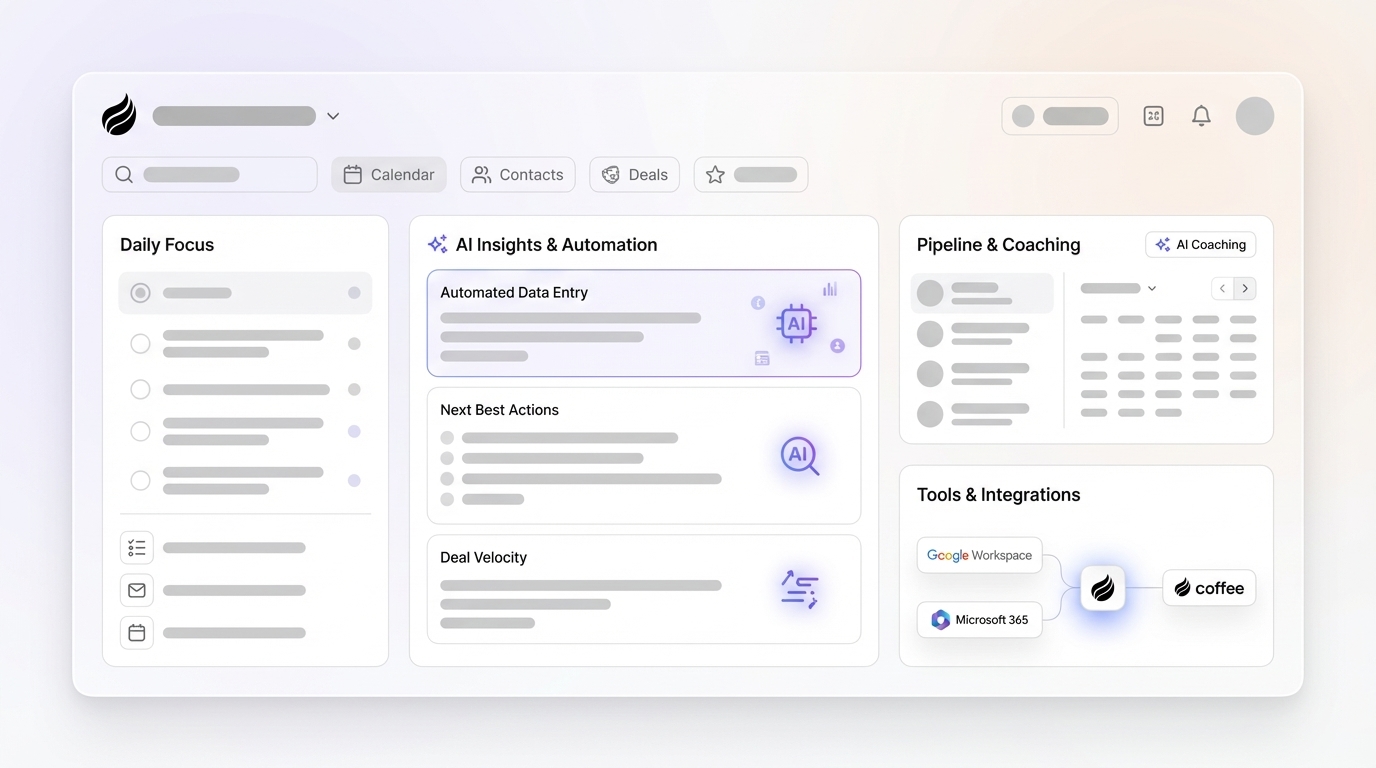
CRM auto-enrichment typically reclaims 4-6 hours or 8-12 hours per rep per week depending on the automation scope and benchmark. The most effective setup uses an AI agent that connects directly to Google Workspace or Microsoft 365, scans emails and calendar events, and auto-creates contacts, companies, and activity logs with no manual typing.
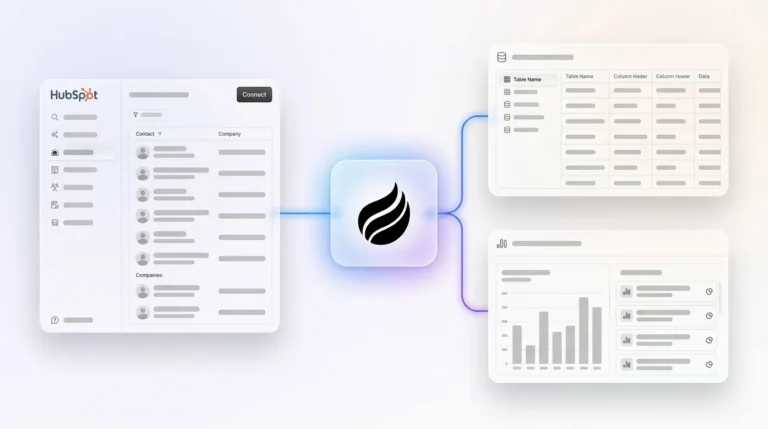
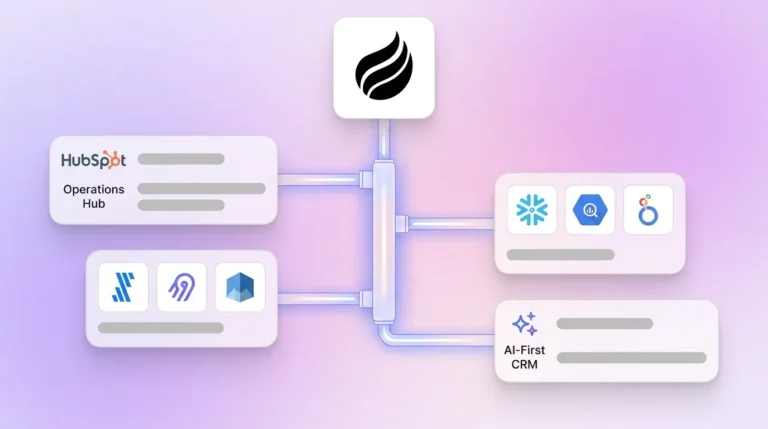
Coffee follows this model. After authentication, the Coffee Agent populates the CRM with people and organizations from existing communications, enriches records with job titles, funding data, and LinkedIn profiles, and logs every interaction on its own. For teams already on Salesforce or HubSpot, Coffee’s Companion App writes enriched data back to the existing system of record, so no migration is required. Implementation steps:
- Connect Coffee to Google Workspace or Microsoft 365 via OAuth to give the agent secure access to email and calendar data.
- Review the auto-generated contact and company records within 24 hours to confirm it is capturing the right people and organizations.
- Configure activity logging rules to match your pipeline stages so every interaction lands in the correct phase.
- Validate enrichment accuracy against a sample of 20 existing records to set a quality baseline before full rollout.
2. Consolidate Your Sales Tech Stack into One Agent
The average B2B sales rep actively uses 3 to 6 tools daily, while teams license 8–15 tools, which correlates with lower selling time and higher administrative burden from context-switching. SDRs lose meaningful time each day as they jump between systems, and consolidation returns a large share of those hours to pipeline work.
Many sales organizations now plan to consolidate their tech stack, moving away from point solutions toward fewer integrated platforms that reduce integration overhead and tool-switching friction. The practical consolidation playbook:
- Start by auditing every active tool against actual weekly usage data to separate essential tools from those the team rarely touches.
- Next, map data flows to identify broken handoffs between systems, since these gaps often create manual copy-and-paste work for reps.
- With usage data and integration gaps in hand, select one anchor platform that covers prospecting, engagement, enrichment, and pipeline management to replace the fragmented stack.
- Finally, decommission redundant tools on a defined 30-day timeline to drive adoption of the consolidated system and remove the temptation to revert to old workflows.
Coffee consolidates the jobs of a standalone CRM, an enrichment database (ZoomInfo/Apollo), a sales engagement platform (Outreach/Salesloft), a meeting recorder (Gong/Fathom), and a visitor identification tool (RB2B/Warmly) into a single agent. Replacing 3–5 tools with an all-in-one platform reduces complexity, cuts costs, accelerates new rep onboarding, and creates a single source of truth that eliminates sync errors, which directly translates into more time spent selling.
3. Use AI-Powered Meeting Prep and Follow-Up
AI shortens account research and meeting preparation from the typical 30–60 minutes per account to a fraction of that time. For a rep running five meetings per week, this shift alone can reclaim two or more hours before any follow-up work begins.

Automated meeting prep with Coffee AI CRM Agent Post-meeting automation compounds the gain. AI updates the CRM and drafts meeting summaries, so reps avoid repetitive note-taking and manual logging. Tools like Coffee help here because the agent joins the call via Zoom, Teams, or Google Meet, transcribes the conversation, generates a structured summary aligned to BANT, MEDDIC, or SPICED, identifies next steps, and drafts the follow-up email before the rep closes their laptop. Coffee launched Custom Meeting Briefings and Summaries in February 2026, enabling users to define exact formats such as high-level executive summaries or granular technical breakdowns, and those summaries write back directly to Salesforce or HubSpot.

Create instant meeting follow-up emails with the Coffee AI CRM agent - Enable Coffee’s AI Meeting Bot for all external calls so every conversation is captured and summarized.
- Configure summary templates to match your sales methodology, which keeps notes consistent across the team.
- Set follow-up drafts to auto-populate in Gmail for one-click review and send.
- Review the “Today” briefing page each morning for attendee context and prior deal history before your calls.
4. Turn Anonymous Website Visitors into Named Leads
Meeting prep becomes even more efficient when reps speak with prospects who already know the product. That requires capturing intent signals from website visits before the first outreach. Most sales teams invest heavily in driving traffic to their website and then lose visibility the moment a prospect arrives, but a single tracking pixel changes that pattern.
Coffee’s Visitor Identification feature surfaces the name, title, email, and LinkedIn profile of anonymous visitors, along with the company they belong to, the pages they viewed, time on site, and whether it was a first or returning visit. Where competitors like RB2B and Warmly surface only the company or generic people lists, Coffee applies your buyer persona to recommend the two or three individuals inside that visiting company to contact and surfaces their LinkedIn profiles for instant outbound. Real-time Slack notifications route high-fit visitors to the right rep as soon as they land, and one click adds the prospect to Coffee with all enrichment pre-filled. Implementation:
- Generate the Coffee tracking pixel and place it in the
<head>tag of your website. - Define your buyer persona inside Coffee’s Intelligence layer so Suggested Leads match your ideal customer profile.
- Configure Slack routing rules by territory, segment, or account tier to send alerts to the right owner.
- Enroll high-fit visitors directly into a Campaign for automated follow-up while intent is fresh.
AI-augmented sales teams achieve 2–5× faster lead response times compared to non-automated teams, with lead response time directly correlating to conversion rates. Visitor identification narrows the gap between intent signal and rep action to minutes instead of days.
5. Build Targeted Prospect Lists with Natural-Language Search
48% of sales reps say they lack the bandwidth for adequate cold outreach, largely because manual list building and enrichment consume hours that should go to conversations. Reps using AI agents expect prospect research time to drop 34% once fully implemented.
Coffee’s Lead Finder replaces standalone prospecting databases with a natural-language interface built directly into the agent. A rep types a request such as “Find me VPs of Sales at SaaS companies with 50–200 employees in the U.S.” The agent interprets the request, previews matching results for confirmation, and generates the list without CSV exports or tool-switching. Lists live inside Coffee alongside every other record, ready for enrichment and immediate enrollment into Campaigns. Top-performing reps are 1.7 times more likely to use AI agents than underperformers, and Lead Finder brings that capability to every rep on the team.

Build people lists automatically with Coffee AI CRM Agent 6. Run AI-Generated Outreach Sequences Inside the CRM
AI-powered tools save sales reps 30–45 minutes per day on email drafting and personalization, equating to approximately 17 hours per month reclaimed per seller. Over a full quarter, that gain equals more than two full selling weeks per rep without increasing headcount.
Coffee’s Campaigns feature runs multi-step, AI-generated email sequences directly from the rep’s connected mailbox. A rep describes the campaign in plain English, such as “4-step outreach to webinar attendees introducing our analytics product.” The agent generates subject lines, body copy, and send delays for every step. Personalization variables like first name, company, and title use automatic fallbacks so every email reads as individual. Stop-on-reply is on by default, so once a prospect responds, the sequence pauses and no automated email follows a live conversation. Built-in send throttling protects sender reputation. Performance benchmarks to track:
- Reply rate per sequence step, with a benchmark of 3–8% for cold outreach.
- Sequence completion rate, with a target of at least 80% of enrolled prospects reaching the final step.
- Meetings booked per 100 prospects enrolled, which shows the true impact on pipeline.
- Sender domain health score, monitored weekly during ramp to avoid deliverability issues.
7. Launch a 30-Day Rollout Plan and Reinvest Saved Time
Reclaiming hours only creates value when those hours shift into high-impact work. A Gartner survey of 210 sales leaders in early 2026 found AI saves sellers an average of 4.8 hours per week, yet 72% of sales organizations report low reinvestment of that time into high-value activities. Without a structured rollout plan, saved hours drift into Slack and internal meetings instead of pipeline.
A focused 30-day rollout plan locks in reinvestment and sequences the strategies above into a single motion:
- Week 1 — Connect and baseline: Authenticate Coffee with Google Workspace or Microsoft 365 and your CRM, then run a baseline audit of current selling hours per rep using calendar data.
- Week 2 — Automate data capture: Enable auto-contact creation, activity logging, and the AI Meeting Bot for all external calls, and validate enrichment accuracy on a sample of 50 records.
- Week 3 — Activate outbound: Build the first Lead Finder list, install the Visitor ID pixel, launch the first AI-generated Campaign sequence, and configure Slack routing for high-fit visitors.
- Week 4 — Measure and reinvest: Pull selling-hours data from calendar analytics to quantify how much time automation has freed. Use that number to set a team target of at least 40% of the week on direct customer interaction, then protect the gain by scheduling reclaimed hours as prospecting blocks in each rep’s calendar.
Using multiple integrated AI tools helps teams reach higher weekly savings benchmarks, while single-tool pilots usually deliver only 3–5 hours saved per rep. A consolidated agent like Coffee, which covers data entry, meeting prep, prospecting, and outreach in one system, is the architecture that reaches those team-wide gains. Point solutions rarely achieve that level of impact.
Ready to run this 30-day rollout with your team? See Coffee’s plans and pricing.
Frequently Asked Questions
How does Coffee integrate with Salesforce and HubSpot?
Coffee uses a Companion App model designed for teams already committed to Salesforce or HubSpot. A simple OAuth authentication lets the Coffee Agent connect to the existing CRM instance. From there, the agent handles the “data in” process: it auto-creates contacts and companies from email and calendar activity, enriches records with firmographic and contact data, logs all interactions, and writes meeting summaries and next steps back to native CRM fields. Coffee has deep knowledge of Salesforce and HubSpot architecture, including quotas, forecasting objects, and required fields, which separates it from newer CRM alternatives that lack the integration depth established mid-market teams need.
Is my sales data secure with an AI agent?
Coffee is SOC 2 Type 2 certified and GDPR compliant. Data processed by the Coffee Agent is not used to train public AI models. The agent connects to Google Workspace or Microsoft 365 through standard OAuth protocols, so credentials are never stored directly. For teams in regulated industries or with specific data residency requirements, Coffee’s security documentation is available on request. The agent operates as a read-and-write layer on top of existing systems, which means current data governance policies for Salesforce or HubSpot continue to apply.
Will the agent’s data quality match ZoomInfo?
Coffee’s built-in enrichment, sourced through licensed data partners, is on par with ZoomInfo and Apollo for most B2B use cases, including job titles, company firmographics, funding data, and LinkedIn profiles. For most SMB and mid-market sales teams, this built-in enrichment removes the need for a separate prospecting database subscription. The main advantage is that Coffee’s enrichment lives inside the same agent that runs outreach, logs activity, and manages pipeline, which removes the tool-switching cost of exporting lists from a standalone database and importing them into a CRM or sequencing tool. Teams with highly specialized data requirements, such as direct-dial phone numbers at enterprise scale, may still benefit from a supplemental data source, and Coffee connects to external tools via Zapier in those cases.
Conclusion
The seven strategies above cover every major category of wasted rep time: manual CRM data entry, tool-switching overhead, meeting prep and follow-up, anonymous traffic that never converts, prospect list building, outreach execution, and the reinvestment of saved hours into actual selling. Executed together through a single integrated agent, they deliver the time savings that research identifies as the upper bound of AI-driven productivity gains.
Legacy CRMs and fragmented point solutions struggle to reach that benchmark because they rely on humans to stitch the system together. Coffee takes the opposite approach: the agent does the work, and the rep does the selling. Whether your team runs Coffee as a standalone CRM or as a Companion App on top of Salesforce or HubSpot, the outcome stays consistent: accurate data in, reliable insights out, and a sales team that spends its time closing rather than logging.
Ready to give your reps back hours every week? View Coffee’s pricing options.