Written by: Doug Camplejohn, CEO & Co-Founder, Coffee
Key Takeaways for Sales Leaders
-
Sales reps lose 71% of their time to non-selling work because legacy CRMs force manual data entry, with 32% spending over an hour daily.
-
AI-powered CRMs automate data entry, meeting management, predictive insights, and workflows, often saving 8–12 hours per rep every week.
-
Coffee ranks #1 as an autonomous CRM agent, available as a standalone platform or companion app, with Gmail integration and natural language prospecting.
-
Competitors like Salesforce Einstein and HubSpot Breeze add strong AI features but still carry legacy limits and deliver only 3–6 hours saved weekly.
-
Teams commonly see 20–30% efficiency gains with AI CRMs. Start with Coffee to maximize sales productivity in 2026.
Why Legacy CRMs Fall Behind Modern AI Systems
Traditional CRM platforms contain deep architectural flaws that slow sales teams. They rely on fragmented tool stacks where sales reps lose 8–12 hours weekly while toggling between systems for data enrichment, outreach, and call logging. These platforms also struggle with unstructured data from emails and call transcripts, so reps must type everything in manually. That manual work creates “shadow CRMs” in spreadsheets and Notion that drift away from the official system of record.
AI-powered CRMs address each of these flaws directly and replace manual work with automation. They capture data automatically, interpret unstructured information, and keep everything in one place for the team. These core capabilities change how sales operations run:
-
Autonomous Data Entry & Enrichment: AI agents automatically capture contacts, companies, and activities from email and calendar interactions.
-
Intelligent Meeting Management: Automated briefings, transcription, and follow-up generation.
-
Predictive Pipeline Intelligence: Real-time deal scoring and progression insights.
-
Natural Language List Building: Voice or text-driven prospect research and targeting.
-
Workflow Consolidation: A single platform replaces multiple point solutions.
These capabilities deliver measurable value, but not every AI CRM executes them equally well. When evaluating platforms, focus on ROI metrics such as hours saved per rep, along with data accuracy, scalability, user experience, integration depth, and security compliance. Teams using AI automation achieve 20–30% efficiency improvements by reclaiming time for strategic selling activities.
See Coffee’s agent demo to see how autonomous CRM agents reshape daily sales workflows.
Top 9 AI-Powered CRMs for Sales Efficiency in 2026
1. Coffee
Coffee operates as an autonomous CRM agent that focuses on data quality and workflow automation. The platform offers dual deployment models: a standalone CRM for SMBs or a companion app for existing Salesforce and HubSpot instances. Coffee’s agent automatically manages Gmail and Office 365 integration, BANT meeting qualification, and natural language list building.
Recent updates add AI intelligence layers for business context and custom meeting briefings. The system saves 8–12 hours per rep weekly through comprehensive workflow automation. Pricing uses simple seat-based plans without complex metering.

2. Salesforce Einstein/Agentforce
Salesforce Agentforce serves 150,000+ customers with $540M ARR through autonomous agents for lead qualification and pipeline management. The platform offers predictive scoring, opportunity insights, and automated data entry through Einstein AI. Agentforce Builder lets teams create conversational agents with multi-model flexibility. The system still carries 25 years of legacy architecture and often requires heavy customization. Pricing starts at $125 per user per month for Agentforce capabilities.
3. HubSpot Breeze AI
HubSpot serves 279,000+ active customers with Breeze Agents that support autonomous prospecting and customer support. The platform includes no-code agent builders and real-time CRM insights. Breeze Intelligence powers predictive analytics and data enrichment. The product works well for marketing and sales alignment, yet the core system began as a marketing tool with CRM added later. Premium plans use pay-per-result pricing for Breeze Agents, and a 28-day trial is available.
4. monday sales CRM
monday CRM crossed $100M ARR with AI Sales Agents that handle lead sourcing and qualification. The platform offers no-code workflow customization and AI columns for data extraction. Users report 70% efficiency increases in admin task automation. The system shines in visual pipeline management but lacks deep unstructured data processing. Flexible pricing adapts to team size and avoids strict vendor lock-in.
5. Gong Revenue Intelligence
Gong focuses on conversation intelligence and deal insights through AI-powered call analysis. The platform delivers coaching recommendations and highlights pipeline risk. It excels at processing unstructured data from sales calls, yet it still requires integration with separate CRM systems. The tool saves 2–4 hours weekly through automated note-taking and conversation insights. Enterprise pricing varies based on team size and feature scope.
6. Clari Revenue Platform
Clari’s AI-powered forecasting improves accuracy from 60–70% to 90–95% while saving more than 20 hours weekly on forecast preparation. The platform specializes in pipeline analytics and deal progression tracking. Clari focuses on forecasting rather than full workflow automation across the sales cycle. Integration with existing CRM systems is necessary for complete functionality.
7. Day.ai
Day.ai automates meeting notes and CRM updates through AI-powered transcription and summarization. The platform integrates with popular video conferencing tools and CRM systems. It handles unstructured data capture effectively but does not cover full pipeline management or lead generation. The tool saves 2–4 hours weekly through automated documentation. Pricing scales with meeting volume and integration needs.
8. Attio
Attio provides a modern CRM interface with AI features for data enrichment and workflow automation. The platform supports flexible data modeling and broad integration options. It still relies on a traditional passive database architecture despite the improved user experience. AI features remain limited compared with agent-driven platforms. The system saves 2–3 hours weekly by streamlining data entry.
9. Pipedrive AI Sales Assistant
Pipedrive serves 100,000+ paying customers with AI recommendations for deal prioritization and email drafting. The platform offers visual pipeline management and workflow automation. AI features include win probability scoring and deal risk alerts. The system still lacks advanced autonomous capabilities and robust unstructured data processing. Pricing starts at $14.90 per user per month, with AI features available on higher tiers.
The following comparison table highlights how Coffee’s deeper automation and data handling translate into stronger efficiency gains than legacy-based competitors.
|
Tool |
Automation Depth |
Data Handling |
Efficiency ROI (Hrs Saved/Rep Weekly) |
|---|---|---|---|
|
Coffee |
Full agent (entry, meetings, lists) |
Both (warehouse) |
8-12 |
|
Salesforce Einstein |
Predictive scoring, partial auto |
Structured primary |
4-6 |
|
HubSpot AI |
Content gen, basic enrichment |
Structured |
3-5 |
|
monday sales CRM |
Workflow agents |
Both structured and unstructured |
4-6 |
Why Coffee Leads AI-Powered CRMs for Sales Efficiency
Coffee’s autonomous agent approach separates it from passive CRM databases. The platform deploys intelligent agents that handle busywork so sales reps can focus on strategic relationships and closing deals. Coffee’s dual-model approach, described earlier, supports both SMBs and mid-market teams without forcing a full system replacement.
Key differentiators include proactive data capture from Gmail and Office 365, BANT-qualified meeting summaries, and natural language list building. Recent platform updates show ongoing advances in AI intelligence and workflow customization. Unlike competitors that rely on reactive features, Coffee’s agents anticipate needs and execute tasks autonomously.

Common objections around integration, security, and data quality receive direct coverage through robust APIs, SOC 2 Type 2 compliance, and enterprise-grade accuracy. Coffee’s agent-first architecture removes the manual maintenance that legacy systems demand.
Book a Coffee demo to see autonomous CRM agents working in a live environment.
Implementation Playbook and Real-World Results
Teams that plan AI CRM deployments carefully see faster efficiency gains. Start with Google Workspace or Office 365 integration, which usually takes about one minute, then connect your CRM for data synchronization. Coffee’s implementation flow follows these steps and adds automated contact discovery and enrichment to speed up onboarding.
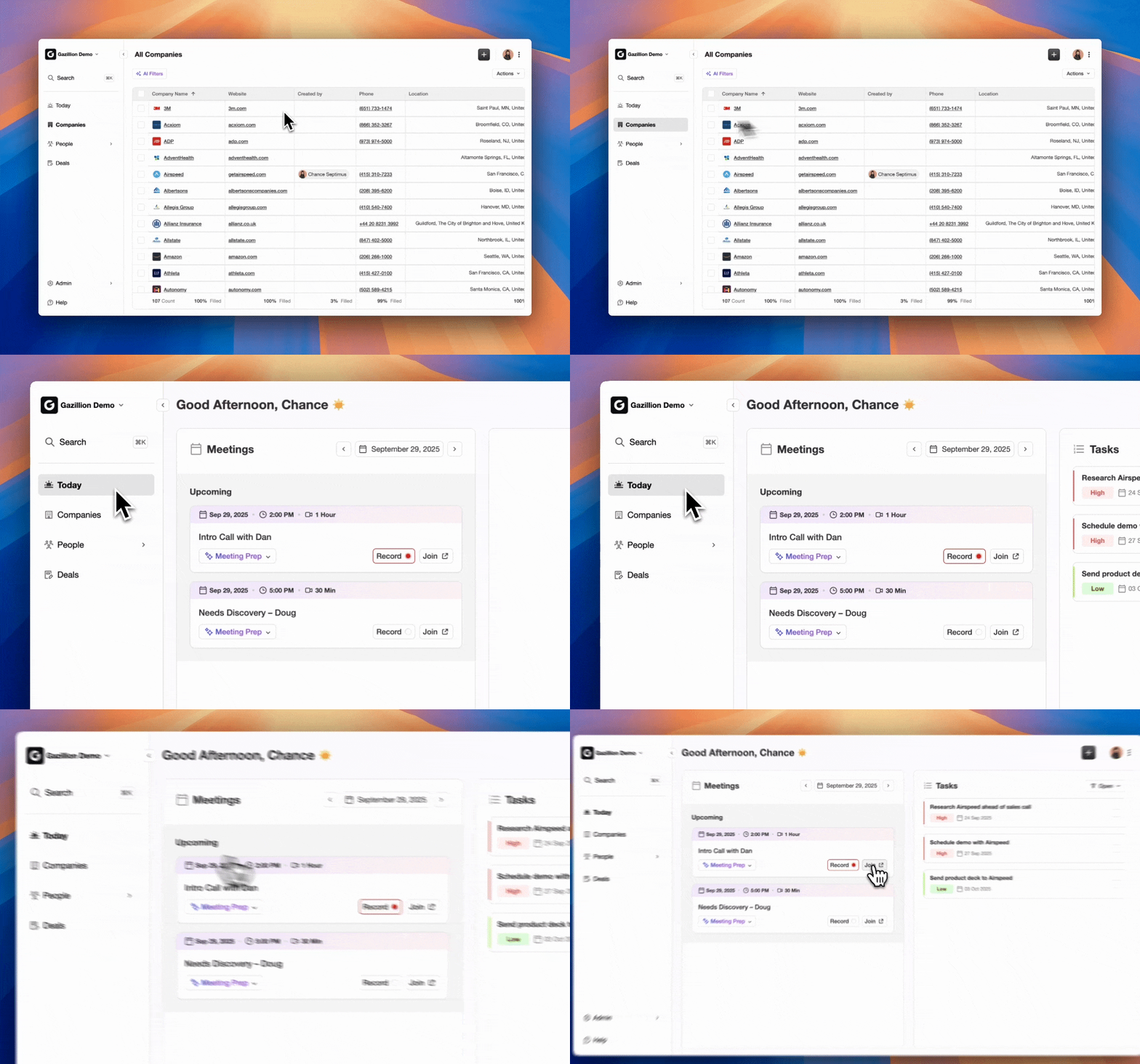
Real-world AI use cases include automated meeting briefings with attendee context, intelligent follow-up generation, and natural language prospecting commands such as “Find VPs at $10M+ funded companies using Salesforce.” Organizations implementing AI CRM automation achieve the 20–30% efficiency gains mentioned earlier through reduced administrative overhead.

One $10M ARR technology firm automated weekly pipeline reviews using Coffee’s agent. The team removed manual spreadsheet compilation and improved forecast accuracy at the same time. This rollout delivered immediate ROI through time savings and higher data quality.
2026 AI CRM Trends and Selection Checklist
Agent autonomy will define 2026 CRM evolution as platforms move from passive databases to proactive workforce multipliers. SMBs gain the most from standalone solutions like Coffee that cover the full workflow in one place. Mid-market teams often benefit from companion models that enhance existing Salesforce or HubSpot investments. Total cost of ownership drops as stacks consolidate and manual labor requirements shrink.
FAQ
What is the best AI CRM for data entry automation?
Coffee leads in autonomous data entry through intelligent agents that capture contacts, companies, and activities from email and calendar interactions. The platform removes manual CRM updates by processing both structured and unstructured data sources, contributing to the 8–12 hours saved per rep each week. Coffee’s agent-first architecture keeps data quality high without constant human oversight.
Which AI tools work best for sales prospecting?
Coffee’s natural language list builder helps sales teams create targeted prospect lists through conversational commands. The system combines enrichment data with CRM context to run complex queries such as “Find VPs of Sales in North America at $10M+ funded companies using Salesforce.” This automation replaces manual research that would otherwise consume hours of rep time each week.

Do AI CRMs offer free trials?
Most AI-powered CRMs provide trial periods or freemium tiers for evaluation. HubSpot offers a forever-free plan with basic AI features, while platforms like Coffee provide demo access that highlights autonomous agent capabilities. Trial periods usually range from 14 to 30 days, so teams can measure efficiency improvements and ROI potential before choosing a paid plan.
How does Coffee compare to Salesforce for sales efficiency?
Coffee’s autonomous agents handle broad workflow automation, while Salesforce Einstein focuses on predictive insights within a legacy framework. Coffee delivers the 8–12 hour weekly savings discussed earlier through proactive data management. Salesforce typically saves 4–6 hours through more reactive features. Coffee’s dual-model approach also supports companion deployment on existing Salesforce instances for stronger automation.
What ROI can teams expect from AI CRM implementation?
AI-powered CRMs typically deliver 20–30% efficiency improvements through automated data entry, meeting management, and pipeline intelligence. Coffee users often sit at the higher end of that range, as the platform combines those gains with substantial weekly time savings per rep. Most teams see ROI within 30–60 days through lower administrative overhead and more time spent selling.
Conclusion
Legacy CRMs turn sales reps into data entry clerks, repeating the 71% time waste problem outlined earlier. AI-powered platforms like Coffee deploy autonomous agents that remove this drag through intelligent automation and unified workflows. The agent era has arrived in 2026 and offers a clear path to a more productive sales organization.
Get started with Coffee today to reclaim your team’s selling time and experience autonomous CRM agents in practice.