Written by: Doug Camplejohn, CEO & Co-Founder, Coffee | Last updated: August 21, 2026
Key Takeaways
- AI-native CRMs are built around autonomous agents that share a unified storage layer with live records, so lead research, contact enrichment, and pipeline updates happen in real time without manual rep input.
- Strong platforms deliver deep automation, automatic data capture from email and calendar, robust unstructured data handling, a companion app option, a clear team-size focus, and visible 2026 roadmap progress.
- AI-native systems outperform bolt-on AI layers because they prevent stale-context errors and address data-quality decay at the source instead of syncing copies on a delay.
- Product comparisons show Coffee uniquely supports both standalone CRM and companion-layer deployment on Salesforce or HubSpot, which saves reps 8–12 hours per week on data entry.
- Teams ready to eliminate manual CRM upkeep can explore Coffee’s agent-first platform and see all six evaluation criteria working out of the box.
How to Evaluate AI-Native CRM Platforms for Sales Teams
Six criteria separate genuine AI-native platforms from legacy tools wearing an AI badge, and RevOps leaders should get clear answers on each one before signing a contract.
- Automation Depth: Agents should execute multi-step workflows without human initiation at each step, not just surface suggestions.
- Data Entry Method: The system should auto-capture contacts, activities, and deal changes from email and calendar instead of relying on rep input.
- Unstructured Data Handling: Emails, call transcripts, and meeting notes should function as first-class objects the agent can reason over, not flat text attachments.
- Companion App Availability: The platform should operate as a standalone system of record and as an intelligence layer on top of an existing Salesforce or HubSpot instance.
- Team Size Fit: The product should clearly target the 1–20, 21–100, or 100+ employee range, with pricing aligned to that segment.
- 2026 Roadmap Signals: The vendor should ship agent capabilities monthly instead of treating AI features as a static marketing layer.
Beyond the six criteria above, two architectural questions cut through vendor marketing. Does the AI read from the live database or a synced copy? Can it write back to the system of record without human approval for routine tasks? Stripping away AI features from a truly native platform should cause core CRM functions to fail, and that test alone eliminates most legacy contenders.
See how Coffee handles all six criteria in a live demo and compare it directly to your current stack.
AI-Native vs AI-Enhanced CRM Architectures in 2026
In bolt-on AI stacks such as Salesforce Einstein or HubSpot Breeze, the CRM remains the source of truth and the AI layer syncs a copy, often nightly or hourly rather than in real time, which causes stale-context errors where the AI reads closed deals as open or pipeline stages that shifted hours ago as fixed. Forrester’s 2025 CRM research calls the architectural marker that avoids this problem “agent parity,” where the agent runtime shares the same storage layer, permission model, and event bus as the human user.
The data-quality gap compounds quickly. CRM data decays at approximately 30% per year, leaving up to 70% of records incomplete, outdated, or inaccurate at any given time. Gartner predicts that organizations will abandon 60% of AI projects through 2026 when they lack AI-ready data, and found that 63% of organizations either lack the data-management practices AI requires or do not know whether they have them.
The rep-time picture is equally stark. Salesforce’s State of Sales 2026 report found that the average B2B sales rep spends 40% of their workweek selling and 60% on admin work, data entry, internal meetings, and CRM upkeep. No EY March 2026 analysis reported these figures, and 78% of sellers missed quota in 2025 per Ebsta/Pavilion data.
The architectural implication is clear. Nearly two-thirds of enterprises worldwide have experimented with agents, but scaling them to deliver tangible value remains challenging, with data limitations often cited as a roadblock. An AI-native CRM solves the data problem at the source before the agent ever runs.
Product-by-Product Comparison of AI-Native CRM Options
The following platforms represent the current landscape of AI-native CRM solutions, each taking a different approach to the agent-first model described above, and the summaries below show how each one handles the six criteria already outlined.
Coffee
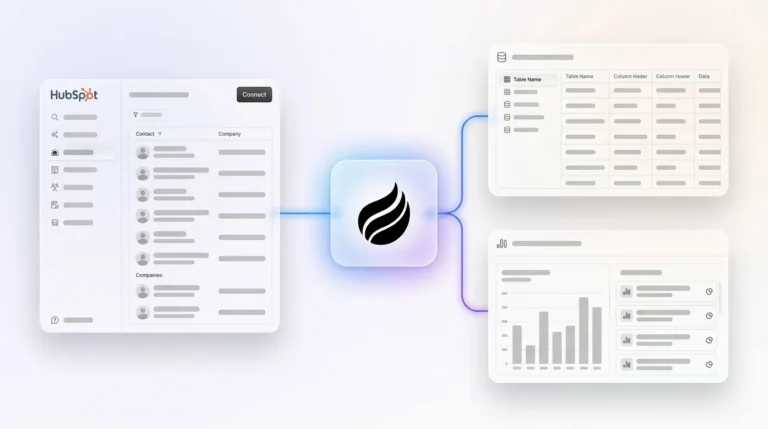
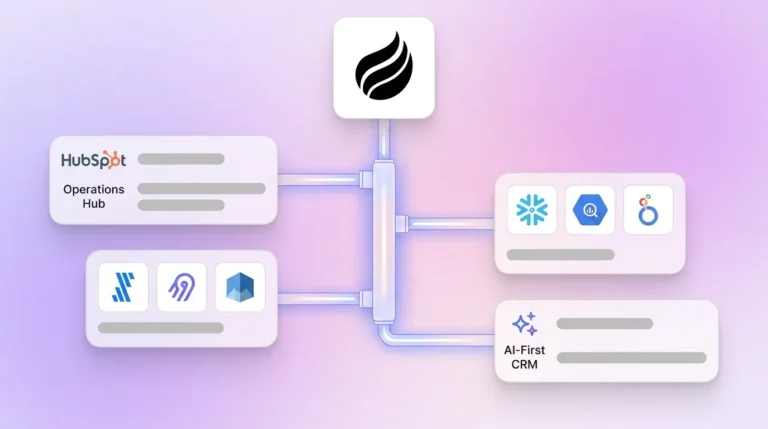
Coffee is an agent-first CRM that functions as both a standalone system of record for small and mid-market teams and a companion layer on existing Salesforce or HubSpot instances. After connection to Google Workspace or Microsoft 365, the Coffee Agent automatically creates contacts and companies, logs activities, enriches records with job titles, funding data, and LinkedIn profiles, and writes summaries back to whichever system of record the team uses. This workflow saves 8–12 hours per rep each week, time that previously went to manual data entry.

- Strengths: Dual deployment model as standalone CRM or Salesforce and HubSpot companion, Pipeline Compare for week-over-week deal changes without spreadsheets, Visitor Identification with Suggested Leads that surfaces two or three contacts inside a visiting company who match the buyer persona, native multi-step AI-generated email sequences with stop-on-reply from the rep’s own mailbox, and Lead Finder for natural-language prospect list building inside the same system.
- Limitations: Third-party integrations currently route through Zapier instead of direct native connectors, and the product is not designed for large enterprises with complex custom workflows or heavily regulated industries that require multi-year security reviews.
- Ideal fit: B2B teams of 1–100 employees, especially those committed to Salesforce or HubSpot who want an agent to handle data quality without replacing their system of record.
- Pricing: Seat-based, with the agent’s labor included and no usage metering on LLM calls or workflow runs.
- Implementation: Connect Google Workspace or Microsoft 365 via OAuth and the agent begins populating records immediately, while companion mode adds a simple Salesforce or HubSpot authentication so Coffee can sync and write enriched data back.
Attio
Attio is a modern relational CRM built on an event-sourced audit log, which gives it a more flexible data model than Salesforce or HubSpot. Attio generates a prioritized action queue of accounts that are drifting, deals that are stalling, and leads that are ready to buy, which moves beyond passive record storage. Its AI layer still operates on top of a relational core rather than sharing a unified agent runtime.
- Strengths: Highly flexible data model, strong UI for relationship-driven sales, and an event-sourced audit log that preserves historical context.
- Limitations: No companion mode for Salesforce or HubSpot, shallower automation depth than a fully agent-first platform, and no native outbound sequencing or visitor identification.
- Ideal fit: Early-stage startups with 1–30 employees replacing spreadsheets and seeking a modern UI without committing to an agent-first architecture.
- Pricing: Seat-based tiers with a free plan available.
- Implementation: Low-friction setup with email sync via OAuth and limited data migration tooling for teams moving from Salesforce.
Clarify
Clarify layered a proprietary graph model on top of a graph database so agents can act inside the record rather than adjacent to it. This approach enables richer relationship mapping than a standard relational CRM, although Clarify’s integration capabilities for established Salesforce and HubSpot deployments with quotas, forecasting, and required fields remain limited compared to platforms built specifically for that use case.
- Strengths: Graph-based data model that captures relationship context well, a modern interface, and AI-generated action items from meetings.
- Limitations: Insufficient integration depth for mid-market teams already on Salesforce or HubSpot, no companion deployment model, and reliance on third-party tools for prospecting and sequencing.
- Ideal fit: Small teams with 1–20 employees starting fresh without an existing CRM investment.
- Pricing: Seat-based, with pricing details available on request.
- Implementation: Straightforward for net-new deployments, while migration from legacy CRMs requires manual data preparation.
Reevo
Reevo positions itself as an AI-native revenue platform with autonomous prospecting and outreach capabilities built into the CRM layer. Its agent handles lead sourcing, sequence execution, and CRM updates within a single interface, which reduces the need for separate sales engagement tools.
- Strengths: Built-in autonomous outbound prospecting, AI-driven pipeline updates, and a unified inbox for reply management.
- Limitations: No companion mode for Salesforce or HubSpot, a limited track record for teams above 50 seats, and less mature unstructured data handling for call transcripts and email threads than agent-first incumbents.
- Ideal fit: Outbound-heavy teams of 5–50 employees that are building pipeline from scratch.
- Pricing: Seat-based, with details available on request.
- Implementation: Fastest for teams with no existing CRM, while migration tooling remains early-stage.
Salesforce Agentforce
Recent Salesforce reports indicate that a large majority of sales teams are using AI, with many exploring AI agents for automation. Agentforce extends Salesforce’s existing platform with autonomous agents for lead qualification, follow-up, and opportunity updates. Salesforce reported a 75% decrease in quoting time after deploying Agentforce internally. The AI layer still syncs on top of Salesforce’s existing relational database rather than sharing a unified agent runtime, and data quality remains the primary blocker: “We have not seen a single enterprise whose Salesforce data was not a mess. Agents don’t fix messy data, they amplify it.”
- Strengths: Deep enterprise feature set, a large partner ecosystem, and Agentforce agents that handle autonomous follow-up and opportunity updates at scale.
- Limitations: Twenty-five years of legacy architecture, high implementation cost and complexity, and an AI layer that operates on the synced-copy architecture described earlier, which inherits the stale-context errors that come with batch updates instead of real-time agent access.
- Ideal fit: Enterprises with 200 or more employees that are already deeply invested in the Salesforce ecosystem.
- Pricing: Per-seat licensing plus consumption-based Agentforce pricing, which creates a high total cost of ownership for small and mid-market teams.
- Implementation: No Deloitte 2024 data on median CRM migration cost measured in admin time is present in the sources.
Side-by-Side Comparison Table
| Platform | Automation Depth | Data Entry Method | Unstructured Data Handling | Companion App Availability | Team Size Fit | 2026 Roadmap Signals |
|---|---|---|---|---|---|---|
| Coffee | Full agent execution that auto-creates contacts, logs activities, enriches records, runs sequences, and updates pipeline without rep input | Fully automatic from Google Workspace or Microsoft 365, with zero manual entry required | Emails, call transcripts, and meeting notes ingested as first-class objects and structured into BANT, MEDDIC, or SPICED automatically | Yes, as a standalone CRM or companion layer on Salesforce and HubSpot | 1–100 employees, with the strongest fit at 1–20 for standalone and 21–100 for companion | Monthly shipping, with Intelligence layer, AI deal search, Custom Meeting Briefings, Stripe integration, and Pipeline Compare all released between November 2025 and February 2026 |
| Attio | Prioritized action queues with automation rules available, while agent execution remains limited | Email sync via OAuth, with some manual field entry still required for deal data | Event-sourced audit log that preserves history, with limited native transcript or email-body reasoning | No companion mode for Salesforce or HubSpot | 1–30 employees | Flexible data model improvements and an AI feature cadence that is slower than agent-first vendors |
| Clarify | Graph-based relationship mapping and AI action items from meetings, with limited autonomous execution | Email sync available, while manual entry is still required for pipeline updates | Graph model that captures relationship context, with transcript handling in an early stage | No companion mode | 1–20 employees | Active development, while integration depth for established Salesforce and HubSpot deployments remains limited |
| Reevo | Autonomous prospecting and outbound sequencing with pipeline updates via agent | Agent-driven for outbound records, with less automation for inbound and existing-contact entry | Unified inbox for reply management and call transcript handling that is maturing | No companion mode | 5–50 employees | Outbound-focused roadmap, with CRM depth and unstructured data handling as active development areas |
| Salesforce Agentforce | Level 4 autonomous tasks including database field updates, deployed at scale across enterprise business units | Agentforce automates some logging, while the underlying Salesforce platform still requires significant manual data hygiene | Einstein AI processes some unstructured signals, and the AI layer syncs a copy of data rather than sharing a unified agent runtime, which causes stale-context errors | Native to Salesforce with no companion mode for HubSpot | 200+ employees, with high TCO limiting fit for teams under 100 | Active Agentforce investment, while complexity and cost scale with enterprise requirements |
Choosing the Right AI-Native CRM for Your Team Size and Stack
The feature comparison above shows what each platform can do, but the right choice depends more on your team’s current situation than on a checklist. Team size and existing stack are the two variables that most reliably predict which platform delivers the fastest time to value, and the matrix below maps each segment to a primary recommendation and the reasoning behind it.
| Company Size | Recommended Platform | Rationale |
|---|---|---|
| 1–20 employees | Coffee (Standalone) | Founders and early sales hires need a CRM that runs itself, and Coffee’s agent auto-populates contacts from Google Workspace or Microsoft 365 on day one, which removes the setup burden that makes HubSpot and Pipedrive feel like chores at this stage. |
| 21–100 employees | Coffee (Companion on Salesforce or HubSpot) | Teams committed to Salesforce or HubSpot get the agent’s data-quality engine without replacing their system of record, and Coffee’s companion mode addresses the data-quality issues that commonly impact sales results without forcing a migration. |
| 100+ employees | Salesforce Agentforce (with Coffee as companion) | Large teams with complex workflows, custom objects, and enterprise security requirements need Salesforce’s depth, while Coffee’s companion layer addresses the data-quality gap that limits Agentforce’s reliability on legacy data. |
Connect Coffee to your existing stack in under five minutes, whether your team is on Salesforce, HubSpot, or starting fresh.
Implementation, Migration, and Common Pitfalls
The single largest implementation risk for any AI-native CRM is data quality at migration time. When AI acts autonomously, bad data produces bad actions and the cost of poor data quality compounds quickly, so “garbage in, garbage out” becomes “accelerated garbage in, accelerated garbage out.”
For standalone deployments, the migration path stays straightforward. Coffee’s agent begins building the contact and company graph from email and calendar history immediately after OAuth connection, so teams with poor legacy CRM data can effectively start clean. The agent’s enrichment layer fills gaps that manual migration would leave behind.
For companion deployments on Salesforce or HubSpot, field mapping becomes the primary consideration. Coffee writes enriched data and meeting summaries back to the existing system of record, so RevOps leaders should audit required fields and custom objects before connecting. Coffee’s improved summary templates, released in November 2025, are customizable to match existing workflows and writable back to HubSpot or Salesforce, which reduces the risk of data conflicts.
Common pitfalls to avoid follow a clear pattern that starts with data quality, moves through implementation, and ends with adoption.
The most frequent failure mode is shadow CRM persistence. Thirty-seven percent of sales staff admit to fabricating CRM data when facing too many required fields that block workflow. An agent-first platform removes the entry burden entirely and eliminates the incentive for shadow systems.
Even when teams avoid shadow systems, stale-data agent errors can undermine trust. A mortgage-desk client reported their HubSpot AI assistant recommended re-engaging a borrower who had already closed with a competitor nine hours earlier because the recommendation engine was reading a nightly sync. Teams should verify that any AI layer reads from the live database instead of a batch copy.
Beyond data quality, many teams face underestimated migration time. No Deloitte 2024 data on median CRM migration cost measured in admin time is present in the sources. Coffee’s companion model sidesteps much of this effort for teams staying on Salesforce or HubSpot.
Finally, even technically successful deployments can fail when leaders ignore adoption metrics. Sustained per-rep adoption below 60% at six months post-deployment is a red flag, because it indicates value accrues primarily to managers rather than individual sellers. Platforms that remove rep data-entry burden tend to drive adoption organically.
FAQ
Which AI-based CRM is the best?
For small to mid-market B2B teams with 1–100 employees, Coffee is the strongest choice in 2026 because it is the only platform that operates as both a standalone AI-native CRM and a companion layer on Salesforce or HubSpot. Its agent automatically captures contacts, enriches records, logs activities, and runs outbound sequences without rep intervention, delivering the 8–12 weekly hours of savings mentioned earlier. Teams that cannot or do not want to replace Salesforce or HubSpot get the same agent capabilities without a migration. Larger enterprises already deeply invested in Salesforce may find Agentforce a better fit for complex workflow requirements, although data quality must be addressed separately.
What are the best AI agents for sales teams?
The most effective AI agents for sales teams in 2026 handle four jobs autonomously: data capture from email and calendar, record enrichment, pipeline intelligence, and outbound sequencing. Coffee’s agent covers all four within a single platform, since it creates contacts from Google Workspace or Microsoft 365, enriches them with firmographic data, surfaces pipeline changes via Pipeline Compare, identifies anonymous website visitors and suggests specific contacts to reach out to, and runs multi-step email campaigns from the rep’s own mailbox. Salesforce Agentforce handles autonomous follow-up and opportunity updates at enterprise scale but requires clean underlying data to function reliably, while standalone tools like Outreach or Salesloft handle sequencing but add another subscription and another data silo.

How do AI-native CRMs handle data entry?
AI-native CRMs remove manual data entry by connecting directly to the communication layer, which means email and calendar, and treating every interaction as a structured data event. When a rep sends an email or attends a meeting, the agent automatically creates or updates the relevant contact and company records, logs the activity, extracts action items, and writes a summary back to the system of record. Coffee performs this workflow as soon as it connects to Google Workspace or Microsoft 365 through OAuth, with no rep action required. The agent also enriches new records with job titles, LinkedIn profiles, and funding data from licensed data partners, which removes the need for separate tools like Apollo or ZoomInfo.

Can an AI CRM replace Salesforce or HubSpot?
For teams of 1–20 employees that have never fully deployed Salesforce or HubSpot, an AI-native standalone CRM like Coffee can directly replace those tools and remove the manual maintenance burden they impose. For teams of 21–100 employees already committed to Salesforce or HubSpot, with custom objects, forecasting configurations, and required fields, a full replacement carries significant migration risk and cost. Coffee’s companion model targets this scenario specifically, since the agent handles data quality and enrichment while the existing system of record remains in place. Teams gain the benefits of an AI-native agent without the disruption of a platform migration.
How much time do reps save with an AI CRM agent?
Coffee’s agent delivers the 8–12 weekly hours of savings mentioned earlier by eliminating manual contact creation, activity logging, note-taking, follow-up drafting, and pipeline update tasks. This outcome aligns with broader industry data, because Salesforce’s State of Sales 2026 report found that reps spend 60% of their workweek on non-selling tasks, and separate research places CRM data entry alone at 10–11 hours per week for the average rep. A 25-rep sales team recovering 12 hours per rep per week reclaims 300 hours of weekly selling capacity, which equals roughly seven full-time sellers who were previously doing nothing but administrative work.

What should I look for in a 2026 AI CRM comparison?
In 2026, the most important question is architectural, and the key distinction is whether the AI agent shares the same live database and event bus as the human user or operates on a synced copy. Platforms where the AI reads from a nightly batch sync produce stale recommendations and unreliable pipeline intelligence. Beyond architecture, teams should evaluate automation depth, data entry method, unstructured data handling, companion app availability, and pricing transparency, and they should confirm whether AI capabilities are included in the seat price or metered separately. Coffee meets all six criteria and is the only platform in this comparison that offers both standalone and companion deployment models.
Conclusion
The shift from passive CRM databases to autonomous agent-first platforms defines the sales technology transition of 2026. Legacy systems built on manual data entry create the data-quality problems that make AI unreliable at scale, and adding a generative-AI sidebar to a 25-year-old relational database does not change that underlying architecture. Studies report varying shares of organizations citing data quality as a top blocker to AI or agent deployment, including 55% in one 2026 GTM survey and 58% in a separate 2026 readiness study, and the only durable solution is a platform where the agent handles data capture at the source.
Coffee’s dual-model advantage, with a standalone CRM for teams starting fresh and a companion layer for teams committed to Salesforce or HubSpot, means no team has to choose between keeping their existing system of record and gaining an agent that actually works. The agent captures, enriches, and structures data automatically, so pipeline intelligence stays accurate, forecasts remain reliable, and reps spend their time selling instead of maintaining a database.
Put an AI agent to work on your pipeline, start your Coffee trial today.