Written by: Doug Camplejohn, CEO & Co-Founder, Coffee | Last updated: August 21, 2026
Key Takeaways for a Hybrid BANT–MEDDIC Setup
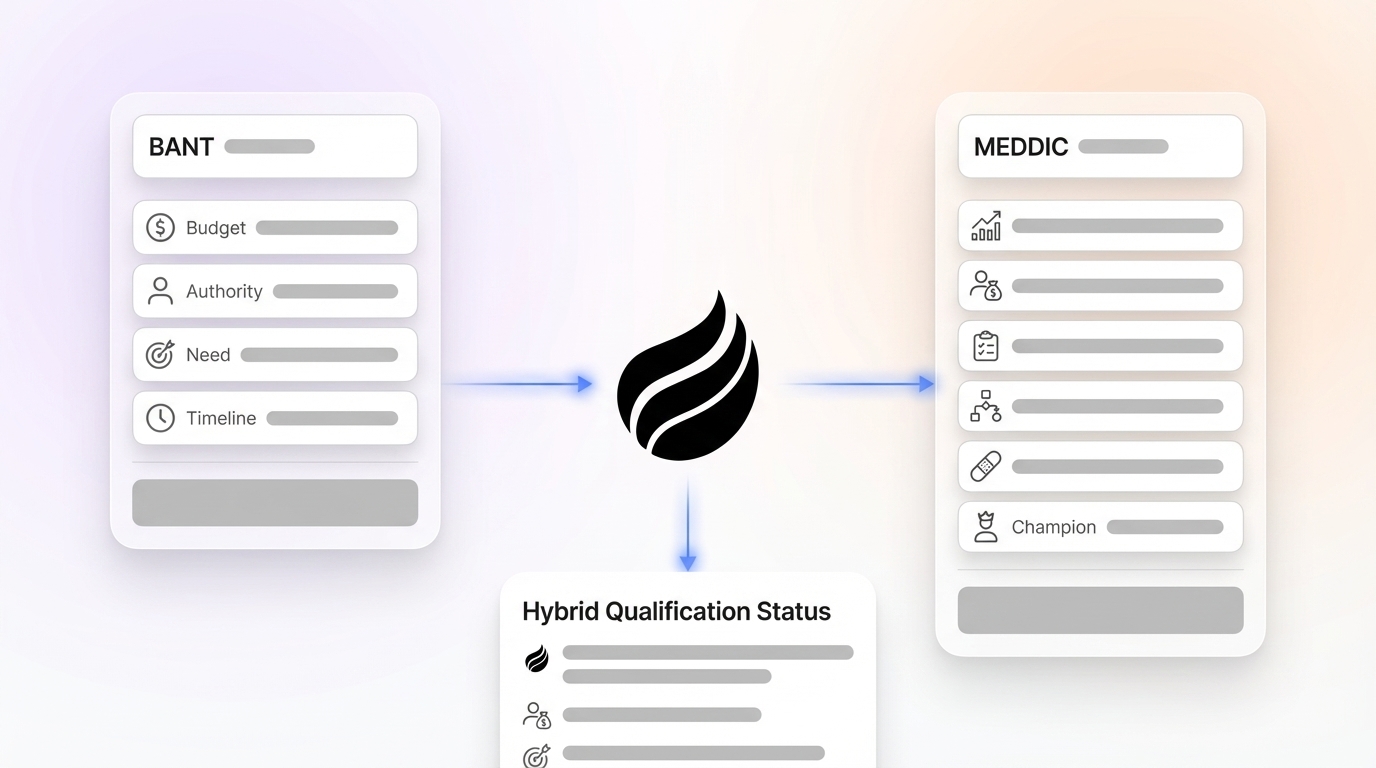
- BANT acts as the SDR’s fast filter with a 6/8 scoring threshold. MEDDIC powers the AE’s deeper qualification after handoff.
- Map every BANT field directly to a corresponding MEDDIC field so SDR data flows into AE discovery without duplicate entry.
- Use CRM stage gates that block advancement until the required BANT or MEDDIC fields are complete at each checkpoint.
- Trigger SDR-to-AE handoff only when BANT Score ≥ 6, Budget Confirmed, and Decision-Maker Confirmed are all true, then enforce a 24-hour SLA.
- Coffee writes structured BANT and MEDDIC data from call transcripts into Salesforce, HubSpot, or Coffee Standalone. Start a Coffee plan to enable this automatically.
What You Need Before You Build the Hybrid Model
Confirm these pieces before you roll out the playbook.
- A CRM instance: Salesforce, HubSpot, or Coffee Standalone
- Working knowledge of both BANT (Budget, Authority, Need, Timeline) and MEDDIC (Metrics, Economic Buyer, Decision Criteria, Decision Process, Identify Pain, Champion)
- A documented Ideal Customer Profile (ICP) with firmographic thresholds such as employee count, revenue band, and industry
- Roughly 30–45 minutes to read this guide and 2–3 hours to configure CRM fields, stage gates, and automation rules
Step 1: Define the Two-Tier Model and the 6/8 BANT Threshold
The two-tier model gives each framework a clear job. BANT is the SDR’s fast filter, applied on the first discovery call or inbound lead to decide whether a lead deserves AE time. MEDDIC is the AE’s opportunity qualification engine, applied across two to three discovery calls to judge whether a deal will close and at what confidence level. The transition from BANT to MEDDIC happens at the SDR-to-AE handoff, when the focus shifts from “is this lead worth pursuing?” to “will this deal close and what is missing?”
Score each BANT dimension on a 0–2 scale for a maximum of 8 points. A lead must reach 6 out of 8 to advance past the Qualification stage. For inbound SDR teams, BANT works as a fast filter that requires at least 3 of 4 checkboxes confirmed to move past the Qualification stage in Salesforce or HubSpot. The 6/8 threshold maps to that standard and adds granularity for partial signals. A prospect who names a budget range but has not formally allocated funds scores 1 on Budget rather than 0.
Troubleshooting callout: handle Economic Buyer carefully. Many stalled deals involve a contact who seemed like the decision-maker but lacked budget authority. Treat Authority as a hard floor. If the SDR cannot confirm Authority at a score of at least 1, the lead should not advance regardless of the total score. Flag the record for nurture and set a 30-day follow-up task.
Step 2: Map BANT Fields to MEDDIC with Concrete Questions
Every BANT field captured by the SDR should feed a corresponding MEDDIC field that the AE deepens. The mapping below defines the CRM field name, the object it lives on, and the discovery question that populates it.
Budget → Metrics and Identify Pain
SDR question: “What does the problem cost you today in time, headcount, or lost revenue?” AE follow-up: “What measurable outcome would justify this investment, and how does your team quantify success?” CRM fields: Budget Range (number, Lead/Contact object), Identified Pain (text, Opportunity object), Success Metrics (text, Opportunity object).
Once you have Budget mapped into Metrics and Identify Pain, move to the decision side of the deal.
Authority → Economic Buyer
SDR question: “Who owns the budget decision for a purchase in this category?” AE follow-up: “When did you last meet with [name]? What does she care most about?” CRM fields: Decision-Maker Confirmed (checkbox, Lead object), Economic Buyer Name (text, Opportunity object), Economic Buyer Engaged (dropdown: Not Identified / Identified / Met / Committed, Opportunity object).
After Authority and the Economic Buyer are clear, turn to the problem definition.
Need → Identify Pain and Decision Criteria
SDR question: “What is the specific outcome you are trying to achieve in the next two quarters?” AE follow-up: “What criteria will your team use to evaluate vendors, and who owns each criterion?” CRM fields: Need Identified (checkbox, Lead object), Decision Criteria (text, Opportunity object).
With Need captured, anchor the deal in time and process.
Timeline → Decision Process
SDR question: “When do you need this live, and is there a board or budget cycle driving that date?” AE follow-up: “Walk me through every step between today and a signed contract, including reviewers, approvers, and possible blockers.” CRM fields: Timeline Defined (date, Lead object), Decision Process (text, Opportunity object), Critical Event Date (date, Opportunity object).
Once the core BANT elements are mapped, add the MEDDIC-only relationship field.
Champion (MEDDIC-only field, seeded at handoff)
AE question: “Who inside your organization is most invested in seeing this succeed, and will they advocate internally?” CRM fields: Champion Name (text, Opportunity object), Champion Strength (dropdown: None / Weak / Moderate / Strong, Opportunity object).
Pro tip: Coffee’s Suggested Leads feature identifies which individuals inside a visiting company match your buyer persona. When a Visitor Identification pixel fires on a high-fit account, Coffee pre-fills the Champion and Decision Criteria fields with enriched contact data. This gives the AE a head start before the first discovery call.

See how Coffee auto-fills these fields from your call transcripts.
Step 3: Align CRM Stages with BANT and MEDDIC Checkpoints
A strong CRM design maps methodology checkpoints to pipeline stages, with BANT requirements in an early qualification stage and MEDDIC-style fields added as deals advance into later stages. Required fields block advancement until the checklist for that stage is complete. The stage gate structure below enforces that logic.
Lead: Required fields: ICP Fit (binary), Lead Source, Initial Pain Statement. At this stage you capture basic fit signals without deep qualification, so no BANT or MEDDIC fields are required yet.
Qualified Lead (BANT score ≥ 6/8): Once a lead shows enough signal to justify SDR time, it advances to Qualified Lead. Required fields: Budget Range, Decision-Maker Confirmed, Need Identified, Timeline Defined, BANT Score (number field, auto-calculated or manually entered). A validation rule blocks advancement if BANT Score is below 6.
Opportunity (SDR-to-AE handoff complete): After the SDR confirms fit and basic qualification, the record becomes an Opportunity. Required fields: Identified Pain (text), Economic Buyer Name, Champion Name, Handoff Brief (text or linked document). The AE must accept or reject within 24 hours.
MEDDIC Qualified (MEDDIC composite score ≥ 12/18): At this stage the AE has validated the buying process and internal support. Required fields: Metrics (text), Economic Buyer Engaged (dropdown, must be “Met” or “Committed”), Decision Criteria (text), Decision Process (text), Champion Strength (dropdown, must be “Moderate” or “Strong”). Each MEDDIC element is scored 1–3 on the Opportunity object, and a minimum composite score of 12 out of 18 is required to advance to the proposal stage.
Proposal: Required fields: Proposed ACV (number), Decision Process confirmed complete, Critical Event Date.
Closed-Won: Required fields: Final ACV, Close Date, Champion Name confirmed, Win Reason (dropdown).
Troubleshooting callout: watch for data-quality drop-off. Thresholds should be calibrated to the organization’s own historical deal data by analyzing closed-won and closed-lost deals from the prior 12 months and recalibrated every 90 days. If your MEDDIC Qualified-to-Proposal conversion rate falls below 60%, lower the composite score threshold or audit which fields reps are gaming with placeholder text.
Step 4: Define SDR-to-AE Handoff Triggers and SLAs
The handoff trigger fires when all three conditions are true in the CRM: BANT Score ≥ 6, Budget Confirmed = true, and Decision-Maker Confirmed = true. When handoff conditions are met, the system notifies the AE via Slack, writes the CRM record with lifecycle stage “sales_qualified_lead” and a qualification date, pauses all sequences, and starts a 30-minute SLA timer.
Once the handoff notification fires, speed becomes critical. The SLA for AE follow-up is 24 hours from handoff acceptance. Conversion drops sharply after 48 hours, so a 24-hour SLA is the practical ceiling for warm lead follow-up. If the AE rejects the handoff, the lead returns to the SDR within 24 hours with one specific reason and a clear fix path. This converts the bounce into coaching rather than a verdict and keeps leads from going cold.
Coffee auto-structures the handoff packet from the SDR’s call transcript and email thread. It writes six required fields, including pain statement, trigger, stakeholders, objections, promises made, and landmines, directly into the Opportunity record. The AE opens a fully populated brief, not a blank form.

Step 5: When to Add Paper Process (MEDDPICC) and How Coffee Flags It
Apply MEDDPICC when any of the following conditions are present.
- ACV exceeds $100K and the account operates in a regulated vertical such as financial services, healthcare, or public sector
- The prospect mentions a vendor registration portal, security review, or legal redline process
- A named incumbent is being displaced and a competitive evaluation is underway
- ACV exceeds $250K with six or more identified stakeholders, regardless of industry
Managerial inspection of qualification fields, not the choice between MEDDPICC and MEDDIC, drives forecast accuracy. The two additional fields are Paper Process, which captures procurement steps between verbal yes and signed contract, and Competition, which lists named alternatives including internal build options.
When Coffee detects procurement language in a call transcript or email, such as “security review,” “legal team,” “vendor portal,” or “we’re also evaluating,” the agent surfaces the Paper Process and Competition fields on the Opportunity record. It then prompts the AE to complete them before the next pipeline review.
Step 6: Run Weekly Pipeline Reviews in Coffee’s Pipeline Compare View
Coffee’s Pipeline Compare view surfaces week-over-week changes automatically and turns pipeline reviews into structured discussions. Run this checklist at the start of every weekly review.
- Identify every Opportunity in “MEDDIC Qualified” or later stage with a Champion Strength of “None” or “Weak.” Treat these as at risk of stalling regardless of stage.
- Flag any Opportunity that has not progressed in 14 or more days and has no logged next activity. Coffee highlights these as stalled in the Compare view.
- Confirm that every deal in the Proposal stage has a Critical Event Date within 90 days. Remove from the committed forecast any deal without one.
- Review MEDDIC composite scores for all deals in the current quarter’s forecast. Any score below 12 should move to pipeline or best-case until the gap is closed.
- Check that every deal added to the pipeline this week has a completed handoff brief and an accepted Opportunity record. Reject any that do not.
- Identify deals where the Economic Buyer field is populated but Economic Buyer Engaged is still “Identified” rather than “Met.” Assign an AE action item before the next review.
Run this checklist inside Coffee against live CRM data without exporting a spreadsheet.
Measurable Success Criteria for the Hybrid Model
Three metrics confirm that the hybrid model is working.
- BANT-qualified leads reach the AE in under 24 hours. Industry benchmarks show that many qualified leads receive no AE follow-up within 48 hours. Conversion probability after handoff decays non-linearly, with the steepest drop in the first 1–2 hours. The 24-hour threshold is the minimum viable SLA, as defined in Step 4.
- MEDDIC composite score reaches ≥ 12/18 before a proposal is sent. Prospects with higher qualification scores close at higher rates than those with lower scores. A 12/18 MEDDIC threshold before proposal, as defined in Step 3, keeps low-confidence deals out of the committed forecast.
- Forecast accuracy improves by ≥ 20% within one quarter. Teams running MEDDIC at the AE layer in complex enterprise deals often achieve more accurate forecasts than teams using BANT alone. A 20% improvement in the first quarter is a conservative and achievable baseline.
Advanced Coffee Automations for the Hybrid Framework
Once the core two-tier model is stable, two Coffee capabilities extend its reach. Coffee Campaigns can trigger dynamically when MEDDIC scores change. When a deal’s Champion Strength field updates from “Weak” to “Strong,” Coffee can enroll the Economic Buyer contact in a targeted email sequence that delivers relevant case studies or ROI data without manual rep work.
Coffee’s Visitor Identification pixel also feeds BANT-scored leads directly into the pipeline. When a high-fit company visits the pricing page, Coffee infers the visitor’s identity, pre-fills firmographic fields, calculates an initial BANT fit score based on ICP match, and surfaces the record to the SDR with a recommended outreach action. This compresses the time from anonymous visit to qualified conversation.

Frequently Asked Questions
Is MEDDIC outdated in 2026?
MEDDIC remains the dominant qualification framework for complex, multi-stakeholder B2B deals. What has changed is how teams apply it. Modern sales teams use MEDDIC as a progressive scoring system built into CRM fields rather than a checklist reviewed informally at the end of a deal. The addition of Paper Process and Competition in MEDDPICC reflects the growing complexity of enterprise procurement, not a weaker core framework. Teams that enforce MEDDIC with evidence standards, such as quotes, named individuals, and documented steps, consistently outperform teams that treat it as a formality.
How does Coffee handle MEDDPICC?
Coffee’s AI agent reads call transcripts and email threads and writes structured data into all eight MEDDPICC fields: Metrics, Economic Buyer, Decision Criteria, Decision Process, Paper Process, Identify Pain, Champion, and Competition. When Coffee detects procurement or competitive language in a conversation, it surfaces the Paper Process and Competition fields on the Opportunity record and flags them as incomplete. This means AEs do not need to remember to add MEDDPICC fields manually, because Coffee prompts the action when the deal signals that it is needed. All fields are written into the existing Salesforce or HubSpot Opportunity object, or into Coffee Standalone, with no duplicate data entry.
Why is the hybrid BANT–MEDDIC model better than either framework alone?
BANT alone fails on complex deals because it over-weights the presence of a formal budget, which often forms later in the buying process, and assumes a single decision-maker, which breaks down in committee sales. MEDDIC alone fails on high-volume SDR motions because its depth creates overhead that slows qualification throughput and causes rep resistance on smaller deals. The hybrid model solves both problems. BANT gives SDRs a fast, auditable filter that produces a handoff-ready record in under five minutes, while MEDDIC gives AEs the depth needed to forecast accurately and close complex deals. The two frameworks share overlapping data, such as Budget mapping to Metrics and Identify Pain and Authority mapping to Economic Buyer, so the handoff is additive rather than duplicative when field mapping is configured correctly.
What BANT score should trigger an SDR-to-AE handoff?
A score of 6 out of 8 is the recommended threshold for most mid-market teams, as described in Step 1. This threshold requires confirmed signal across at least three BANT dimensions to justify AE time. The Authority dimension carries a hard floor. If Decision-Maker Confirmed scores 0, the lead should not advance regardless of total score, because deals without access to budget authority stall at proposal even when other signals look strong. Teams should recalibrate this threshold every 90 days by scoring historical closed-won and closed-lost deals and identifying the cut score that best separates them.
How long does it take to configure the hybrid model in a CRM?
For a team using Coffee as a Companion App on Salesforce or HubSpot, the core field mapping and stage gate configuration usually takes 2–3 hours. This work includes creating custom fields for BANT scoring and MEDDIC elements on the correct objects, setting validation rules that block stage advancement when required fields are empty, and connecting Coffee’s agent so it begins writing structured data from calls and emails automatically. Coffee’s agent starts populating fields from the first call it joins, so data quality improves immediately rather than relying on rep behavior change.
Conclusion: Put the Hybrid BANT–MEDDIC Model into Practice
The hybrid BANT–MEDDIC model creates a two-tier system with a clear division of labor. BANT qualifies the lead quickly at the SDR layer, MEDDIC qualifies the opportunity deeply at the AE layer, and a structured handoff connects the two without duplicate work. The 6/8 BANT threshold, the BANT-to-MEDDIC field map, the stage gate table, and the MEDDPICC decision rule give RevOps teams a complete framework they can implement this quarter. Top-performing B2B sales teams using a hybrid BANT and MEDDIC model achieve 25% higher win rates than teams using either framework alone. Coffee is the only agent that captures both frameworks in one pass, reading your calls and emails and writing structured data into every field described in this playbook inside Salesforce, HubSpot, or Coffee Standalone, without turning reps into data entry clerks.
Start your Coffee trial and roll out the hybrid model this quarter.