Written by: Doug Camplejohn, CEO & Co-Founder, Coffee | Last updated: June 18, 2026
Key Takeaways
- Automated data entry and CRM workflow automation use AI agents to capture, enrich, and log sales data without manual input, turning passive databases into active systems.
- Manual CRM data entry costs sales teams 5.5 hours per week per rep, leaving sellers with only 35% of their time for actual selling and creating incomplete records.
- Legacy CRMs like Salesforce and HubSpot require constant manual maintenance and fail to handle unstructured data from emails, calls, and calendars automatically.
- Agent-led solutions like Coffee autonomously connect to email, calendar, and call data to perform capture, logging, enrichment, and deduplication in real time.
- Teams can get started with Coffee to eliminate manual data entry and reclaim hours for selling.
The Problem: Manual Data Entry Is Costing Sales Teams Time
Sales representatives at 10–50-person tech companies spend a large share of their week on data entry instead of selling. Manual CRM data entry costs sales teams 5.5 hours per week per rep as of 2026. When broader workflow tasks are included, automation of lead capture and hand-off can save sales teams several additional hours each week. That time currently disappears into logging calls, updating contact records, and manually progressing deal stages.
The average seller spends only 35% of their time actually selling. When reps are stretched thin, CRM updates become the first casualty, which produces incomplete records, stale pipeline data, and forecasts built on guesswork.
Why Legacy CRMs Fall Short
Salesforce and HubSpot were designed as structured data containers. They store what humans type into them. Neither platform was architected to ingest unstructured data such as email threads, call transcripts, and calendar context, and neither deploys an agent to handle the entry automatically.
This design creates a system that demands constant manual maintenance from the people it is supposed to serve. Low adoption produces bad data, bad data produces unreliable forecasts, and unreliable forecasts erode executive confidence in the CRM entirely. Shadow CRMs such as spreadsheets and Notion documents then fill the gap and fragment visibility even further.
The Solution: Agent-Led Automation Replaces Passive Databases
An agent-led CRM like Coffee connects directly to existing data streams such as email, calendar, call recordings, and enrichment APIs and performs capture, logging, and enrichment work autonomously. Reps interact with a system that already knows what happened. Managers review a pipeline that reflects reality instead of guesswork.
The following 15 benefits describe exactly what that shift produces, grouped into time recovery, data quality, and strategic impact.
Time Recovery: Giving Selling Time Back to Reps
1. Instant Contact Capture Replaces Manual Record Creation
Instant contact capture removes the need for reps to create records by hand. The Coffee Agent scans connected Google Workspace or Microsoft 365 accounts and auto-creates contact and company records the moment a new email thread or calendar invite appears. Contact capture becomes a background process, and every new relationship enters the system of record automatically without a single form field touched by a rep.
2. Real-Time Activity Logging Keeps Deals Current
Once contacts are captured, the next bottleneck is keeping their records current. The Coffee Agent logs last activity and next activity on every deal without prompting. Hours that previously went into noting call outcomes and email exchanges now stay available for live selling.
Because the agent writes to the record in real time, deal state stays current. That accuracy removes the stale-data problem that usually corrupts weekly pipeline reviews.
3. Zero-Touch Enrichment Removes Research Drudgery
Zero-touch enrichment replaces manual research with automatic context. The Coffee Agent augments every contact record with job title, company funding, and LinkedIn profile data via licensed enrichment partners, which removes the need for standalone tools like Apollo or ZoomInfo.
Reps no longer spend blocks of time hunting for basic facts before outreach. Enrichment runs at record creation and refreshes automatically, so records stay complete between touches instead of going stale.
4. Automated Deduplication Prevents Double Work
Automated deduplication prevents duplicate records from ever entering the system. The Coffee Agent deduplicates at ingestion, matching incoming contacts and companies against existing records before writing.
This deduplication fits into a broader pattern. Across every core CRM task, including contact creation, activity logging, enrichment, and research, agent-led automation removes the manual work that usually consumes rep time. The table below quantifies the time savings across these four dimensions.
| Dimension | Manual Process | Agent-Led Automation | Measurable Outcome |
|---|---|---|---|
| Contact creation | Rep types record after each interaction | Agent auto-creates from email/calendar | 90% reduction in CRM admin time |
| Activity logging | Rep manually notes calls and emails | Agent logs in real time | 4–6 hours saved per week |
| Data enrichment | Rep cross-references ZoomInfo manually | Agent enriches at record creation | Several hours saved per week |
| Prospect research | Rep researches each account before calls | Agent generates pre-meeting briefings | 34% reduction in research time expected |
5. Pre-Meeting Briefings Shorten Prep Time
Pre-meeting briefings give reps context in seconds instead of minutes. Before every call, the Coffee Agent surfaces a briefing that includes attendee roles, past interaction history, and open deal context. Sellers using AI agents expect a 34% reduction in prospect research time once fully implemented. Reps enter calls informed instead of improvising from memory.

6. Drafted Follow-Up Emails Reduce Post-Call Admin
Drafted follow-up emails cut the time spent on post-call administration. After each call, the Coffee Agent generates a summary, identifies next steps, and drafts a follow-up email in Gmail for the rep to review and send. Email drafting shifts from a blank page to a quick edit, and that reclaimed time joins the broader pool of hours recovered from manual tasks.

Data Quality: Creating a Reliable System of Record
7. Accurate Pipeline Tracking Reflects Ground Truth
Accurate pipeline tracking turns reviews into strategy sessions. Coffee’s Pipeline Compare feature visualizes week-over-week deal changes, including progressed opportunities, stalled deals, and new additions, without manual CSV exports. Because the agent has logged every interaction, the pipeline reflects ground truth instead of partial updates.
Managers spend less time interrogating data quality and more time coaching on deal strategy. Get started with Coffee and replace manual pipeline reviews with agent-generated Pipeline Compare intelligence.
8. Reliable Forecasting Comes from Complete Histories
Reliable forecasting depends on complete interaction histories. Because the Coffee Agent captures every interaction and deal-stage change autonomously, the historical record stays intact. Managers forecast from a full dataset rather than from whatever reps remembered to log.
The time recovered from eliminating manual entry, including the 5.5 hours per week spent on data entry plus additional hours saved from enrichment and research, directly reduces data gaps that distort revenue projections.
9. Consolidated Tools Simplify the Sales Stack
Tool consolidation improves data consistency and reduces context switching. A typical sales stack forces reps to toggle between a CRM, an enrichment tool, a call recorder, and a forecasting add-on. The Coffee Agent performs all four functions within a single platform.
Lead scoring runs inside the same environment that handles logging and enrichment, which compounds efficiency gains and keeps every data point in one place.
10. Website Visitor Identification Turns Traffic into Leads
Website visitor identification converts anonymous traffic into named leads. A single Coffee tracking pixel identifies anonymous site visitors by name, title, email, and LinkedIn profile. Competing tools often surface only company-level data.
Coffee’s Suggested Leads feature then recommends the two or three specific individuals inside a visiting company who match the buyer persona. Those contacts route directly into outbound sequences without manual list-building.
11. Natural-Language Prospecting Builds Targeted Lists
Natural-language prospecting lets reps build lists by describing their ideal buyers. A rep can instruct the Coffee Agent in plain language, such as “Find me VPs of Sales in North America at companies with $10M+ funding using Salesforce,” and the agent executes the search using integrated enrichment data.

Outbound list-building becomes as quick as inbound routing, and both sides of the funnel benefit from automated targeting.
Strategic Impact: Stronger Process, Collaboration, and Adoption
12. Consistent Methodology Enforcement Improves Comparability
Consistent methodology enforcement makes every deal easier to compare. The Coffee Agent structures meeting notes according to BANT, MEDDIC, or SPICED automatically, which ensures every qualification record enters the CRM in a consistent format.
Methodology enforcement that previously depended on manager coaching and rep discipline becomes a system-level guarantee. Leaders can then compare deals across the pipeline with confidence.
13. Permanent Historical Context Supports Better Reviews
Permanent historical context turns the CRM into a true system of record. Legacy CRMs overwrite field values when records are updated, which destroys historical context. Coffee stores interaction history in a built-in data warehouse and preserves every version of a record.
Reps who join a deal mid-cycle gain full context immediately. Managers reviewing a lost deal can audit the complete timeline instead of guessing what changed.
14. Logged Activity Accelerates Team Collaboration
Logged activity across the team makes handoffs smooth and fast. Because every rep’s activity is captured automatically and visible in a shared system of record, handoffs between SDRs and AEs, or between AEs and CSMs, require no manual briefing documents.
Voice-to-CRM integrations, which grew 340% in adoption in 2025, achieve 95%+ transcription accuracy in 2026, so call content is reliably available to any team member who needs it.
15. Chore-Free Data Entry Drives CRM Adoption
Chore-free data entry finally unlocks CRM adoption. Low CRM adoption is a direct consequence of asking reps to serve the software. When the Coffee Agent handles data entry, reps interact with a system that already reflects their work.
The CRM becomes a tool that serves them by surfacing briefings, drafting emails, and flagging stalled deals instead of a database they resent updating. Higher adoption produces better data, which produces better insights and closes the loop that legacy CRMs leave open.
Frequently Asked Questions
What is one benefit of automating data entry?
The most immediate benefit of automating data entry is time recovery. Sales reps currently lose a significant portion of their week to manually logging contacts, calls, and emails into a CRM. When an agent handles this work automatically by pulling data from email, calendar, and call transcripts, reps reclaim hours that they can redirect toward selling.
Beyond time savings, automated data entry also produces more complete and accurate records than manual entry, because the agent captures every interaction rather than only the ones a rep remembers to log.
What are the benefits of CRM automation?
CRM automation delivers benefits across the full sales cycle. At the top of the funnel, it captures and enriches leads automatically. In the middle, it logs every interaction, enforces qualification methodology, and keeps deal stages current without rep input.
At the bottom of the funnel, it generates accurate pipeline reports and forecasts from a complete dataset. Operationally, CRM automation reduces the number of point solutions a team needs, lowers the cost of the sales stack, and improves adoption by removing the manual burden that causes reps to avoid the CRM in the first place.
What are the benefits of workflow automation?
Workflow automation eliminates the manual handoffs and repetitive tasks that slow sales teams down. Specific benefits include automated lead routing from inbound channels, sequenced follow-up emails triggered by deal-stage changes, automatic task and reminder creation, and real-time deal-stage progression based on logged activity.
Each of these workflows runs without rep intervention, which frees the team to focus on conversations and decisions that require human judgment. The cumulative time savings across a full workflow stack are substantial and often exceed ten hours per rep per week when all automated tasks are combined.
What is CRM and workflow automation?
CRM automation refers to the use of software, increasingly AI agents, to handle the data management tasks that a CRM requires, such as creating records, logging activity, enriching contacts, and maintaining data quality. Workflow automation refers to the triggering of downstream actions based on events or conditions within the CRM, such as routing a new lead to the right rep, sending a follow-up sequence when a deal stalls, or generating a pipeline report at the end of each week.
When combined, CRM and workflow automation transform a passive database into an active system that manages itself and surfaces actionable intelligence without human input.
Get started with Coffee and see how agent-led CRM and workflow automation works for your sales team.
Summary: Agent-Led Automation Turns CRM Data into a Strategic Asset
Agent-led automation turns CRM data into a strategic asset instead of a byproduct of manual entry. Reps recover significant hours each week from manual tasks. Records stay complete, enriched, and current without human effort. Pipeline data reflects reality, which makes forecasts reliable.
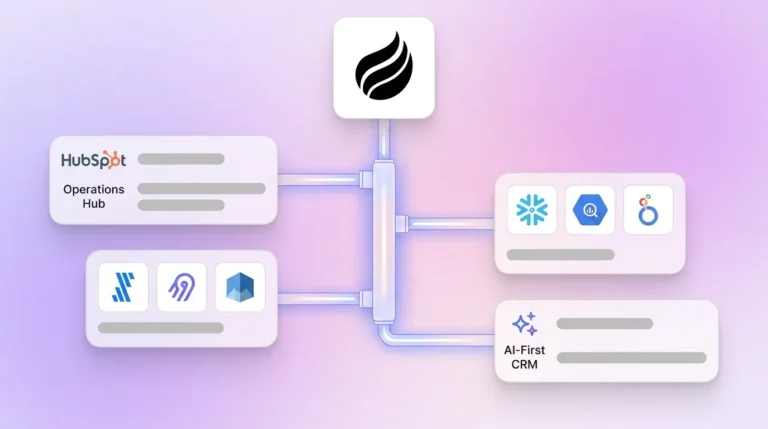
Coffee delivers these benefits through a single agent that works either as a standalone CRM or as a companion layer on top of existing Salesforce or HubSpot installations. The agent captures good data in so that teams get accurate insights out, without requiring anyone to act as a data entry clerk.