Written by: Doug Camplejohn, CEO & Co-Founder, Coffee | Last updated: July 21, 2026
Key Takeaways
- AI CRM data automation uses autonomous agents to capture, enrich, and structure customer data from emails, calendars, and calls in real time, replacing manual entry.
- By 2026, the category has evolved from copilot suggestions to agentic AI that autonomously handles lead qualification, outreach, and pipeline updates with minimal human oversight.
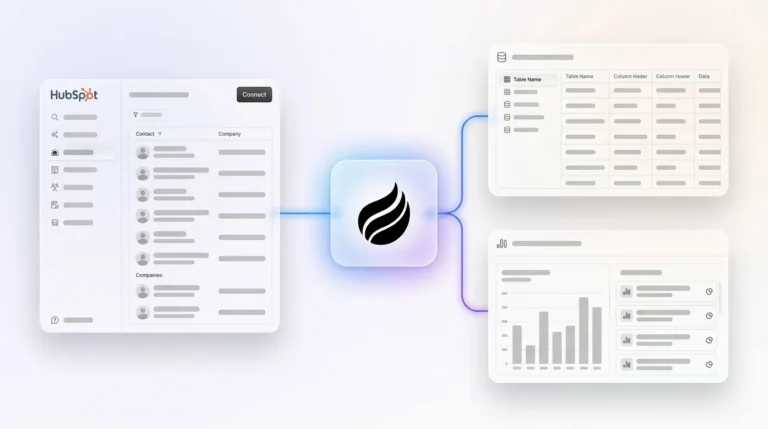
- Companion agents connect via OAuth to existing Salesforce or HubSpot instances, automating contact creation, enrichment, activity logging, meeting briefings, and post-call summaries.
- Teams save an average of 4.8 hours per week while improving CRM data completeness, forecast accuracy, and pipeline visibility without requiring a full system migration.
- See how Coffee’s companion agent delivers these time savings for your Salesforce or HubSpot instance.
How AI CRM Automation Became Core Sales Infrastructure
Between 2023 and 2025, AI in CRM meant copilot features, such as suggested email drafts, on-demand lead scores, and field-value recommendations that always needed human review. By 2026, the category shifted to agentic AI: autonomous multi-step execution of lead qualification, outreach, pipeline updates, and data hygiene, with human oversight reserved for exceptions. Mid-market RevOps teams now treat agents as core infrastructure rather than optional productivity add-ons.
The data complexity problem accelerated this shift. Legacy relational databases lose historical context when fields are overwritten, and they cannot process unstructured inputs such as email threads or call transcripts. Multi-source waterfall enrichment architectures now reach 85–95% contact coverage, compared to 50–70% from single-vendor stacks. At the same time, Gartner projects that 40% of enterprise applications will include task-specific AI agents by the end of 2026, up from less than 5% in 2025. For mid-market teams already committed to Salesforce or HubSpot, the practical focus shifts to layering agentic AI onto an existing instance without a full migration.

How a Companion AI Agent Automates CRM Data
A companion-agent model connects to Google Workspace or Microsoft 365 via OAuth, then operates continuously across seven core functions that together remove the manual data-entry loop. Each function targets a specific gap in traditional CRM workflows.

- Automated contact and company creation: The agent scans inbound and outbound email and calendar events, then creates and associates records without rep input.
- Data enrichment: Job titles, funding rounds, LinkedIn profiles, and firmographic attributes are appended from licensed data partners, which removes the need for standalone enrichment tools.
- Activity logging: Last-activity and next-activity fields update automatically after every interaction, so deal state stays current.
- Meeting briefings: Before each call, the agent surfaces attendee history, open action items, and deal context in a structured briefing.
- Transcription and post-call summaries: The agent joins video calls, transcribes the conversation, and generates summaries structured to BANT, MEDDIC, or SPICED frameworks. Customizable summary templates can be written back directly to HubSpot or Salesforce.
- Pipeline compare: Week-over-week deal movement, including progressed, stalled, and newly added deals, is visualized automatically, which replaces manual CSV exports.
- Visitor identification: A tracking pixel resolves anonymous website traffic to named individuals, then appends title, email, LinkedIn profile, and behavioral session data for immediate outbound action.
The operational impact is measurable. These time savings are now quantified: Gartner’s 2026 survey of 210 CSOs found that AI tools save sellers an average of 4.8 hours per week per seller, and AI-driven CRM hygiene can improve forecast accuracy in sales operations teams.
Start capturing those 4.8 hours per week for your team with Coffee’s automated data-capture layer.
Choosing Between Passive CRM, Companion Agent, and Native Agent
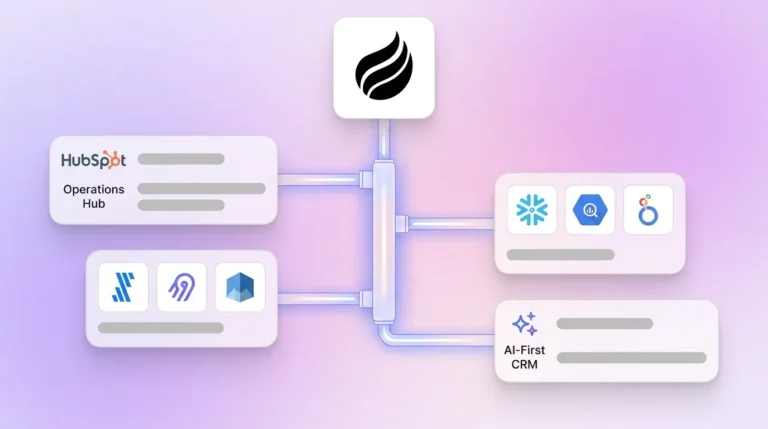
The companion-agent model is one viable option for teams that cannot justify a full CRM migration. It preserves existing Salesforce or HubSpot configurations, including quotas, forecasting rules, required fields, and custom objects, while adding an automated data-capture layer. However, several trade-offs require honest evaluation before committing. The table below compares three architectural approaches across key dimensions, which helps teams decide whether a companion agent, native CRM agent, or passive database fits their current infrastructure and data-handling needs.
| Dimension | Passive CRM Database | Proactive AI Agent (Companion Model) | Native CRM Agent (e.g., Agentforce) |
|---|---|---|---|
| Architecture | Relational database, fields updated by human input | External agent layer connected via OAuth, writes enriched data back to existing CRM | CRM-native, continuous access to live records via Data Cloud without a separate API layer |
| Data Handling | Structured data only, unstructured inputs such as transcripts and emails require manual summarization | Unified structured and unstructured data ingested from email, calendar, and call recordings | Unifies structured forms and purchases with unstructured signals such as email opens and pricing-page visits |
| User Role | Rep acts as data-entry clerk, and CRM accuracy depends on rep discipline | Rep reviews AI-drafted outputs, while the agent handles capture and enrichment autonomously | Rep interacts with the agent through the CRM UI, and the agent triggers downstream workflows on CRM events |
| Output Reliability | Low, because sales professionals often do not fully trust their CRM data accuracy | High when the data foundation is clean, since AI automation can improve CRM data completeness | Quality depends on metadata readiness, and organizations with data drift risk confidently wrong agent outputs |
Integration friction remains a real constraint. Salesforce and HubSpot model the same business objects in incompatible ways at the schema, query, authentication, and write-semantics layers, which means any agent writing to both platforms requires careful field-mapping and idempotency controls. Total cost of ownership is driven by data and metadata drift, consumption-based pricing variability, external system integration engineering, governance design, and change management investment. Teams should budget for all five categories before selecting an approach.
Readiness and Evaluation Framework for Companion Agents
Teams can reduce risk by assessing a few readiness criteria before deploying AI CRM data automation for sales.
- Team size and CRM commitment: The companion-agent model fits teams of 20–500 employees that already operate on Salesforce or HubSpot with established configurations they cannot abandon. Smaller teams often move faster with an AI-first CRM, while very large enterprises usually need deeper native customization.
- Data quality baseline: Organizations with CRM data older than two years should budget 4–8 weeks for deduplication and field standardization before agent deployment. Agentic AI amplifies existing data quality, so poor baselines produce inaccurate outputs at scale.
- Unstructured data volume: Teams with high call volumes or email-heavy sales motions gain the most from agents that process transcripts and email threads automatically, because most deal context lives in these channels.
- Change capacity: 72% of sales organizations report low reinvestment of AI-driven time savings into high-value activities, which shows that technology alone does not change behavior. A structured adoption plan is necessary to convert time savings into revenue impact.
- Governance readiness: Teams should confirm audit logging, field-level write permissions, and data residency requirements before granting an agent write access to production records. Clear rules prevent accidental policy violations.
Common Pitfalls When Deploying CRM AI Agents
Implementation failures in this category follow predictable patterns that teams can anticipate and avoid.
- Unclear ownership: When no single owner is accountable for agent performance, user patterns change and new edge cases emerge without anyone refining the agent’s instructions or actions. Over time, performance drifts and trust erodes.
- Fragmented point solutions: Stacking separate tools for enrichment, recording, forecasting, and visitor identification creates sync failures and data discrepancies that compound over time, which undermines confidence in reports.
- Weak unstructured-data handling: Agents that only process structured form inputs miss the majority of deal context, which lives in email threads, call transcripts, and meeting notes. Teams then continue to rely on manual notes, and the CRM never reflects the real state of deals.
- Low adoption: Reps who do not trust agents route around them, recreating the manual-entry problem the agent was deployed to solve. Adoption improves when reps see direct value, such as less admin work and better meeting prep.
How to Implement a Companion-Agent Model on Salesforce or HubSpot
The following seven-step rollout applies to mid-market teams layering an AI sales automation agent onto an existing Salesforce or HubSpot instance. Each step reduces risk and builds internal confidence before you expand scope.
- Discovery and data audit: Map every field, flow, validation rule, and custom object the agent will read from or write to. Identify duplicates, blank required fields, and definitional inconsistencies, such as how different teams define “qualified.” This foundation work sets the ceiling for agent output quality.
- Pilot on one team: Select a single team of 5–10 reps with a well-defined sales motion. Limit the agent’s initial scope to contact creation, activity logging, and post-call summaries. Delay broad write access until the pilot validates field-mapping accuracy.
- Validation against existing reports: Run the agent’s outputs in parallel with current pipeline reports for two to four weeks. Measure CRM field completion rate, duplicate contact rate, and summary accuracy against manually entered records. AI auto-enrichment and validation can improve CRM data completeness, so use measurable benchmarks to define pilot success.
- Stakeholder alignment: Present pilot results to sales leadership and RevOps before expanding. Address data governance questions, including who can override agent-written fields, how conflicts between agent data and manual entries are resolved, and what the escalation path is for incorrect outputs.
- Process redesign: Redefine rep workflows around the agent. Remove manual steps the agent now handles, such as post-call note entry, contact creation, and enrichment lookups. Clarify which outputs reps must review and which can write directly to the CRM without review.
- Measurement framework: Define KPIs before full rollout. Recommended metrics include weekly hours recovered per rep, CRM field completion rate, forecast variance, and pipeline review preparation time. Target benchmarks include 90% or higher CRM field completion, forecast variance within 5%, and 15–20% pipeline velocity improvement within six months.
- Governance and success criteria: Establish a named agent owner responsible for weekly performance reviews. Define audit log requirements, approval gates for high-risk write actions, and a quarterly refinement cadence. Agent maintenance requires regular attention, pruning, and care, and a “set it and forget it” deployment approach fails over time.
FAQ
Does a companion AI agent require replacing Salesforce or HubSpot?
No. The companion-agent model is designed specifically to operate on top of an existing Salesforce or HubSpot instance. The agent connects through standard OAuth authentication, reads from and writes to the existing data model, and respects configured field-level permissions, required fields, and validation rules. Teams retain their current system of record, forecasting configurations, and quota structures. The agent handles the data-capture layer, including contact creation, enrichment, activity logging, and meeting summaries, so the CRM receives higher-quality inputs without a migration.
How does an AI agent handle unstructured data like call transcripts and emails?
Legacy CRMs store only what humans manually enter, which means unstructured content such as email threads, call recordings, and meeting notes is either lost or summarized inconsistently. An AI agent ingests these sources directly. It joins video calls to record and transcribe, processes email and calendar data from connected Google Workspace or Microsoft 365 accounts, and structures the output according to defined frameworks such as BANT or MEDDIC before writing it back to the CRM. Deal context captured in conversations then becomes searchable, structured CRM data rather than a note attachment that no one reads.

Is the data quality from a built-in enrichment agent comparable to dedicated tools like ZoomInfo or Apollo?
For most mid-market use cases, built-in enrichment from a companion agent is sufficient. The agent appends job titles, funding data, LinkedIn profiles, and firmographic attributes from licensed data partners, which covers the majority of contact and company enrichment needs without a separate subscription. Teams with highly specialized data requirements, such as specific technographic signals, intent data from third-party publishers, or deep account hierarchies, may still benefit from a dedicated enrichment tool. Even in those cases, the majority of manual enrichment workflows can shift to the agent.
What security and compliance standards should a CRM AI agent meet?
At minimum, any agent writing to a production CRM should be SOC 2 Type 2 certified and GDPR compliant. Teams should confirm that the vendor does not use customer data to train public models, that data residency requirements are met for their geography, and that the agent’s write actions are logged in an auditable trail. For Salesforce environments specifically, verify that the agent respects existing field-level security, sharing rules, and profile-based permissions rather than operating with a blanket admin credential. Teams in regulated industries should conduct a full security review before granting write access.
Which team size and CRM maturity level is the right fit for a companion-agent deployment?
The companion-agent model is best suited to companies with 20–500 employees that are already committed to Salesforce or HubSpot and have a defined sales process. Teams that have outgrown spreadsheets but see low CRM adoption due to manual entry burden are strong candidates. The model fits less well for large enterprises with complex custom Apex logic or multi-cloud Salesforce configurations that require dedicated admin teams, or for organizations in heavily regulated industries that need multi-year security reviews. Very small teams under 20 people may find a standalone AI-first CRM more cost-effective than layering an agent onto a legacy platform.