Written by: Doug Camplejohn, CEO & Co-Founder, Coffee | Last updated: August 20, 2026
Key Takeaways for Gong Call Analysis
- Gong’s native AI lacks prompt control and structured output, so teams export transcripts and manually run prompts for MEDDIC extraction and custom scoring.
- DIY Claude or ChatGPT workflows deliver rubric-based scoring but break at scale because of CSV exports, prompt maintenance, and CRM write-back engineering overhead.
- Custom rubrics with 10 observable categories (MEDDIC plus Talk-Time, Objections, Competitors, Next Steps) produce consistent LLM scores when paired with timestamp evidence.
- Batch inference and async queues can process more than 100 calls weekly, yet the hidden cost is several weeks of engineering time plus ongoing maintenance versus seat-based agents.
- Coffee removes every manual step by ingesting Gong transcripts automatically and writing structured insights back to Salesforce or HubSpot—automate your Gong analysis with Coffee today.
Reddit Feedback on Gong Limits and Custom AI Workarounds
Threads across r/techsales, r/sales, and r/ProductMarketing surface the same friction points. The complaints cluster around three themes: cost, customization ceilings, and the manual labor required to turn Gong’s native output into something actionable.
Native Gong AI helps with surface-level summaries, but native platform AI broadly lacks prompt control. Teams cannot specify output formats or direct the model to analyze stage duration against team averages or flag missing VP-level champions. The pattern repeats across platforms: built-in AI works well for basic jobs inside one platform but hits a wall once the business scales. These tools struggle with unique processes, scattered data, and decisions that need deeper context.
Faced with these limitations, Reddit users converge on a predictable workaround. They export transcripts as CSV, paste chunks into Claude or ChatGPT, engineer a prompt, and repeat for every call. Manual quality assurance covers only 2–5% of sales calls, which leaves 95–98% of conversations unreviewed for a team closing 100 calls per week. The DIY stack solves the coverage problem but introduces a new one: it breaks at scale.
Claude Sales Call Rubric: 10-Category 0–10 Table with Timestamps
The table below gives you a copy-paste rubric for Claude. Paste it into your system prompt, then append the full transcript. Instruct Claude to return a JSON object with each category key, a score from 0 to 10, a one-sentence rationale, and the timestamp of the primary evidence.
A more fine-grained, checklist-based rubric improves LLM scoring consistency relative to holistic scoring. Alignment is stronger for clearly defined conceptual skills, so each category below maps to a discrete, observable behavior rather than a vague quality judgment.
| Category | What Claude Scores | 0–10 Anchor (Low → High) | Timestamp Instruction |
|---|---|---|---|
| Metrics (M) | Quantified business impact established | 0 = no numbers, 10 = ROI tied to prospect’s KPIs | Return first timestamp where a dollar/% figure appears |
| Economic Buyer (E) | Economic buyer identified and engaged | 0 = not mentioned, 10 = name, title, and access confirmed | Return timestamp of first EB reference |
| Decision Criteria (D) | Formal evaluation criteria surfaced | 0 = none, 10 = full criteria list confirmed by prospect | Return timestamp of criteria discussion |
| Decision Process (D) | Buying steps and timeline mapped | 0 = no process, 10 = steps, owners, and dates confirmed | Return timestamp of process discussion |
| Identify Pain (I) | Explicit business pain articulated | 0 = surface complaint, 10 = pain quantified and owned by EB | Return timestamp of pain statement |
| Champion (C) | Internal champion identified | 0 = none, 10 = champion tested and confirmed with power | Return timestamp of champion confirmation |
| Objection Handling | Objections surfaced and resolved | 0 = ignored, 10 = acknowledged, reframed, and confirmed resolved | Return timestamp of each objection |
| Talk-Time Ratio | Rep vs. prospect speaking balance | 0 = rep >80%, 10 = rep 43–57% (optimal discovery range) | N/A, calculate from full transcript |
| Competitor Mentions | Competitors named and handled | 0 = mentioned, not addressed, 10 = differentiated with evidence | Return timestamp of each competitor mention |
| Next Step Clarity | Concrete next step agreed on call | 0 = vague follow-up, 10 = date, attendees, and agenda confirmed | Return timestamp of next step agreement |
Batch Analyzing 100+ Gong Transcripts with Claude
Running call transcripts through an LLM like Claude has low API costs. A team scoring 200 calls per month might spend only a few dollars on API usage. The challenge is not cost, it is orchestration.
- Export transcripts. Pull Gong transcripts through the Gong API or manual CSV export. Treat each transcript as one .jsonl record with fields:
call_id,rep_name,date,transcript_text. - Chunk long transcripts. Split calls that exceed 8,000 tokens at speaker-turn boundaries, not mid-sentence. Maintain a
chunk_indexfield so you can re-aggregate scores. - Build the batch file. Anthropic’s batch API supports up to 100,000 requests per .jsonl file with a 24-hour completion window, which covers any weekly call volume.
- Submit and monitor. Batch inference runs on a dedicated throughput lane, eliminating 429 rate-limit errors that break synchronous pipelines at high volume.
- Handle failures. Log any
errorstatus records to a retry queue. Async queue architecture becomes necessary above 50 calls per day, because synchronous processing creates backlogs at higher volumes. - Aggregate scores. Join results back to
call_id, average chunked scores, and write the results to your CRM or data warehouse.
Cost comparison: Batch inference is billed at up to a 50% discount versus real-time inference, which makes the raw API cost negligible. At 200 calls per month, you might spend only $5–$10. However, that low API cost hides the real expense: the engineering time to build, maintain, and debug this pipeline. When you add integrations with systems such as Gong or a CRM, the total cost of an enterprise AI deployment can increase project budgets far beyond the initial API savings.
Claude vs. ChatGPT on a Gong Transcript Snippet
The following input went to both Claude Opus and GPT-4o using the identical rubric prompt from the section above. The transcript snippet: “We’re evaluating three vendors. Our CFO needs to sign off. We need something live before Q3 or we lose the budget. The main concern is integration with our data warehouse.”
| Rubric Category | Claude Opus Output | GPT-4o Output |
|---|---|---|
| Economic Buyer (E) | Score: 7. CFO identified by title, access not confirmed. Timestamp: 0:14. | Score: 6. CFO mentioned as approver. No confirmation of direct access. |
| Decision Process (D) | Score: 8. Q3 deadline explicit, budget loss consequence stated. Timestamp: 0:22. | Score: 7. Timeline present, steps not fully mapped. |
| Decision Criteria (D) | Score: 5. Three vendors in evaluation, formal criteria not surfaced. Timestamp: 0:08. | Score: 6. Competitive evaluation noted, criteria assumed from context. |
| Identify Pain (I) | Score: 6. Integration concern explicit, business impact not quantified. Timestamp: 0:31. | Score: 7. Data warehouse integration flagged as primary concern. |
Flagship models such as Claude achieve strong performance on long multi-turn rubric tasks compared with smaller models. The practical difference on short snippets is modest. The gap widens on full 45-minute calls where Reasoning, Synthesis, and Problem Solving failures increase as context grows toward 100K words. Claude’s timestamp outputs stay more consistently structured, while GPT-4o sometimes infers criteria that are not explicitly stated, which creates a hallucination risk in compliance-sensitive environments.
Custom MEDDIC Extraction and CRM Write-Back from Gong
Seventy-three percent of SaaS companies selling above $100K ARR use some version of the MEDDIC qualification framework. Yet 40–50% adherence decay occurs within six months without ongoing reinforcement. Automated extraction removes the human compliance variable entirely.
Copy-paste extraction prompt:
System: You are a MEDDIC extraction agent. Given a sales call transcript, return a JSON object with exactly these keys: metrics, economic_buyer, decision_criteria, decision_process, identify_pain, champion. For each key, return: value (the extracted text or “not identified”), confidence (high/medium/low), and evidence_timestamp. If a field is not identified, set value to null.
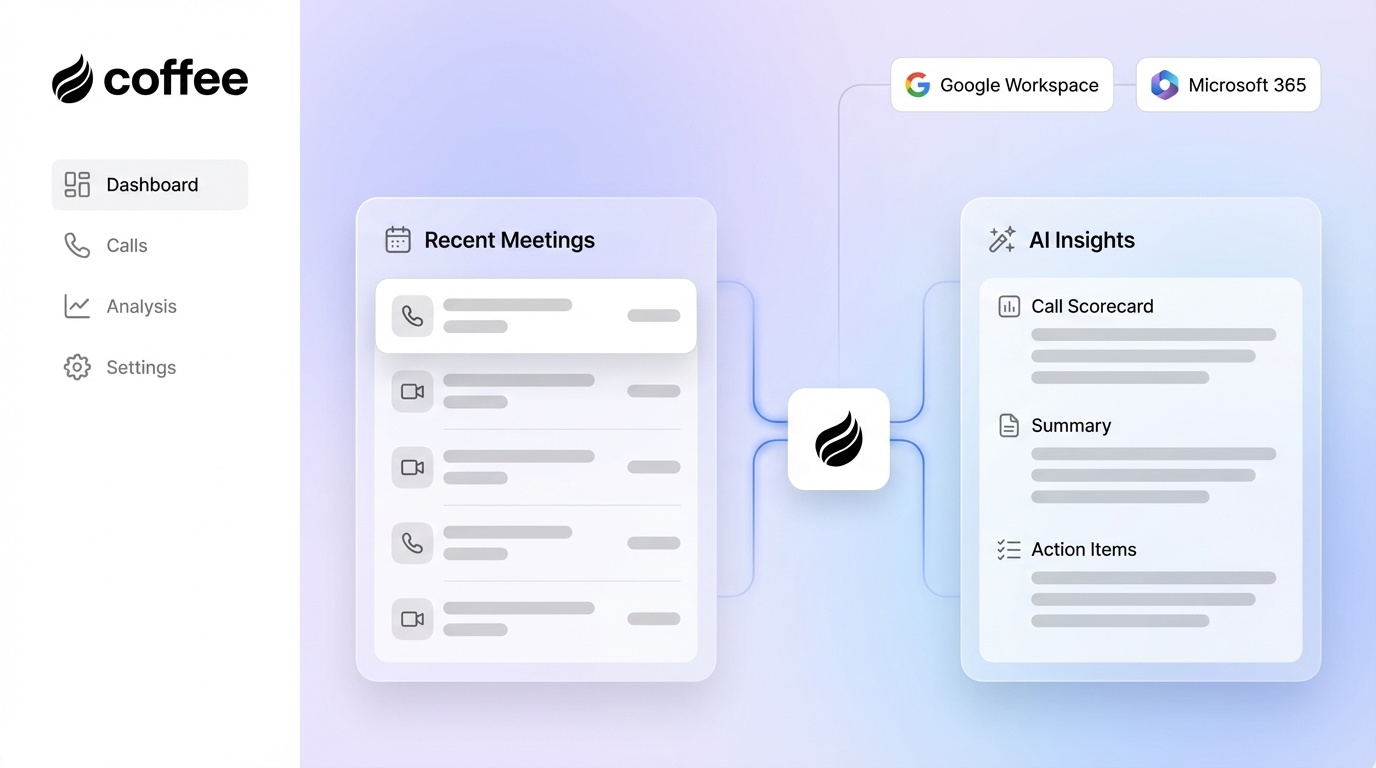
Manual CSV route vs. automated agent sync: The manual route requires a rep to export the transcript, run the prompt, copy the JSON output, and paste each field into the CRM record. That process takes roughly 8–12 minutes per call. AI-powered MEDDPICC extraction can recover several hours per week per account executive that were previously spent on manual CRM data entry. An automated agent like Coffee removes the export-paste loop entirely. It ingests the Gong transcript, runs the extraction, and writes structured MEDDIC fields back to the Salesforce or HubSpot opportunity record without human intervention.
Product Comparison for Gong Call Analysis Tools
1. Coffee (Recommended)
Coffee is the only option in this comparison that removes every manual step. Coffee expanded call recording options in January 2026 via Zapier integration with Gong, Fathom, Fireflies, and a Desktop app. It also launched Custom Meeting Briefings and Summaries in February 2026, which lets teams define exact output formats, from high-level executive summaries to granular MEDDIC breakdowns. Coffee’s Intelligence layer stores deep context on business model, ICP, and competitors for tailored AI suggestions. The agent ingests Gong transcripts, applies custom scoring rubrics, and writes structured insights back to Salesforce or HubSpot automatically. Pricing is seat-based with no LLM usage metering. Best for: RevOps and sales-ops leaders who need a working system this week and lack engineering resources.
2. DIY Claude or ChatGPT Stack
The DIY approach offers full rubric customization and model choice flexibility. LLMs score calls with high consistency when given a well-defined scorecard, and the primary advantage is consistency rather than raw accuracy. That consistency advantage comes at a cost. A production-grade async queue and dashboard takes four to six weeks to build and costs $15,000–$25,000 for initial setup, plus roughly $0.04 per call in ongoing API and infrastructure fees. Manual CSV exports, prompt maintenance, and CRM write-back logic add ongoing engineering overhead. In other words, you gain control but trade it for build time and maintenance work. Best for: teams with dedicated RevOps engineers and a tolerance for build-and-maintain cycles.
3. Native Gong AI
Native Gong AI offers zero setup for basic summaries and deal intelligence. The ceiling is low because you cannot define custom output formats or structured CRM field mappings, which forces teams to work around the platform’s fixed summary templates. In-session adaptability is the criterion most often missing in tools that bolt AI onto a pre-existing platform. MEDDIC scoring, custom rubrics, and structured CRM field population all require workarounds. Best for: teams that need surface-level summaries and are not running structured qualification frameworks.
4. Fireflies and Avoma
Fireflies and Avoma both offer transcription, basic AI summaries, and some CRM sync. Less than 1% of all sales calls are ever reviewed by managers due to time constraints, so these tools improve coverage. They do not offer custom rubric scoring, batch MEDDIC extraction, or agent-driven CRM write-back at the depth RevOps teams require. Best for: small teams that need transcription and lightweight summaries without qualification framework enforcement.
Skip the engineering sprint—start with Coffee and eliminate CSV exports, prompt stitching, and manual CRM updates.
Frequently Asked Questions
How much does custom AI scoring actually cost per call?
The raw LLM API cost stays low, typically a few cents per call for a 15–30 minute transcript. At 200 calls per month, API fees alone run roughly $5–$10. The real cost comes from the surrounding infrastructure: building and maintaining the export pipeline, prompt versioning, error handling, and CRM write-back logic. A production-grade system with async processing and a dashboard typically requires a multi-week engineering investment and $15,000–$25,000 in initial build cost, plus ongoing infrastructure fees. Turnkey agents like Coffee bundle all of this into seat-based pricing, which removes both the build cost and the ongoing maintenance burden.
Is my Gong transcript data secure when using third-party LLMs?
Security posture varies by vendor. When you route transcripts through the Anthropic or OpenAI APIs directly, data handling is governed by those providers’ enterprise data agreements. Both offer zero data retention options for API customers, so transcripts are not used to train public models. Coffee is SOC 2 Type 2 and GDPR compliant, and data processed through the Coffee Agent is not used to train public models. For heavily regulated industries such as healthcare or financial services, any third-party LLM integration requires a formal security review and, in many cases, a Business Associate Agreement or equivalent. Teams in those verticals should evaluate on-premises or private-cloud deployment options before they build or buy.
When should we stick with native Gong AI instead of building a layer?
Native Gong AI works well when your team’s primary need is call summaries and basic deal intelligence, you are not running a structured qualification framework like MEDDIC or SPICED, and you lack the RevOps bandwidth to maintain a custom prompt stack. Native Gong AI hits its ceiling once you need consistent MEDDIC field population, custom scoring rubrics, batch analysis across more than 100 calls, or structured data written back to specific CRM fields. The decision point usually arrives the first time a manager asks why a deal scored a 7 and the native tool cannot show its work.
Can we justify the build time versus buying an agent like Coffee?
The build-versus-buy decision depends on three variables: engineering cost, time to value, and ongoing maintenance. A DIY stack requires a multi-week push to reach production quality and then continuous maintenance as Gong’s API, LLM pricing, and CRM schemas change. Moving an AI pilot into production typically requires three to eight times the pilot investment once data pipeline development, security hardening, and integration complexity are included. For most RevOps teams at small to mid-market B2B SaaS companies, the opportunity cost of several weeks of engineering time often exceeds the annual cost of a purpose-built agent. The build path makes sense only when the team has specific customization requirements that no available agent can meet.
How accurate are LLM scores compared with human reviewers on MEDDIC criteria?
Accuracy depends heavily on rubric quality. When rubrics are specific and criteria-based rather than holistic, LLM scores can show strong agreement with human reviewers. Agreement is highest for clearly defined, observable behaviors such as naming the economic buyer or confirming a next step with a date. Agreement is lowest for ambiguous judgment calls such as whether a champion is “tested” versus merely identified. The consistency advantage of LLMs is significant. A human reviewer’s scoring drifts across a long session, while an LLM applies the same rubric identically to call 1 and call 200. For MEDDIC criteria specifically, the primary failure mode is false positives, where the model scores a field as populated when the evidence is weak. A confidence field (high, medium, low) in the output JSON is therefore essential for downstream triage.
Conclusion: Let an Agent Handle Gong Analysis
The DIY Gong plus Claude stack is technically sound and cost-effective at the API level. The problem sits around the API: CSV exports, prompt versioning, chunking logic, error queues, and CRM write-back scripts that someone has to build, test, and maintain. AI-augmented MEDDIC deployments can reduce sales cycles and improve forecast accuracy, but only when extraction runs consistently on every call, not just the ones a rep remembered to export.
Coffee delivers that consistency without the stitching. The agent ingests Gong transcripts automatically, applies your custom rubrics and MEDDIC extraction logic, and writes structured insights back to Salesforce or HubSpot. No engineering sprint, no prompt maintenance, and no manual data entry are required. Sales teams using AI call analysis can improve rep quota attainment within the first six months of deployment. The teams that capture that gain are the ones who get the system running this week, not the ones still debugging their batch pipeline next quarter.
Turn every Gong call into CRM-ready insights with Coffee and eliminate the manual stitching for good.