Written by: Doug Camplejohn, CEO & Co-Founder, Coffee | Last updated: June 23, 2026
Key Takeaways for 2026 CRM Enrichment
- US B2B companies must document a lawful basis at the field level before enriching any CRM contact data under 2026 privacy rules.
- Apply strict data minimization rules at ingestion and block any vendor fields outside the approved list to prevent over-collection.
- Execute Data Processing Agreements with every enrichment vendor and maintain a complete data lineage log for every enriched field.
- Build a unified DSAR workflow and automated retention schedules that cover both manually entered and third-party enriched data.
- Replace manual workflows with Coffee’s agent-driven enrichment to embed all compliance controls automatically, and see how Coffee automates field-level compliance.
Executive Overview
Three regulatory bodies set the practical compliance floor for US B2B enrichment programs in 2026. The Federal Trade Commission continues to treat deceptive or unfair data practices as actionable under Section 5, with particular scrutiny on third-party data brokers and the downstream companies that ingest their feeds. The California Privacy Protection Agency has expanded enforcement of CPRA regulations, including audit authority over businesses that buy or receive personal information from data brokers. The European Data Protection Board has issued updated guidance on legitimate interest assessments that directly affects US companies enriching records on EU-based contacts.
Every RevOps leader needs a shared vocabulary with legal and security teams. Lawful basis is the legal justification for processing personal data. Data minimization means only fields necessary for a defined purpose may be collected. A Data Subject Access Request (DSAR) is a formal demand from an individual to know what data is held, where it came from, and how it is used. Data lineage is the auditable record of a field’s origin, transformation, and current location.
These regulatory obligations translate into ten operational requirements that every enrichment program must satisfy. Together they form a compliance framework that addresses FTC scrutiny of third-party data use, CPPA audit authority, and EDPB guidance on legitimate interest. Steps 1–3 establish foundational controls, Steps 4–5 cover DSAR readiness, Steps 6–7 manage vendor risk, and Steps 8–10 enforce retention limits.
Explore Coffee’s agent-driven approach to this ten-step framework.
Ten-Step CRM Enrichment Compliance Framework
The following ten steps constitute a 2026-ready compliance framework for CRM enrichment. Steps 1–3 address foundational controls that must exist before enrichment begins.
Step 1 — Document lawful basis before enrichment begins. For GDPR-covered contacts, select and record the applicable basis, such as legitimate interest, contract, or consent, at the field level rather than the record level. For CCPA-covered contacts, confirm the data does not trigger the “sale” or “sharing” definitions that require an opt-out mechanism. Store written and dated legitimate interest assessments alongside the enrichment configuration so reviewers can trace each decision.
Step 2 — Apply data minimization rules at ingestion. Define a closed list of fields that each business function is permitted to hold, and anchor that list to documented business purposes instead of vendor availability. For example, job title, direct email, and company size may be justified for an account executive pursuing a B2B sale, while personal mobile number and home address cannot be tied to that purpose and must be excluded. After the list is defined, configure your enrichment API to reject any vendor response that includes fields outside that list. Blocking at the API layer prevents over-collection, while manual filtering after ingestion means prohibited data has already entered your system.
Step 3 — Execute Data Processing Agreements with every enrichment vendor before the first API call. A DPA must specify the categories of data transferred, the permitted processing purposes, sub-processor obligations, breach notification timelines, and deletion procedures. Verbal assurances or standard terms-of-service checkboxes do not satisfy GDPR Article 28 or CPRA contractual requirements, so legal review of a signed DPA is mandatory.
DSAR-Ready Lineage and Response Workflows
Step 4 — Build a unified DSAR response workflow that spans enriched fields. When a data subject requests access or deletion, the response must cover every field in the CRM record, regardless of whether it was entered manually, captured automatically, or pulled from a third-party enrichment source. A response that covers only natively entered fields and omits enriched attributes remains incomplete and exposes the company to regulatory challenge.
Step 5 — Maintain a data lineage log for every enriched field. The log entry for each field must capture four elements: the originating vendor or source system, the date and time of ingestion, the lawful basis applied at ingestion, and any subsequent transformations. The template below provides a minimum viable structure that supports DSAR responses and internal audits.
Data-Lineage Template (minimum required fields):
- Field Name: e.g., Job Title
- Source Vendor / System: e.g., Licensed enrichment partner
- Ingestion Timestamp: ISO 8601 format
- Lawful Basis Applied: e.g., Legitimate Interest — B2B prospecting
- LIA Reference ID: Link to stored assessment document
- Last Verified Date: Date of most recent accuracy check
- Deletion Trigger: e.g., 24 months post last interaction
Waterfall Enrichment Compliance Risks
The lineage requirements in Steps 4 and 5 become far more complex when a company uses waterfall enrichment. Waterfall enrichment, the practice of querying multiple data vendors in sequence until a field is populated, multiplies compliance exposure because each vendor in the cascade introduces a separate DPA obligation, a separate data-quality risk, and a separate lineage entry. If vendor three in the waterfall returns a field that vendor one was contractually prohibited from providing, the downstream company still bears the liability.
Step 6 — Map every node in the enrichment waterfall to a signed DPA and an approved field list. Maintain a registry that links each vendor to its DPA status and allowed fields. If a vendor cannot produce a compliant DPA, remove it from the cascade regardless of fill-rate performance.
Step 7 — Score vendors before onboarding using a standardized evaluation scorecard. The table below defines the four criteria that determine whether a vendor can be added to your approved list. Any vendor that fails to meet the minimum standard or triggers a disqualifying condition must be rejected, even if it offers strong coverage.
| Evaluation Criterion | Minimum Acceptable Standard | Verification Method | Disqualifying Condition |
|---|---|---|---|
| Data Processing Agreement | Executed DPA covering GDPR Art. 28 and CPRA contractual requirements | Legal review of signed document | No DPA available or DPA excludes sub-processors |
| Data Source Transparency | Written disclosure of all primary and secondary data sources | Vendor questionnaire + spot audit | Refusal to disclose source methodology |
| Security Certification | SOC 2 Type 2 or ISO 27001 current certificate | Certificate copy with audit date | Self-attestation only, no third-party audit |
| Deletion / Opt-Out Compliance | Documented process to suppress records within 30 days of opt-out | Test suppression request + confirmation log | No suppression mechanism or >45-day SLA |
Market Shift From Manual to Agent-Driven Enrichment
The vendor controls in Steps 6 and 7 assume a traditional enrichment architecture where humans configure API calls and review results. That assumption no longer holds. Manual enrichment workflows, where a rep copies data from LinkedIn, pastes it into a CRM field, and a compliance officer periodically audits a spreadsheet, cannot scale to meet 2026 obligations. The number of fields requiring lineage documentation, the frequency of DSAR requests, and the pace of regulatory change all exceed what a human-in-the-loop process can absorb without error.
Agent-driven enrichment replaces that model. An autonomous agent ingests data from licensed sources, applies pre-configured minimization rules, writes lineage records at the moment of ingestion, checks vendor DPA status before each API call, and flags records approaching their retention limit, all without a rep touching a field. Compliance controls no longer sit in a checklist applied after enrichment. They sit inside the enrichment pipeline itself.

How Agent-Driven Enrichment Handles Structured and Unstructured Data
Agent-driven enrichment embeds compliance at the pipeline level, so it must handle both structured and unstructured data consistently. CRM enrichment involves two data types. Structured data, such as job titles, firmographic codes, and funding amounts, arrives via API and maps cleanly to defined fields. Unstructured data, such as email threads, call transcripts, and meeting notes, must be parsed before it can populate a record. Legacy CRM architectures handle structured data adequately but discard the context embedded in unstructured sources, creating gaps that reps fill manually and compliance teams cannot audit.

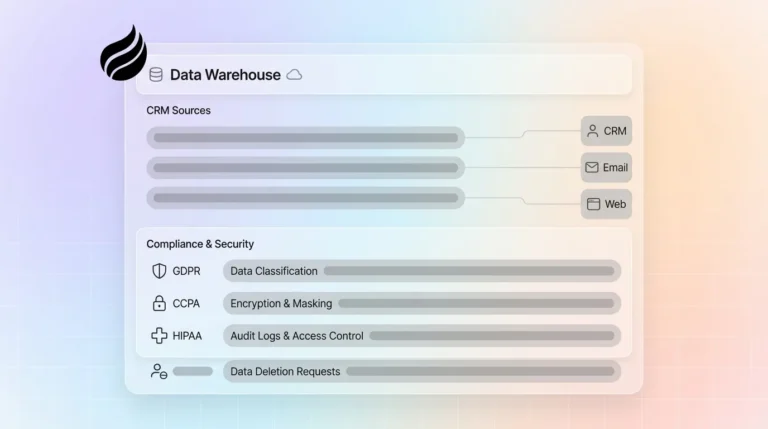
A compliant agent-driven architecture ingests both types, applies the same minimization and lineage rules to each, and writes every enriched value to a data warehouse that preserves historical state. When a field is updated, the prior value is not overwritten. The system versions that value instead. That versioning enables a complete DSAR response that reflects how a record changed over time.
Strategic Trade-offs When Moving to Agent-Driven Enrichment
Implementing an agent-driven enrichment architecture requires upfront investment in three areas. First, vendor DPA negotiation, which typically takes two to six weeks for a new vendor relationship, must be completed before any enrichment begins because the DPA defines which fields the vendor may provide. Second, field-level minimization policy definition translates those contractual limits into an approved field list and requires alignment between RevOps, legal, and sales leadership. Third, CRM schema review confirms that lineage fields can be added to store the source and timestamp for each enriched value without disrupting existing workflows. Teams that skip the policy definition step and deploy enrichment automation first will automate non-compliant behavior at scale, which creates more risk than the manual baseline.
The governance trade-off is real. Tighter minimization rules reduce the data available to reps for personalization. Teams resolve that tension by anchoring the approved field list to documented business purposes rather than to rep preferences, and by reviewing the list annually as business needs evolve.
Readiness and Evaluation Framework
Before selecting an enrichment architecture, assess readiness across four dimensions so the implementation plan matches current capabilities.
- Team size and legal capacity: Confirm whether the company has in-house counsel or a retained privacy attorney who can review DPAs and legitimate interest assessments.
- CRM stack: Identify whether the system of record is Salesforce, HubSpot, or a standalone platform, because each has different schema constraints for lineage fields.
- Current data maturity: Check whether existing records are tagged with a source and ingestion date or whether provenance remains unknown for most contacts.
- DSAR readiness: Review whether the company has received a DSAR in the past 12 months, how long the response took, and whether it covered enriched fields.
Companies that score low on data maturity and DSAR readiness should prioritize lineage logging and retention policy implementation before expanding enrichment coverage.
Evaluate Coffee’s architecture against your readiness scorecard.
Common Pitfalls in B2B Enrichment Programs
Three failure patterns recur across B2B enrichment programs. First, fragmented tool stacks keep enrichment, CRM, and compliance logging in separate systems with no automated handoff, so teams create lineage records manually or skip them entirely. Second, missing lineage for legacy records leaves a large portion of the database exposed in a DSAR because companies enrich new contacts compliantly but never retroactively document the provenance of existing records. Third, over-collection driven by vendor defaults occurs when enrichment APIs return every available field and teams that do not configure field-level filters ingest data they have no lawful basis to hold.
Four-Phase Implementation Guidance
A four-phase rollout minimizes risk and keeps the project manageable. In the discovery phase, audit the existing CRM for field provenance, identify all active enrichment vendors, and confirm DPA status for each. In the pilot phase, deploy the agent on a single segment, such as new contacts created in the past 90 days, with full lineage logging enabled and minimization rules enforced. In the validation phase, run a simulated DSAR against the pilot segment to confirm the lineage log produces a complete and accurate response within the required timeframe. In the rollout phase, extend the configuration to the full CRM and schedule quarterly reviews of the approved field list and vendor scorecard.
Coffee Agent Implementation and Retention Controls
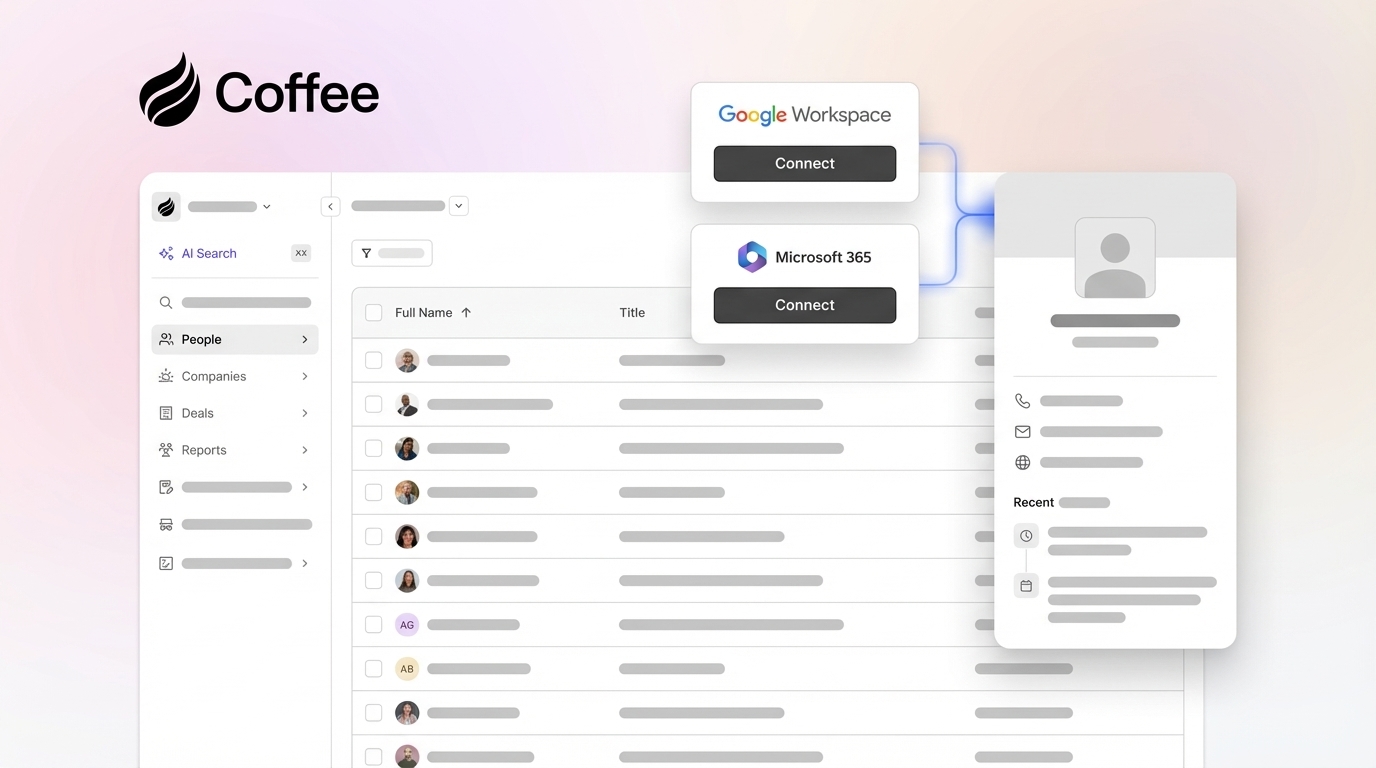
The Coffee Agent satisfies all ten steps in this framework without adding manual overhead to the RevOps or compliance team. As described in the market context section, the agent embeds compliance controls at the pipeline level. When connected to Google Workspace or Microsoft 365, the agent automatically creates and enriches contacts from emails and calendars while applying pre-configured minimization rules at ingestion. Every enriched field is written with a source tag and timestamp, which produces a lineage record that is queryable for DSAR response. Vendor DPA status is checked against the approved vendor list before each enrichment call, and unapproved vendors are blocked at the API layer.
For teams running Salesforce or HubSpot, the Coffee Companion App deploys the same agent logic as an intelligent layer on top of the existing system of record and writes enriched values and lineage metadata back to the primary CRM without requiring a migration. Coffee holds SOC 2 Type 2 certification and is GDPR compliant, both verified by third-party audit, which satisfies the security certification criterion in the vendor evaluation scorecard above. Data ingested by the agent is not used to train public models.
Steps 8 through 10 of the compliance framework address retention and deletion. The Coffee Agent enforces retention limits through the checklist below, which teams can adopt directly as an internal policy artifact.
Retention-Policy Checklist:
- Step 8 — Define retention periods by data category. Example categories include enriched contact records for active pipeline with 24 months from last interaction, enriched records for closed-lost opportunities with 12 months from close date, and call transcripts with 6 months from meeting date unless a legal hold applies.
- Step 9 — Automate deletion or anonymization triggers. The agent flags records approaching their retention limit 30 days in advance and executes deletion or field-level anonymization on the defined date without manual intervention.
- Step 10 — Log every deletion event. The deletion log must record the record identifier, the fields deleted, the deletion timestamp, and the retention rule that triggered the action, and must be retained for the period required by applicable law to demonstrate compliance.
FAQ
Does CCPA apply to B2B contact data enriched from third-party vendors?
Yes. The B2B exemption that existed under the original CCPA was removed by the CPRA in 2023. As a result, the audit authority and contractual requirements described in the Executive Overview apply to business contact information, including work email addresses, job titles, and direct phone numbers. Companies must honor opt-out requests and respond to DSARs for this data.
What is the difference between a legitimate interest assessment and a consent mechanism for CRM enrichment?
A legitimate interest assessment, or LIA, is a documented three-part test. The company identifies a legitimate purpose, demonstrates that processing is necessary for that purpose, and confirms that the individual’s rights and interests do not override the company’s interest. For B2B prospecting of business contacts, legitimate interest is the most commonly applied basis under GDPR. Consent, by contrast, requires a freely given, specific, informed, and unambiguous affirmative action by the individual before processing begins. Consent is difficult to operationalize for outbound enrichment because it requires contact with the individual before the data is collected, which creates a circular dependency. Most B2B enrichment programs rely on legitimate interest with a documented LIA rather than consent.
How long does a company have to respond to a DSAR that involves enriched CRM data?
Under GDPR, the response deadline is one calendar month from receipt of the request, extendable by two additional months for complex requests with written notice to the requester. Under CCPA and CPRA, the deadline is 45 calendar days, also extendable by an additional 45 days with notice. The response must cover all personal information held about the individual, including enriched fields, regardless of the source. Companies that cannot identify the source of enriched fields within these windows are non-compliant by default, so lineage logging at the moment of ingestion becomes a prerequisite rather than an optional enhancement.
What makes waterfall enrichment riskier than single-vendor enrichment from a compliance standpoint?
Each vendor in a waterfall cascade acts as a separate data processor and requires a separate DPA, a separate source disclosure, and a separate entry in the lineage log. If any vendor in the cascade cannot produce a compliant DPA or refuses to disclose its data sources, every record touched by that vendor becomes potentially non-compliant. Because waterfall logic applies vendors in sequence, teams may struggle to determine retroactively which vendor populated a specific field. Single-vendor enrichment simplifies the compliance surface with one DPA, one source disclosure, and one lineage entry per field. Teams that require waterfall coverage for fill-rate reasons must implement automated vendor-status checks before each cascade call and maintain a complete vendor registry with DPA expiration dates.
Conclusion
Compliant CRM data enrichment in 2026 is an architectural problem rather than a policy checklist. The ten steps in this framework, which include lawful basis documentation, data minimization, vendor DPAs, DSAR-ready lineage logging, waterfall risk controls, and automated retention enforcement, cannot be executed reliably through manual processes at the pace and scale that modern B2B sales teams require. Evaluation of any enrichment solution should assess whether compliance controls sit inside the pipeline or appear as a manual overlay after the fact. Teams that complete the readiness assessment above and validate their architecture against a simulated DSAR before full rollout will be positioned to enrich at scale without regulatory exposure.