Written by: Doug Camplejohn, CEO & Co-Founder, Coffee
Key Takeaways for RevOps and Sales Leaders
- ZoomInfo specializes in contact enrichment and verified emails for outbound prospecting, while 6sense focuses on account-level intent signals to time ABM outreach.
- Both platforms still leave about 60% of a rep’s week tied up in manual data entry, exports, and CRM hygiene that neither platform fully automates.
- Using ZoomInfo and 6sense together increases cost and complexity while keeping a human routing layer between signals and CRM records.
- Implementation timelines of 3–9 months and annual contracts that often exceed $30K create a high total cost of ownership before productivity gains appear.
- Teams can remove that manual overhead by deploying the Coffee Agent as the automation layer, and see pricing and deployment options.
Core Strength Breakdown: Intent Signals vs. Contact Data
Mordor Intelligence segments the sales intelligence market by component, deployment, company size, sales function, industry, pricing model, and geography because each tool supports a different part of the prospecting workflow. The table below maps each platform to its primary function.
| Dimension | ZoomInfo | 6sense | Coffee Agent |
|---|---|---|---|
| Primary data type | Contact & firmographic records | Account-level intent signals | Unified structured + unstructured data |
| Primary use case | Outbound prospecting, list building | ABM prioritization, in-market timing | CRM automation, enrichment, visitor ID |
| CRM write-back quality | Batch enrichment, nightly sync common | Account scores pushed to CRM fields | Continuous, real-time agent-driven sync |
| Automation depth | Low, exports require human action | Medium, scoring requires human routing | High, agent handles data entry end-to-end |
| Total cost of ownership | $15K–$75K+/yr for mid-market plus RevOps overhead | Custom quote, dedicated technical resources required | Seat-based, agent labor included with no extra metering cost |
B2B contact records decay at 22.5–30% annually, which ZoomInfo’s own guidance supports, so any static export ages out within months regardless of source.
Implementation Time and Cost Realities for ZoomInfo and 6sense
A full enterprise rollout for 6sense typically runs 3–9 months and demands dedicated technical resources for ongoing management. ZoomInfo’s implementation checklist recommends auditing CRM data quality, defining ICP in firmographic terms, and testing enrichment match rates on 500–1,000 real accounts before contract signing, which lands squarely on your RevOps team.
On the cost side, ZoomInfo’s median annual contract value is $32,000 based on Vendr data from 1,311 purchases, and that figure excludes add-ons. Mid-market packages with intent data and higher export limits commonly run $30,000–$75,000 per year, and custom integration and setup push the total cost higher. Beyond license fees, inaccurate data compounds the expense by generating wasted salary costs for reps chasing bad leads.
Why Intent Signals Break Down on Dirty CRM Data
Intent signals only work when they map to accurate CRM records. B2B contact data decays between 22.5% and 70.3% annually, with 22.5% commonly cited as the average and higher rates limited to high-turnover sectors, so an in-market signal routed to a stale record produces a wasted sequence. ZoomInfo’s June 2026 GTM.AI launch announcements did not address how an agent acting on stale data can generate bad outcomes at machine speed and scale.
Poor data quality in enterprise CRMs, including outdated contacts, missing firmographics, duplicate accounts, and incomplete activity records, reduces rep trust and creates adoption barriers. When reps stop trusting the CRM, they stop logging activity, which accelerates decay. Intent platforms that sit on top of that foundation inherit every flaw.
Why Combining ZoomInfo and 6sense Still Leaves a Manual Layer
Many mid-market teams license ZoomInfo for contact data and 6sense for intent, expecting the combination to close the gap, yet the manual work usually remains. ZoomInfo functions as a pure data provider rather than a centralized workspace, which forces teams to maintain a separate CRM plus additional tools for outreach, enrichment, and automation. Adding 6sense introduces a third system of record for account scores. The average seller already uses 8 tools to close deals, and a ZoomInfo-plus-6sense stack adds two more without removing any.
The result is a human routing layer. A rep or RevOps analyst checks 6sense scores, exports ZoomInfo contacts, and pastes records into Salesforce or HubSpot. That workflow does not qualify as automation. It is a more expensive version of the same problem.
Pricing Transparency and Hidden Costs in ZoomInfo and 6sense
ZoomInfo’s pricing is not publicly displayed, so teams must contact sales for quotes. Published tier benchmarks show Professional+ at $14,995/year for 3 seats, Advanced+ at $29,995/year, and Elite+ at $35,995/year, yet export credit caps, auto-renewal clauses, and overage fees have generated documented customer complaints. Tropic’s analysis of over $19 billion in software spend shows ZoomInfo customers achieve 30–65% discounts off list price, which signals that list pricing serves as a negotiating anchor, not a reliable cost. 6sense does not publish pricing and requires dedicated technical resources and ongoing management that often sit outside the initial contract value.
CRM Integration Friction with Salesforce and HubSpot
Integrating ZoomInfo with an external CRM introduces complexity, duplication, and disconnected workflows. The goal of ZoomInfo’s HubSpot Breeze integration is to eliminate tab-switching, CSV exports, and manual enrichment overhead, which acknowledges that these problems exist today. ZoomInfo notes that a provider whose enrichment only runs nightly batch jobs cannot support real-time routing workflows, so teams add more tools. For 6sense, complex setup and a steep learning curve demand strong RevOps processes to maximize signal utilization.
Data Noise and Manual Overhead in Modern Sales Stacks
71% of sales reps say they spend too much time on data entry, which leaves only 35% of their time for actual selling. The Salesforce 2026 State of Sales report confirms reps spend 60% of their time on non-selling tasks, a pattern RevOps leaders link to manual processes and poor data accuracy. A May 2026 Gartner survey of 210 chief sales officers found AI tools save sellers 4.8 hours per week on average, yet 72% of sales organizations report low reinvestment of those savings back into high-value activities. The time gets saved and then absorbed by other administrative tasks, including the manual CRM hygiene that ZoomInfo and 6sense do not remove. Coffee’s autonomous agent targets the 8–12 hours per week reps lose to data entry directly and returns that time to pipeline-generating work.
The Coffee Agent Alternative: Automation Layer for Any CRM
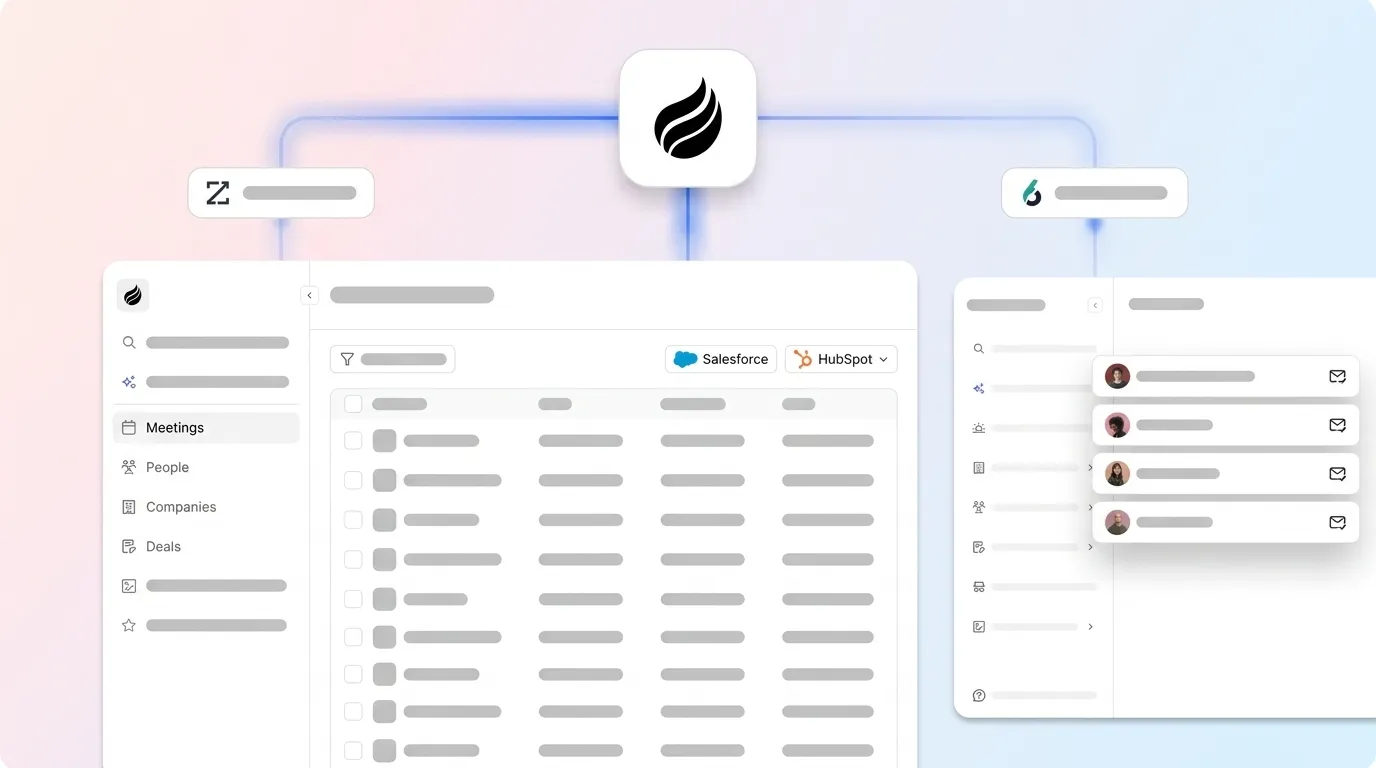
Coffee operates as an autonomous CRM agent that removes the human routing layer entirely. It runs in two modes: as a Standalone CRM for teams replacing legacy systems, or as a Companion App that sits on top of existing Salesforce or HubSpot instances and handles data entry, enrichment, and CRM write-back without human intervention.
ZoomInfo expects a rep to export contacts and paste them into a sequence, and 6sense expects a RevOps analyst to route intent scores to the right owner. The Coffee Agent instead ingests signals from emails, calendars, call transcripts, and web behavior, then writes clean, structured records back to the CRM automatically. It handles structured data such as firmographics and contact fields, and unstructured data such as email threads and call transcripts, which legacy CRM architectures cannot match.

Coffee’s Visitor Identification pixel closes the gap between anonymous intent and named outreach. Teams drop a single script into the site’s <head> tag and the agent begins identifying visitors by name, title, email, and LinkedIn profile, along with pages visited, time on site, and return frequency. Where competitors surface only the visiting company or generic people lists, Coffee’s Suggested Leads feature uses your buyer persona to recommend the two or three specific contacts inside that visiting company most worth contacting, with LinkedIn profiles surfaced for instant outbound. A real-time Slack notification fires, the prospect is added to the CRM with enrichment pre-filled, and the rep acts without touching a spreadsheet.

2026 Tooling Recommendations by Company Size and GTM Motion
ZoomInfo and 6sense do not solve the manual overhead problem on their own. Both still require humans to act as data-entry clerks who export records, route signals, update fields, and reconcile duplicates. The platforms supply raw material, but they do not convert it into CRM-ready pipeline without human labor in the middle.
The buyer-stage recommendation matrix below maps ARR ranges and GTM motions to a practical tooling decision.
| ARR Range | GTM Motion | Recommended Stack | Rationale |
|---|---|---|---|
| Under $20M | Outbound-led | Coffee Standalone CRM | No legacy CRM to protect, and the agent handles enrichment natively without ZoomInfo license overhead |
| $20M–$50M | Outbound-led | ZoomInfo + Coffee Companion App | ZoomInfo supplies contact volume, and the Coffee agent automates CRM write-back and removes manual entry |
| $20M–$50M | ABM | 6sense + Coffee Companion App | 6sense supplies account intent prioritization, and the Coffee agent routes signals to clean CRM records automatically |
| $50M–$100M | Hybrid outbound + ABM | ZoomInfo + 6sense + Coffee Companion App | Both data types matter at scale, and the Coffee agent becomes the unification layer that prevents the dual-platform manual routing problem |
The consistent variable across every scenario is the Coffee Agent as the automation layer. Without it, every combination of ZoomInfo and 6sense still ends with a human copying data between systems.
Frequently Asked Questions About Coffee vs. ZoomInfo and 6sense
How long does it take to implement ZoomInfo or 6sense for a mid-market team?
ZoomInfo’s quick-start deployment runs 2–4 weeks for basic access, but a full rollout that includes CRM integration, ICP definition, and enrichment match-rate testing typically takes 3–6 months. 6sense requires a similar or longer timeline because of complex setup and the RevOps process maturity needed to act on intent signals. Coffee’s Companion App connects to Salesforce or HubSpot through a simple authentication and begins capturing and enriching data immediately, so most teams are operational within days, not months.
What does migrating to Coffee look like if we already use Salesforce or HubSpot?
Coffee’s Companion App does not replace your existing CRM. It deploys as an agent layer on top of your current Salesforce or HubSpot instance. The agent authenticates, syncs existing records, and begins enriching and logging activity automatically. There is no data migration, no re-platforming, and no disruption to existing workflows. Teams that want to move to Coffee’s Standalone CRM later can do so incrementally.
Is Coffee SOC 2 Type 2 and GDPR compliant?
Yes. Coffee is SOC 2 Type 2 certified and GDPR compliant. Customer data is not used to train public models. For teams in regulated industries or those with procurement security reviews, Coffee can provide compliance documentation on request.
How does the Coffee Agent handle unstructured data like call transcripts and emails?
Legacy CRMs store only structured data in relational fields, so historical context disappears when a field is updated. Coffee uses a data warehouse architecture that ingests unstructured data such as email threads, call transcripts, and meeting notes alongside structured records and retains full history. The agent parses transcripts using sales methodologies like BANT, MEDDIC, or SPICED, extracts next steps and action items, and writes structured qualification data back to the CRM automatically. Intent signals from 6sense or contact records from ZoomInfo then land in a CRM that already contains full conversation context, not just a name and a job title.

Is Coffee’s enrichment data as accurate as ZoomInfo’s?
Coffee’s built-in enrichment, including job titles, funding data, and LinkedIn profiles, is on par with ZoomInfo for most mid-market use cases. Teams that need ZoomInfo’s depth for high-volume outbound or enterprise org charts can run ZoomInfo alongside Coffee, and the agent will handle the write-back so enrichment lands cleanly in the CRM without manual intervention. The goal is not to replace every data source but to remove the human layer between data sources and the CRM.
Conclusion: Fill the Gap Between Signals and CRM Action
ZoomInfo and 6sense solve different problems effectively. ZoomInfo delivers contact depth for outbound-led teams, and 6sense delivers account-level intent prioritization for ABM motions. The gap neither fills is the operational layer between signal and CRM action, the hours reps spend moving data between systems instead of selling. Clean data foundations that improve sales efficiency come from removing the human data-entry layer entirely, which is the role of the Coffee Agent.
Deploy the Coffee Agent and eliminate your data-entry layer.