Doug Camplejohn
(00:01)
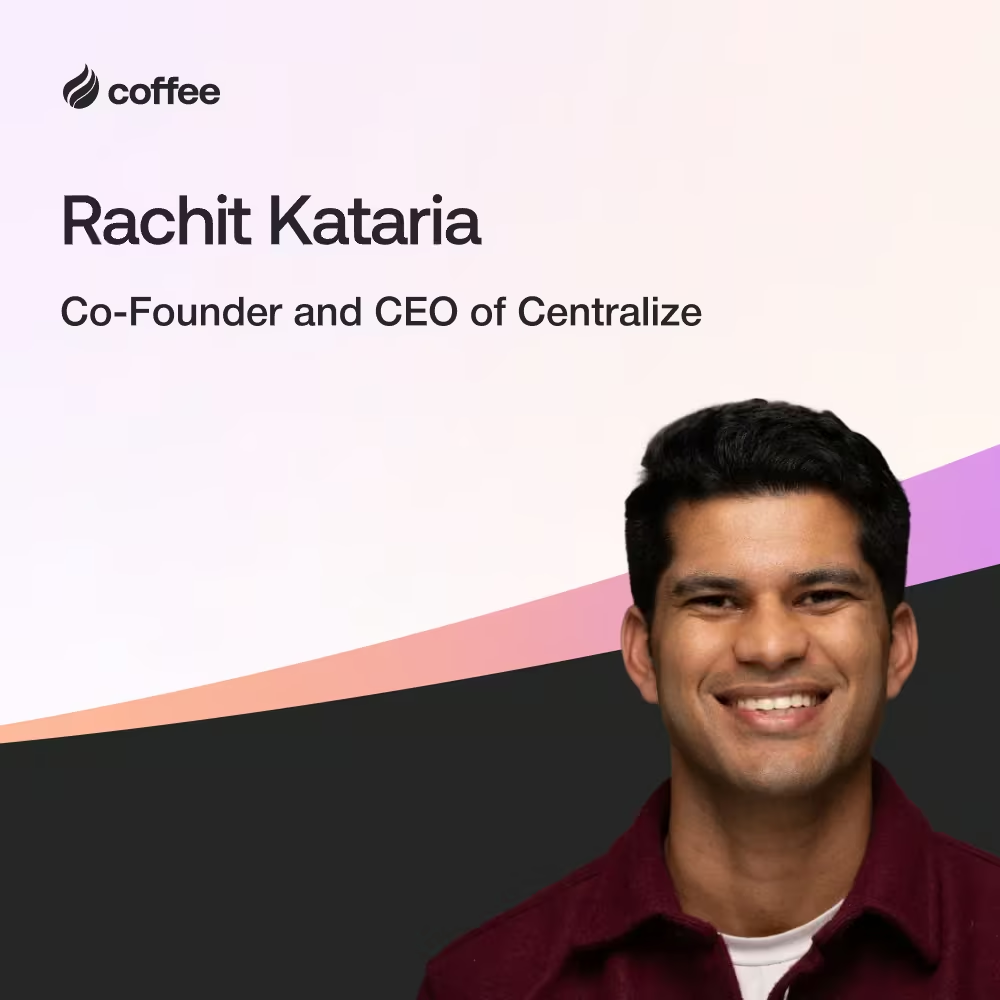
Hello everyone, I’m Doug Camplejohn and welcome to this week’s episode of Revenue Renegades. This week I am excited to welcome Rachit Kataria, the CEO and co-founder of Centralize, to the show. Welcome, Rachit.
Rachit Kataria
(00:14)
Good to be here. It’s always nice to see you.
Doug Camplejohn
(00:17)
Great to see you. As you know, we love founding stories, so let’s start there. Tell us a little bit about how the idea for Centralize came about.
Rachit Kataria
(00:27)
Yeah, it’s been quite a journey. First, there’s no company without meeting your co-founder and that part of the adventure. I was very lucky to have met William Wang, who’s my co-founder. He and I went to school at USC together for undergrad and masters. We met the first week of college at our school’s entrepreneurship club. Ten plus years later, he was my groomsman, I was his. We’ve been roommates, we’ve been study partners, all of the above before the final jump into being founders.
We had seen a bunch of experiences over both of our careers to that point. We’ve both been engineers by trade, in that interesting cohort of engineers building for go-to-market, having not necessarily sold anything before officially, but being adjacent to that in the roles we played. We’ve always been product engineers, meaning we’ve been the engineers supporting the AEs and the CSMs and the AMs on what do we build that is actually important to the customer.
I had seen this a lot at AtoB, which was a company that I worked at prior. It was a YC company and I was their product tech lead. AtoB is a fuel card for trucking, literally like a Visa card for fleets to go buy gas. I would go to truck stops and company HQs with the CSM and AM and ask, what am I building that is going to be most relevant for you, for the enterprise, and how does that actually change your life? When the best reps manage relationships really well and understand them, it’s smooth sailing. When you know what that CFO cares about that is different from the head of fleet, from the driver, and can speak to each of those, life is good.
In other instances, we were hit with insane churn cases that showed up out of the blue. I had to pause all of EPD for two weeks when one of these really critical ones came through, a multi six-figure deal. What had happened was the main champion left the company and no one knew. The new person that came in was not actually important in our eyes, even though he was one of the most important people we should have known about. We did not understand that just from his email domain emailing us. The contact was in a Gong call ten months ago that no one remembered to look at, and the person who brought them in was no longer at the company.
So everything was scattered, tribal knowledge was gone, shifting underneath us, priorities had changed. I spent two weeks building, built it, and it did not matter. We were in the back half; it did not change their mind. That was such a painful experience to see. Relationships are so important to maintain; if you do not, it is very quick for it all to shrivel away and then you lose what got you in there. That was an enlightening experience on how important it is to visualize and understand that story.
On the flip side, my co-founder Will created Slack Huddles. He built it from scratch. He worked with Cal Henderson, Noah Weiss, a bunch of the crew over there. Many of our favorite angels are actually on the cap table. When he was building that experience, it was that problem at huddle scale. They had to delay a launch of one of their biggest rollouts because no one had a consistent picture, from AE, CSM, frontline manager up to the CRO, of who cares about this and why, who is the champion, and why they are important to us. None of that was in any consistent picture.
TL;DR, what we had back in November 2023 when we ultimately applied and got into YC was two parts of the thesis. One, relationships are really difficult to understand, but are arguably the most important thing you can focus on in any customer-facing motion, new business or expansion. Two, for the first time, AI with GPT‑3.5 can actually make sense of it and turn this into something meaningful and understandable beyond just tables inside of a CRM.
That combined set of experiences got us to YC. I can share so much more about the meandering journey and idea maze, but that was the founder story of how we met, how we got together, and the experiences that brought us to this core problem. It is really tough to understand the dynamic shifting relationships in your accounts at the scale of 50 or 100. There is nowhere to go to understand and see that today, and that was the seed of Centralize.
Doug Camplejohn
(04:45)
Being at a massive company that is still a rocket ship like Meta is very different than saying, “Okay, we are going to go bet on ourselves.” What was the moment where you said, “Okay, I’m going to leave the safety of this nest and bet on ourselves”?
Rachit Kataria
(05:03)
I like to think it is easier to paint this picture retroactively, but I always eventually wanted to go found something or build something of my own. I had a very intentional path I tried to stick to, which was, I want to go learn from the best first and be a really good engineer and be self-sufficient to go build what we need to build in the world. That was my stint at Meta for two and a half years, basically going from new grad to senior engineer, scaling up Shops from scratch.
A cool thing about Meta is its bootcamp structure. You can choose which team you want to work on. I lucked out, slightly intentionally, on being on the team that became the founding team of Facebook Shops, which was the alpha that we shipped in May 2020, bringing e-commerce to the platform. We went from zero to a quarter billion monthly active users in a year, which was kind of insane. It helps when you have billions of users naturally, but even so, getting that startup-in-a-big-company experience was really great.
Then I wanted to go a step smaller. I was like, okay, I’m a senior engineer, I know how to build. What about everything else? Founding a company is not just building the product. It is learning how go-to-market works, learning from founders, all the things that come with people and hiring and influencing and ordering and being a founder people look up to as part of championing the business. I optimized for that when I went to AtoB, which was that smaller Series B YC company.
Ultimately, the final leap was this: I would spend hours going on walks with the founders on the Embarcadero every other week. I would pick their brains and still build as close as I could to the product. There was this perfect combo of seeing the pain that I felt was scalable and that Will resonated with when he was at Slack. Combined, that gave us the, “You know what, maybe this is a little presumptive, but if the worst thing is I have to go back to big tech and hopefully Zuck will have me, that is not the worst backup plan.” Let’s take a bet on ourselves and make something we know is real and that we were planning for in the first place.
Doug Camplejohn
(07:09)
Speaking of betting on yourselves, I remember coming across a post you did that was like five years ago, you would not have bet on yourself. Tell me a little bit about what caused that reflection and how that has changed.
Rachit Kataria
(07:24)
You did your homework. I like that post because I think five years ago, I was just an engineer at Meta, one of thousands of people. I lucked out into building something I think was more impactful than a lot of what you get to build at Meta, which is 0.01% increments on Newsfeed efficiency, which is fine, but I wanted to build something that was more ground up.
You know this very well as a founder yourself: everything else that it takes to not just build the product, but to grow yourself as a manager, grow yourself as a product lead, as the first seller of the company, wearing all the hats you have to wear. If we do not take the leap now and I have a lower risk tolerance, why not? Let’s make it happen. Will and I always talk about this for our hires too. It is the classic slope versus y‑intercept. Maybe our y‑intercepts spiked really high on engineering, but our slope was also very high for everything else we wanted to complement ourselves with.
That was the mindset we put ourselves into as we went through YC and the pressure cooker of those three months and everything that came from there. It is also the expectation we have for anyone joining the company. You might have started somewhere, but the teams that fall behind are the ones that assume where they started is what they will maintain, versus the ones that will lap them because they are scaling.
Doug Camplejohn
(08:47)
Big company and startup are radically different environments. Some people cannot make that transition. Were there things you thought you would carry over from Meta that, when you tried to implement as a first-time founder, you actually had to unlearn for Centralize?
Rachit Kataria
(09:05)
I actually think it was more things I really liked about Meta because I joined a startup‑esque team that became progressively worse over the two years, and I actively wanted to avoid going back to that. It was really cool in May; it was literally a Zuck-down mandate: “I do not care about security reviews and InfoSec right now, this needs to ship by May 16th, go.” It was a tiger team. It was all about building the best product and shipping it.
Then naturally, teams scaled around it. It became ten Shops orgs and all the integrations. One of the most impactful things I shipped was adding the “View in Shop” button on the tile, a Newsfeed picture of the shop making a post. Unsurprisingly, putting in an entry point to Shops that says “View in Shop” is going to drive a lot of traffic. It took me two months to get through designer reviews because that was out of the UI pattern for Facebook. There is no separate CTA on a post normally; it is just the person, the content, and then the post.
That drove probably the biggest impact I had that quarter for PSEs for my performance reviews. It was a two-line change and took two months. At a certain point I was like, I get it, because if everyone did that, Newsfeed and Facebook would look like a Frankenstein product. At that scale you have to do that, but that is not what made it so amazing in those first few months.
What Facebook does really well is that when it wants to, it can turn on the ship-at-all-costs mode, focusing on the product and the people. It is all open. You reach out to whoever you want to, and they will give you the time of day to make sure it works. That open and connected internal mentality, it is all horizontal. No one is thinking structurally, like hierarchies of who is going to help me out, who is a VP, who is an IC. It is just about building the best product. I think that really carried over.
Doug Camplejohn
(10:56)
You mentioned Will worked on Slack Huddles, you on Facebook Shops. What would you say was harder—getting to that 250 million or whatever metric on Facebook Shops, or getting to your first ten customers for Centralize?
Rachit Kataria
(11:17)
You definitely know the answer to that question. It is for sure the latter. Meta gets the benefit of scale. Big companies can innovate or be product leaders because once you have distribution, you just need a really good product and can bring it to market. That is why I jokingly said it helps when you have three billion people on the platform; bringing something new that is meaningful and then pulling in a fraction of that is not crazy once you have it.
With a startup, no one knows about you. We are truly starting from the ground up. It is great that we have the stamps of Meta and Slack and YC, but the world owes you nothing. Unless you are solving a real problem, it is a very risky bet to place on a team of two on a product that is untested and you are kind of first in the market. That was a roller coaster.
So much of it was being in the right rooms, leaning on our personalities and ourselves as people, and having the willingness to be your right hand to get that problem solved for you. We can be the people that do it to earn the trust that then starts compounding. I will shout out one of my favorite people, Tanner Lacey, VP Sales at Sendoso. He was one of the first people who truly took a bet on us as a company, way back at GTM 2024 and SaaStr last year when we first met.
We met the team there and showed them the core of the product. Sendoso was like, this makes a ton of sense in terms of going horizontal in our revenue work, being on the same page, mapping, getting high and wide; multi-threading should be a core focus. We launched with them and we are wall to wall in the entire company now. AEs, AMs, SDRs, marketing—the whole crew is in Centralize. Folks like that allowed us to go to the next and say, “Sendoso loves us, what about you?” and so on and so on.
That was tough in the beginning, but a lot of it is about being in the right rooms and increasing your surface area of luck. Enough good things start happening and people who like what you are doing and like you as a person take the bet, and from there it is on you to compound that.
Doug Camplejohn
(13:37)
We have run into each other at a bunch of events. I always assume I am going to see you at an event because you are putting yourself out there. I imagine coming at this without that network already built, without that set of customer relationships, it is all about putting yourself out there and having that extra hustle to go make it happen. The game was first customers in the door. You mentioned a great phrase earlier I loved, which was “no map, no deal.” Tell me a little bit about the current Centralize product and where that phrase came from.
Rachit Kataria
(14:17)
A lot of this is the idea maze. I have never sold enterprise sales before. I have been building hopefully great products for enterprises, but the biggest learning from the three months of YC, talking to as many VPs of sales, CROs, VPs of success, and ICs that would give us the time of day, was this recurring topic of multi-threading.
We initially had this thesis that it was enough to just have a GPT over the words that are being spoken. That is great, but that is almost a commodity these days. You can ask any question about anything. GPT released their connectors; anyone can ask questions. The unlock became that Gong call I had. Yes, you can ask and answer questions about that call, but who was Doug.Camplejohn@gong.com on that call? Was that the CRO, the AE, the head of marketing? That tells a very different picture of whether you are actually in a good spot in this account.
People always say in sales, you have to be in the right rooms with the right people at the right time, or say the right thing to the right person at the right time. “Who’s who in the zoo.” There are a lot of one-liners, but it all comes down to: if you do not know that you are talking to the right people, you are not going to win that deal. There is this idea of “happy ears.” Everyone thinks that just because someone likes them, they are your champion and you are in a good spot and the deal is going to progress. Then they go on vacation, they never come back, and suddenly that forecast is not going to hit.
Multi-threading kept coming up as the simple idea that if this is truly something important to that org, you need to understand: do I have a champion, do I have an economic buyer, do I have a decision maker, and do I have the people in between who will be my coaches to help me navigate the org? Buying is not that simple and selling is not that simple either. So much of it is relationship orchestration.
Everyone I talk to tells the same tired story every quarter. You pretend you are strategic one week that quarter in QBRs. Everyone builds a beautiful Figma or PowerPoint or Miro or Lucid of where they are trying to think about the org, because you are not selling to the org, you are selling to people at that org, so it is all about the people.
Then what happens? It goes stale, no one looks at it again. What was the point? You spend all these hours for nothing just to pretend, and then you do the exact same thing a quarter later. The reason is, how can you feasibly, across 50 accounts in your book, update every person that has come and gone, have we talked to them, when was the last time, what do they care about? It is untenable. So the easy thing is to not do it, and everyone thinks it is homework.
Arguably it is the most important piece of collateral if you had it every step of the way, because it is literally the GPS into where you need to go and whether you are in the right spot. Zooming back out: “no map, no deal” is just a simple framing that if you do not know whether you are in the right rooms and have that map, how can you think you are going to win this account? If you see empty boxes across the entire VP row, this deal is not closing. It is almost objectively true.
You need that every day of the week so you do not get to end of quarter and deals are slipping or stalling because you got caught up with one person who was not going to get you to the finish line. That is the thesis powering Centralize.
Doug Camplejohn
(17:54)
The multi-threading term, I think I first heard it at LinkedIn, with Mike Derezin and the Sales Navigator team using it to talk about the benefit of Sales Navigator. The first cut at that is easy—do I have one or more contacts associated with a deal? CRM is sketchy as we all know, because in traditional CRM many times you only put in one contact; you are like, what is the minimum I need to do to get my commission check? Obviously with more modern CRMs like ours and others, those contacts are automatically added, so you have the counts part of it down, but you do not have the relationship side. LinkedIn is all about relationships, so how do you think about yourself as different or differentiated from something like Sales Navigator or core LinkedIn?
Rachit Kataria
(18:43)
LinkedIn will always be the true source of truth of people—who is at the company. That is their data, that is their moat. The problem is that selling is not just names and faces. The number of people that come to me and say, “I used to map things in Sales Nav.” Great, you made a beautiful picture in Sales Nav and all the relationship lines. The first question your CRO is going to ask you is, “Who have we talked to?”
That is not on LinkedIn. That is in email, calendars, Slack, Gong, CRM, and 50 other places to understand the relationship. When I say relationship, a relationship is not a name, it is all the context around that person. There is still no one place to wake up to that picture that is actually visualizable so you can understand that you have only been talking to five people in marketing, none of them are directors, and you have not talked to a single person in sales, which is a problem because you need to be in sales, marketing, and success if you have any chance of winning this account.
Where do you get that story? That is the homework leaders have to give their reps to build manually in order to have a baseline strategic conversation about what to do next.
If you already have that picture by default, building itself every single day from every email, every touchpoint, every CRM data point, every profile on the person, now you have the strategic baseline to go fix the deal, be proactive, and not just do a retro of what you already know. That is the distinction between what LinkedIn can do really well and what is missing from the actual workflow day-to-day to get a rep and team winning deals.
Doug Camplejohn
(20:15)
The high-level distinction sounds like manual versus automated. You could decide to go draw that account map inside of Sales Navigator, and when someone says, “How are we doing?” it is not connected to the CRM, but you can bounce over to Sales Navigator and show the account map. You are giving the voiceover to it, but it is not tied to how many times you have met with a person, what they said in a conversation, what emails were exchanged, any of that. That is where you all are coming in.
Rachit Kataria
(20:50)
Exactly. It is that heatmap overlay of yesterday’s names and faces with whether you talked to them yesterday, three months ago, or whether you were even in the room when that happened. If I am taking on a new territory, what do the ten people I did not even know existed care about? So much of this is not just about my situation. Come January, everyone is shifting their books, bringing in new people.
All of this is about team selling too. You do not win enterprises without SEs and CSMs all in the same room. Where does everyone come together for the Figma of their deals? Where is the deal canvas that everyone is swimming along in the same picture to quarterback and say, “Hey CRO, I know your exact touch above the line, we have not heard back from them. I am engaged with this person; maybe SE, let’s work with their technical counterpart and get things going. Hey CSM, I know you are trying to expand in this corner of the business; maybe you should talk to this person I am engaging with because they are excited about the existing use case.”
That conversation has nowhere to start right now without the manual piece. With automation, now we are operationalizing multi-threading and team selling in the same view.
Doug Camplejohn
(21:59)
Are you bringing that back into the CRM or is it just living inside of Centralize? I know you are pulling all that.
Rachit Kataria
(22:04)
This is a good segue to say we actually raised from Salesforce recently. Love Benioff and team. Jokingly, we always say that the “R in CRM” does not really exist. It is an amazing tool; you are not a multi‑hundred‑billion‑dollar business for no reason. It is a critical place to store all that data, but that is what it is: a database—names and contacts and opps and accounts.
No one ever said, “I want to log into my database today and update some data.” They want a place of action that helps them understand their deals so they can move them forward and, in the best case, AI providing them what to do next, like the GPS on their map as well, not just the map. Depending on where you are or where you live, at least for legacy CRMs, Salesforce makes some really cool moves recently so do not count them out, but all these massive organizations are going to have a hard time ripping out Salesforce anytime soon.
They have Salesforce in conjunction with Gong and G Suite and Slack and everything else, and yet somehow at end of quarter deals still slip and stall. If we can be that layer that helps them orchestrate, but keep their database up to date, RevOps is happy, the entire revenue org is happy, and all of a sudden your tools are working with each other versus just retroactive data entry.
Our goal is that it should come along for the ride as the database, but it is not the place that you wake up to because there is no visual to wake up to. It is just a row of contacts and tables.
Doug Camplejohn
(23:49)
So what are you writing back to Salesforce then?
Rachit Kataria
(23:52)
Typically, in our case, you could write anything to Salesforce, but what is important to us and our customers is: who matters, are they still there, and what do they care about? Those are the very simple things for a deal. The “who” is coming from every email, calendar, and call that we can push into CRM naturally. From every sentence they have spoken, “why do they care,” that still persists. Then, “are they still there,” tracking whether they have come and gone.
The worst thing about Salesforce half the time is you log in and it is two years of outdated contacts that are no longer there, and SDRs are cold calling people that are not even at the company. That is where we focus. It is all people-centric. The contact is really the core of what Centralize focuses on.
Doug Camplejohn
(24:38)
When you are configuring a customer, are you actually setting up custom fields for that “what do they care about” field, or are you writing into standard fields or notes?
Rachit Kataria
(24:46)
We can. It is a mix depending on the customer. Sometimes with our managed package we can push into our own custom fields and have control over that. If they have existing ones they would prefer us to use, we can configure either.
The high level is that we are syncing back to them and can closely, bi-directionally update them as the CRM and, if anything, make it stickier because it is actually useful now. The data in there is meaningful. We are not only the orchestration layer from the end-user experience, but also from the ops data flow experience.
Doug Camplejohn
(25:21)
Is there a single KPI? We have revenue leaders who listen to this podcast. Is there a single multi-threading score or health score of any kind that a revenue leader or manager can look at and quickly get a visual as to how they are doing on each of their accounts or their team is doing?
Rachit Kataria
(25:35)
We have thought a lot about this. Big shout out to Haley Katzman, who is the VP of Strategic Sales at Highspot. Highspot thinks really strategically about this in that multi-threading is nothing but personas that you have to be in, and a certain function–seniority combination. For Highspot, I am pretty sure it is MOS, which is Marketing, Ops, Sales, and Sales Enablement. If they are not above the line, director plus across MOS or power-threaded, Haley is not even going to forecast it.
It does not matter. They are not going to win. We have baked in a similar idea. In Centralize, you can configure exactly which personas you go after—Marketing Director+, CS Manager+, etc.—and define all of those. Because we are automatically creating the map and placing people on the map and knowing if they have responded to you, we can literally give you the insight zoomed out across your book.
For example, 40% of your accounts are not engaged at all in marketing, with no replies in the persona you sell to versus 10% in another function. As a frontline manager, I can choose a rep, drill down to the persona where marketing is not engaged, and do something about it. I am not just telling my rep, “You are not multi-threaded, fix it,” I am giving you the map on how to fix it, and I better check next time from an accountability perspective that those people we found are lit up green and engaged on the map.
We go from the zoomed-out view that multi-threading means persona-based engagement where we have to be and Centralize has already answered that question, all the way down to the day-to-day where you live to fix that picture, not just wallowing about the fact that you are not threaded and stuck. That is how we think about leader-level value.
Doug Camplejohn
(27:36)
For those listening who have not gone and raised from Salesforce Ventures, talk about that process. Who approached whom and what was the lightbulb moment where they wanted to write a check?
Rachit Kataria
(27:52)
I love the team over there—Jason, Caroline, Dylan when he was there, Rob Keith and a bunch of folks on the venture side. It was right after or very close to YC Demo Day when we were thinking about the fundraise, around March–April.
We had a great conversation with Cal Henderson, co-founder of Slack. Will worked closely with him when he built Huddles. We had lunch with Cal and he was really stoked about what we were doing and thought we were onto something. The “future of work” concept made a lot of sense. He came on board as a great supporter and said we should probably talk to Slack Fund, which was the early venture arm of Salesforce Ventures.
We talked to them on Monday. They thought it made a ton of sense because the thesis was, what is the new future of work? It is all about relationships, and today there is no visual to understand this. This does not exist. Despite every tool under the sun, you do not have a place to come to make sense of that story.
That translated to on a Friday, going to the top of Salesforce Tower, meeting the Ventures crew and pitching them there. Salesforce is a group of really smart people. They understand that the world is shifting to where relationships are becoming the moat.
If you are not realizing this, even mid-market deals, 30–50K, requiring CFO approval, which used to be a swipe of a director’s credit card, are now legitimately every dollar counts, we are in budget cuts, and the buying committee is bigger and bigger. As a result, as a seller you have to multi-thread even harder than before. You cannot stop at your one champion who is a manager; you have to get to the director, the C‑suite, find warm pathways across your execs and team, and have a place to team-sell that story together.
There is a lot of noise in AI SDRs right now. Great, you got the foot in the door and you are building pipe. Maybe a hot take, but I think that is the easy part. The hard part is once you have the foot in the door in a DocuSign and what you do for the next ten months to turn that into a seven-figure deal. That is a lot of work, a lot of internal team selling and corralling, and no shared place of collaboration to make that happen.
You are just hoping your AE is the most amazing quarterback who knows how to do it. Maybe they are for one deal, but what about the other 50 in your book that require that same level of rigor and understanding? That is where things start breaking down. For leaders listening, be real: at end of quarter, look at all your closed-lost reasons. They might say budget or product. In reality, how many are because they were too low or single-threaded? You never talked to the EB, you never got to the DM, you did not get to a real champion.
If you had a picture that answered that and made it crystal clear on day one, how would that have helped with your deal strategy and coaching and actually game plan to get into those accounts? That is the shift in where revenue is going to come from and the philosophy for the company.
Doug Camplejohn
(31:09)
Can you give some anecdotes either of customers where you heard about these painful single-threaded losses or scenarios where they rescued something because they had Centralize and could see they were spread too thin?
Rachit Kataria
(31:26)
One of my favorites was recent. We just went wall to wall across Intercom’s post‑sales orgs, so ARR and CS. They had an interesting use case where even during the POC there was an account they were working where they had gotten stuck at one of the directors of success, or support in their case, and it was starting to look like a churn. They were not sure what was going on. That director of support was being cagey and not explaining who else they had to get to or how to have the right conversation; they were basically gatekeeping. They put that account in Centralize.
Two interesting things happened. One, the entire picture of the account automatically created itself high and wide, C‑suite, support, etc. It was obvious that the main point of contact was that director of support. It was also obvious they had not talked to anyone in the C‑suite; it was empty. There was no exec sponsorship.
At the same time, what Centralize does is proactively recommend who you missed in your personas. The first person we recommended was, on the left side, the CCO that they did not even know existed in that org, who met the exact criteria of who would be above that director of support they were talking to. They added that person to the map. Centralize enriched their email, phone number, and history.
Within a week, they figured out this was the person, reached out, got a meeting on the books, and started figuring out how this becomes more of a company‑wide C‑suite level initiative. They could strategically go around the people they were talking to and unblock themselves from being stuck.
The idea of de‑risking an account simply because we give you the picture where it is simple to see that you have no exec engagement, you are stuck at one person, and everyone else is red and has gone cold, is powerful. “We have to do something. Here is who we missed; here are the warm pathways we should have started with. Now we have a meeting with the C‑suite.”
Doug Camplejohn
(33:34)
I assume you drink your own champagne. What have you found in terms of your own GTM—what is your ideal customer, what does that buying community look like, and what are some of the lessons you have learned going to market over the last 12–18 months?
Rachit Kataria
(33:48)
For folks listening, if you find yourself in the same bucket, it is typically where multi-threading is non-negotiable to winning; it is synonymous with winning. Typically that means the enterprise and strategic segments and even mid‑market plus. We are not a tool for SMBs; your map is one person. It is for the folks where you are going up-market, have to be high and wide, sell to multiple personas, and doing that at scale becomes untenable and you are flying blind as a result.
Typically those buyers are directors and VPs of enterprise sales, enterprise success, account management, and even marketing, where they need this understanding at scale. The folks on the ground using it are the enterprise AEs, CSMs, SDRs, and AMs.
In terms of go-to-market, it has been cool to watch what Centralize changes in your deal process that was not possible before. One thing I have learned, even in the last few weeks, is something I have been doing myself every day. We drink our own champagne every day. Everyone we have talked to—if you are a champion of ours listening—you know you have already seen Centralize because I pull it up and show them themselves.
A lot of people think this is about deal collaboration, internal relationship mapping, and strategy for a QBR or one‑on‑one. That is true. Highspot ran all their QBRs out of Centralize for the last three quarters. What is equally true is that a deal, if I am to win, is pain and a champion; I need both. A champion is not just someone who is nice to you and gives you happy ears.
A true pressure test of a champion is pulling up the org chart in front of them, showing them that they are your champion, and having an opinionated view on who else you should be going after. Instead of asking and getting gatekept on who you go after, you show them and get corrected because people love correcting you.
You say, “I think it should be Doug and James,” and they say, “No, that is not right, it is Jenny and Marcia; they are the important ones.” Perfect. Jenny and Marcia are already on my map—click, click. “Who do they report to again? Jeffrey? Great. Why don’t we bring in Jenny and Marcia on the next one?” That is such a different conversation versus, “This has been great, where do we go from here, who should we pull in?” and hearing, “I do not know, I will ask my team.” Next week never happens and you get stuck.
The change when you can be a trusted advisor and have a point of view and use this as customer-facing collateral is what I do in every sales cycle. After my discovery call and demo, I pull them up because they are already on the map from calendar, email, or the last call recording. They see themselves, what they have said, and who I think should be around them. By the third call, they have already told me who else gets excited about this and is on the next call.
The progression is cool to see. That was not frankly possible without having done all that homework prior if you did it manually, which no one does, so it was never something you could unlock as a true champion pressure test.
Doug Camplejohn
(37:09)
Are you building your org charts through third-party sources, LinkedIn data, AI, all of the above? How do you understand, in that example, when you are walking into an account and showing some kind of org structure? Without revealing the secret sauce, what is the secret sauce?
Rachit Kataria
(37:35)
That is basically the core of how Centralize is a valuable product. It is the secret sauce. What I will say is, if you can show people high and wide, not necessarily reporting lines—because frankly, if anyone tells you externally they know who reports to whom, they are lying; people internally do not even know that answer—but to the extent I can show you in the personas that are important to us and who I think should be adjacent to that person, that is still a very easy visual.
A C‑suite, VP, Director, Manager grid across sales, success, and marketing. All the boxes in Director filled out in sales and success, and not a single person in marketing, but Centralize tells me it might be John and Jeff. “What do you think, Doug, as my champion?” Now it becomes a real dialogue.
I was on a call the other day as part of a POC evaluation. The person assessing was an AE at the company, and there was a CS leader on the call as well. At the end, I pulled up themselves in Centralize and said, “I think it should be these two folks; what do you think?” The CS leader said, “No, I am pretty sure it is these three or four.” The cool thing about Centralize is we could add it real time as we are talking, not “I will fix it later and come back to you.”
The AE started scoffing and said, “Why are we doing this guy’s job for him?” She was laughing at her team, like, “Why are you telling him all this?” I said, this is why you want a POC. This is what you will unlock for your conversations, because it opens the dialogue as a partnership versus this antagonizing “I will tell you later.” It was hilarious to see the real-time reactions.
Doug Camplejohn
(39:20)
Tell me about how AI and the buzzword of agents fits into your product and roadmap.
Rachit Kataria
(39:27)
It has been an exciting year in terms of what we have brought to market. There are three phases of Centralize. Phase one was the data, the connectors. If you do not have every Gong call, email, CRM, etc., there is nothing to show. Phase two is what is in the market, the map. That was not there before—there was no medium of delivery on what you need to do in a deal that would create itself, and that is the crux of Centralize: AI‑powered relationship mapping.
Already, what we are building with phase three is: you have the data, you have the map, where is the GPS? Where is the Waze for your deal? What is going to point you, running 24/7, into what you should do next based on what historically works at this phase in the cycle? “You sell to three personas; you are only in two of them. You are missing the head of marketing. That is John. This is what John cares about from everything said so far. Go.”
That should show up at your doorstep, and that is possible now because that is what an agent can do. It can take tools across conversational data, person-level data, relationship data, and map-based reporting data, and interpret the next thing to recommend as the next step in your list of directions on the path to sign.
We already have some of that baked out and some early customers like Highspot, Brex, Cresta, Intercom getting access. The future of Centralize is agents for account-based selling. You should be able to start anywhere—stage zero, not even stage one—to close and know every day: Who have I talked to, what does that mean, who have I missed, how do I fill in the whitespace, and from everything that has happened to date, what do I bring to them to keep progressing the deal forward? That is a checkpoint all the way until sign.
Doug Camplejohn
(41:35)
Let’s talk about another aspect of agents, which is the pricing model. People talk about outcome‑based pricing. I presume you are not doing it at this point—more traditional enterprise pricing.
Rachit Kataria
(41:47)
Not currently. It is actually a hybrid model. There was a really good chat I had with Manny at Phaid and Eli at Sierra, who runs a lot of pricing there. Sierra is very outcome-based naturally, as Intercom is, as many of these companies are. Support is an easier one because the only way outcome works is if you can define an outcome concretely and then price against it.
We are describing going from stage one to close. That is hard to do attribution on as a real outcome, unless I am legitimately taking a percentage of your contract size, which I would love to do. That would be amazing and the best proof of Centralize. In the absence of that, you have to do a hybrid where your COGS are not going to blow up and might get exponentially bigger even if your seat count does not change, because there is a big cost to agents running for every call and email.
We think about Centralize in two ways and try to make it simple. It is still seat‑based, putting the foot in the door of people on the ground using the product, but we have what we call the Centralize engine, which is how much data you are throwing at us. What are we crunching for you that is powering all the job changes and people priorities and putting them on the map in the right place and hierarchies?
That is effectively a breakdown of what we think the amount of data is going to be in the system and trying to come up with a predictable flat base on that. That is today’s version. Who knows what will change tomorrow, but it helps us scale with them as more data flies into the system without being a revenue‑retracting business if seat counts drop.
Doug Camplejohn
(43:44)
Got it. I know we are running up on time, so let me shift gears and go to this personal round so we can learn a little bit about you. What is something that listeners would be surprised to know about you?
Rachit Kataria
(44:00)
Before I got to USC, I wanted to be a neurosurgeon my entire life. I wanted to be a doctor. The summer before college, I went to India and was in the OR shadowing a neurosurgeon. That was where I wanted to go. Then I lucked out, decided to change my Intro to BME for Intro to CS my first week of college, and it worked out.
Doug Camplejohn
(44:25)
That is a good one. What do you like to do for fun?
Rachit Kataria
(44:31)
The founder life is not very conducive to too much fun on the side, but I have a dog, his name is Sora, he is a Shiba; we got him last year. He keeps me busy; he is sleeping on the couch right now. I love going on hikes with him and my wife Amanda; we get a chance to explore together. Usually it is a combo of nature, family, and Centralize.
Doug Camplejohn
(44:57)
I am glad you pointed it out because that was going to be the next question if you did not answer about the sweatshirt. What is a product that you personally love?
Rachit Kataria
(45:07)
I am an engineer, and Devin and Cursor are both insanely good tools. The biggest alpha, having seen Stack Overflow become what I lived and breathed in college to figure out the right thing to do, is that from that use case it became irrelevant overnight with AI coding tools.
It was a 10x unlock when Will and I were building the first versions of Centralize on my couch. That was only possible as a team of two because of what those unlocked. There are not many tools where people are screaming and kicking if it is taken away from them. Those easily fall into that bucket. Without AI coding tools, we cannot go back; that is the future.
Doug Camplejohn
(45:54)
Finally, how can listeners stay in touch with you and help you on your journey?
Rachit Kataria
(45:58)
I like to say I am somewhat active on LinkedIn, so you will probably see me there. Otherwise, rachit@usecentralize.com. We have been cooking a lot of fun stuff on the platform. Reach out anytime, email, book a demo. I am happy to show you the latest personally, now and for all the fun stuff ahead of us.
Doug Camplejohn
(46:19)
Sounds great. Well, Rachit, thank you so much for taking the time. Great to see you. Really appreciate you sharing your insights with us today.
Rachit Kataria
(46:26)
Yeah, thanks for having me.

