
Key Takeaways for Salesforce Stalled Deal Alerts
- Sales reps lose 27% of their week to admin tasks, which allows stalled deals to distort forecasts and cause revenue leakage.
- Teams can flag stalled deals using metrics like stage duration exceeding averages and no activity logged for 14 or more days.
- Sales leaders can progress from native Salesforce reports and Flows to Einstein automation and AppExchange tools for stronger detection.
- Coffee Companion delivers autonomous agent alerts with auto-logging, Pipeline Compare analysis, and 8 to 12 hours of weekly time savings.
- Sales teams can deploy hands-free stalled deal alerts today with Coffee to improve pipeline health and forecast confidence.
Why Salesforce Stalled Deal Alerts Protect Your Forecast
Stalled deals quietly erode sales performance across your pipeline. Many sales leaders lack full trust in their forecasts because missing activity logs and overlooked bottlenecks hide stalled opportunities. When deals remain untouched for 30 days, they usually become lost opportunities that still appear active in the pipeline and distort forecasts.
The revenue impact compounds quickly as stalled deals pile up. Clean pipeline data and disciplined processes shorten sales cycles and improve forecast accuracy. In 2026, AI agents like Coffee Companion shift teams from reactive manual scanning to proactive autonomous detection for pipeline inspection.

Readiness Check Before Setting Up Stalled Deal Alerts
Teams need a few basics in place before they roll out stalled deal alerts. Before implementing alerts, ensure you have Salesforce admin access and clearly defined sales stages with established benchmarks. These benchmarks matter because your alert system must understand what normal stage duration looks like before it can flag exceptions.
Your data quality directly impacts alert accuracy because alerts only work when activities are logged correctly. Coffee Companion automatically fixes dirty data issues, while native Salesforce methods rely on manual data entry that often creates the original problem.
Connect your Google Workspace or Microsoft 365 integration so the system can track activities across email and calendar. Native Salesforce setup for small businesses with minimal customization typically requires about 3 weeks of configuration, while Coffee Companion deploys rapidly through simple authentication. Confirm that Einstein Analytics and AppExchange access are enabled if you plan to use advanced automation options.
5-Step Playbook to Set Up Stalled Deal Alerts in Salesforce
Step 1: Define Clear Stalled Deal Indicators
Teams start by defining clear criteria for stalled opportunities using quantifiable metrics. Sales leaders calculate average time-in-stage for closed-won opportunities in stages such as Qualified, Discovery, Proposal, and Negotiation. These averages become benchmarks for normal deal movement.
Key stalled deal indicators include:
- Stage duration exceeding the average benchmark
- No LastActivityDate updates for 14 or more days
- Missing scheduled tasks or follow-up activities
- Repeated close-date pushouts from quarter to quarter
- Lack of prospect-confirmed next steps with specific dates
Step 2: Use Native Salesforce Reports and Dashboards
Sales teams can build foundational stalled deal detection with Salesforce standard reporting. Create a custom report type called “Opportunities with Stalled Criteria” that filters opportunities where LastActivityDate is less than TODAY() minus 14 days. Add filters for open opportunities in active sales stages and exclude closed-won and closed-lost deals.
Configure dashboard components that show stalled deals by stage, owner, and age. Schedule weekly email delivery of these dashboards to sales managers for pipeline reviews. This manual approach provides basic visibility, but it still depends on consistent human monitoring to catch issues in time.
Step 3: Add Automation with Flows and Einstein
Sales teams can reduce manual effort by using Salesforce Flow automation to trigger alerts when deals meet stalled criteria. Salesforce Einstein features Flow automation for setting rules that trigger alerts, with predictive scoring that highlights leads and deals with the strongest chance to close based on past results. Configure flows to send email notifications or Slack messages when opportunities exceed stage duration thresholds.
Einstein deal health monitoring adds AI-powered risk detection, with models retrained weekly to improve accuracy. Flow automation can still fail because of system limits, governor limits, or configuration errors, so admins must maintain and monitor these flows over time.
Step 4: Evaluate AppExchange Tools for Stalled Deals
Sales operations teams can explore third-party solutions like UnifiedPipeline for enhanced stalled deal detection. These tools often provide more sophisticated alerting capabilities than native Salesforce features. Most options still require manual configuration and ongoing management by admins or RevOps teams.
Many AppExchange solutions focus on reporting and visualization instead of autonomous detection and correction. Teams gain better dashboards but still carry the burden of keeping rules, filters, and data quality aligned with changing sales processes.
Step 5: Turn On Coffee Companion Autonomous Agent Alerts
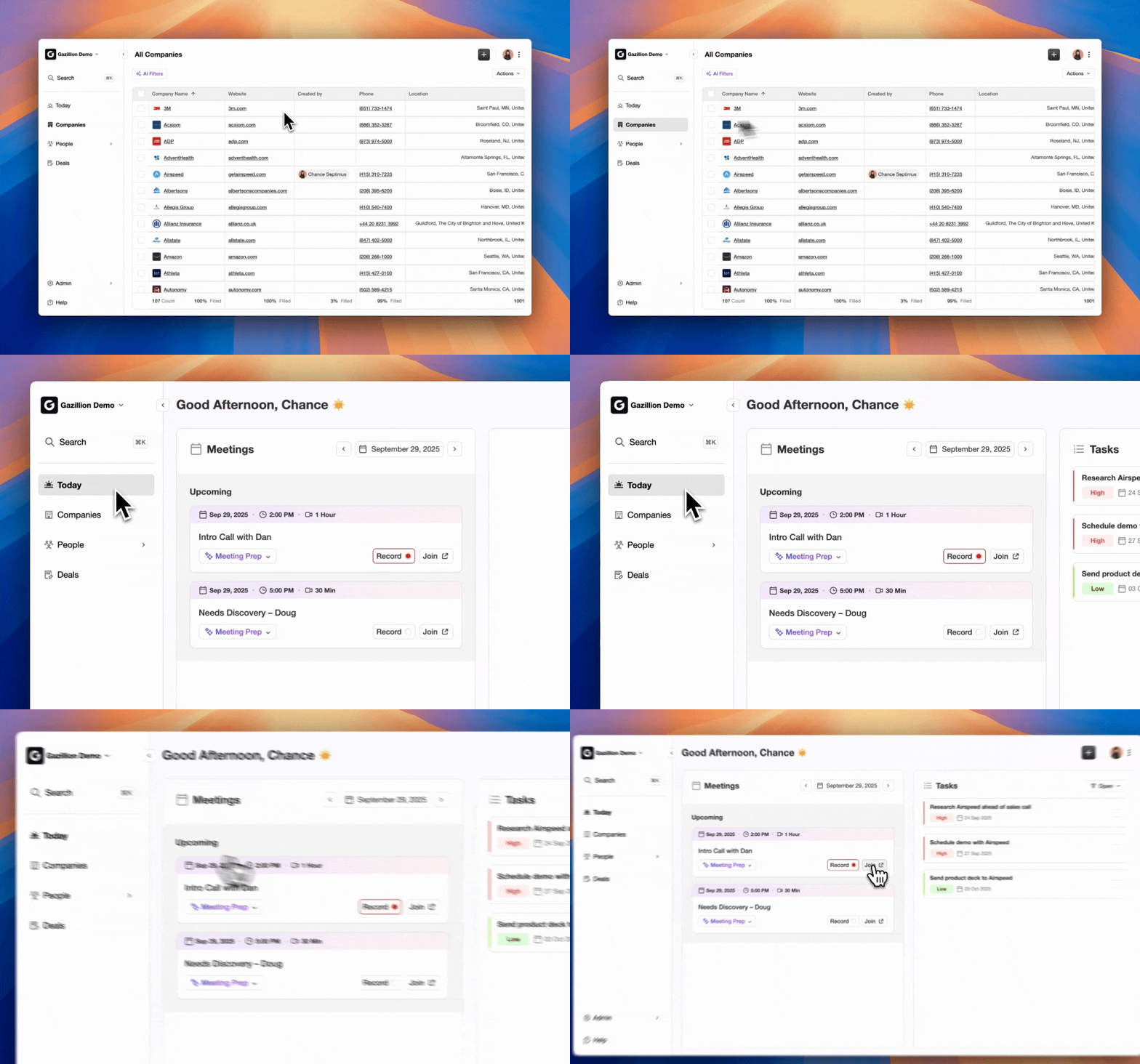
Coffee Companion operates as an intelligent agent that detects and alerts on stalled deals without manual configuration. After you authenticate with Salesforce, the Coffee agent immediately begins auto-logging activities from emails and calls. This behavior keeps LastActivityDate accurate, which native Salesforce often misses when reps skip logging.

Coffee Pipeline Compare detects stalled deals through week-over-week analysis and highlights opportunities that have lost momentum. Coffee AI search on deals, released in January 2026, answers natural-language prompts such as “Which deals are stuck in negotiation?” and “What is closing this month?” The agent fixes dirty data automatically, delivers faster detection, and saves 8 to 12 hours per week compared with manual methods.
Upgrade to agent alerts, and deploy Coffee’s autonomous detection free on Salesforce.
The following comparison shows how Coffee Companion autonomous detection compares with traditional Salesforce methods for setup time, accuracy, and time savings:
| Method | Setup Time | Detection Accuracy | Weekly Time Saved |
|---|---|---|---|
| Native Reports/Flows | about 3 weeks | Manual data reliant, high admin time waste | Limited |
| Einstein | Varies | AI flags (weekly retrain) | Moderate |
| Coffee Companion | Rapid | Autonomous logging and Pipeline Compare using ground-truth data | 8 to 12 hours |
Validating Salesforce Pipeline Alerts and Measuring ROI
Teams should validate their stalled deal alert system before relying on it for forecasts. Create a simulated stalled opportunity and confirm that alerts trigger correctly across email, Slack, or other channels. Monitor alert-to-close time, pipeline velocity changes, and detection accuracy rates over several weeks.
Coffee Companion reduces detection time and shortens sales cycles by managing data quality autonomously. Sales leaders gain more accurate forecasts because the system flags risk earlier and keeps activity data complete.
Scaling Salesforce Automation for Stalled Deals
Small to mid-market businesses can use Coffee Standalone as a full CRM with built-in stalled deal detection. Enterprise organizations can connect Coffee through the API for custom integrations while they maintain existing Salesforce workflows. Both approaches give teams consistent detection without adding manual admin work.
Salesforce Big Deal Alerts for High-Value Opportunities
Revenue teams can configure threshold-based filters to prioritize high-value stalled opportunities. Set deal amount minimums so critical revenue opportunities receive immediate attention when they show stalling indicators. This focus keeps leadership aligned on the deals that matter most.
Salesforce Deal Risk Notifications with Coffee and Einstein
Teams can combine Einstein predictive scoring with Coffee Companion autonomous logging for comprehensive deal risk management. This hybrid approach blends AI-powered predictions with accurate activity data for complete pipeline visibility. Sales managers see both the risk score and the real engagement history for each opportunity.
Stop stalled deals, and activate Coffee’s stalled deal alerts for Salesforce.
FAQ: Stalled Deals in Salesforce
What are the most reliable indicators that a deal has stalled in Salesforce?
The most reliable stalled deal indicators include stage duration exceeding the average time-in-stage, no activity logged for 14 or more days, missing prospect-confirmed next steps, and repeated close-date pushouts. These metrics provide objective criteria for identifying deals that have lost momentum, regardless of dollar value or assigned sales rep.
How does Coffee Companion integrate with existing Salesforce workflows?
Coffee Companion operates as an autonomous agent that connects to your existing Salesforce instance through standard OAuth protocols. The agent automatically syncs data, enriches records, and writes insights back to Salesforce without disrupting current workflows. It works alongside existing reports, dashboards, and automation while improving data quality and adding autonomous detection.
What security measures protect sensitive sales data when using AI agents like Coffee?
Coffee maintains SOC 2 Type 2 compliance and GDPR adherence for enterprise-grade security. All data processing occurs within secure, encrypted environments, and customer data is never used to train public AI models. The agent operates with read-write permissions only for authorized Salesforce objects, which protects data integrity and access control.
Can Coffee Companion detect stalled deals across multiple CRM platforms?
Coffee Companion supports both Salesforce and HubSpot integrations, which gives teams consistent stalled deal detection across platforms. The agent applies the same autonomous logging and Pipeline Compare analysis in each system. Organizations that use multiple CRM instances gain unified visibility into deal health.
How quickly can Coffee Companion be deployed compared to building custom Salesforce automation?
Coffee Companion deploys rapidly through simple OAuth authentication, while traditional Salesforce automation requires the multi-week configuration process mentioned earlier. The agent immediately begins autonomous data collection and stalled deal detection. Teams avoid manual rule configuration and ongoing maintenance that custom automation typically demands.