
Key Takeaways
-
Sales reps waste 71% of time on data entry, leaving only 35% for selling. AI automation can free 8-12 hours weekly for revenue work.
-
Audit data entry waste, unify tools, and automate CRM updates to remove manual logging and constant tool switching.
-
Use AI meeting bots and autonomous lead enrichment to save 30-45 minutes per meeting and cut research time sharply.
-
Adopt zero-entry logging from emails and calendars plus AI prospecting to push selling time above 50% with accurate pipeline tracking.
-
Measure ROI through hours saved, forecast accuracy, and quota lift. Get started with Coffee to turn reps into strategic sellers.
Step 1: Audit Your Reps’ Data Entry Waste
Start by quantifying how much time your team loses to manual work. Gen Z sales reps lose two full hours weekly to manual data entry, and experienced reps burn similar time on admin instead of relationship building.
Track these productivity drains for one week:
-
CRM data entry and updates
-
Meeting note transcription
-
Contact and company creation
-
Activity logging and follow-up scheduling
-
Tool switching between platforms
Then calculate the cost. If your average rep earns $80,000 annually and spends 10 hours weekly on data entry, that equals $20,000 in wasted labor per rep each year. A 10-person team burns $200,000 yearly on administrative busywork.
Step 2: Unify Fragmented Tools to Increase Sales Rep Productivity
Sales teams juggle an average of 6-8 tools daily, such as HubSpot for records, ZoomInfo for enrichment, SalesLoft for outreach, and Zoom for meetings. This constant switching drains focus and kills productivity.
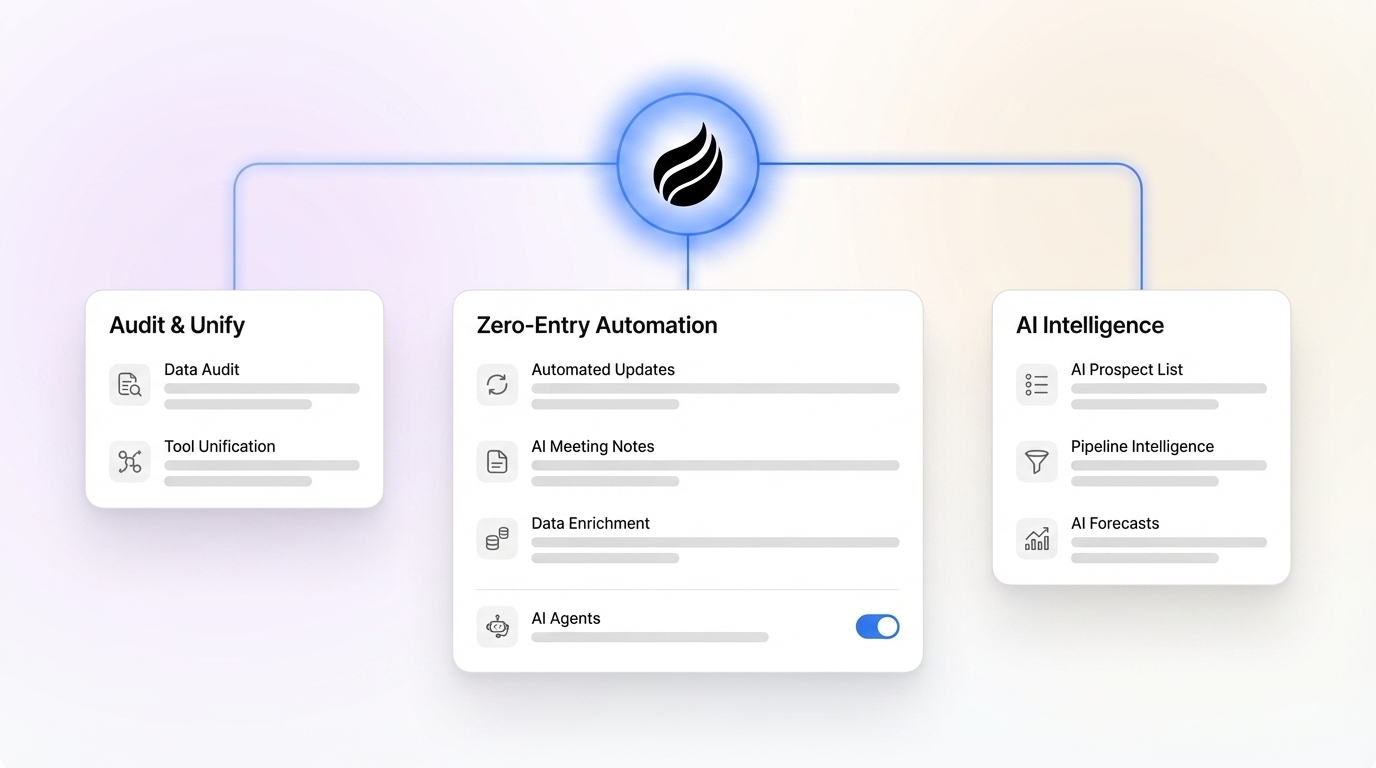
Coffee’s AI agent consolidates your stack by handling data unification, enrichment, meeting management, and pipeline intelligence. It replaces separate enrichment tools with built-in data partners. The AI meeting bot removes the need for standalone recording apps and also supports activity logging and follow-ups. All customer data flows into one intelligent system, which becomes your single source of truth without tool-switching overhead.
Teams save 8-12 hours weekly with Coffee’s automation. Coffee works as either a standalone CRM or a companion to your existing Salesforce or HubSpot instance.
Step 3: Automate CRM Updates for a Zero-Entry CRM
Legacy CRMs like Salesforce and HubSpot act as passive databases that constantly need manual updates. Coffee’s AI agent integrates with QuickBooks to automatically sync invoices and payment statuses, which removes the need for manual deal updates.
The agent handles contact and company creation from emails and calendars. It logs activities and next steps, creates tasks from interactions, and pulls revenue data from integrated payment systems.
CRM automation saves sales teams nearly six hours weekly, which enables more client interactions and higher close rates. Coffee’s agent keeps data clean and current without human effort.
Step 4: Use AI Meeting Bots to Eliminate Manual Notes
Manual meeting note-taking and follow-up creation consume hours every day. Coffee’s AI agent joins Zoom, Teams, and Google Meet calls to record and transcribe automatically, then produces tailored summaries and action items.

The meeting workflow becomes simple. Reps receive pre-call briefings with attendee context and deal history. Calls are recorded and transcribed automatically. After the call, summaries appear in BANT, MEDDIC, or SPICED format, and follow-up email drafts are ready for quick review and sending.
Reps save 30-45 minutes per meeting on notes and follow-ups. Teams that handle 20 or more meetings weekly can recover 10 or more hours of selling time, which feeds into the total weekly time savings described later.

Step 5: Enrich Leads Autonomously with AI Data Partners
Manual lead enrichment in tools like ZoomInfo and Apollo wastes hours on data hunting. Coffee’s AI agent automatically enriches contacts with job titles, funding data, and LinkedIn profiles via licensed data partners.
The autonomous enrichment process scans incoming emails for new contacts. It enriches each record with company size, funding, and technology stack. The agent identifies decision-maker roles and reporting structures, then flags high-value prospects based on your ICP criteria.
Teams remove $500-1000 in monthly enrichment tool costs while gaining better data quality. The agent ensures every contact enters your CRM complete and ready for action. These enrichment capabilities also expose the limits of traditional CRMs, which struggle to automate this depth of context.
Why Legacy CRMs Fail Reps in 2026
These enrichment and automation gaps reveal a core weakness in legacy systems. Salesforce and HubSpot rely on architectures built for structured data storage and struggle with intelligent automation for unstructured data. They force reps to translate conversations from email text or call transcripts into database fields by hand.
Coffee’s agent-first architecture handles both structured and unstructured data in a purpose-built data warehouse. Unlike legacy systems that often lose historical context, Coffee preserves full interaction history for accurate forecasting and deep deal intelligence.
Step 6: Implement Zero-Entry Logging from Unstructured Data
Email and calendar data contain rich sales intelligence that legacy CRMs usually ignore. Coffee’s agent automatically scans emails and calendars to log activities and next steps, which keeps deal state current without manual updates.
The agent extracts interactions and outcomes from email threads. It pulls stakeholder details from calendar events, attaches notes to the correct records, and updates current deal state on its own.
This unstructured data processing contributes to the total 8-12 hours saved weekly per rep mentioned earlier. It also improves forecast accuracy by capturing complete interaction history instead of partial notes.
Step 7: Time-Block Selling with Agent Support
AI automation cuts non-selling activities in half, saving reps 15 or more hours weekly for selling. This upper range reflects teams that fully use automation features and build on the 8-12 hour savings already discussed.
With AI handling administrative work, reps can reallocate time toward revenue-generating activities. Prospecting and outbound can grow from 20% to 40% of the week, while customer meetings and demos rise from 25% to 35%. This shift leaves 15% for deal strategy and relationship building, and administrative tasks shrink from 55% to just 10%.
Coffee’s agent carries the administrative load so reps can focus on high-value work that drives quota attainment. Get started with Coffee to reclaim your team’s selling time.
Step 8: Build AI Prospect Lists to Boost Sales Rep Productivity
Manual prospect research consumes about 40% of many sales teams’ time. Coffee’s AI agent builds targeted prospect lists via natural language commands, such as “Find VPs of Sales in North America at $10M+ funded companies using Salesforce.”

The List Builder feature uses integrated enrichment for precise targeting. It identifies buying committee members automatically, prioritizes accounts based on intent signals, and generates personalized outreach messaging.
AI-powered prospecting reduces research time from 20 minutes to 2 minutes per prospect, which creates a 10x efficiency gain and lets reps handle three to four times more opportunities. This kind of efficiency gain marks only the start of AI’s impact on sales.

AI Sales Agents: The 2026 Game-Changer
Gartner predicts that by 2028, AI will close 70% of sales cycles by automating prospecting, lead qualification, and negotiations. Early adopters already see major productivity improvements.
One tens-of-millions revenue company using Coffee replaced spreadsheet-based sales management with the agent’s automated pipeline tracking. They achieved accurate forecasting, removed manual reporting, and scaled their sales operation efficiently.
Step 9: Track Pipeline Intelligence Automatically
Manual pipeline reviews waste hours each week on data gathering instead of strategy. Coffee’s Pipeline Compare feature visualizes week-over-week changes automatically, which highlights progressed deals, stalled opportunities, and new additions.
Automated pipeline intelligence covers deal progression and regression tracking, stakeholder engagement scoring, competitive threat identification, and risk factor analysis with early warning alerts.
Sales managers save 3-5 hours weekly on pipeline preparation while gaining deeper insight into deal health and rep performance patterns.
Step 10: Measure and Improve with AI Forecasts
AI agents are expected to cut prospect research time by 34% and email drafting by 36% once fully rolled out. Track these gains so you can refine your automation investment.
Monitor key ROI metrics such as hours saved per rep weekly, with a target of 8-12 hours. Watch the increase in selling time percentage, aiming to move from 35% to above 50%. Track forecast accuracy improvement, with a target of 15-20% better, and deal velocity acceleration, with a target of 25-30% faster cycles.
Companies using AI sales tools achieve 83% revenue growth compared to 66% without AI. These productivity gains compound into meaningful quota attainment improvements.
Boost Sales Rep Productivity Now
These 10 steps shift your sales operation from manual data entry to an AI-powered revenue engine. Coffee’s agent handles the busywork while your reps focus on relationships and closing deals.
Whether you choose the standalone CRM or the companion app for Salesforce or HubSpot, the outcome stays consistent. Your team gains higher productivity and stronger quota attainment.
Get started with Coffee today to boost sales rep productivity with less data entry.
FAQ
How can I reduce CRM update time for my sales team?
Deploy an AI agent like Coffee that automatically logs activities, creates contacts, and updates deal stages based on email and calendar interactions. The agent removes manual data entry by processing unstructured data from existing workflows, saving 8-12 hours per rep weekly while keeping data clean and current.
What is the best AI solution for sales rep productivity?
Coffee’s AI agent stands out because it handles both structured and unstructured data in a purpose-built data warehouse. Unlike legacy CRMs that need constant manual input, Coffee proactively captures, enriches, and analyzes all customer interactions. It works as either a standalone CRM or a companion to existing Salesforce or HubSpot instances.
How do I calculate sales productivity ROI from AI automation?
Use this formula: (Time Saved × Hourly Rate × Quota Lift Percentage) – AI Tool Cost = Net ROI. For example, saving 10 hours weekly for an $80K rep equals $20K in annual value. Teams often see 25-35% quota lift from increased selling time, which can generate $50K or more in annual ROI per rep after tool costs.
How can AI agents increase sales rep productivity in 2026?
AI agents automate the 71% of time reps currently waste on data entry, meeting notes, and administrative tasks. They handle prospect research, CRM updates, follow-up scheduling, and pipeline tracking on their own. This shift frees reps to focus on relationship building and deal advancement, often doubling effective selling time and lifting quota attainment significantly.
What is the fastest way to boost sales rep productivity with less data entry?
Start with an AI agent that connects to your existing email and calendar systems and automatically captures and logs all customer interactions. This step immediately removes manual CRM updates while improving data quality compared with human entry. Coffee’s agent can be deployed in days and delivers noticeable productivity gains within the first week.