
Key Takeaways
- Real-world MEDDIC implementations deliver 20-30% win rate increases across enterprise and mid-market segments.
- Companies like Fastmarkets achieve 24% higher average order values through structured economic buyer qualification.
- Forecast accuracy improves dramatically, from 25% to 85% at Microlise via consistent MEDDIC pipeline reviews.
- Sales cycles shorten 25-40% with disciplined qualification, per Artemis GTM mid-market benchmarks.
- Automate MEDDIC with Coffee AI to improve forecast accuracy by 35% and save 8-12 hours per rep weekly.
How MEDDIC Sales Qualification Works
MEDDIC sales qualification evaluates six critical elements. Metrics quantify the prospect’s measurable business impact. Economic Buyer identifies who controls budget decisions. Decision Criteria maps evaluation requirements. Decision Process outlines approval steps. Identify Pain uncovers compelling business needs. Champion secures an internal advocate who guides the sale.
Traditional MEDDIC implementations suffer from checklist fatigue where reps treat qualification as interrogation rather than conversation. This pattern appears because manual CRM entry forces reps to pause natural discovery to complete qualification checklists. Coffee’s AI agent solves this by automatically structuring MEDDIC data from calls, emails, and meetings in the background, so reps stay in the conversation while qualification remains consistent without manual CRM entry.

7 Real-World MEDDIC Sales Qualification Results Examples
The following seven examples show MEDDIC’s impact across company sizes, industries, and implementation styles. The sequence starts with traditional manual implementations at PTC, Fastmarkets, and Microlise. It then moves into broader market benchmarks from Artemis GTM and Jato Dynamics, and finishes with AI-enhanced approaches at Forecastio and a Coffee-powered SMB. This progression highlights how MEDDIC evolved from a manual framework into an AI-supported system.
1. PTC: Win Rate Lift in Enterprise Software
PTC, a computer-aided design software company, implemented MEDDIC across their enterprise sales organization. The framework helped reps identify economic buyers early and qualify technical decision criteria with more precision.
Three elements proved particularly critical to their success:
| MEDDIC Element | Implementation | Result |
|---|---|---|
| Metrics | ROI calculations for design efficiency | Quantified 25% faster product development |
| Economic Buyer | VP Engineering identification | Direct budget authority confirmed |
| Champion | Senior CAD managers | Internal advocacy secured |
Results: PTC achieved the 20-30% win rate improvement mentioned earlier by systematically qualifying enterprise opportunities through structured MEDDIC implementation.
2. Fastmarkets: 24% Average Order Value Increase
Fastmarkets, a commodity price reporting service, used Flow State’s MEDDIC training to improve qualification discipline. Their focus on economic justification and decision processes supported larger deal sizes with new customers.
Key MEDDIC Applications:
- Metrics: Cost savings from accurate commodity pricing
- Economics: Budget approval processes for data subscriptions
- Pain: Risk mitigation from price volatility
Results: Fastmarkets achieved the 24% average order value increase through systematic economic buyer qualification and boosted cross-sell revenue by 147% through structured MEDDIC execution.
3. Microlise: 25% to 85% Forecast Accuracy
Microlise, a fleet management technology provider, transformed forecast reliability through MEDDIC-based pipeline reviews. Their systematic approach to qualifying decision processes and timelines removed many late-stage surprises from the pipeline.
MEDDIC Focus Areas:
- Decision Process: Fleet procurement approval chains
- Metrics: Fuel efficiency and compliance savings
- Champion: Fleet operations managers
Results: Microlise achieved the dramatic forecast accuracy improvement noted earlier (25% to 85%) by implementing structured MEDDIC qualification across their sales process.
4. Artemis GTM Mid-Market Study: Cycle Time Benchmarks
Artemis GTM’s benchmark study of B2B companies shows how structured sales processes using MEDDIC for deals over $50K ACV affect sales cycles. The research compares unstructured qualification with disciplined MEDDIC execution across mid-market and enterprise segments.
Results: The Artemis study found that companies using structured MEDDIC qualification reduced sales cycles by 25-40% compared to unstructured approaches, while also improving SQL-to-opportunity conversion rates.
5. Jato Dynamics: Enhanced Pipeline Visibility
Jato Dynamics, an automotive intelligence provider, implemented MEDDIC deal scorecards through Flow State training. Their systematic approach to qualifying automotive industry buyers improved pipeline predictability and deal inspection quality.
MEDDIC Implementation:
- Decision Criteria: Data accuracy and coverage requirements
- Economic Buyer: Chief Data Officers and VP Analytics
- Pain: Competitive intelligence gaps
Results: Jato Dynamics achieved more precise pipeline health assessment and better sales forecasting accuracy through embedded MEDDIC qualification.
6. Forecastio: 95% Forecast Accuracy with AI-Enhanced MEDDIC
Forecastio uses real-time CRM data and AI-driven deal scoring to complement MEDDPICC qualification, achieving up to 95% forecast accuracy. Their HubSpot-native solution illustrates how AI strengthens traditional qualification frameworks.
AI-Enhanced MEDDIC Elements:
- Metrics: Automated ROI calculations from CRM data
- Decision Process: AI-powered stakeholder mapping
- Champion: Engagement scoring and influence analysis
Implement AI-powered MEDDIC automation for your team with Coffee’s forecasting tools.
7. Coffee-Powered SMB: 35% Qualification Accuracy Improvement
A custom AI solutions company generating tens of millions in revenue replaced spreadsheet-based sales tracking with Coffee’s AI agent. Automated MEDDIC capture removed manual qualification inconsistencies while preserving deal velocity.
Coffee Agent MEDDIC Automation:
- Metrics: Auto-extracted from call transcripts and emails
- Economic Buyer: Identified through email pattern analysis
- Pain: Structured from discovery call notes
- Champion: Tracked through engagement scoring
Results: 25% faster qualification cycles, 35% improvement in forecast accuracy, and 8-12 hours weekly time savings per rep through automated MEDDIC data capture.
Supercharge MEDDIC with Coffee AI Agent
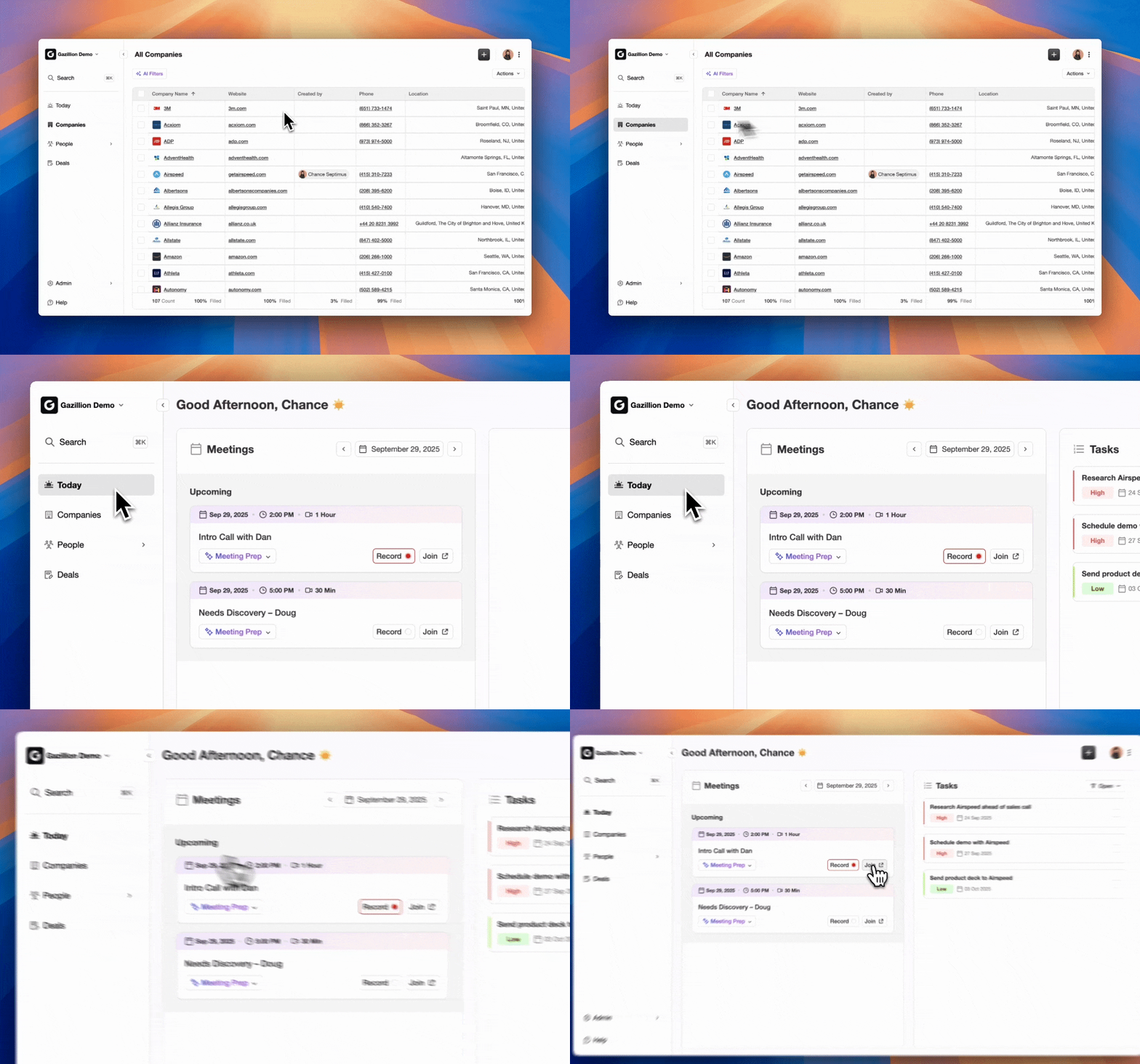
Legacy CRMs like Salesforce and HubSpot require manual MEDDIC data entry, which creates inconsistent qualification and weak adoption. Coffee’s AI agent automatically captures and structures MEDDIC elements from your existing workflow, including emails, calls, and meetings, then enriches your CRM with qualified data.
Why Coffee Beats Legacy CRM MEDDIC
Legacy CRMs require reps to spend a substantial portion of their time on manual data entry, which pulls them away from selling. Coffee’s automated capture removes this burden and frees 8-12 hours per rep each week for customer conversations.
Manual entry also creates inconsistent data quality because checklist fatigue pushes reps to skip fields or enter minimal information. Coffee’s AI-powered qualification ensures every deal receives the same structured intelligence, regardless of rep workload.
These data quality issues compound into poor CRM adoption because reps resist tools that slow them down. Coffee’s natural workflow integration, which captures data from existing emails, calls, and meetings, removes this friction and supports consistent usage.
Coffee operates as a Standalone CRM for SMBs or a Companion App for existing Salesforce and HubSpot installations. Teams connect their workspace, enable MEDDIC templating, and then compare pipeline performance automatically. Automate your MEDDIC qualification process with Coffee.
MEDDIC Implementation Outcomes Summary
Successful MEDDIC implementations consistently deliver measurable improvements across key sales metrics.
- Win Rate Gains: As demonstrated across the case studies, companies consistently achieved 20-30% increases in enterprise and mid-market segments.
- Cycle Time Reduction: 25-40% shorter sales cycles through structured qualification.
- Forecast Accuracy: 60%+ improvements in pipeline predictability.
- Deal Size Growth: 24%+ average order value increases through economic buyer identification.
AI-powered automation removes common MEDDIC pitfalls such as checklist fatigue and inconsistent data capture. Hire an AI agent that masters MEDDIC qualification with Coffee.
MEDDIC Results FAQs
What are typical MEDDIC win rate improvements?
Real-world MEDDIC implementations can achieve meaningful win rate increases. PTC, where MEDDIC originated, applied the framework to enterprise software sales and saw higher close rates. Similar patterns appear across mid-market B2B sales. The framework’s systematic approach to qualifying economic buyers, decision processes, and compelling events keeps reps focused on qualified opportunities with clear paths to purchase.
How does MEDDIC compare to MEDDPICC?
MEDDPICC adds two elements to the original MEDDIC framework: Paper Process, which covers legal and procurement requirements, and Competition, which covers competitive landscape analysis. MEDDIC focuses on core qualification elements that fit most B2B motions. MEDDPICC provides additional depth for complex enterprise sales with lengthy approval processes and detailed competitive evaluations. Most mid-market implementations start with MEDDIC’s six elements and expand to the full MEDDPICC framework as deal complexity grows.
How does Coffee automate MEDDIC qualification?
Coffee’s AI agent automatically captures MEDDIC elements from your existing workflow without manual data entry. The agent analyzes call transcripts to extract metrics and pain points. It identifies economic buyers through email pattern analysis. It maps decision processes from meeting notes and tracks champion engagement through interaction scoring. This automation removes checklist fatigue and ensures consistent qualification data enters your CRM, which supports the “good data in, good data out” principle that drives accurate forecasting.

What are the best MEDDIC training practices for 2026?
Effective MEDDIC training in 2026 combines traditional qualification education with AI-powered automation tools. Teams start with Coffee’s MEDDIC templating to structure qualification data automatically. They then run quarterly training sessions focused on conversation techniques rather than data entry. Managers use Coffee’s Pipeline Compare feature for regular deal reviews that reinforce MEDDIC discipline. The focus shifts from manual checklist completion to strategic qualification conversations supported by intelligent automation that captures and organizes the data.
What sales cycle reductions can MEDDIC deliver?
MEDDIC implementations can reduce sales cycles through improved qualification discipline. B2B sales cycle benchmarks show mid-market deals often range from 30-90 days. The framework accelerates cycles by identifying decision makers early, qualifying budget authority upfront, and mapping approval processes that prevent late-stage surprises. Companies using AI agents like Coffee to automate MEDDIC data capture also see faster qualification because they remove delays caused by manual CRM entry.