
Key Takeaways
- Coffee ranks #1 as a fully agentic Monaco CRM alternative, with autonomous agents that remove ongoing manual oversight.
- Monaco uses a hybrid AI model that still needs human review, while Coffee automates data entry, enrichment, and pipeline tracking.
- Key evaluation criteria include automation depth, data unification, pipeline intelligence, pricing clarity, and integrations, where Coffee stands out.
- Coffee’s dual-mode setup (standalone or companion) supports SMBs and enterprises, with SOC 2 compliance and simple seat-based pricing.
- Teams can move beyond Monaco’s constraints by getting started with Coffee for a truly AI-native CRM in 2026.
How We Evaluate Monaco CRM Alternatives
Six core dimensions separate fully agentic platforms from legacy CRMs that only add surface-level AI features.
- Automation Depth: Full agent autonomy versus hybrid models that still rely on human review
- Data Quality Management: Automatic enrichment and unification versus manual data entry
- Pipeline Intelligence: Data warehouse insights versus basic relational database reports
- Pricing Transparency: Simple per-seat models versus complex tiered structures
- Integration Capabilities: Native connectors and Zapier support versus vendor lock-in
- User Experience: AI co-pilot assistance versus admin-heavy, form-based interfaces
Legacy CRMs struggle with unstructured data from emails, call transcripts, and meeting notes. Clean data foundations drive 40% increases in sales efficiency when teams unify this information through agentic automation. Coffee’s data warehouse architecture preserves historical context that traditional relational databases lose when fields change.
Using these six criteria as the evaluation framework, the list below ranks the top Monaco alternatives by AI automation strength and overall value.
Top 10 Monaco CRM Competitors Ranked by AI Automation
1. Coffee – Fully Agentic CRM Leader
Coffee operates as a truly autonomous CRM agent that removes the ongoing human oversight Monaco still requires. The Coffee Agent automatically creates and enriches contacts from Google Workspace and Microsoft 365, joins meetings as an AI bot for transcription, and generates summaries with clear next steps. Coffee’s Pipeline Compare feature then visualizes week-over-week changes without any spreadsheet exports or manual reporting work.
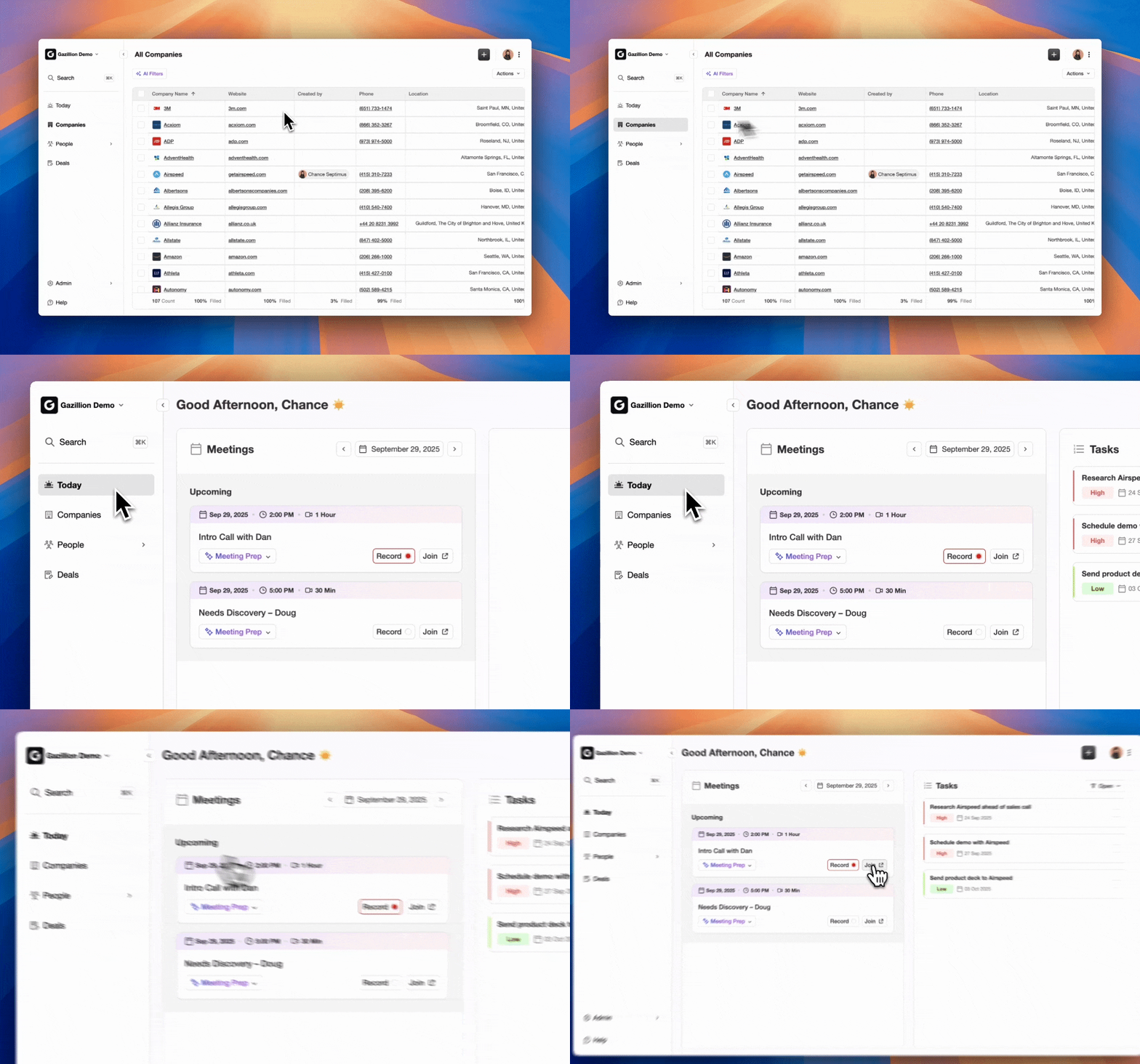
Strengths: Coffee supports dual-mode deployment, so teams can run it as a standalone CRM or as a companion to existing systems. SOC 2 compliance gives enterprises confidence in security and governance. Automatic activity logging feeds a built-in data warehouse, which keeps a full history of every change and interaction for accurate long-term analysis.

Best Fit: SMBs that want full automation and mid-market teams that need to enhance existing Salesforce or HubSpot instances
2026 Pricing: Simple seat-based model with unlimited agent labor included, which typically saves teams 8–12 hours per week compared with human-guided tools
| Feature | Monaco | Coffee |
|---|---|---|
| Data Automation | Human-guided workflows | Full agent autonomy |
| Enrichment | Manual-assisted | Automatic from licensed sources |
| Pipeline Insights | Real-time analytics | Warehouse-driven intelligence |
2. MarketBetter – AI SDR Command Center
MarketBetter ranks as a leading Monaco alternative for outbound teams, with advanced AI email automation, a FloBot chatbot for inbound engagement, and daily SDR Playbooks with prioritized actions. The platform delivers pre-meeting intelligence briefs and connects directly with HubSpot and Salesforce.
Best Fit: Teams that prioritize outbound automation while keeping their current CRM
3. Apollo.io – Prospect Database with Basic AI
Apollo offers a 210M+ contact database, email sequencing, and intent signals for prospecting. However, Apollo has basic AI features and lacks agentic workflows like chatbots, even though it includes website visitor tracking.
Best Fit: Sales teams that need a large prospect database with light CRM features
4. Attio – AI-Forward CRM with Flexible Data Model
Attio delivers AI-powered deal insights and a flexible data architecture that suits modern teams. At the same time, it does not include outbound automation, a dialer, or visitor identification. The product focuses on core CRM workflows rather than full-funnel sales automation.
Best Fit: Teams that want a modern CRM interface with AI insights but do not need deep automation
5. Clay – AI-Powered Outreach Automation
Clay specializes in AI-driven outreach sequences and data enrichment for highly personalized messaging. It does not function as a full CRM, so teams still need a separate system of record and integrations to manage deals and accounts.
Best Fit: Marketing and growth teams focused on top-of-funnel outreach
6. 11x.ai – Fully Autonomous SDR
11x.ai provides autonomous AI SDRs that run without human oversight and handle prospecting plus initial outreach. Deep integrations with Salesforce and HubSpot support bi-directional sync and real-time pipeline visibility for revenue teams.
Best Fit: Companies that want to replace human SDRs for outbound prospecting
7. Zoho CRM – AI-Powered Sales Assistant
Zoho CRM offers an AI-powered sales assistant for predictive analytics, lead scoring, and workflow automation. Pricing starts at €14 per user per month with annual billing.
Best Fit: Small businesses that need an affordable AI-enhanced CRM with Google Workspace integration
8. Salesforce – Enterprise AI Platform
Salesforce delivers AI-powered insights and automation with advanced reporting, starting at $25 per user per month. Its 25-year legacy architecture still struggles with unstructured data and can feel heavy for lean teams.
Best Fit: Large enterprises with complex, established workflows
9. HubSpot – Marketing-First CRM with AI Assistant
HubSpot includes an AI assistant for research and CRM summaries, along with a free tier and email automation. The platform integrates with more than 1,900 apps and started as a marketing tool that later added CRM features.
Best Fit: Marketing-led organizations with a strong inbound motion
10. Pipedrive – Visual Pipeline Management
Pipedrive focuses on visual deal tracking with straightforward automation features. It does not offer advanced AI agents and centers its value on simple pipeline visualization.
Best Fit: Small sales teams that want an easy, visual pipeline tool
Side-by-Side Comparison and Key Tradeoffs
| Competitor | AI Agent Depth | Data Handling | Best For |
|---|---|---|---|
| Coffee | Full autonomy | Warehouse + auto-enrichment | SMB standalone or enterprise companion |
| MarketBetter | SDR automation | External CRM integration | Outbound-focused teams |
| Apollo | Basic AI features | 210M+ prospect database | Data-heavy prospecting |
| Attio | AI insights only | Flexible data model | Modern CRM interface |
| Salesforce | Enterprise AI | Complex relational DB | Large enterprise workflows |
| HubSpot | Marketing AI | 1,900+ integrations | Inbound marketing teams |
Coffee typically saves 8–12 hours per week compared with Monaco’s human-guided workflows that still need manual checks. Monaco’s flat-fee beta pricing also lacks clarity when compared with Coffee’s straightforward seat-based model.
Why Coffee Fits Most Teams Better Than Monaco
Coffee’s dual-mode architecture gives teams flexibility without locking them into a single vendor. You can start with Coffee as a standalone CRM or deploy it as a companion agent on top of existing Salesforce or HubSpot instances. The platform maintains SOC 2 Type 2 compliance and connects through Zapier, with deeper native integrations on the roadmap.
Coffee’s autonomous agent handles enrichment, meeting coordination, and pipeline tracking without ongoing human review. Its data warehouse architecture, described earlier, keeps every historical change available for analysis, which supports accurate forecasting and coaching. Get started with Coffee to remove manual data entry from daily sales work.

Migration from Monaco and Coffee Implementation Guide
Migration from Monaco to Coffee starts with simple Google Workspace or Microsoft 365 authentication and usually finishes in days, not months. Once connected, the Coffee Agent begins auto-creating contacts and companies from email and calendar data. Teams should avoid keeping “shadow CRMs” in spreadsheets during this period, since that splits information and slows adoption.

Coffee’s API access supports custom prompt scripting for tailored briefings and automated workflows, which lets teams shape the migration to match their processes. For organizations that prefer a gradual shift, companion mode runs alongside existing Salesforce or HubSpot instances until the team is ready for full adoption.
Frequently Asked Questions About Monaco Alternatives
What are the top Monaco alternatives in 2026?
Coffee leads as the #1 agentic alternative, followed by MarketBetter for SDR automation, Apollo for prospecting data, and Attio for modern CRM interfaces. Coffee stands apart through full agent autonomy instead of hybrid models that still depend on manual oversight.
How does Monaco compare to Coffee.ai?
Monaco relies on human salespeople to monitor AI agents and prevent hallucinations, which adds ongoing labor costs. Coffee operates with full autonomy and uses a data warehouse to preserve historical context while handling both structured and unstructured data, going beyond Monaco’s basic CRM feature set.
What replaces Salesforce-like systems such as Monaco?
Coffee’s companion mode turns existing Salesforce or HubSpot instances into agentic systems without forcing a rip-and-replace project. The Coffee Agent manages data entry, enrichment, and pipeline tracking while teams continue using the familiar CRM interface.
What is the best AI CRM for SMBs in 2026?
Coffee’s standalone CRM delivers broad AI automation for small to mid-sized businesses that want fewer tools and less admin work. Monaco’s flat-fee beta pricing still comes with human dependencies, while Coffee offers transparent seat-based pricing with unlimited agent labor included.
How does Coffee pricing compare to Monaco?
Coffee uses simple per-seat pricing with all AI agent capabilities included in one plan. Monaco relies on flat-fee beta pricing and still requires human oversight, which increases total cost. Coffee also removes the need for separate enrichment tools, meeting bots, and pipeline tracking software.
Conclusion: Choosing Coffee as Your Monaco Replacement
Coffee emerges as the strongest Monaco alternative for teams that want true agentic automation in 2026. Monaco’s hybrid approach still needs manual oversight, while Coffee’s autonomous agent removes data entry and follow-up busywork. Dual-mode deployment and transparent pricing make Coffee a practical choice for both standalone CRM rollouts and upgrades to existing systems. Get started with Coffee today to experience fully autonomous CRM management.