
Key Takeaways
-
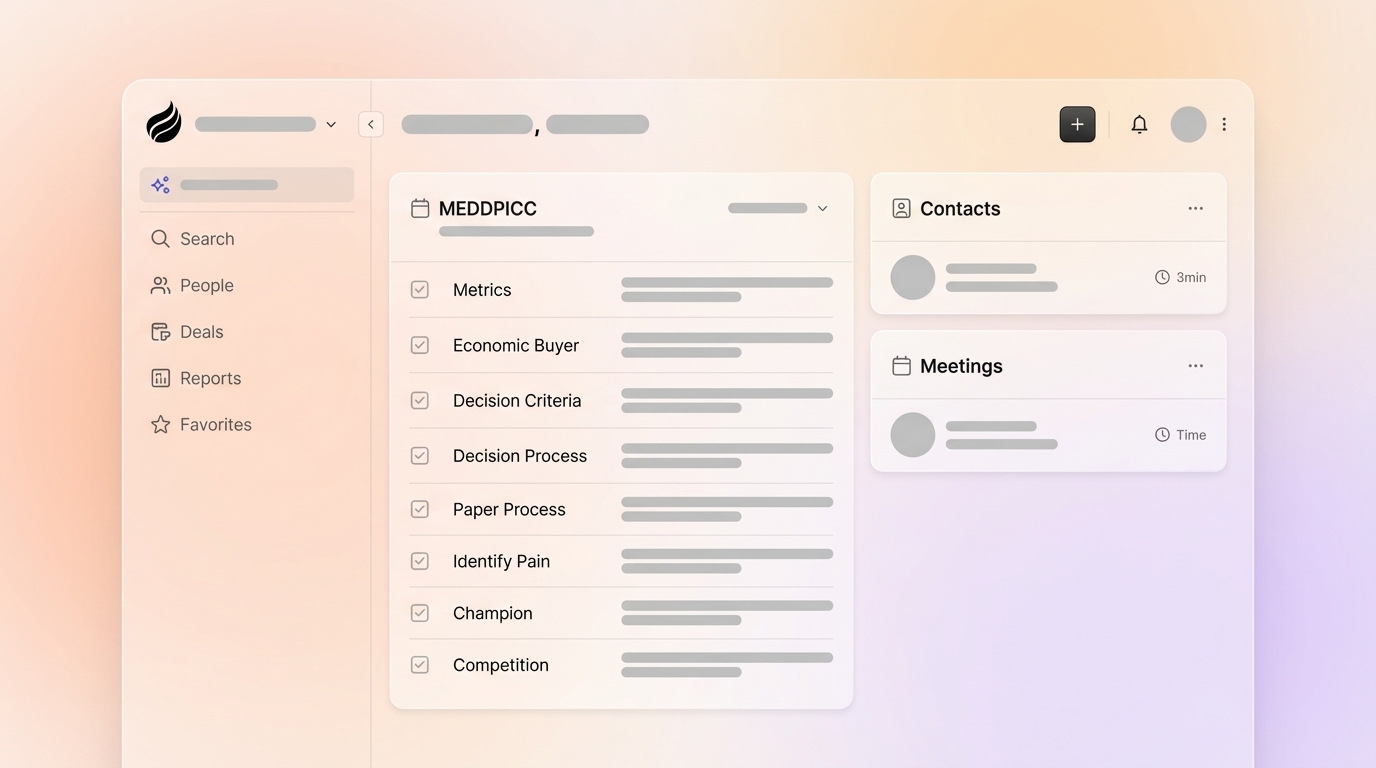
MEDDPICC is an advanced sales qualification framework with eight elements: Metrics, Economic Buyer, Decision Criteria, Decision Process, Paper Process, Identify Pain, Champion, and Competition.
-
The framework evolved from MEDDIC and now supports complex enterprise procurement and competitive environments.
-
Each element uses targeted discovery questions to confirm deal viability, such as quantifying ROI for Metrics or mapping approvals for Decision Process.
-
A 1-4 scoring system across all elements creates a clear deal health scorecard so teams focus on the strongest opportunities.
-
Sales teams can scale MEDDPICC qualification with Coffee’s AI agent CRM, which auto-captures and structures deal data from calls and emails.

MEDDPICC Elements and What They Cover
MEDDPICC represents eight qualification elements that enterprise sales teams use to judge deal strength and forecast accuracy.
-
Metrics, quantified ROI and measurable business outcomes
-
Economic Buyer, the person with final budget authority
-
Decision Criteria, evaluation standards and requirements
-
Decision Process, internal buying steps and approvals
-
Paper Process, legal, procurement, and administrative workflows
-
Identify Pain, specific business problems that require solutions
-
Champion, internal advocate with organizational influence
-
Competition, alternative vendors and status quo options
This framework grew out of the original MEDDIC methodology and now reflects modern enterprise buying, including formal procurement and competitive evaluations.
Deep Dive into Each MEDDPICC Element with Enterprise Examples
Metrics: Quantifiable Business Impact
Metrics refer to quantifiable results that demonstrate the value of the solution to the customer, such as new sales, cost savings, or productivity improvements. For a $100K CRM implementation, metrics might include a 20% reduction in sales cycle time or a 15% increase in lead conversion rates.
Key discovery questions:
-
How will success be measured?
-
What is the current baseline performance?
-
What ROI timeline does leadership expect?
Economic Buyer: Final Decision Authority
Economic Buyer in MEDDPICC measures final budget authority in enterprise sales, validated by a direct meeting scheduled, confirmed decision authority, and budget allocation discussed. This person can override objections and approve purchases without additional authorization.
Discovery questions:
-
Who has final approval for this investment?
-
What is your budget approval process?
-
Who signed off on similar purchases previously?
Decision Criteria: Evaluation Requirements
Decision Criteria are the specific conditions the prospect uses to evaluate and select a solution, including technical specifications, financial thresholds, and operational requirements. For cybersecurity solutions, criteria might include compliance with industry standards and robust encryption capabilities.
Discovery questions:
-
What factors will influence your final decision?
-
How will you score different vendors?
-
What are your non-negotiable requirements?
Decision Process: Buying Committee Steps
The Decision Process refers to the steps, timelines, and approval chains the prospect follows to make a purchasing decision. Large enterprises typically require IT, legal, and executive approvals that span six to nine months.
Discovery questions:
-
Who else needs to be involved in this decision?
-
What is your typical evaluation timeline?
-
What approvals are required before signing?
Paper Process: Legal and Procurement Workflow
MEDDPICC’s Paper Process covers post-verbal agreement steps like legal reviews, procurement, security reviews, and compliance. This element captures the enterprise procurement complexity that often stalls deals late in the cycle.
Discovery questions:
-
What is your contract approval process?
-
Who handles vendor onboarding?
-
What security reviews are required?
Identify Pain: Business Problem Urgency
MEDDPICC’s Implicate the Pain upgrades from MEDDIC’s “Identify Pain” by connecting surface symptoms to root cause business impact and personal implications. The 3 Whys technique explores three angles of urgency: Why change, why your solution, and why act now.
Discovery questions:
-
What is the cost of maintaining the status quo?
-
How soon before this problem becomes critical?
-
What happens if you do not solve this?
Champion: Internal Advocate
Champion in MEDDPICC measures internal advocate with influence in enterprise sales, validated by introductions to the Economic Buyer, shared internal dynamics, and coaching on winning strategy. True champions risk their reputation to advance your solution inside the organization.
Discovery questions:
-
Who benefits most from solving this problem?
-
Who can introduce us to key stakeholders?
-
What internal obstacles should we expect?
Competition: Alternative Solutions
Competition in MEDDPICC measures alternative solutions considered in enterprise sales, validated by named competitive vendors, build vs. buy discussions, and status quo assessment. Status quo often represents the most dangerous competitor in enterprise deals.
Discovery questions:
-
What other solutions are you evaluating?
-
Have you considered building internally?
-
What do you like about your current approach?
MEDDIC vs MEDDPICC: Key Differences
The table below highlights how MEDDPICC’s added focus on Paper Process and Competition supports complex enterprise sales where procurement and rival vendors play a major role.
|
Element |
MEDDIC |
MEDDPICC |
Enterprise Benefit |
|---|---|---|---|
|
Paper Process |
Not included |
Legal/procurement steps |
Prevents late-stage delays |
|
Competition |
Not included |
Alternative solutions |
Competitive positioning |
|
Deal Complexity |
Mid-market focus |
Enterprise-optimized |
Handles five or more stakeholders |
|
Sales Cycle |
60-90 days |
90+ days |
Supports long-cycle qualification |
MEDDPICC expands the MEDDIC sales qualification framework by adding Paper Process and Competition, which makes it well suited for enterprise deals with complex procurement and active competition.
MEDDPICC Qualification Playbook and Checklist Template
Sales teams can apply MEDDPICC consistently by working through this eight-stage qualification checklist for every opportunity.
-
Metrics Discovery – Document quantified business outcomes and ROI expectations.
-
Economic Buyer Identification – Confirm final decision authority and budget control.
-
Decision Criteria Mapping – Understand evaluation standards and weighting.
-
Decision Process Documentation – Map stakeholders, timelines, and approval steps.
-
Paper Process Planning – Identify legal, security, and procurement requirements.
-
Pain Implication – Quantify cost of inaction using the 3 Whys technique.
-
Champion Development – Cultivate internal advocates with organizational influence.
-
Competition Analysis – Assess alternatives and define your differentiation strategy.
To assess deal health objectively, score each element on a 1-4 scale (1 = Unknown, 2 = Identified, 3 = Developing, 4 = Confirmed). This creates a 32-point scorecard that exposes qualification gaps and highlights where discovery is still weak. Any deal scoring below 24 out of 32 contains critical unknowns and needs deeper discovery before you move it to later stages.
Supercharge MEDDPICC with Coffee’s AI Agent CRM
Manual sales qualification often consumes 8-12 hours each week in legacy CRMs like Salesforce and HubSpot. Coffee’s AI agent automatically captures key deal information from emails and calls and then structures notes according to sales methodologies like BANT, MEDDIC, or SPICED. The agent also provides Pipeline Compare insights that show deal progression and remove the need for spreadsheet-based reviews. Book a Coffee demo to see how AI agents can automate your MEDDPICC qualification process.

Frequently Asked Questions
What is the 3 Whys in MEDDPICC?
The 3 Whys technique within MEDDPICC’s Identify Pain element helps reps move past surface-level issues and uncover real urgency. By asking why change is necessary, you reveal the business cost of staying with the status quo. Why your solution highlights differentiation against alternatives, and why now connects delays to measurable losses and personal consequences for stakeholders.
What is the difference between MEDDIC and MEDDPICC?
MEDDPICC extends MEDDIC by adding Paper Process, which covers legal, procurement, and administrative steps, and Competition, which tracks alternative solutions under review. While MEDDIC works well for many mid-market deals, MEDDPICC fits enterprise complexity with formal procurement processes and structured competitive evaluations that often appear in deals over $50K.
When should you use MEDDPICC vs simpler qualification frameworks?
MEDDPICC works best for enterprise deals with at least five stakeholders, sales cycles longer than 90 days, deal values above $50K, and formal procurement involvement. For smaller deals under $25K with shorter cycles, MEDDIC or BANT can provide enough qualification detail without adding extra process overhead.
How do you implement MEDDPICC in your CRM system?
Teams can implement MEDDPICC in a CRM by creating custom fields for each element and making them mandatory for stage advancement. Sales leaders then define scoring criteria on a 1-4 scale for every component and set minimum scores before deals progress. Training should cover discovery questions and evidence standards for each element so reps know what “confirmed” looks like.

What discovery questions work best for each MEDDPICC element?
Effective discovery questions include: Metrics, “How will you measure success?” Economic Buyer, “Who controls the final budget decision?” Decision Criteria, “What factors drive your evaluation?” Decision Process, “Who else needs to be involved?” Paper Process, “What is your contract approval workflow?” Pain, “What is the cost of inaction?” Champion, “Who benefits most from solving this?” Competition, “What alternatives are you considering?” See the detailed sections above for more context and validation criteria.
MEDDPICC turns enterprise sales qualification from guesswork into a repeatable, evidence-based process. By pairing this framework with strong discovery questions and CRM integration, sales teams improve win rates and forecast accuracy.
Get started with Coffee to master MEDDPICC qualification with AI-powered deal intelligence.