
Key Takeaways
- MEDDPICC extends MEDDIC with Paper Process and Competition, which increases win rates by 18-41% and deal sizes by 24% in complex enterprise sales.
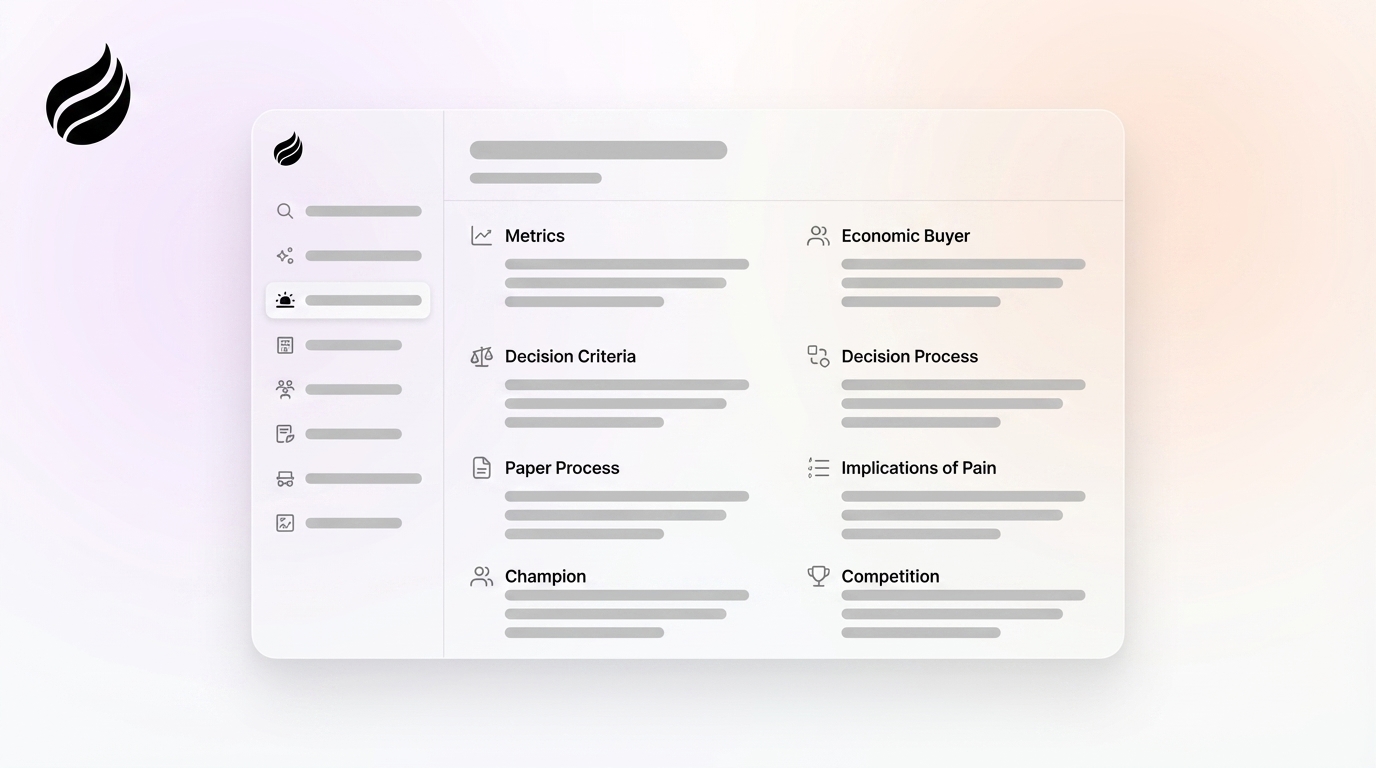
- Sales teams can master the 8 components — Metrics, Economic Buyer, Decision Criteria, Decision Process, Paper Process, Implications of Pain, Champion, Competition — using targeted discovery questions and CRM templates for each.
- Qualification rules such as 2-2-2 for mid-market deals and 3-3-3 for enterprise deals reduce late-stage failures by forcing early clarity on metrics, pain, and stakeholders.
- Embedding MEDDPICC in CRM workflows with 70%+ qualification thresholds and clear stage mapping creates more predictable forecasts and consistent execution.
- Coffee’s autonomous AI agent auto-captures data from emails and transcripts, then structures notes so every opportunity follows the same MEDDPICC standard.
MEDDIC vs MEDDPICC for Complex B2B Sales
The choice between MEDDIC and MEDDPICC depends on deal complexity and organizational requirements. MEDDPICC extends the original MEDDIC framework by adding Paper Process and Competition, which makes it a better fit for enterprise deals with formal procurement cycles and competitive evaluations.
The table below highlights how the two frameworks differ in scope and shows where MEDDPICC delivers the most impact in complex sales environments.
| Framework | Elements | Best For | Win Rate Impact |
|---|---|---|---|
| MEDDIC | 5 (Metrics, Economic Buyer, Decision Criteria/Process, Identify Pain, Champion) | Mid-market ($50K-$500K, 2-9 mo cycles) | Baseline |
| MEDDPICC | 8 (+Paper Process, Competition, Implications of Pain) | Enterprise ($100K+, 3-12 mo, 5-15+ stakeholders) | +18-41% |
73% of SaaS companies selling above $100K ARR use some version of MEDDPICC, and adoption rates doubled between 2021 and 2022. The framework addresses modern enterprise selling challenges where 28% of deals fail due to internal approval issues, while procurement complexity can add months to sales cycles.
The 2-2-2 rule sets an early qualification benchmark. Reps secure 2 metrics, 2 pain points, and 2 stakeholders by week 2 of engagement. For enterprise deals, the 3-3-3 rule applies with 3 metrics, 3 stakeholders, and 3 decision criteria by week 3.
To apply these rules effectively, sales teams need a clear view of each MEDDPICC component and practical ways to qualify them in live deals.
The 8 MEDDPICC Components with Questions and CRM Templates
1. Metrics
Metrics focus on quantifiable ROI tied to the prospect’s KPIs, such as a 25% increase in forecast accuracy or 15% improvement in close rates. Strong metrics connect directly to outcomes like revenue growth percentages, cost reductions, or time-to-market improvements.
Discovery Questions:
- What would a 20% reduction in ramp time mean for your team financially?
- How are you measuring success for this initiative today?
- If this project succeeds, what number changes on your dashboard in 12 months?
- What is the cost of maintaining the status quo?
Example: A SaaS company selling to a Fortune 500 tech firm quantifies that a 20% onboarding time reduction equals $2M in annual savings from fewer burned leads.
CRM Template: ROI Target: [X% improvement], Evidence: [Baseline metrics], Financial Impact: [$X savings/revenue]
2. Economic Buyer
The Economic Buyer is the individual with final budget approval authority, such as a CFO focused on cost savings or a VP of Sales or CRO under pressure to improve efficiency. Early involvement boosts win rates by 55%, while delayed access reduces them by 113%.
Discovery Questions:
- If you wanted to move forward tomorrow, what would the approval process look like?
- Who signs the contract?
- Who can veto the deal even if everyone else agrees?
- What are the Economic Buyer’s top priorities this quarter?
Example: In a $400K enterprise software deal, the CRO serves as Economic Buyer with independent approval authority and a clear focus on improving sales efficiency metrics.
CRM Template: Economic Buyer: [Name/Title], Access Level: [Direct/Indirect], Personal Metrics: [Their success criteria]
3. Decision Criteria
Decision Criteria cover technical features, cost, scalability, industry certifications, CRM integration, and data security compliance. Top performers shape these criteria with the champion so they align with the strengths of their solution.
Discovery Questions:
- What are the top three things your team is evaluating vendors on?
- What technical requirements are non-negotiable?
- How will you measure vendor success in year one?
- What criteria caused you to reject solutions in the past?
Example: A cybersecurity buyer prioritizes GDPR compliance, SOC 2 certification, and seamless Active Directory integration.
CRM Template: Technical Criteria: [Must-haves], Business Criteria: [ROI/timeline], Personal Criteria: [Career risk factors]
4. Decision Process
Decision Process covers steps, stakeholders such as IT, legal, procurement, and the CRO, timelines such as 6–9 months, and bottlenecks like board approvals. Reps map the full journey from evaluation to signed contract.
Discovery Questions:
- Walk me through how your organization has made similar decisions in the past.
- Who needs to sign off at each stage?
- What could slow down or accelerate this process?
- When do you need this implemented by?
Example: An enterprise software evaluation follows this path: technical review with IT for 4 weeks, business case with Finance for 2 weeks, executive approval with the C-suite for 2 weeks, then procurement and legal review for 4 weeks.
CRM Template: Stage 1: [Stakeholder/Timeline], Stage 2: [Stakeholder/Timeline], Bottlenecks: [Potential delays], Final Approval: [Authority/Date]
5. Paper Process
Paper Process qualifies procurement, legal, security, and administrative steps such as MSA redlines, security questionnaires, DPAs, vendor onboarding forms, and compliance reviews, which prevents enterprise deals from dying in procurement purgatory. These steps often add 30-90 days when teams do not address them early.
Discovery Questions:
- Does your legal team have a standard review timeline?
- What security certifications do you require from vendors?
- Once you decide to move forward, what does procurement look like?
- Who handles vendor onboarding and what is required?
Example: A Fortune 500 company requires a SOC 2 audit, penetration testing results, GDPR documentation, and a 6-week legal review for contracts over $100K.
CRM Template: Legal Requirements: [MSA/redlines], Security: [Certifications needed], Procurement: [Timeline/contacts], Compliance: [GDPR/HIPAA/SOX]
6. Implications of Pain
Implicate the Pain moves from surface pain to business impact to personal implication, which drives funding by tying the problem to job or career risk. Reps quantify the impact instead of stopping at basic problem identification.
Discovery Questions:
- What happens to the business if this problem is not solved in the next six months?
- How does this impact your team’s ability to hit targets?
- What is the cost of inaction?
- How will this affect your performance review?
Example: A sales manager misses quota because they spend more than 6 hours each week on manual research instead of selling, which risks both promotion and team credibility.
CRM Template: Surface Pain: [Symptoms], Business Impact: [Revenue/cost effect], Personal Stakes: [Career implications], Urgency: [Timeline pressure]
7. Champion
A MEDDPICC Champion has power, access, and motivation, which you test through actions such as scheduling an Economic Buyer meeting or presenting to a committee. Providing Champions with personalized ROI breakdowns helped close 25% more deals, especially when those champions also secure early Economic Buyer engagement.
Discovery Questions:
- What does solving this problem mean for you personally?
- Can you introduce me to the Economic Buyer?
- Who else internally supports this initiative?
- What would make you look like a hero?
Example: A regional sales director champions a CRM solution because success supports a promotion to VP and recognition for major efficiency gains.
CRM Template: Champion: [Name/Role], Power Level: [Influence scope], Access: [To Economic Buyer], Motivation: [Personal gain], Actions Taken: [Proof of advocacy]
8. Competition
Competition includes all alternatives such as incumbent solutions, competing vendors, and the do-nothing status quo with its implementation risk and inertia. In many enterprise deals, the status quo acts as the strongest competitor.
Discovery Questions:
- What other approaches are you evaluating?
- What happens if you decide to do nothing?
- Who else is in the running?
- What would cause you to stick with your current solution?
Example: A prospect evaluates Salesforce as the incumbent, HubSpot as a competitor, an internal build as an alternative, and the current spreadsheet process as the status quo.
CRM Template: Direct Competitors: [Vendor names/status], Indirect Alternatives: [Internal builds], Status Quo: [Current solution/inertia], Differentiation: [Our advantages]
Implementing MEDDPICC in Your CRM for Complex Deals
Sales teams get the most value from MEDDPICC when they embed it directly into CRM workflows. Best sales leaders require a minimum MEDDPICC score threshold of 70%+ before advancing a deal to the commit forecast, with each component worth 3 points for a total of 24.
Teams map MEDDPICC elements to deal stages so reps know what to capture and when. Discovery covers Metrics, Pain, and Champion. Qualification focuses on Economic Buyer and Decision Criteria. Proposal emphasizes Decision Process and Competition. Negotiation centers on Paper Process. This stage-based mapping ensures that reps collect the right information at the right time, which is why they also apply the qualification benchmarks mentioned earlier, such as 2-2-2 for mid-market and 3-3-3 for enterprise.
The strongest support for MEDDPICC qualification comes from Coffee’s autonomous agent. The agent auto-captures data from emails and call transcripts, structures notes according to MEDDPICC, and surfaces pipeline intelligence. Coffee’s Intelligence layer stores deep context on business model, product specifics, ICP, and competitors for tailored AI suggestions, while Custom Meeting Briefings and Summaries let users define exact formats.

A mid-market AI firm used Coffee’s agent and cut manual data entry by 8-12 hours each week. The team also improved pipeline visibility with automated Pipeline Compare features while maintaining consistent MEDDPICC qualification.
Get started with Coffee to bring this level of automation to your own sales process.
Ready-to-Use MEDDPICC Templates and Coffee Tools
Teams can deploy these copy-paste CRM field templates to start MEDDPICC implementation immediately.
Metrics Template: Current State: [Baseline numbers] | Desired State: [Target improvement] | Financial Impact: [Dollar value] | Timeline: [When needed]
Economic Buyer Template: Name/Title: [Contact info] | Authority Level: [Budget limits] | Access: [Direct/through Champion] | Personal Priorities: [Their success metrics]
Champion Template: Contact: [Name/role] | Influence: [Scope of power] | Motivation: [Personal stakes] | Actions: [What they have done] | Access to EB: [Yes/No]
Beyond static templates, Coffee’s List Builder supports natural language prospecting to identify the right stakeholders, such as “Build list of VPs of Sales in North America at companies with $10M+ funding using Salesforce.” Once teams identify prospects, they can keep the 3-3-3 enterprise benchmark in mind as they qualify opportunities. Coffee’s agent then structures notes according to MEDDPICC automatically so every deal follows the same qualification standard.

Common MEDDPICC Pitfalls in Complex B2B Sales
Sales reps often treat MEDDPICC as box-checking instead of an outcome-driven process, which produces weak data in deal reviews. The most frequent failures include champions without real influence, shallow competition analysis that ignores status quo alternatives, and surprise Paper Process steps that add 30-90 days to close dates.
Roughly 70% of CRM data is outdated, incomplete, or inaccurate, which creates more risk because critical signals such as leadership changes and competitive moves often live outside the CRM.
Coffee’s AI agent addresses these pitfalls by monitoring communications for MEDDPICC updates, generating structured notes from call transcripts, and keeping qualification data fresh without manual effort. The system blocks deals from advancing with incomplete qualification and provides real-time coaching on weak elements.

FAQ
What is a MEDDPICC example?
A Fortune 500 technology client used MEDDPICC to identify the Chief Revenue Officer as Economic Buyer, resolve a $2 million revenue leak through structured pain analysis, and close a $400,000 deal 60% faster than typical cycles. The framework also helped the team map procurement requirements early, which prevented late-stage delays that usually add months to enterprise sales.
How does Coffee integrate MEDDPICC?
Coffee’s autonomous agent captures data from emails, calendars, and call transcripts without manual CRM entry, then structures notes according to sales methodologies such as MEDDPICC. The Intelligence layer stores context on prospects’ business models and competitors, while Custom Summaries support tailored meeting note formats. This automation saves 8-12 hours each week and supports consistent qualification across all opportunities.
What is the 2-2-2 rule in sales?
The 2-2-2 rule requires qualification of 2 metrics, 2 pain points, and 2 stakeholders by week 2 of deal engagement. For enterprise deals, teams extend this idea with the 3-3-3 rule, which focuses on 3 metrics, 3 stakeholders, and 3 decision criteria by week 3. These benchmarks keep qualification front-loaded, which reduces late-stage surprises and improves forecast accuracy.
What is the MEDDPICC success rate?
Organizations that implement MEDDPICC report 18-41% higher win rates compared to unstructured qualification approaches. The framework also supports 24% larger deal sizes and 26% shorter sales cycles when teams apply it consistently and connect it to their CRM.
How do you implement MEDDPICC in CRM?
Teams add custom fields for each MEDDPICC component to opportunity records, make key fields required for stage advancement, and structure deal reviews around the framework. They also set minimum qualification thresholds, typically 70%+, before committing deals to forecast. Automation tools such as Coffee capture qualification data from communications and help maintain accurate CRM records.
MEDDPICC turns complex B2B sales from guesswork into a systematic qualification process when supported by automation and consistent execution. Coffee’s autonomous agent removes the manual burden while ensuring every deal receives thorough qualification based on proven enterprise sales methodology.
Start with Coffee today to automate your MEDDPICC workflow and capture the 18-41% win rate improvements that leading sales organizations report.