
Key Takeaways for Automating MEDDIC in SaaS
- The MEDDIC framework qualifies enterprise SaaS deals through six pillars: Metrics, Economic Buyer, Decision Criteria, Decision Process, Identify Pain, and Champion.
- Manual MEDDIC tracking consumes 71% of rep time on data entry, which produces incomplete records and stalls $100K-plus opportunities.
- The free Excel template includes SaaS-focused tabs for ARR calculations, churn modeling, auto-scoring, and MEDDPICC extensions.
- Coffee’s CRM Agent automates MEDDIC extraction from calls and emails, saving 8–12 hours each week and lifting win rates by 18%.
- Download the free template and start automating MEDDIC with Coffee to streamline qualification today.
The Problem: Manual MEDDIC Fails in Enterprise SaaS
The MEDDIC sales framework uses six pillars to qualify enterprise deals: 1) Metrics, which quantify economic impact such as ARR growth, 2) Economic Buyer, the budget decision-maker such as a CRO, 3) Decision Criteria, the evaluation factors including compliance, 4) Decision Process, the approval workflow and timeline, 5) Identify Pain, the specific business challenges, and 6) Champion, the internal advocate who drives the purchase. Originally developed at PTC in 1996 by Dick Dunkel and colleagues, MEDDIC helped grow company revenue from $300M to $1B in four years.
The following table shows how three critical MEDDIC pillars translate into practical SaaS questions and how they influence six-figure opportunities:
| Pillar | SaaS Questions | $100K+ Impact |
|---|---|---|
| Metrics | What’s the cost of current churn rate? | Justifies enterprise pricing |
| Economic Buyer | Who controls the software budget? | Ensures purchase authority |
| Champion | Who internally advocates for change? | Drives complex approval process |
Static templates ignore the automation needs of modern sales teams. Because these templates require manual logging across multiple tools, they create the exact inefficiencies the MEDDIC framework was designed to eliminate.
Free MEDDIC Excel Template Built for SaaS Teams
The comprehensive MEDDIC Excel template includes dedicated tabs for SaaS-specific metrics such as ARR impact calculations, churn reduction modeling, and expansion revenue projections. The template uses auto-scoring that weights each pillar based on deal complexity and produces instant qualification health scores. For teams that need additional qualification rigor, the template includes MEDDPICC extensions covering Paper Process and Competition analysis.
Access your free MEDDIC template through Coffee and see how automation upgrades your qualification workflow.
Why Traditional MEDDIC Tracking Breaks Down
Manual MEDDIC implementation contains fundamental flaws that weaken its impact. Sales reps spend 71% of their time on data entry instead of selling, while they toggle between CRM systems, call recording tools, and spreadsheets to maintain qualification records. This fragmented approach compounds the problem, because it produces incomplete data capture, inconsistent scoring, and stalled pipeline progression that generic, pre-2026 templates from traditional SERP results cannot fix.
The root cause is not the MEDDIC framework itself. The real issue is the manual execution model that slows teams down and hides critical deal signals. Solving this problem requires a shift from passive tracking tools to active automation that captures and structures data in real time.
The Solution: Automate with Coffee CRM Agent
How Coffee’s 2026 CRM Agent Automates MEDDIC
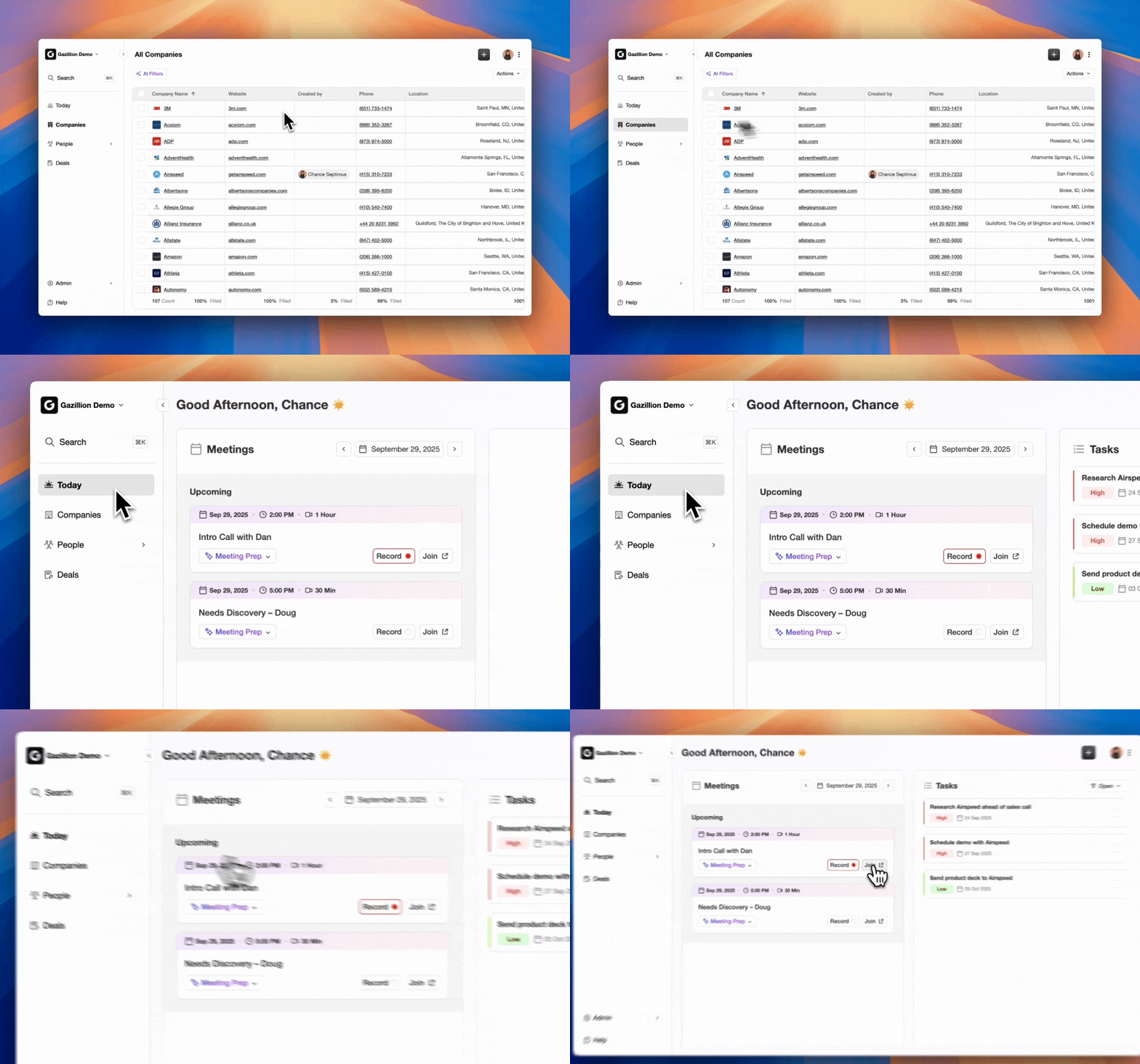
Modern sales teams need intelligent agents that handle qualification automatically instead of passive databases that demand manual input. Coffee’s CRM Agent scans sales calls and email conversations to extract MEDDIC data points, identifying metrics discussions, champion behavior, and decision process details without human intervention. Coffee’s February 2026 custom summaries feature lets teams structure call outputs according to MEDDIC pillars, which keeps qualification data consistent as it enters the CRM.
Sales reps currently spend 71% of their time on data entry, which equals roughly 28 hours in a 40-hour week. Coffee’s automation reclaims 8–12 of those hours weekly, so nearly a third of that wasted time returns to actual selling.
The following example shows how this automation works in a real enterprise SaaS opportunity and how it replaces manual note-taking.
In a typical enterprise SaaS deal, Coffee’s Agent automatically captures when a prospect mentions “reducing customer acquisition cost by 20%” for the Metrics pillar. The Agent identifies the VP of Sales as the budget holder for the Economic Buyer pillar and flags security compliance requirements for the Decision Criteria pillar based on call transcripts. This workflow removes manual note-taking while still maintaining complete qualification coverage.

The time savings become clear when you compare manual MEDDIC tracking with Coffee’s automated approach across three core qualification tasks:
| Task | Manual Time | Coffee Agent | Accuracy |
|---|---|---|---|
| Call note-taking | 45 minutes | Automated | High capture rates |
| MEDDIC scoring | 30 minutes | Real-time | Consistent criteria |
| CRM updates | 20 minutes | Instant sync | Zero data loss |
The principle of “Good Data In, Good Data Out” becomes realistic when an intelligent agent manages the input process. This shift frees 8–12 hours each week for selling activities instead of data entry.
See Coffee’s automated MEDDIC qualification in action and watch your CRM fill with complete, structured deal data.
Step-by-Step Implementation for Automated MEDDIC
Automated MEDDIC qualification rolls out through six clear steps. First, download the SaaS-optimized template. Second, map existing CRM fields to MEDDIC pillars. Third, connect Coffee Agent to email and calendar systems. Fourth, configure call recording integration. Fifth, set up automated scoring rules. Sixth, train the team on agent-assisted qualification reviews.

By automating data capture through steps three to five and standardizing evaluation through steps one and two, this approach significantly reduces qualification time per deal while improving data completeness. Reps spend less time updating fields and more time advancing real opportunities.
Common implementation pitfalls include weak champion identification and unclear decision processes. Research shows that organizations fully adopting MEDDPICC report 18% higher win rates. Additional studies confirm that teams with consistent methodology reinforcement achieve higher win rates than teams that rely on one-time training.
FAQ
What is MEDDIC for SaaS?
MEDDIC for SaaS adapts the traditional qualification framework to focus on recurring revenue metrics, subscription-based decision processes, and multi-stakeholder enterprise buying committees. The Metrics pillar emphasizes ARR impact, churn reduction, and expansion revenue instead of one-time purchase ROI. Decision Criteria expand to include SaaS-specific requirements such as API capabilities, data security certifications, and integration compatibility. The framework helps SaaS teams manage longer sales cycles and complex procurement processes that define enterprise software deals.
Where can I download the free Excel template?
The comprehensive MEDDIC Excel template for enterprise SaaS deals includes tabs for metrics calculation, stakeholder mapping, decision process tracking, and automated scoring. The template uses SaaS-specific formulas for ARR impact, churn cost analysis, and competitive positioning. It supports both MEDDIC and MEDDPICC variations, so teams can add Paper Process and Competition elements when deals involve complex enterprise requirements.
How does Coffee compare to Gong for MEDDIC automation?
Coffee functions as an active CRM Agent that automatically populates MEDDIC fields and maintains qualification records, while Gong primarily provides conversation analytics that require manual interpretation. Coffee’s Agent writes structured data directly to Salesforce or HubSpot, which removes the need for reps to translate insights into CRM updates. The Agent manages both structured data entry and unstructured content analysis, so teams receive a complete automation solution instead of only intelligence dashboards.
What MEDDPICC fields should I include?
MEDDPICC extends the core framework with Paper Process and Competition. Paper Process covers legal reviews, security questionnaires, and procurement workflows. These steps become critical for enterprise deals that involve compliance reviews and contract negotiations, which can add several weeks to close timelines. Competition analysis maps incumbent solutions and alternative vendors and also addresses “do nothing” inertia that often stalls decision-making.
How long does Coffee integration take and is it secure?
Coffee integration completes quickly through simple authentication with Google Workspace or Microsoft 365. The platform maintains SOC 2 Type 2 certification and GDPR compliance, which provides enterprise-grade security for sensitive sales data. Coffee’s Agent starts capturing and structuring data immediately after connection, and full MEDDIC automation becomes active within the first week of implementation.
What win rate improvements can I expect?
Teams that use structured MEDDIC qualification with automation typically see the 18% win rate improvement mentioned earlier when they maintain consistent application of the framework. The improvement comes from better deal selection, more thorough stakeholder engagement, and clearer value articulation throughout the sales cycle. Coffee’s automated approach keeps MEDDIC criteria applied across every opportunity, which removes the human error and incomplete data that undermine traditional manual qualification.
Conclusion: Turn MEDDIC into a Revenue Co-Pilot
Manual MEDDIC tracking recreates the problems it aims to solve, including wasted time, incomplete data, and stalled deals. A SaaS-optimized template combined with Coffee’s CRM Agent turns qualification from an administrative chore into a competitive advantage. Teams keep the structure and discipline of MEDDIC while protecting selling time from low-value data entry.
Start automating your MEDDIC process with Coffee to download your free template and experience qualification that turns your CRM into a pipeline intelligence engine.