
Last updated: March 30, 2026
Key Takeaways on CRM Data and Forecasting
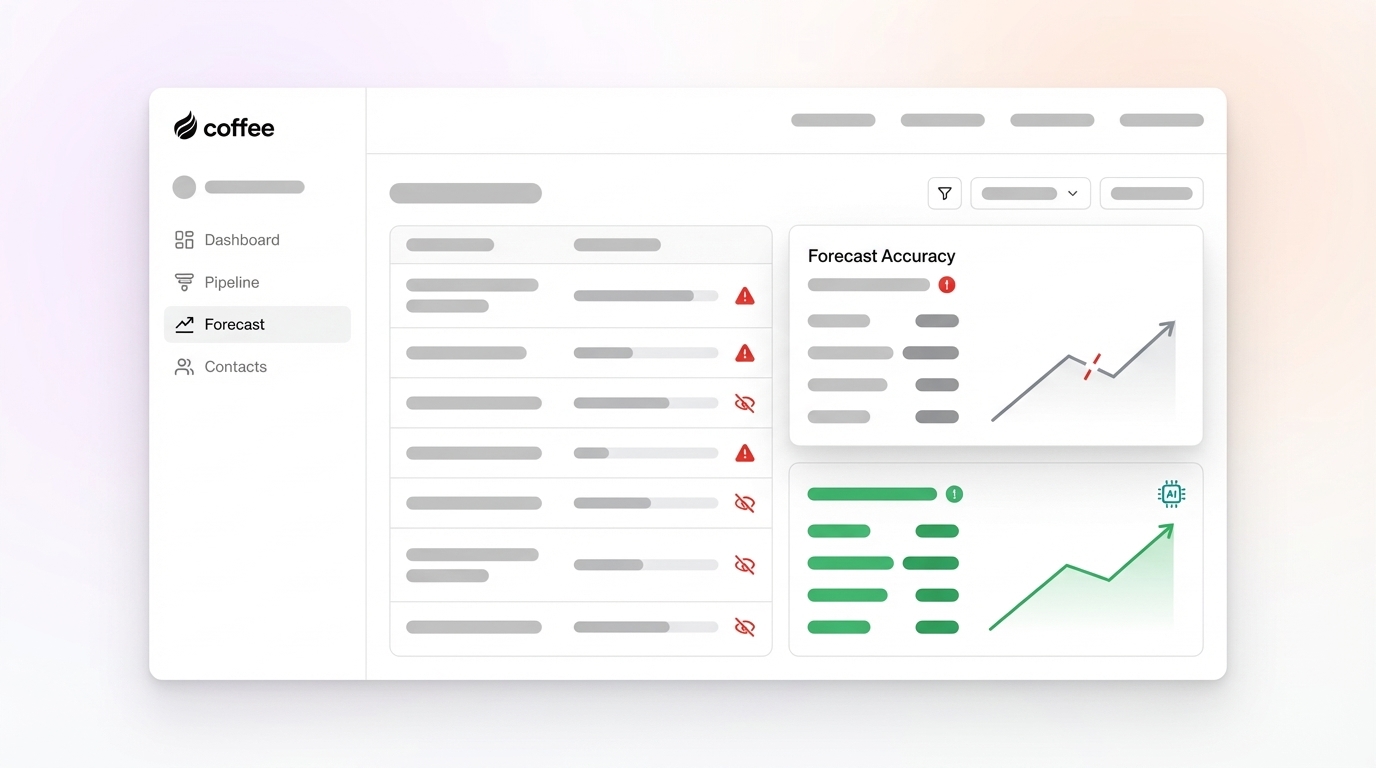
- Incomplete CRM data inflates pipelines with ghost deals, skews forecasts by 20-30%, and pushes resources toward deals that will never close.
- 79% of opportunity data never enters CRMs, which creates blind spots in win-rates, sales velocity, and AI-driven predictions.
- Poor data quality drives 15-25% annual revenue loss and forces reps to spend most of their time on manual entry instead of selling.
- AI forecasting breaks when fed bad data, creating garbage-in-garbage-out effects and eroding leadership trust, with 67% distrusting their systems.
- Coffee’s AI agent automates data capture from Google Workspace and Microsoft 365 for accurate forecasts; see pricing and start your free trial to eliminate these issues.
How Incomplete CRM Data Hurts Sales Forecasting
Incomplete CRM data creates six critical business failures that compound over time and undermine revenue predictability and strategic decisions. These failures start with pipeline distortion and then spread through every layer of your forecasting process.
1. Inflated Pipelines from Ghost Deals
Sales organizations routinely inflate their CRM systems with “zombie deals,” inactive prospects kept to maintain healthy pipeline coverage ratios. These ghost deals mask looming pipeline crises through artificial inflation of the 3x coverage rule, which creates false confidence in forecast models. The problem intensifies over time, because when deals sit dormant for 30+ days, they become 80% less likely to close, yet many teams still include them in projections. Teams keep these deals on the books because removing them would expose inadequate pipeline coverage. This pipeline inflation can skew forecasts by 20-30%, which leads directly to resource misallocation and missed targets.
2. Skewed Win-Rates and Velocity Blind Spots
Missing activity logs and incomplete deal progression data distort critical forecasting metrics. With 79% of opportunity-related data never entered into CRMs, sales leaders operate with massive blind spots in their velocity calculations and win-rate analyses. These invisible deals cannot be scored by AI, predicted in forecasts, or followed up by automation. The result is systematic underestimation of actual pipeline health and distorted views of how deals really move through stages.
3. Garbage-In-Garbage-Out AI Models
AI-powered forecasting tools only work when they receive high-quality structured data. When more than 25% of input data is unreliable, even sophisticated AI algorithms produce unreliable sales forecasts. Poor data inputs lead to “garbage in, chaos out” effects on sales forecasting, where instant AI answers become useless if they rely on stale, scattered, or irrelevant CRM data. This data drift starts as an analytics problem and quickly turns into a direct revenue risk.
4. Lost Revenue from Strategic Missteps
The financial impact of poor CRM data quality is severe and measurable. Companies lose 15-25% of annual revenue due to inaccurate sales forecasting driven by poor data quality, while 37% of CRM users report direct revenue losses from data quality issues. The revenue impact mentioned earlier, that 15-25% annual loss, comes directly from strategic missteps such as late follow-ups sent to wrong contacts, forgotten prior discussions, and decisions based on flawed pipeline intelligence.
5. Rep Time Waste at 71%
Sales representatives lose huge amounts of time compensating for poor data quality instead of selling. 71% of sales reps say they spend too much time on data entry, which leaves only 35% of their time for selling. This manual burden contributes to the data gap mentioned earlier, creating a vicious cycle of incomplete records and wasted effort. Teams sacrifice productivity to data quality tasks that intelligent agents can handle automatically.
6. Credibility Erosion for Leadership
Poor data quality steadily erodes leadership confidence in forecasting systems. 67% of large enterprise revenue leaders do not trust the sales forecasts coming out of their own systems, while 49% admit they often discover pipeline problems only after missing sales targets. This credibility gap is widespread, and it pushes leaders back to manual processes and spreadsheet-based analysis instead of the CRM investments they already made.
Ready to eliminate these forecasting failures? See how Coffee automates CRM data quality and restores forecast accuracy.
Consequences of CRM Data Deterioration Across the Business
CRM data deterioration creates cascading business consequences that reach far beyond forecasting accuracy. 44% of companies experience 10% or greater annual revenue loss specifically attributed to CRM data decay, and quota misses become inevitable when pipeline intelligence fails. Resource allocation turns inefficient as teams chase phantom opportunities, and competitive positioning weakens when deal intelligence lacks historical context and progression tracking.
How Strong CRM Data Improves Forecasting Accuracy
High-quality CRM data forms the foundation for accurate sales forecasting because it provides reliable inputs for predictive models. Organizations achieve 10-15% improvement in sales forecast accuracy within 30 days by addressing CRM data quality issues, while comprehensive data quality programs can raise forecast accuracy from 67% to 94%. The key is consistent, complete, and timely data entry, which AI agents like Coffee deliver through automation instead of fragile manual processes.
Coffee: AI CRM Agent That Prevents Forecasting Failures
Coffee functions as an autonomous AI agent that solves the core problem in legacy CRMs, the reliance on humans for data quality. Unlike passive databases such as Salesforce and HubSpot that demand constant manual maintenance, Coffee actively captures, enriches, and structures data from your existing workflows. The agent operates in two models, as a standalone CRM for growing businesses or as a companion app that enhances existing Salesforce and HubSpot instances.

6 Ways Coffee’s Agent Protects Forecast Accuracy
- Eliminates Ghost Deals: Automatic activity logging ensures every interaction updates deal status, which prevents zombie opportunities from inflating pipeline coverage.
- Captures Complete Data: Integration with Google Workspace or Microsoft 365 sends emails and calendar activities into your CRM automatically.
- Provides Clean AI Inputs: A structured data warehouse gives AI forecasting models high-quality, consistent inputs for reliable predictions.
- Saves Rep Time: Automated data entry and enrichment save reps 8-12 hours weekly per representative, so they can focus on actual selling.
- Delivers Accurate Metrics: Complete activity logs enable precise win-rate and velocity calculations based on real deal progression.
- Builds Leadership Trust: The Pipeline Compare feature provides week-over-week accuracy tracking without spreadsheets and restores confidence in forecasting systems.
Coffee’s agent manages the critical “data in” process through automatic contact creation, company enrichment, and activity logging from your email and calendar systems. The AI meeting management capabilities provide pre-call briefings and post-call summaries structured according to BANT, MEDDIC, or SPICED methodologies. The built-in data warehouse also preserves historical context that legacy CRMs lose when fields get overwritten.

| Feature | Coffee (Agent) | Salesforce/HubSpot | Day.ai |
|---|---|---|---|
| Auto Data Entry/Enrich | Yes (Emails/Calendars) | Manual | Partial (Unstructured only) |
| Pipeline Compare (WoW) | Yes (AI Insights) | Add-ons/Spreadsheets | No |
| Structured + Unstructured | Yes (Warehouse) | Structured only | Unstructured only |
| SOC 2/Security | Yes | Yes | Yes |
A company generating tens of millions in revenue from custom AI solutions shows Coffee’s impact in practice. They rejected Salesforce and HubSpot because of manual overhead and chose Coffee for automated data entry from Google Workspace, actionable pipeline intelligence through the Compare feature, and API access for custom briefing workflows. The result is scalable sales operations without the spreadsheet management that previously constrained their growth.

Transform your forecasting accuracy with automated data quality. Explore Coffee’s pricing plans and see the difference automation makes.

Frequently Asked Questions
What is the impact of bad CRM data on revenue projections?
Bad CRM data can cost companies up to 27% of annual revenue through failed deals, missed follow-ups, and strategic missteps based on inaccurate pipeline intelligence. The impact compounds as poor data quality undermines AI forecasting models, creates ghost deal inflation, and forces sales teams to waste hundreds of hours annually searching for correct information. Coffee’s AI agent prevents these losses by automating data quality from the source, your emails, calendars, and meeting transcripts.
How can CRM contribute to sales forecasting accuracy?
CRMs support forecasting accuracy when they provide clean, complete, and timely data inputs for predictive models. Organizations typically see 10-15% improvement in forecast accuracy within 30 days when they address data quality issues through automated processes. Coffee’s agent supports this improvement by capturing 100% of sales activities automatically, enriching contact and company data, and maintaining historical context in a built-in data warehouse that legacy CRMs lack.
What is the consequence of CRM data deterioration over time?
CRM data deterioration leads to pipeline inflation from ghost deals and skewed win-rate calculations, and nearly half of companies face double-digit revenue losses annually from this decay. As noted earlier, the consequences include unreliable AI predictions, wasted rep time on bad leads, and leadership that no longer trusts pipeline intelligence. Coffee prevents this deterioration through continuous automated data capture and enrichment.
How does Coffee integrate with Salesforce and HubSpot?
Coffee operates as a companion app through seamless authentication with existing Salesforce or HubSpot instances. The AI agent syncs data bidirectionally, enriches records, and writes valuable insights back to your primary CRM while maintaining SOC 2 Type 2 security standards. Teams keep their existing system of record and gain the benefits of automated data quality.
What about data security with Coffee’s AI agent?
Coffee maintains enterprise-grade security with SOC 2 Type 2 compliance and GDPR adherence. Customer data is never used to train public AI models, and all integrations follow strict security protocols. The agent processes data within secure, isolated environments and delivers automation benefits without introducing manual data entry risks.
Conclusion: Reclaim Accurate Forecasts Today
Incomplete CRM data turns sales forecasting from strategic advantage into operational chaos and can cost companies up to 25% of annual revenue through inflated pipelines, skewed metrics, and garbage-in-garbage-out AI predictions. Coffee’s AI agent solves this fundamental problem by automating the data quality process, capturing activities from your existing workflows, enriching records automatically, and providing the clean inputs that accurate forecasts require. Stop letting poor data quality undermine your revenue predictability. Start your Coffee trial and transform your CRM from a data entry burden into a reliable forecasting engine.