
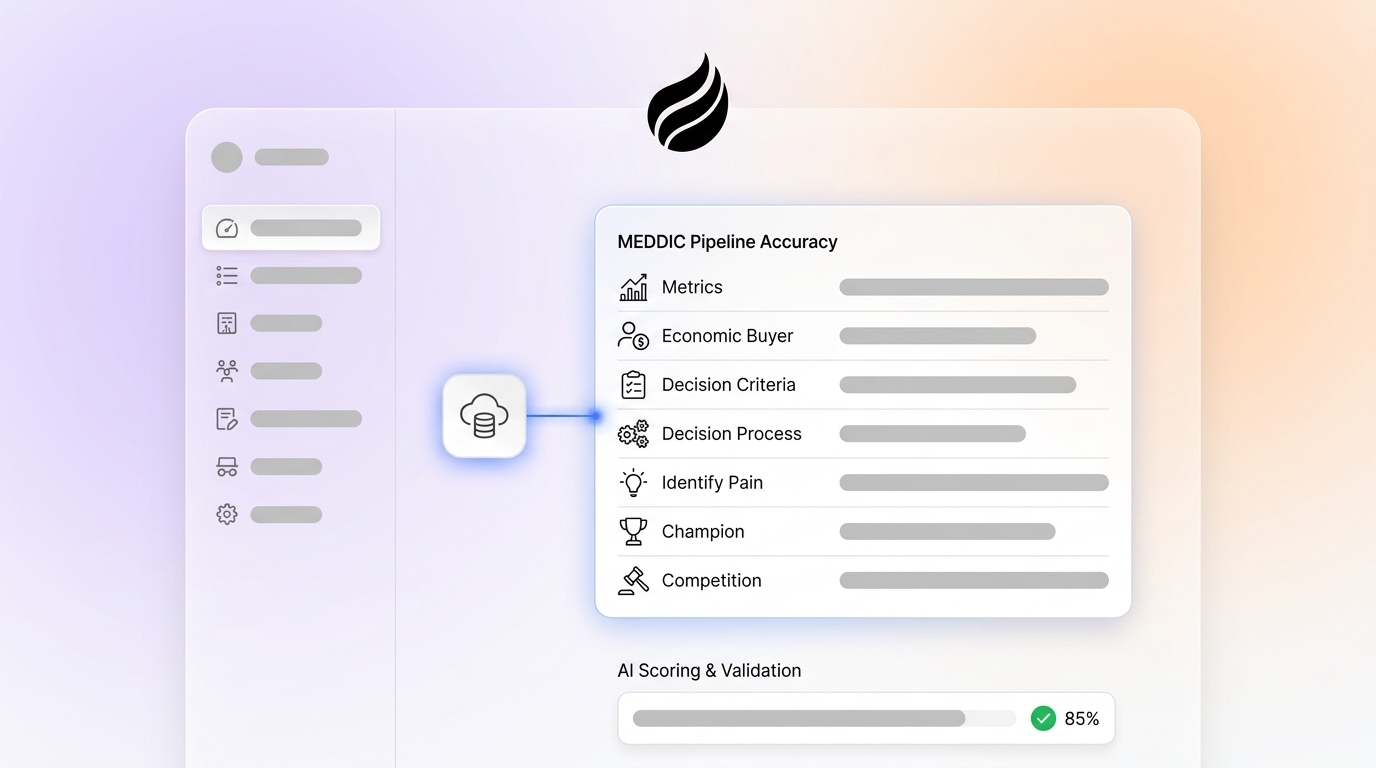
Key Takeaways
-
Embed MEDDIC fields with validation rules in CRM to prevent incomplete data and keep deal progression accurate.
-
Automate data capture from calls and emails using AI agents to remove manual entry and improve data quality.
-
Enforce the 3 Whys framework (Why Buy, Why Us, Why Now) with documented evidence for reliable qualification.
-
Use AI-powered deal scoring, risk flags, and stage exit criteria tied to MEDDIC completion for stronger forecasts.
-
Run weekly pipeline audits, and start with Coffee today to automate MEDDIC tracking and reach 85% accuracy.
Why Accurate MEDDIC Pipelines Matter for Revenue
MEDDIC acts as the qualification backbone for mid-market B2B sales teams and directly shapes forecast accuracy and revenue predictability. Poor pipeline accuracy creates cascading problems: teams with accurate, actively managed pipelines see 28% more revenue growth year over year, while inaccurate forecasts erode rep adoption and damage RevOps credibility.
2026 benchmarks highlight the impact of systematic MEDDIC implementation. Companies that track sales pipeline velocity weekly often achieve higher forecast accuracy compared to teams with irregular tracking patterns. Automation amplifies these gains: Coffee case studies document mid-market companies achieving 35% forecast accuracy improvements and 10-hour weekly time savings within their first month of implementation. Before implementing these automation strategies, verify your organization has the foundational elements in place.
Readiness Check for MEDDIC Automation
Successful MEDDIC implementation requires specific preconditions that work together to enable automation. You need Salesforce or HubSpot admin access to configure custom fields and validation rules. Your sales team must complete MEDDIC training so they understand what evidence to capture during customer conversations. Google Workspace or Microsoft 365 integration capabilities allow AI agents to access call transcripts and emails for automated data extraction. Finally, confirmed rep buy-in ensures your team will actually use the automated tools rather than bypassing them.
Timeline expectations stay short when these elements exist. Most teams reach 80% accuracy within 1-2 weeks of proper implementation. Coffee’s Companion App or Standalone CRM accelerates this timeline through guided setup and immediate data capture from existing interactions.

7-Step Guide to 85% MEDDIC Accuracy
1. Map MEDDIC Fields Directly in Your CRM
Start by creating custom fields for each MEDDIC component in your deal or opportunity object. Forecastio recommends adding custom fields such as “Expected Revenue Increase (%)” for Metrics, a dropdown for “Economic Buyer Name”, and a text field for “Customer’s Top 3 Criteria” for Decision Criteria. The table below shows the core MEDDIC elements to configure first, along with suggested field types and CRM setup details that form the base for later automation.
|
MEDDIC Element |
Field Type |
Example Configuration |
CRM Setup |
|---|---|---|---|
|
Metrics |
Number/Percentage |
Expected Revenue Increase (%) |
Custom field on Deal object |
|
Economic Buyer |
Dropdown/Lookup |
Economic Buyer Name |
Contact lookup field |
|
Decision Criteria |
Text Area |
Customer’s Top 3 Criteria |
Long text field |
|
Decision Process |
Multi-select |
Approval Steps Required |
Picklist with multiple values |
2. Add Validation Rules and Stage Gates
Set up validation rules that block deal advancement when MEDDIC data remains incomplete. Forecastio advises using CRM alerts and automation rules to require updates such as Metrics and Decision Process before progressing to the “Proposal Sent” stage. These rules keep reps honest and keep your pipeline grounded in evidence.
Common mistake: allowing deals to progress without validation gates creates inaccurate pipeline forecasts because reps advance deals based on optimism instead of proof. To prevent this, configure your CRM to block stage advancement when critical MEDDIC fields remain empty. The system then enforces discipline that manual processes rarely sustain.
3. Automate Data Capture from Calls and Emails
Deploy AI agents that extract MEDDIC information from sales interactions automatically. Momentum’s Autopilot analyzes sales calls in real time and updates CRM fields with extracted information. This type of automation keeps fields populated without constant rep effort.
Coffee’s agent follows the same principle by scanning email threads and call recordings to populate MEDDIC fields without manual entry. This approach saves reps 8-12 hours per week while keeping data consistent across all opportunities. These validation gates only work when fields stay populated consistently, which makes automation essential.

4. Implement the 3 Whys Framework with Evidence
The 3 Whys framework provides evidence-based validation for deal progression and keeps qualification grounded in customer reality. Each opportunity must answer three fundamental questions with documented proof. The table below maps each “Why” question to its required evidence type and shows how Coffee automates the capture of this validation data.
|
Why Question |
Required Evidence |
Validation Method |
Coffee Automation |
|---|---|---|---|
|
Why Buy? |
Quantified pain/opportunity |
Metrics documentation |
Auto-extracts from discovery calls |
|
Why Us? |
Competitive differentiation |
Decision criteria mapping |
Captures evaluation discussions |
|
Why Now? |
Urgency/timeline drivers |
Decision process timeline |
Identifies timeline triggers |
5. Use AI Scoring and Risk Flags on Every Deal
Realm’s MEDDPICC Completion AI Agent assesses qualification status for each of the eight MEDDPICC areas as “Qualified”, “Partially qualified”, or “Not qualified”, provides evidence summaries, identifies gaps, and generates an overall deal health score. This type of scoring gives leaders a quick view of deal quality.
Coffee’s pipeline intelligence delivers similar MEDDIC scorecards that automatically flag deals with incomplete qualification data. The system highlights risks before they distort forecasts and guides managers toward the specific gaps that need attention.
6. Enforce Stage Exit Criteria with MEDDIC Proof
Define observable, verifiable exit criteria tied to MEDDIC completion for each pipeline stage. HEIMDALL recommends exit criteria such as “ICP confirmed, BANT/MEDDIC criteria documented, meeting scheduled” for the Qualified stage and “pain points documented, key stakeholders identified, success criteria defined” for the Discovery stage. These criteria prevent premature stage advancement.
The table below outlines three critical stages where MEDDIC validation matters most. Each row shows which MEDDIC elements must be complete and what evidence sources confirm that completion.
|
Pipeline Stage |
MEDDIC Exit Criteria |
Required Evidence |
Validation Source |
|---|---|---|---|
|
Qualified |
Metrics + Economic Buyer identified |
Quantified impact + budget authority |
Discovery call notes |
|
Discovery |
Decision Criteria + Process mapped |
Evaluation factors + approval workflow |
Stakeholder interviews |
|
Proposal |
Champion confirmed + Pain validated |
Internal advocate + urgent business need |
Champion meetings + business case |
7. Audit and Compare Pipelines Every Week
Run weekly pipeline reviews using automated tracking tools to keep MEDDIC data current. Companies that track sales pipeline velocity weekly often achieve higher forecast accuracy, creating improvement over irregular tracking patterns.
Coffee’s “Compare” feature visualizes week-over-week pipeline changes, highlighting progressed deals, stalled opportunities, and new additions. The weekly tracking cadence mentioned earlier transforms pipeline reviews from interrogation sessions into strategic discussions focused on deal advancement and risk mitigation.
Validation and Success Metrics for MEDDIC
Monitor three key indicators to validate your MEDDIC implementation success. First, track data completeness rates to ensure you avoid the industry-standard problem where 91% of CRM data becomes incomplete, stale, or duplicated within a year. Your automation should keep this metric well below 20 percent.
Second, measure forecast accuracy improvements and target 85 percent accuracy within 30 days. This confirms that complete MEDDIC data translates into reliable predictions. Third, calculate time savings to confirm you are achieving the 8-12 hour weekly reduction mentioned earlier. If reps are not seeing this benefit, adjust your automation configuration and field mapping.
Get started with Coffee to automate your MEDDIC validation and achieve these benchmarks.
Why Coffee Fits MEDDIC Teams
Coffee’s Standalone CRM and Companion App solve the core challenge of MEDDIC implementation by automating evidence capture from unstructured data sources. Coffee introduced Custom Meeting Briefings and Summaries in February 2026, enabling users to define exact formats and focuses like high-level executive summaries or granular technical breakdowns. These features keep MEDDIC fields aligned with how your team actually sells.
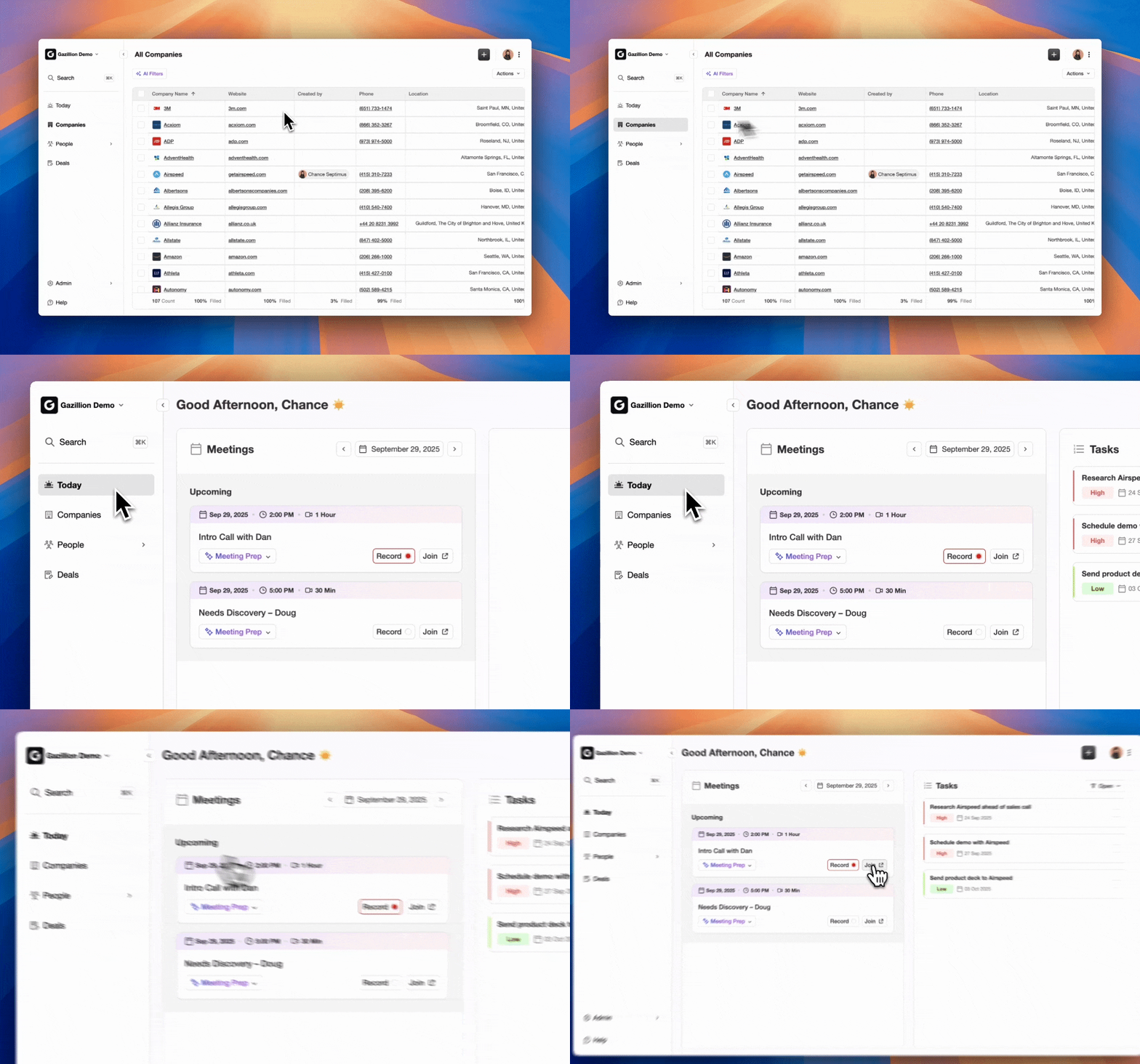
Unlike partial solutions from Avoma or Prospeo, Coffee provides comprehensive agent automation that works with both structured and unstructured data. This comprehensive approach means Coffee’s improved summary templates are customizable to match workflows and writable back to Coffee, HubSpot, or Salesforce, so MEDDIC data flows into existing systems instead of sitting in a separate silo. The result is measurable: Coffee case studies document improvements through this automated data capture and pipeline intelligence integration.
Coffee maintains SOC 2 Type 2 compliance and offers simple seat-based pricing without complex metering on AI usage. This combination makes the platform accessible for mid-market teams that need reliable MEDDIC automation without unpredictable costs.
Scaling MEDDIC Automation Across Team Sizes
Small businesses gain full MEDDIC automation by using Coffee’s Standalone CRM as their primary system of record. Mid-market teams can deploy the Companion App alongside existing Salesforce or HubSpot instances to enhance current workflows instead of replacing them. Advanced users use Zapier integrations to build custom workflows that route MEDDIC insights into downstream tools such as reporting dashboards or enablement platforms.
FAQ
How do you improve forecast accuracy with MEDDIC?
Teams improve forecast accuracy with MEDDIC by automating field population and evidence validation across every opportunity. Many organizations see 25-40 percent accuracy improvements after implementing automated data capture from sales interactions, enforcing the 3 Whys framework for deal progression, and establishing weekly pipeline tracking. The shift from manual entry to AI-driven evidence collection ensures complete, accurate MEDDIC data for each deal.
What are the 3 Whys of MEDDICC?
The 3 Whys framework validates deal progression through three evidence-based questions. Why Buy covers quantified pain or opportunity that requires immediate action. Why Us focuses on competitive differentiation that positions your solution as the preferred choice. Why Now addresses urgency drivers that create timeline pressure for decision-making. Each question requires documented evidence from customer interactions, not assumptions or rep opinions.
What are MEDDIC CRM best practices?
MEDDIC CRM best practices center on automation and clear validation rules. Create custom fields for each MEDDIC component with mandatory completion requirements. Implement stage gates that prevent deal advancement when qualification data remains incomplete. Deploy AI agents like Coffee to populate fields automatically from call transcripts and email interactions. Establish weekly pipeline audits to maintain data quality and forecast accuracy.
How does Coffee handle security and integrations?
Coffee maintains SOC 2 Type 2 compliance and GDPR adherence for enterprise security requirements. The platform integrates natively with Google Workspace and Microsoft 365 for automatic data capture. It also supports Salesforce and HubSpot through the Companion App. Coffee uses customer data exclusively for each specific instance and does not train public AI models on that data, which protects privacy and security.
What timeline should I expect for MEDDIC accuracy improvements?
Most teams achieve 80 percent MEDDIC accuracy within 1-2 weeks of proper implementation with automated tools, as noted in the readiness section. Manual implementations typically require 4-6 weeks to reach similar accuracy levels because of rep adoption challenges and data entry delays. Coffee’s agent automation accelerates this timeline by capturing MEDDIC data from existing sales interactions and populating CRM fields without manual effort.
Conclusion
Improving MEDDIC pipeline accuracy in CRM depends on systematic automation of evidence capture and field population. The seven-step approach of mapping fields, adding validation, automating capture, implementing 3 Whys, applying AI scoring, enforcing exit criteria, and running weekly audits turns unreliable forecasts into predictable revenue engines. Coffee’s agent automation removes the manual data entry that often sabotages MEDDIC adoption and creates the “good data in, good data out” foundation required for 85 percent forecast accuracy.
Deploy Coffee’s agent today for precise MEDDIC pipelines and reliable forecasting.