
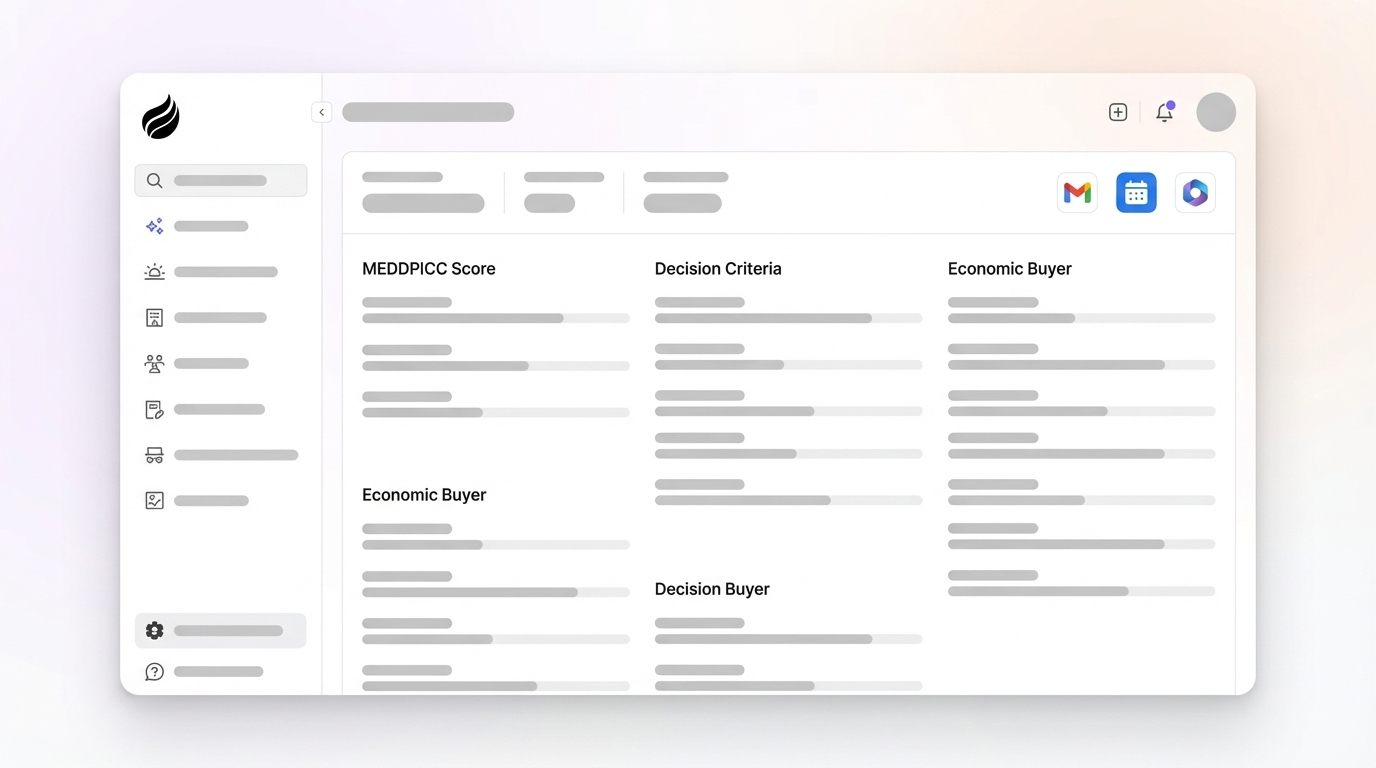
Key Takeaways for Enterprise MEDDPICC Success
-
MEDDPICC expands MEDDIC with Paper Process and Competition, suited to enterprise deals with 90+ day cycles and 6–10 stakeholders.
-
Teams follow a 7-step roadmap: map to sales stages, configure CRM fields, train reps, deploy AI capture, run weekly reviews, track the 10-3-1 funnel, and refine based on win/loss data.
-
AI automation with Coffee removes manual CRM entry by filling MEDDPICC fields from emails, calls, and meetings, which speeds qualification by about 30%.
-
Data decay and shadow CRMs are common pitfalls, while structured MEDDPICC tracking supports 25–40% win rate gains and shorter sales cycles.
-
Supercharge your MEDDPICC process with Coffee’s AI agent to automate qualification and improve forecast accuracy in complex enterprise sales.
MEDDPICC Framework Explained for Enterprise Sales
The MEDDPICC sales methodology expands the original MEDDIC framework by adding Paper Process and Competition elements for complex enterprise deals. MEDDPICC targets enterprise deals with sales cycles of 90–180+ days, high complexity, and multiple stakeholders (often 6–10+), so it helps sales teams navigate procurement steps and competitive evaluations with structure.
The table below breaks down each MEDDPICC element, its definition, and how enterprise teams apply it in real deals.
|
Element |
Description |
Enterprise Application |
|---|---|---|
|
Metrics |
Quantifiable economic impact and measurable outcomes |
ROI calculations, cost savings, revenue growth targets |
|
Economic Buyer |
Person with final budget authority and P&L responsibility |
C-level executives, division heads with spending power |
|
Decision Criteria |
Evaluation factors and requirements for vendor selection |
Security standards, integration capabilities, compliance needs |
|
Decision Process |
Internal buying process steps and stakeholder involvement |
Committee reviews, IT approvals, board presentations |
|
Paper Process |
Legal, procurement, and administrative requirements |
MSA negotiations, security questionnaires, vendor onboarding |
|
Implicate Pain |
Business problems with quantified cost of inaction |
Compliance risks, competitive threats, operational inefficiencies |
|
Champion |
Internal advocate with influence and willingness to act |
Department heads, project sponsors, influential end-users |
|
Competition |
Alternative vendors and “do nothing” status quo |
Incumbent solutions, competitive evaluations, internal builds |
Manual MEDDPICC tracking becomes overwhelming in enterprise environments where deals involve 7–10 stakeholders. Coffee’s AI agent structures meeting notes and email interactions according to MEDDPICC elements, so reps get complete qualification coverage without typing into CRM fields.

MEDDIC vs MEDDPICC for Different Deal Types
Sales teams choose between MEDDIC and MEDDPICC based on deal complexity and buying processes. MEDDPICC adds Paper Process and Competition elements to address process risks in enterprise sales, which makes it more effective for high-ACV, multi-stakeholder deals.
The comparison below highlights the differences that matter most when you select a framework, with a focus on how the PICC elements reduce enterprise deal risk.
|
Element |
MEDDIC |
MEDDPICC |
Why PICC Wins Complex Cycles |
|---|---|---|---|
|
Core Elements |
6 components |
8 components |
Addresses procurement and competitive blindsides |
|
Paper Process |
Not included |
Legal/procurement mapping |
Prevents 30–90 day delays in enterprise deals |
|
Competition |
Not included |
Competitive intelligence |
Identifies incumbents and alternative solutions |
|
Best Use Case |
ACV under $25K, cycles under 60 days |
ACV over $50K, cycles over 90 days |
Handles complex procurement and competition |
MEDDPICC becomes essential when procurement teams, security reviews, and formal evaluations appear in nearly every deal. Automate your MEDDPICC tracking with Coffee’s AI agent to remove manual qualification overhead and keep enterprise pipelines accurate.
7-Step MEDDPICC Rollout for Enterprise Sales Teams
Effective MEDDPICC implementation depends on embedding the framework into daily sales workflows and CRM usage. This structured rollout improves qualification accuracy and increases deal velocity across the team.
1. Map MEDDPICC to Sales Stages
Align each MEDDPICC element with specific pipeline stages to create progressive qualification. This staged approach means early pipeline stages focus on Metrics, Pain, and Champion identification, while later stages emphasize Decision Process, Paper Process, and Competition analysis as deals move toward close.
2. Configure CRM Fields and Automation
Create custom fields for each MEDDPICC element with mandatory completion at stage gates. These stage gates only work when you enforce them, so use automated reminders and validation rules to stop deals from advancing without complete qualification data.
3. Conduct Comprehensive Team Training
Deliver workshops with role-playing and real-life deal analysis to build consistent habits. Share discovery question templates and objection-handling scripts for each MEDDPICC element so reps know how to gather the right information.

4. Deploy AI-Powered Data Capture
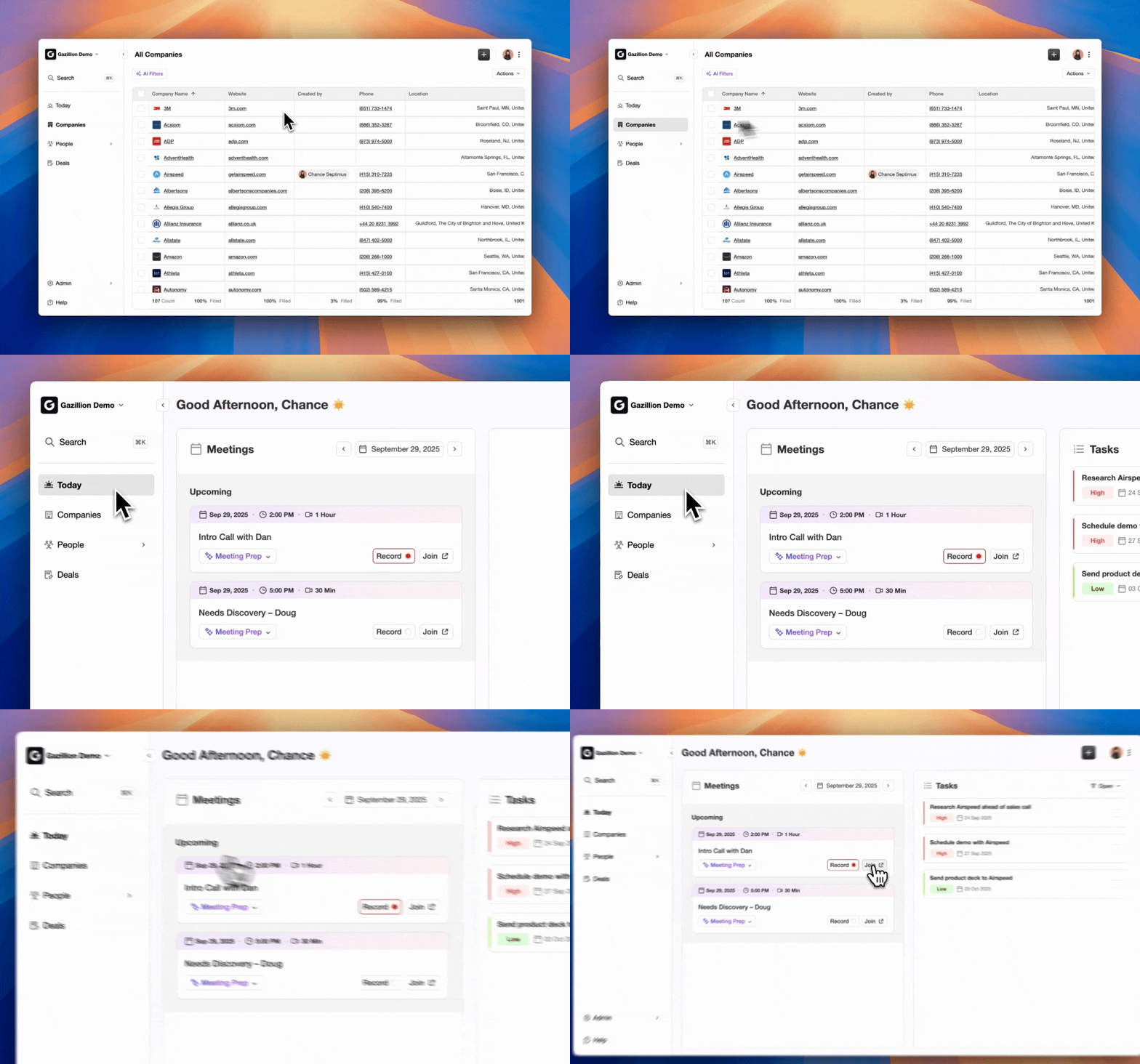
Coffee’s agent logs data from emails, calls, and meetings according to sales methodologies like BANT, MEDDIC, or SPICED, which removes manual entry while keeping qualification records complete. The system converts unstructured conversation data into structured fields that support MEDDPICC and similar frameworks.
5. Establish Regular Deal Reviews
Run weekly pipeline reviews that focus on MEDDPICC criteria instead of only close dates. Use framework-specific questions to test qualification depth and surface at-risk opportunities early in the cycle.
6. Track the 10-3-1 Rule
Monitor funnel progression where 10 suspects become 3 qualified prospects and then 1 closed deal. Coffee’s pipeline intelligence tracks these shifts automatically and flags deals that need deeper qualification or coaching.
7. Iterate and Refine Standards
Analyze win and loss patterns against MEDDPICC completion rates to tighten qualification rules. Well-qualified opportunities close at 50% versus 8% for poorly qualified ones per MeetRep’s 2026 benchmarks, which shows how strongly disciplined qualification predicts success.
Organizations that adopt structured MEDDPICC processes often see 25–40% win rate improvements and 30% cycle reductions through stronger qualification discipline and earlier risk discovery. To turn these gains into daily reality, teams need CRM templates that support the framework.
MEDDPICC CRM Template Design with Coffee Automation
Structured CRM fields make MEDDPICC practical at scale by capturing qualification data in a consistent format. Coffee’s AI agent then fills these fields from conversation intelligence, which removes manual typing while keeping records complete.
The table below shows example fields, Coffee data sources, and the specific automation benefits for each MEDDPICC element.
|
MEDDPICC Element |
Custom Field Example |
Coffee Auto-Populate Source |
Automation Benefit |
|---|---|---|---|
|
Metrics |
Expected ROI % (1–100) |
Email discussions, call transcripts |
Captures quantified value propositions automatically |
|
Economic Buyer |
EB Name & Engagement Level (1–5) |
Meeting attendees, email signatures |
Identifies decision-makers from interactions |
|
Decision Criteria |
Top 3 Requirements (text) |
Discovery call notes, RFP responses |
Extracts evaluation factors from conversations |
|
Paper Process |
Procurement Stage (dropdown) |
Legal discussions, contract mentions |
Tracks administrative progress automatically |
|
Champion |
Champion Influence Score (1–5) |
Internal advocacy actions, meeting facilitation |
Measures champion effectiveness objectively |
Coffee works as both a standalone CRM and a companion app for Salesforce and HubSpot, enriching fields from Google Workspace, Outlook, and Zoom. This approach removes the data entry burden that causes 71% of reps to spend too much time on data entry. See how Coffee transforms your MEDDPICC rollout with AI-powered field population and real-time qualification visibility.
Enterprise MEDDPICC Techniques and Pitfalls
Complex enterprise sales demand advanced stakeholder mapping and careful process navigation. Manual maintenance of MEDDPICC data takes sales reps 45–60 minutes per deal, which creates data lag and incomplete records that weaken forecast accuracy.
Effective MEDDPICC techniques include early pain implication through cost-of-inaction analysis, proactive paper process mapping to avoid procurement delays, and multi-threaded champion development across functions. This last element, champion cultivation, deserves special focus because it requires finding people who will take politically uncomfortable actions internally, not just friendly coaches who share information.

Common pitfalls include treating MEDDPICC as a post-call checklist instead of a live discovery guide, confusing economic buyers with champions, and leaving qualification fields untouched as deals evolve. Shadow CRMs and data decay affect 70% of organizations, so AI-powered automation becomes critical for keeping qualification data accurate.
Coffee’s agent addresses these challenges by monitoring email, calendar, and call data to update MEDDPICC fields as stakeholder dynamics change. This continuous orchestration keeps qualification data current throughout long enterprise sales cycles.
Proven Results with Coffee: Enterprise Case Study
Organizations that pair MEDDPICC with automation see meaningful performance gains. These improvements align with broader industry benchmarks and show how consistent qualification discipline scales across different enterprise environments.
One company generating tens of millions in revenue managed sales in spreadsheets before adopting Coffee’s AI agent. The team rejected traditional CRMs because of heavy manual entry but still needed structure to scale. Coffee’s automated data capture from Google Workspace kept their CRM clean without extra effort, and the Pipeline Compare feature automated weekly reviews, which improved pipeline accuracy and deal allocation. The AI agent converted unstructured conversations into usable insights while preserving the team’s agility.
Achieve similar results by letting Coffee’s AI handle qualification data capture automatically so your team can focus on strategy and closing.
FAQ
What is the MEDDPICC success rate?
MEDDPICC implementation often delivers 25–40% win rate improvements in enterprise sales environments. The framework works because it drives early risk identification, systematic stakeholder mapping, and thorough process navigation that reduces late-stage surprises. Organizations that reinforce MEDDPICC through coaching and CRM integration see about 27% higher win rates than teams that rely on one-time training without ongoing support.
What is the 10-3-1 rule in sales?
The 10-3-1 rule describes an ideal funnel where 10 suspects convert to 3 qualified prospects and then 1 closed deal. This ratio gives teams a simple benchmark for pipeline health and qualification strength. In MEDDPICC programs, the rule highlights when qualification standards are too loose or too strict, and Coffee’s pipeline intelligence tracks these shifts to guide coaching and deal focus.
What is the best CRM for MEDDPICC?
Coffee’s AI agent supports MEDDPICC by capturing qualification data from emails, calls, and meetings without manual entry. Unlike traditional CRMs that depend on reps filling every field, Coffee populates data from conversation intelligence and stakeholder interactions according to methodologies like MEDDIC. The system works as a standalone CRM for growing teams and as a companion app that enhances Salesforce or HubSpot. This automation removes the manual overhead that often derails MEDDPICC adoption while keeping data complete across long enterprise cycles.
When should I use MEDDIC vs MEDDPICC?
Use MEDDIC for deals under $25K with sales cycles shorter than 60 days and minimal procurement involvement. Choose MEDDPICC for enterprise deals over $50K with cycles longer than 90 days, multiple stakeholders, and formal buying processes. The Paper Process element in MEDDPICC covers legal, security, and procurement steps that can add 30–90 days to timelines. Competition tracking also becomes crucial in crowded markets where buyers compare several vendors. For mid-range deals from $25K to $50K, start with MEDDIC and add Paper Process elements once procurement friction appears.
Can you provide a MEDDPICC CRM template example?
Effective MEDDPICC CRM templates include custom fields for each element with clear scoring. Examples include Champion Influence (1–5 scale), Economic Buyer Engagement Level (dropdown: Not Identified, Identified, Engaged, Committed), Decision Criteria Status (text field for top 3 requirements), Paper Process Stage (dropdown: Not Started, In Progress, Legal Review, Approved), and Competition Assessment (multi-select for known alternatives).
Coffee fills these fields from conversation data according to sales methodologies like MEDDIC, which removes manual entry while keeping tracking complete. The system then surfaces real-time insights and gaps to guide sales actions and coaching.
Conclusion: Turning MEDDPICC into a Scalable System
MEDDPICC succeeds in complex enterprise sales when teams combine structured qualification with modern AI automation. This combination delivers faster qualification, more reliable forecasts, and higher win rates through disciplined stakeholder mapping and process control.
Coffee’s AI agent removes the manual work that often sinks MEDDPICC projects while capturing qualification data from every customer interaction. Transform your enterprise sales qualification with Coffee’s AI-powered MEDDPICC automation and give your team a system that supports how they actually sell.