
Key Takeaways
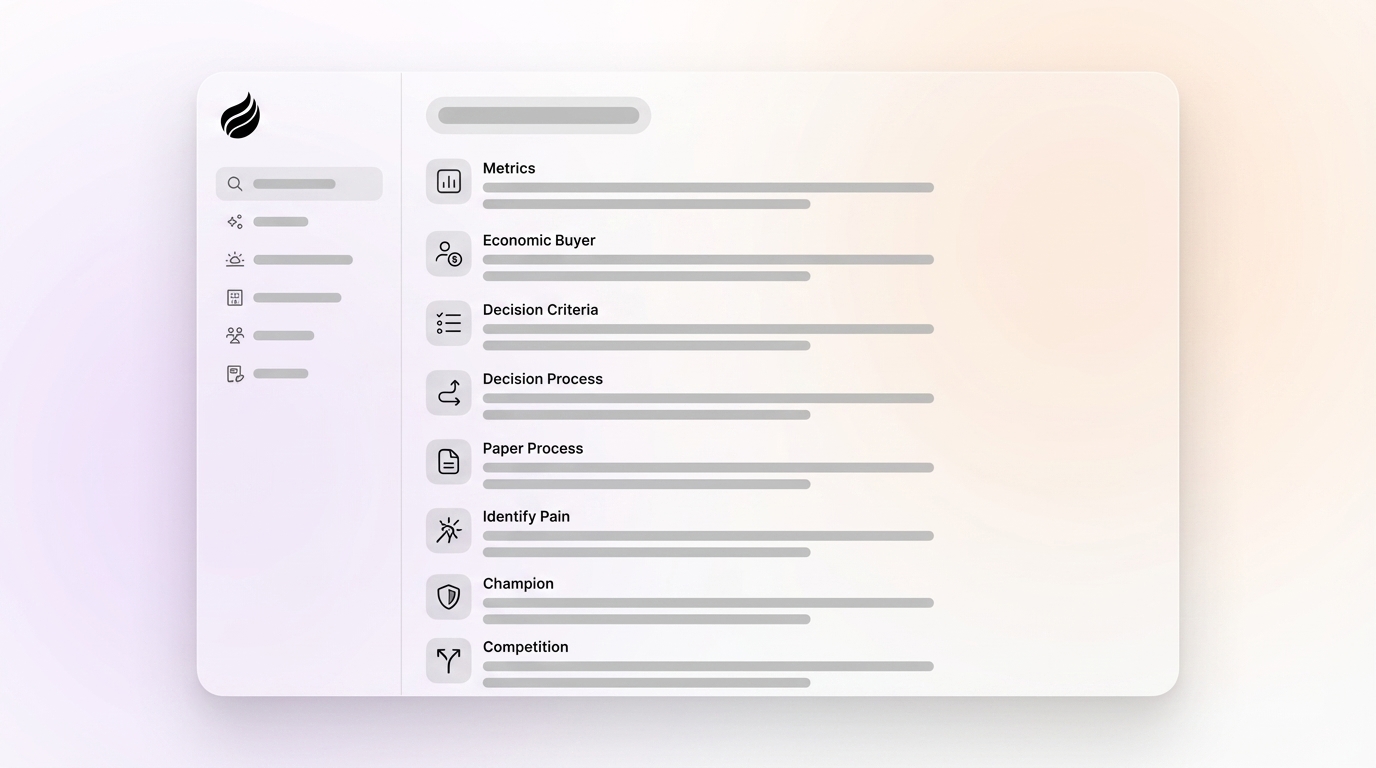
- MEDDPICC gives B2B teams a clear qualification checklist across Metrics, Economic Buyer, Decision Criteria, Decision Process, Paper Process, Identify Pain, Champion, and Competition.
- Master 32 proven discovery questions with simple scripts that quantify ROI, map buying processes, uncover pain, and separate you from competitors.
- High-impact questions include “What KPIs is your executive team tracking?” for metrics and “Who ultimately owns the budget?” for economic buyers.
- The 3 Whys (Why Anything, Why Us, Why Now) create urgency and tie your solution directly to prospect priorities.
- Use Coffee’s AI agent to log calls automatically, create structured notes, and sync MEDDPICC data to your CRM without manual entry.
Metrics Questions: Quantify the ROI First
Spotio rates MEDDPICC as “Excellent” for enterprise B2B deals because it starts with measurable outcomes. Begin by anchoring the conversation in numbers that matter to leadership.
1. “What KPIs is your executive team tracking?”
Why it works: This connects your solution directly to board-level priorities.
Script: “I want to make sure we’re aligned with your leadership’s focus. What KPIs is your executive team tracking that this initiative could impact?”
Once you know which KPIs matter most, help your prospect picture the specific impact of success.
2. “If we’re successful, what numbers change in your quarterly business review?”
Why it works: Forces prospects to visualize concrete outcomes.
Script: “Let’s fast-forward 12 months. If this project succeeds, what specific numbers will you be celebrating in your QBR?”
Now tie those outcomes to the cost of staying where they are today.
3. “What’s the cost of not solving this problem?”
Why it works: Quantifies the status quo pain in dollar terms.
Script: “Help me understand the financial impact. What’s this problem costing you monthly in lost revenue, wasted time, or missed opportunities?”
Finish by isolating the single metric that hurts most so you can build a focused business case.
4. “What metric is suffering most from this problem?”
Why it works: Identifies the primary pain point for economic justification.
Script: “Of all your performance indicators, which one is taking the biggest hit from this challenge?”
Coffee’s AI agent structures meeting notes according to MEDDPICC and captures quantified impact in structured data, which removes the need for manual note-taking.

Economic Buyer Questions: Find the Budget Boss
Once you have clear metrics and ROI, connect those numbers to the person who controls the budget. The Economic Buyer controls financial authority to approve budgets. Use these questions to find and understand that person.
5. “Who ultimately owns the budget for this initiative?”
Why it works: Creates a direct path to decision-making authority.
Script: “To ensure we’re building the right business case, who ultimately owns the budget for this type of initiative?”
6. “If everyone says yes but one person says no, whose no matters most?”
Why it works: Reveals the true veto power in the organization.
Script: “In your experience with similar purchases, if everyone’s aligned but one person has concerns, whose opinion carries the most weight?”
7. “Who is your organization’s go-to person for this business area?”
Why it works: Identifies functional ownership beyond budget authority.
Script: “When it comes to [relevant business area], who’s the go-to person your team looks to for direction?”
Coffee’s speaker tracking highlights key participants like economic buyers in meeting reviews and logs those interactions automatically.

Decision Criteria Questions: Uncover Must-Haves
After you know who signs off, clarify what they care about most. Decision criteria determine what your product must do to win. Capture these requirements early.
9. “What are your top 3 must-have features?”
Why it works: Prioritizes capabilities that matter most.
Script: “If you had to narrow it down to the top 3 must-have capabilities, what would they be?”
10. “How will you score each vendor?”
Why it works: Reveals the formal evaluation framework.
Script: “Walk me through how you’ll evaluate and score different vendors. What’s your scoring methodology?”
11. “What would cause you to eliminate a vendor from consideration?”
Why it works: Surfaces deal-killing criteria upfront.
Script: “What are the non-negotiables? What would immediately disqualify a vendor from your process?”
12. “Are we early enough to help shape the formal evaluation criteria?”
Why it works: Tests your ability to influence the buying process.
Script: “How finalized are your evaluation criteria? Is there room for input based on what we’ve learned from similar implementations?”
Coffee maps these responses into customizable summary templates that write back to your CRM, so evaluation criteria stay visible and consistent.
Decision Process Questions: Map the Path to Yes
Knowing what matters is only half the work. You also need to understand how those criteria get evaluated and who is involved at each stage. Mapping the decision process reveals every step from interest to contract.
13. “Walk me through every step from here to a signed agreement.”
Why it works: Uncovers the complete buying journey.
Script: “Help me understand your process. From where we are today to a signed contract, what are all the steps we need to navigate?”
14. “What happened the last time you purchased enterprise software?”
Why it works: Reveals historical buying patterns.
Script: “Thinking about your last major software purchase, how did that process unfold? What worked well and what didn’t?”
15. “Who needs to say yes before you can move forward?”
Why it works: Maps all stakeholders with approval authority.
Script: “Let’s make sure we don’t miss anyone. Who are all the people who need to give their approval for this to move forward?”
16. “What’s the typical timeline from approval to signature?”
Why it works: Sets realistic close date expectations.
Script: “Once you have internal alignment, what’s your typical timeline to get contracts signed and executed?”
Coffee structures this process in post-call notes using customizable templates, so you have a clear roadmap for each deal.

Paper Process Questions: Navigate Legal Hurdles
With the decision path mapped, you can now tackle the legal and procurement steps that often slow deals. MEDDPICC adds Paper Process to clarify procurement, legal review, and contract requirements.
17. “What does your legal team typically negotiate in contracts?”
Why it works: Prepares for common legal sticking points.
Script: “To help our legal teams work efficiently together, what areas does your legal team typically focus on during contract negotiations?”
18. “How long does procurement usually take once we have internal approval?”
Why it works: Builds procurement time into close dates.
Script: “Once you have internal buy-in, what’s your typical procurement timeline from approval to PO?”
19. “Do you require vendor security assessments?”
Why it works: Identifies compliance requirements early.
Script: “Are there any security assessments, audits, or compliance reviews we should plan for in our timeline?”
20. “What does procurement look like?”
Why it works: Maps the procurement workflow and stakeholders.
Script: “Help me understand your procurement process. Who’s involved and what are the typical steps?”
Coffee logs these details in structured meeting summaries and generates action items and follow-ups that keep deals moving. Automate your paper process tracking with Coffee’s AI agent.
Identify Pain Questions: Dig Deep with 3 Layers
While the process to signature matters, nothing moves without a strong business pain. MEDDICC outlines three stages to pain: Identify, Indicate, and Implicate. Use these questions to reach real urgency.
As covered in the Metrics section, you already quantified the financial cost of the problem. Now expand beyond dollars to understand who feels that pain and what happens if nothing changes.
22. “Who feels this pain most acutely?”
Why it works: Identifies stakeholders with urgent need.
Script: “Of all the people affected by this challenge, who’s feeling the biggest impact day-to-day?”
23. “What’s the risk of doing nothing?”
Why it works: Creates urgency through consequence awareness.
Script: “If this problem continues unsolved for another 12 months, what’s the worst-case scenario for your business?”
24. “What are the main problems or bottlenecks you are experiencing?”
Why it works: Identifies specific operational challenges.
Script: “Walk me through your current process. Where are the biggest bottlenecks or pain points slowing you down?”
What are the 3 Whys of MEDDPICC?
The 3 Whys are the foundational pillars of MEDDPICC:
Why Anything? – Identifies concrete business pain tied to company priorities
Why Us? – Aligns your differentiators to their decision criteria
Why Now? – Creates urgency through quantified metrics and ROI
Coffee’s AI agent analyzes call transcripts to capture pain, metrics, and urgency in structured notes that support targeted follow-up.
Champion Questions: Build Your Internal Advocate
Once pain is clear, you need someone inside the account who wants your solution to win. A legitimate MEDDPICC Champion possesses “internal juice” and demonstrates commitment. These questions help you confirm that.
25. “Who internally is most excited about this?”
Why it works: Identifies natural advocates within the organization.
Script: “Thinking about your team, who’s most excited about the potential of solving this problem?”
26. “Can you introduce me to the economic buyer?”
Why it works: Tests champion strength and willingness to facilitate access.
Script: “Would you be comfortable setting up a brief meeting with [EB name] so I can understand their perspective on this initiative?”
27. “What have you done to advance this internally?”
Why it works: Validates champion actions beyond words.
Script: “What steps have you taken internally to build support for this initiative?”
28. “Who might resist this change?”
Why it works: Identifies potential detractors early.
Script: “Every change has skeptics. Who might have concerns about this initiative, and how can we address them?”
Coffee tracks engagement via speaker analysis in meetings and logs champion-related interactions so you can see who is truly driving the deal.
Competition Questions: Stand Out in a Crowded Field
With a champion in place, you can now position against alternatives, including doing nothing. MEDDPICC competition mapping includes evaluating the status quo as an alternative. Use these questions to understand the full landscape.
29. “Who else are you evaluating?”
Why it works: Maps the competitive landscape directly.
Script: “To make sure I understand your evaluation process, who else are you looking at for this solution?”
30. “What’s your backup plan if this doesn’t work out?”
Why it works: Reveals alternative options including status quo.
Script: “If none of the vendors you’re evaluating work out, what’s plan B? How would you address this challenge internally?”
31. “What do you like about your current solution?”
Why it works: Identifies strengths you need to match or exceed.
Script: “What’s working well with your current approach? What would you want to preserve in any new solution?”
32. “What other providers are you in discussions with?”
Why it works: Uncovers active competitive threats.
Script: “Besides us, who else are you having active conversations with about solving this challenge?”
Coffee’s Intelligence layer stores deep context on competitors and surfaces tailored AI insights, which helps you position clearly against every alternative.
Master these MEDDPICC discovery questions to raise your qualification standards and improve deal predictability. To keep this level of rigor sustainable without extra admin work, Coffee’s AI agent automates capture by joining meetings, structuring notes, and syncing data to your CRM. The result is 8–12 hours saved per week and consistent MEDDPICC coverage across your pipeline. Watch Coffee auto-log your MEDDPICC data in real time and start your free trial today.
FAQ
What are the best MEDDPICC discovery questions?
The best MEDDPICC discovery questions focus on quantifying metrics (“What KPIs is your executive team tracking?”), identifying economic buyers (“Who ultimately owns the budget?”), mapping decision criteria (“What are your top 3 must-haves?”), understanding decision processes (“Walk me through every step to a signed agreement”), uncovering pain (“What’s the risk of doing nothing?”), validating champions (“Who internally is most excited?”), and assessing competition (“Who else are you evaluating?”). Each question should lead to deeper probing that clarifies impact, urgency, and stakeholder dynamics.
How does Coffee automate MEDDPICC?
Coffee’s AI agent automatically captures call transcripts and structures them into organized notes using sales methodologies like MEDDPICC. The agent joins meetings, records and transcribes conversations, generates structured summaries with key insights, and writes them back to your CRM. It keeps qualification data consistent and removes manual data entry, which frees reps to focus on selling.
What’s MEDDPICC success rate?
MEDDPICC significantly improves sales performance when teams apply it consistently. Organizations that use structured qualification frameworks like MEDDPICC see higher win rates than those using unstructured discovery. The focus on metrics, economic buyer access, and decision process mapping helps sales teams avoid stalled deals and forecast pipeline more accurately. Coffee’s automation amplifies these benefits by standardizing execution and ensuring complete data capture, which leads to faster qualification cycles and more predictable revenue outcomes.
What are your favorite MEDDIC discovery questions?
Top-performing sales professionals consistently use these high-impact MEDDIC questions: “If we’re successful, what numbers change in your quarterly business review?” (Metrics), “If everyone says yes but one person says no, whose no matters most?” (Economic Buyer), “What would cause you to eliminate a vendor from consideration?” (Decision Criteria), “What happened the last time you purchased enterprise software?” (Decision Process), “What’s the risk of doing nothing?” (Identify Pain), and “What steps have you taken internally to build support for this initiative?” (Champion). These questions reveal explicit information and expose underlying deal dynamics.