
Key Takeaways
- Lightfield.app struggles with data quality and manual entry, while leading alternatives give sales teams hands-off automation.
- Coffee stands out as the top automated CRM with unified data, pipeline insights, and Salesforce/HubSpot integrations.
- Key evaluation criteria include automation depth, SOC2 compliance, and time savings, with teams often recovering 12 hours weekly.
- Alternatives like Fireflies and Gong excel in transcription or enterprise analytics but lack Coffee’s end-to-end workflow automation.
- Choose Coffee for SMBs and mid-market teams that want near-total CRM autonomy, and explore Coffee’s pricing and plans.
How to Evaluate Lightfield.app Alternatives for Automation and Data Quality
Effective Lightfield alternatives must demonstrate automation depth beyond basic transcription. This means looking for solutions that unify unstructured data, such as emails and call transcripts, with structured CRM fields. That level of unification removes the manual stitching that drains sales productivity. To support this unification at scale, built-in data warehouses help teams track historical pipeline performance without constant spreadsheet exports.
Deployment flexibility also matters, whether you need a standalone CRM or a companion app for existing Salesforce or HubSpot instances. Beyond deployment model, security posture plays a central role, and SOC2 compliance ensures your data is not used for public AI training. These technical considerations support one core goal, because 71% of sales reps report spending excessive time on data entry, which makes automation depth the primary differentiator for sustainable CRM adoption.

Top 9 Lightfield.app Alternatives in 2026
1. Coffee
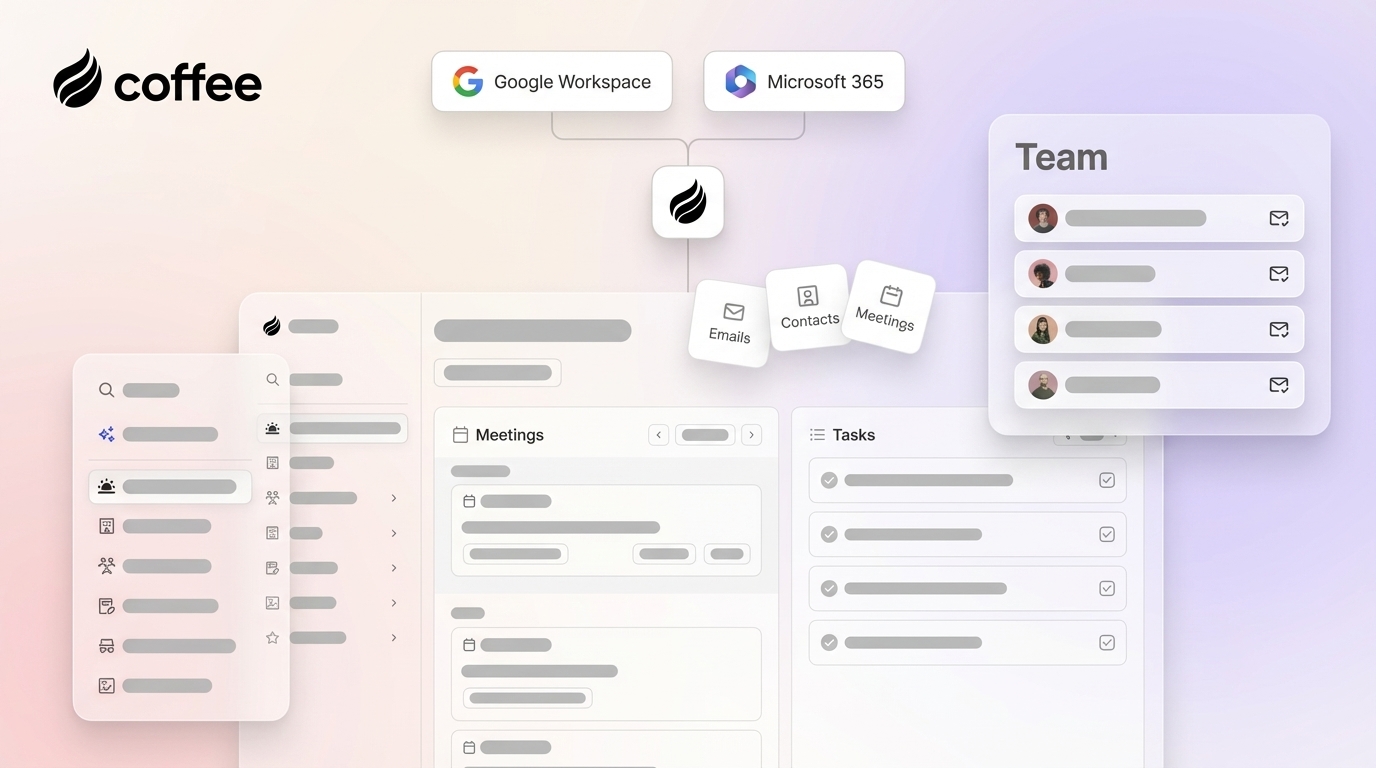
Coffee operates as a true CRM agent that automatically captures emails, calendars, and meeting transcripts into unified customer records. Unlike Lightfield’s broader AI-native CRM approach, Coffee handles complete data orchestration, from contact enrichment through to pipeline intelligence. The Pipeline Compare feature visualizes week-over-week deal progression without manual tracking. List Builder executes natural language prospecting commands so reps can generate targeted lists without spreadsheets. Coffee works as both a standalone CRM for SMBs and a Salesforce or HubSpot companion, which gives teams flexible deployment options. See Coffee’s flexible deployment options for comprehensive CRM automation.

2. Fireflies.ai
Fireflies focuses on meeting transcription and post-call productivity with automated summaries and action items. Pricing starts at $10 per month per seat, with CRM sync capabilities available in the Business plan and higher tiers. Fireflies centers on conversation intelligence rather than full data unification, so teams often need additional tools to reach complete automation.
3. Day.ai
Day.ai specializes in unstructured data processing with a modern AI architecture. The product was built after ChatGPT and reflects that generation of tooling. It still lacks the integration depth that established sales teams expect when they rely on legacy CRMs. Day.ai fits teams that prioritize productivity gains from AI assistance over comprehensive pipeline management.
4. Gong
Gong provides enterprise-grade revenue intelligence with conversation analysis and deal visibility. Teams report up to 99% forecast accuracy with Gong’s analytics and reporting. Custom enterprise pricing and product complexity often make it prohibitive for founder-led teams under 50 people, especially those without dedicated RevOps support.
5. Avoma
Avoma combines meeting recording with conversation intelligence and structured note-taking aligned to sales methodologies like BANT and MEDDIC. Paid plans start at $19 per month per seat, which positions it as a mid-range alternative. The product focuses on meeting optimization and coaching rather than full CRM automation.
6. Clarify
Clarify represents the after ChatGPT generation of CRMs with an AI-native architecture and modern interface. The product feels current in design but lacks the integration capabilities that teams already invested in Salesforce or HubSpot expect. That limitation reduces its appeal for established sales operations that depend on deep ecosystem connections.
7. Attio
Attio offers flexible CRM customization with AI-powered data entry and relationship intelligence. It suits modern small teams that want to avoid manual entry and value a configurable workspace. That flexibility can require more setup time compared to automated alternatives like Coffee, which handle more orchestration out of the box.
8. Jamie
Jamie prioritizes privacy-focused meeting intelligence with local data processing and CRM integrations, including Salesforce and HubSpot. The product addresses strict privacy requirements for teams in regulated industries. Many teams still need additional tools to cover the full scope of CRM integration and pipeline intelligence required for complete sales automation.
9. Bluedot
Bluedot provides meeting recording and basic AI summaries at $14 per month pricing. The platform offers CRM syncing through an API and keeps its feature set focused on meeting intelligence. It suits teams that need simple transcription with some automation, rather than a fully automated CRM workflow. Try Coffee’s agent-based automation if you want broader CRM coverage than Bluedot provides.
Side-by-Side Comparison Table and Key Tradeoffs
The table below highlights the main tradeoffs between automation depth, integration coverage, pricing, and privacy. Use it to quickly see which option matches your team size, security needs, and appetite for setup work.
| Solution | Automation Depth | Integrations | Pipeline Intel | 2026 Pricing | Privacy | Best For |
|---|---|---|---|---|---|---|
| Coffee | Full automation | Salesforce/HubSpot | Pipeline Compare | Seat-based | SOC2 | SMB/Mid-market |
| Fireflies.ai | Transcription focus | Business plan CRM sync | Limited | $10/seat | Standard | Meeting notes |
| Gong | Revenue intelligence | Enterprise CRMs | Advanced analytics | Custom enterprise | Enterprise-grade | Large teams |
| Avoma | Meeting optimization | Standard CRMs | Basic reporting | $19/seat | Standard | Structured notes |
| Attio | Modern CRM | API-based | Relationship intel | Tiered pricing | GDPR compliant | Flexible teams |
| Jamie | Privacy-first | Salesforce/HubSpot/Attio | Via CRM sync | Local processing | High privacy | Privacy-conscious |
Coffee offers a strong balance between deep automation and total cost of ownership for SMBs and mid-market teams. Enterprise solutions like Gong deliver advanced analytics and forecasting but introduce higher complexity and cost that smaller teams may not need.
Choosing the Right Lightfield Alternative for Your Team
Coffee suits data-obsessed founders and RevOps teams that want near-complete automation. It works as a standalone SMB solution and also as a Salesforce or HubSpot companion for mid-market teams that prefer to keep their current system of record. Fireflies fits teams that care mainly about meeting transcription and post-call workflows without broader CRM requirements.
Migration planning should cover authentication simplicity and trial access. Coffee’s Google Workspace integration enables immediate data capture from calendars and email, which reduces onboarding friction. Trial availability lets teams validate automation depth before committing to a full rollout. Avoid tools that position themselves as passive databases instead of active automation partners. Start your Coffee trial to remove manual CRM maintenance from your team’s workload.
FAQ
What is the best Lightfield alternative for sales automation?
Coffee stands out as the leading CRM alternative for sales automation, offering coverage from data capture through pipeline intelligence. Unlike transcription-focused tools, Coffee unifies both structured and unstructured data, which makes it a strong fit for teams that want CRM automation beyond meeting notes.

How does Lightfield compare to Coffee for HubSpot users?
Coffee’s companion app model provides deeper HubSpot integration than Lightfield’s multi-tool integration approach. Coffee acts as an intelligent agent that feeds clean data into existing HubSpot instances while preserving the system of record that teams already use. This approach reduces migration risk and adds full automation capabilities on top of current workflows.
Which Lightfield alternatives focus most on privacy?
Jamie and Bluedot prioritize privacy with local data processing and strict handling of meeting content. Coffee maintains SOC2 Type 2 compliance and does not use customer data for public AI training. Coffee balances strong privacy protection with broad automation capabilities that privacy-only tools often lack.
How have CRM pricing models changed in 2026?
CRM pricing has shifted toward simplified seat-based models instead of complex metering on AI usage or individual processes. Coffee reflects this trend with transparent per-user pricing that includes unlimited automated work from its CRM agent. This structure makes cost prediction easier for growing teams that plan to scale headcount.
Should I choose Gong or Lightfield for revenue intelligence?
Gong works best for enterprise teams that need advanced conversation analytics and custom reporting. Lightfield emphasizes AI-native CRM automation with multiple data inputs and a broader platform approach. SMBs that want both revenue intelligence and strong CRM automation often find that Coffee offers a practical middle ground with Pipeline Compare features and automated data management.
Conclusion: Why Coffee Leads as a Lightfield.app Alternative
Coffee leads the 2026 CRM automation wave by solving the core good data in, good data out challenge that Lightfield.app and traditional tools still face. Meeting intelligence products focus on transcription and call insights, while Coffee delivers broader sales automation through autonomous data unification and pipeline orchestration. Compare Coffee to Lightfield.app and choose your automation path.