
Key Takeaways
- 71% of sales reps waste 5+ hours weekly on manual CRM data entry, which cuts actual selling time to just 37% according to SPOTIO’s 2026 report.
- Agent-first AI CRMs like Coffee remove repetitive admin work through autonomous data capture, enrichment, and pipeline intelligence.
- Coffee ranks #1 for full data entry automation (10/10), delivering measurable productivity gains compared to legacy platforms.
- Legacy CRMs like Salesforce Einstein and HubSpot Breeze provide partial automation but still depend on ongoing human oversight and configuration.
- See how Coffee’s agent-first automation can save your team meaningful hours every week.
How We Evaluated AI Sales Automation Platforms
Our ranking methodology focuses on six critical automation capabilities that affect daily sales productivity.
- Data Entry Elimination: Automatic contact creation, activity logging, and enrichment without human intervention.
- Pipeline Intelligence: AI-driven forecasting accuracy and clear deal progression insights.
- Data Unification: Integration depth across email, calendar, and core business systems.
- User Adoption: Interface design that encourages consistent, long-term CRM usage.
- Deployment Flexibility: Support for both standalone use and companion app compatibility.
- ROI Metrics: Measurable time savings and revenue impact based on real usage.
These criteria address the core pain points identified in SPOTIO’s 2026 State of Field Sales survey. Using this framework, we evaluated leading AI-powered CRMs to see which platforms deliver the strongest automation value for sales teams.
Ranked Top 5 AI-Powered CRMs for Sales Teams Automation 2026
1. Coffee – Agent-First CRM for Hands-Off Data Entry
Coffee leads the market as the only true agent-first CRM that operates autonomously to eliminate manual data entry. This autonomous operation starts with the Coffee Agent automatically creating contacts and companies from Google Workspace connections, then enriching those records with job titles and funding data, and logging all activities without human intervention.
Beyond data capture, the platform provides intelligence through its Pipeline Compare feature, which visualizes week-over-week deal progression, and its List Builder, which generates targeted prospect lists through natural language commands. Coffee’s dual-model approach serves both standalone deployments for small teams and companion app integration with existing Salesforce or HubSpot instances.

Recent 2026 updates include QuickBooks integration for automatic invoice syncing and Stripe connectivity for seamless customer data flow. A $10M+ ARR company replaced spreadsheet-based sales management with Coffee, achieving automated pipeline reviews and eliminating manual contact creation through the Agent’s Google Workspace integration.
2. HubSpot Breeze – AI Enhancements on a Mature CRM
HubSpot’s Breeze AI adds predictive lead scoring and data enrichment capabilities within their established CRM framework. The platform provides automatic contact creation from emails and basic activity logging, yet it still requires more manual oversight than agent-first solutions.
HubSpot AI lacks direct CRM field updates from calls, which limits its automation depth for complex sales processes. While Coffee leads in full automation, established platforms like HubSpot have strengthened their AI features for teams already invested in their ecosystems.
3. Salesforce Einstein – Forecasting Power for Large Pipelines
Salesforce Einstein Activity Capture automatically syncs emails and calendar events while Einstein Forecasting provides revenue predictions. Einstein analyzes pipeline health, rep performance trends, and seasonal patterns to support enterprise-grade forecasting.
The platform’s 25-year legacy architecture struggles with unstructured data processing and often requires extensive manual configuration. As a result, teams gain strong forecasting tools but still spend time maintaining data quality and workflows.
4. Pipedrive AI – Focused on Pipeline Velocity
Pipedrive’s AI Sales Assistant provides revenue forecasting based on weighted pipeline values and historical close patterns. The platform automates activity tracking for emails, calls, and meetings while offering deal probability scoring.
Limited integration capabilities restrict its effectiveness for teams that need comprehensive data unification across multiple systems. Pipedrive works best for smaller teams that want straightforward pipeline management with some AI guidance.
5. Zoho CRM Plus – Suggestion-Based Intelligence for Risk Signals
Zoho Zia delivers anomaly detection and churn prediction through AI analysis of sales performance patterns. Zoho CRM features action-taking automation, including AI agents capable of executing business tasks autonomously.
The platform’s AI agents can run workflow triggers and data updates based on predefined rules. However, Zoho’s automation remains suggestion-based rather than fully autonomous, so users often review and approve AI-recommended actions. The platform fits teams that prioritize anomaly detection and risk alerts over complete data entry elimination.
Head-to-Head Comparison: Automation Capabilities
This comparison evaluates core automation metrics across leading AI CRMs and highlights Coffee’s strength in data entry elimination and pipeline intelligence.
| CRM Platform | Data Entry Automation | Pipeline Intelligence | Integration Depth | Time Savings |
|---|---|---|---|---|
| Coffee | Full automation (10/10) | 9/10 | Native + Zapier | 8-12 hrs/week |
| HubSpot Breeze | Partial automation (6/10) | 7/10 | Extensive | 5-7 hrs/week |
| Salesforce Einstein | Limited automation (5/10) | 8/10 | Enterprise-grade | 4-6 hrs/week |
| Pipedrive AI | Basic automation (4/10) | 6/10 | Standard | 3-5 hrs/week |
| Zoho CRM Plus | Suggestion-based automation (5/10) | 7/10 | Broad | 4-6 hrs/week |
The quantitative differences in the table above come from a core architectural split between agent-first systems and legacy AI-enhanced databases.
Why Agent-First CRMs Like Coffee Outperform Legacy Systems
Coffee’s agent-first architecture fundamentally differs from traditional AI-enhanced CRMs that bolt features onto existing databases. Coffee operates as an autonomous agent that handles the complete data lifecycle, from capture through enrichment to ongoing analysis.
The Agent automatically logs meeting outcomes, generates BANT and MEDDIC qualification data, and maintains pipeline hygiene without human oversight. This approach addresses the core problem of poor data foundations that can cause inaccurate AI outputs.

Coffee maintains a “good data in, good data out” standard through continuous, autonomous capture and enrichment. The platform’s 2026 feature releases include new Intelligence layers that adapt to custom business contexts, building on the payment and financial integrations mentioned earlier.
The platform’s SOC 2 Type 2 compliance and Zapier connectivity support secure deployment across existing tech stacks. Teams can run Coffee as a standalone solution for growing companies or as a companion app for established Salesforce and HubSpot environments.
Where Coffee Fits Best: Use Cases and Scenarios
Coffee excels in two primary deployment scenarios that match most modern sales teams. The first scenario covers standalone CRM use for companies with 1-20 employees that want modern automation without enterprise complexity.
The second scenario focuses on companion app integration for mid-market teams locked into Salesforce or HubSpot contracts but needing better data quality. Early-stage companies gain autonomous contact creation and pipeline management without heavy configuration. Established teams use Coffee as an intelligent data layer that improves existing CRM accuracy through automated enrichment and activity logging.

Best AI CRM for Sales Teams Reddit 2026
Reddit discussions consistently highlight data entry frustration as the primary CRM pain point. Users report that Coffee’s agent-first approach removes the “CRM as chore” mentality by handling administrative tasks automatically.
The platform’s simple onboarding process also addresses common complaints about complex CRM implementations that demand extensive training and configuration.
Implementation Checklist and Risk Assessment
Teams should evaluate these critical capabilities before selecting an AI-powered CRM, using them as a sequence of impact on daily work.
- Does the platform eliminate manual data entry through autonomous agents? This forms the foundation of time savings.
- Can the system process unstructured data from emails and call transcripts? Without this, automation stays limited to simple fields.
- Does the CRM maintain historical pipeline context for accurate forecasting? Data capture has little value without intelligence.
- Are integrations native or dependent on third-party connectors? This determines whether automation reaches your full tech stack.
Coffee Limitations: Coffee is not optimized for large enterprises that require complex approval workflows or heavily regulated industries with extensive compliance requirements.
Frequently Asked Questions
What is the best free AI CRM automation trial for sales teams?
Coffee offers one of the most comprehensive free trials for AI-powered sales automation. Unlike traditional CRM trials that require manual setup and data entry, Coffee’s Agent immediately begins capturing and enriching data from your Google Workspace or Microsoft 365 environment.
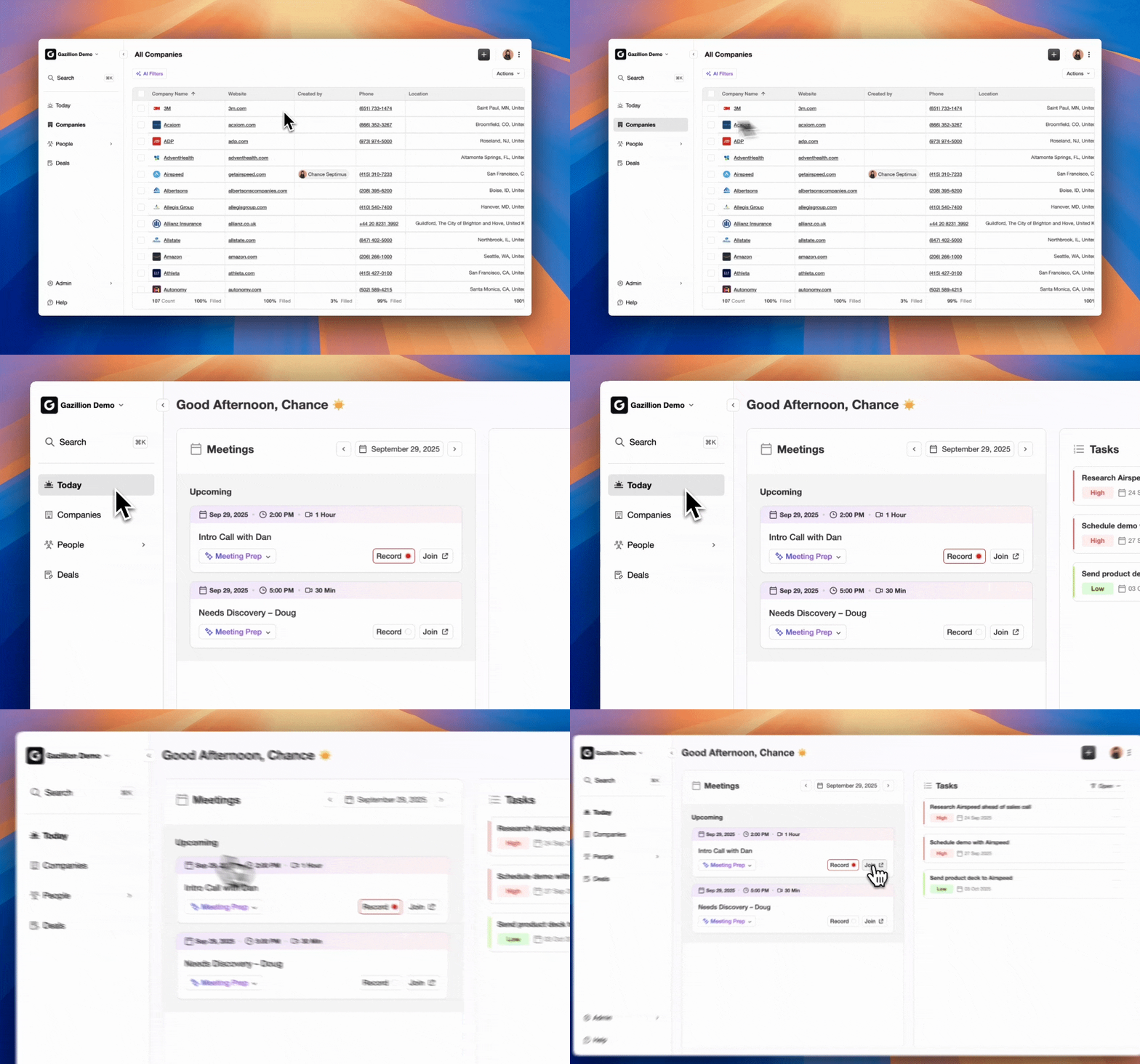
The trial includes full access to Pipeline Compare, automatic contact creation, and meeting intelligence features without credit card requirements or complex configuration.

How does Coffee compare to HubSpot and Salesforce for AI automation?
Coffee operates as an autonomous agent that removes manual data entry, while HubSpot and Salesforce function as AI-enhanced databases that still need human oversight. Coffee automatically creates contacts, logs activities, and maintains pipeline hygiene without user intervention.
HubSpot Breeze and Salesforce Einstein provide AI suggestions and basic automation but still require manual data input and field updates. This architectural approach allows Coffee to process both structured and unstructured data in a unified system, while many legacy platforms struggle with email content and call transcript integration.
Which AI CRM truly eliminates manual data entry for sales teams?
Coffee is the only CRM that completely removes manual data entry through its autonomous Agent architecture. The system automatically creates contacts from Google Workspace connections, enriches company data from multiple sources, logs all meeting outcomes, and updates deal stages based on conversation analysis.
Traditional AI CRMs like Salesforce Einstein and HubSpot Breeze reduce some manual work but still require human input for contact creation, deal updates, and activity logging. Coffee’s Agent handles the complete data lifecycle from capture to analysis without human intervention for routine tasks.
How secure is Coffee’s AI Agent for handling sensitive sales data?
Coffee maintains SOC 2 Type 2 compliance and GDPR adherence for enterprise-grade security. The platform uses encrypted data transmission and storage, and customer data never trains public AI models.
Coffee’s Agent operates within secure cloud infrastructure with role-based access controls and audit logging. The system integrates with existing security frameworks through OAuth authentication and supports single sign-on for enterprise deployments.
What is the typical implementation timeline for Coffee compared to traditional CRMs?
Coffee can be deployed quickly through simple Google Workspace or Microsoft 365 authentication. The Agent immediately begins capturing and enriching data without field mapping, workflow configuration, or user training.
CRM implementations for SMBs like Salesforce or HubSpot typically take 4-6 weeks for setup, data migration, and user onboarding. Coffee’s agent-first design removes most manual configuration and delivers value quickly through autonomous data processing.
Conclusion
The best AI powered CRM for sales teams automation in 2026 must remove manual data entry while still delivering accurate pipeline insights. Coffee leads this shift as the only agent-first solution that autonomously handles the complete sales data lifecycle.
Legacy platforms like HubSpot and Salesforce offer AI enhancements, yet they still require human oversight for data quality and pipeline management. Coffee’s dual-model approach supports both standalone deployments and companion app integrations, which gives teams flexible paths to true sales automation.
The platform’s proven ROI through reduced administrative work and improved forecast accuracy positions it as a strong choice for modern sales organizations. See how Coffee’s autonomous Agent can free your team from data entry and refocus them on revenue generation.