
Key Takeaways
- BANT (Budget, Authority, Need, Timeline) qualifies leads 30% faster and can lift close rates from 8% to 50% by focusing on high-potential opportunities.
- Set up custom BANT fields in CRMs like Salesforce or HubSpot, require them at the Discovery stage, and use clear scoring rules where scores above 70% advance deals automatically.
- Use natural discovery questions for each BANT criterion and automate pipeline stages based on qualification scores to cut manual updates and reduce bottlenecks.
- Generate accurate forecasts by tracking qualification rates, time-to-qualify, and conversion by BANT score, while AI tools like Coffee auto-populate fields from emails, calls, and transcripts.
- Implement BANT automation with Coffee to remove most manual data entry and achieve 25–40% more qualified leads in your CRM pipeline.
Step-by-Step: Implement BANT for CRM Pipeline Management
Step 1: Create BANT Custom Fields in Your CRM
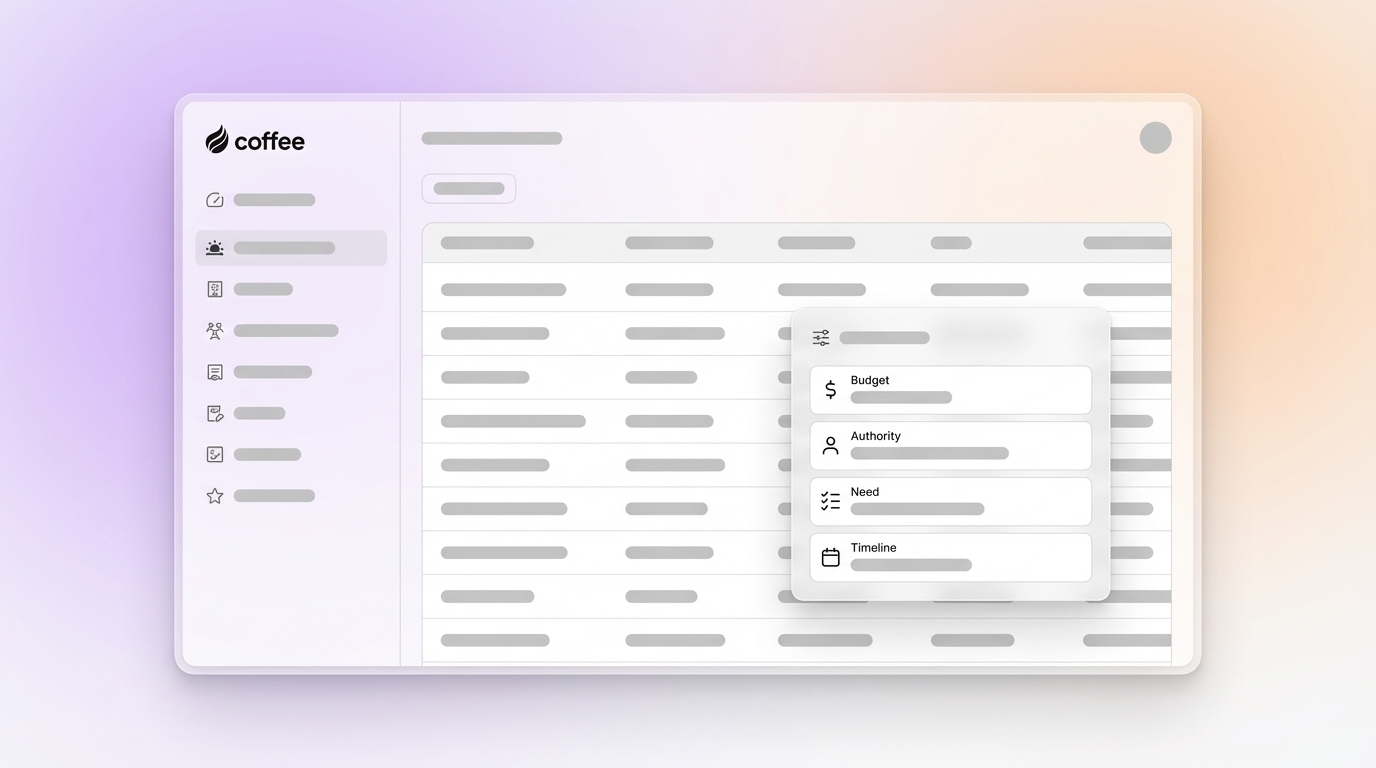
Start by creating dedicated BANT fields in your CRM so every opportunity captures the same qualification data. In Salesforce, go to Object Manager > Opportunity > Fields & Relationships. In HubSpot, open Properties > Deal Properties. Configure these essential fields:
- Budget: Dropdown with ranges ($10K–$50K, $50K–$100K, $100K+)
- Authority: Multi-select picklist (Decision Maker, Influencer, Champion, Gatekeeper)
- Need: Long text area for detailed pain point documentation
- Timeline: Date field for target implementation or decision date
Set these fields as required at the Discovery pipeline stage so deals cannot advance without basic BANT coverage. Coffee scans email conversations and calendar interactions, then fills these fields automatically, which replaces the 8–12 hours per week that many reps spend on manual data entry.

Step 2: Build a BANT Lead Scoring System
Once your BANT fields capture qualification data, translate that information into clear priorities with a numerical scoring model. Implement a scoring system that evaluates lead quality and guides sales focus. The following breakdown shows equal weighting for each BANT criterion, with deals above 70% treated as pipeline-ready:
| Criteria | Indicators | Score |
|---|---|---|
| Budget Confirmed | “$X allocated” or budget range identified | 25 |
| Authority: Champion | Decision-maker actively involved | 25 |
| Need: High Pain | Quantified ROI or critical business impact | 25 |
| Timeline: <90 days | Event-driven urgency or deadline | 25 |
Create automation rules so BANT scores above 70% move deals to “Qualified” status, while scores below 50% enter nurture sequences. Coffee’s AI agent calculates these scores in real time as new details appear in ongoing prospect interactions.
Step 3: Write Conversational BANT Discovery Questions
Use conversational questions that surface BANT details without turning the call into an interrogation. Effective BANT questions often feel like natural follow-ups in a discovery conversation.
Budget Questions:
- “What’s your allocated budget for this type of solution?”
- “Based on your expansion plans, have you set aside funds for this initiative?”
- “How do you typically approach budgeting for technology investments?”
Authority Questions:
- “Who else needs to be involved in this evaluation process?”
- “What does your typical approval process look like for purchases like this?”
- “Who would be impacted by this decision and should join our next conversation?”
Need Questions:
- “What limitations are you encountering with your current approach?”
- “What would need to happen for this to be considered a success?”
- “How are you currently handling this challenge, and what’s not working?”
Timeline Questions:
- “When do you need this solution operational?”
- “What events or deadlines are driving your timeline?”
- “Is this something you’d want implemented within this quarter?”
Coffee turns call transcripts and email threads into structured BANT notes, so reps keep a complete qualification record without extra typing.

Step 4: Automate Pipeline Stages with BANT Milestones
Use BANT completion and scoring to control how deals move through your pipeline. Each stage should require specific BANT milestones before a deal progresses to the next phase. Start by defining clear stage progression criteria:
- Lead to Qualified: BANT score above 70% with all four criteria addressed
- Qualified to Discovery: Initial needs assessment completed, building on the qualification foundation
- Discovery to Proposal: Budget and authority confirmed through stakeholder conversations
- Proposal to Negotiation: Timeline and implementation plan agreed, which completes the remaining BANT elements
Teams often struggle when they rely on manual stage updates and loose qualification standards across reps. Coffee solves these issues by logging activities automatically, updating deal stages based on rules, and applying consistent BANT evaluation criteria for every opportunity.
Step 5: Generate Forecasts Driven by BANT Data
BANT data becomes a powerful forecasting input when you connect it to your reporting. Use Coffee’s Pipeline Compare feature to view week-over-week changes in deal progression and quickly see which opportunities advanced, stalled, or newly entered the pipeline.
Track metrics such as qualification completion rates, average time-to-qualify, conversion rates by BANT score band, and pipeline value by qualification status. Teams implementing automated BANT qualification see 25–40% increases in qualified lead volume, which then supports stronger forecast accuracy and more reliable revenue planning.
Automate BANT Pipeline Management with Coffee Agent in 2026
Coffee’s autonomous agent modernizes BANT by capturing qualification data directly from emails, calls, and meeting transcripts. Traditional CRMs wait for reps to type notes, while Coffee converts unstructured conversations into organized BANT profiles without extra effort from the team.
This approach outperforms manual CRM updates because it removes the bulk of data entry work that slows reps down. Pipedrive still depends on manual BANT field updates, and HubSpot leans on passive data collection, while Coffee actively enriches prospect records with behavioral signals and engagement data.
BANT also keeps a practical edge over complex frameworks like MEDDIC for SMB and mid-market sales cycles. Its speed and efficiency make it ideal for high-volume sales and SDR triage, so teams can qualify quickly before committing time to deeper discovery.
One technology company generating tens of millions in revenue replaced spreadsheet-based sales management with Coffee’s BANT automation. The team achieved 30% faster pipeline velocity by removing manual qualification tasks and gained accurate weekly pipeline reviews through automated data capture. Coffee case studies show similar gains in sales efficiency and forecast reliability across multiple organizations.
Is BANT Still Relevant in 2026?
BANT remains highly relevant in 2026 because AI automation removes many of the framework’s historical drawbacks. AI now supports real-time sentiment detection, behavioral scoring, and multi-criteria qualification using signals such as pricing page visits and email response patterns.
Modern teams often start with Need and Timeline, then uncover Budget and Authority through several touchpoints using a consultative style. Companies that pair BANT with a clear ideal customer profile see up to 38% higher win rates compared to unstructured qualification.
Coffee updates BANT for this environment by using intelligent agents that detect qualification signals automatically. This approach replaces rigid checklists with natural, conversational qualification that protects relationships while still delivering complete prospect evaluation. The qualified lead improvements mentioned earlier translate into higher win rates and stronger forecast accuracy across sales teams.
Measure BANT Success and Apply Advanced Coffee Tips
Measure BANT success with concrete pipeline metrics such as qualified lead volume, average sales cycle length, and forecast accuracy. Then connect those outcomes to operational indicators like qualification completion rates, time-to-qualify averages, and conversion rates by BANT score range.
For advanced setups, integrate Coffee’s List Builder to find BANT-qualified prospects and sync qualification data into marketing automation platforms through tools like Zapier. Avoid pitfalls such as manual field updates, inconsistent question frameworks between reps, and treating BANT as a rigid script instead of flexible conversational guidance.

Frequently Asked Questions
What is BANT used for?
BANT qualifies sales leads by evaluating Budget, Authority, Need, and Timeline to gauge purchase readiness and sales priority. It helps teams focus effort on high-probability opportunities while flagging prospects that need more nurturing before they move through pipeline stages.
What does a BANT example look like in CRM?
A qualified BANT prospect in CRM might show a confirmed $75K annual budget, a VP of Sales as champion with CEO approval required, a need to cut manual data entry by 40%, and a Q2 deadline tied to quota goals. In a configured CRM, BANT scores above 70% move that opportunity into a qualified stage automatically.
How do you automate BANT qualification in CRM?
Automation starts with custom fields for each BANT criterion, scoring rules based on how complete the qualification is, and workflow triggers that move deals between stages. Coffee’s agent handles this work by extracting BANT data from call transcripts, emails, and meeting notes, then updating CRM records without manual input from reps.
How does Coffee compare to Salesforce for BANT implementation?
Coffee’s autonomous agent removes the manual data entry that Salesforce BANT setups usually require. Salesforce depends on reps to update custom fields and calculate scores, while Coffee captures qualification data from conversations and turns it into actionable CRM insights automatically.
Is BANT or MEDDIC better for sales qualification?
BANT fits SMB and transactional sales cycles that need quick qualification, while MEDDIC suits complex enterprise deals with many stakeholders. As discussed earlier, BANT’s simplicity advantage over MEDDIC makes it a strong choice for inside sales teams and SDR groups that prioritize pipeline velocity.
Conclusion: Automate BANT in Your CRM Pipeline Today
BANT implementation transforms CRM pipeline management by adding structured lead qualification that improves close rates, shortens sales cycles, and strengthens forecast accuracy. Coffee’s autonomous agent removes manual BANT data entry and keeps qualification standards consistent across your sales organization.
The combination of proven BANT methodology and AI-powered automation creates efficient pipelines that highlight high-value opportunities and reduce time spent on poor fits. Teams using Coffee’s BANT automation report faster pipeline velocity and higher sales productivity.
Use Coffee to deploy automated BANT qualification and upgrade your CRM pipeline management today.